

The highest export rate isn’t always the best deal. A tariff that pays more for each unit of electricity may also require you to switch your import supplier, so the overall value depends on more than the headline figure. If you’re wondering how to qualify for smart export guarantee payments, check eligibility and tariff terms together.
Before investing in solar or applying to a supplier, it helps to know what you’ll need. Equipment, certification and meter requirements can take time to line up, and export payments aren’t automatic. This guide covers the main checks for eligible technology, MCS or equivalent certification, a suitable smart meter and existing Feed-in Tariff payments.
You’ll also learn how to compare rates alongside contract conditions, import prices and payment arrangements, rather than choosing on the headline rate alone. Finally, we’ll look at how system design can balance the electricity your household uses with what it exports, including the role of battery storage. This will help you prepare your application and make an informed decision about your solar PV system.
Key Takeaways
- Learn how to qualify for smart export guarantee payments by checking your generation technology, installation certification, export meter and any existing Feed-in Tariff payments.
- Prepare for an application by gathering system details and installation evidence, then follow the chosen supplier’s process.
- Compare export tariffs by looking beyond the rate per kilowatt-hour to import prices, payment frequency and contract conditions.
- Use current tariff information when comparing suppliers, as rates and eligibility terms can change.
- Plan solar PV around when your household uses electricity, so you can weigh self-consumption, battery storage and potential exports together.
What is the Smart Export Guarantee, and who can qualify?
The Smart Export Guarantee (SEG) is a framework under which participating electricity suppliers pay eligible small-scale generators for qualifying low-carbon electricity exported to the grid. It does not pay for all the electricity your system produces. Power used in your home, or stored in a battery rather than sent to the grid, does not count as an export at that time.
The SEG followed the UK Feed-in Tariff scheme, which closed to new applicants in 2019. For background, see Feed-in tariffs in the United Kingdom. Unlike the old scheme’s set payments, SEG export rates and contract terms are set by individual suppliers. There is no single universal rate, and eligibility for the scheme does not guarantee access to every supplier’s tariff.
How does the Smart Export Guarantee work?
The Smart Export Guarantee pays eligible generators for electricity from an approved small-scale renewable or low-carbon installation that is measured as exported to the grid. A suitable export meter records what leaves the property, and a participating supplier uses those readings to calculate payments under its tariff. Electricity used directly by household appliances is not exported. Energy stored for later use is not exported either, unless it is subsequently sent to the grid and meets the relevant requirements.
Which households and technologies may be eligible?
Solar PV is a common household technology covered by the scheme. Other eligible technologies include wind, hydro, anaerobic digestion and micro combined heat and power. Ofgem’s published scheme rules set capacity limits: up to 5MW for most eligible technologies and 50kW for micro-CHP. Installations and installers must also meet the applicable MCS or equivalent certification requirements.
These are scheme-level checks, not a promise that every supplier will accept every application on the same terms. Suppliers can set their own tariff conditions and application requirements. A household already receiving export payments under the Feed-in Tariff cannot also receive SEG payments for those exports.
The SEG framework described here does not apply uniformly across the UK. Check the rules that apply to your installation rather than assuming the same scheme covers every part of the country. Rules and supplier offers can change, so confirm the current requirements before applying.
If you’re researching how to qualify for smart export guarantee payments, start with three questions: does your technology meet the scheme rules, can your installation and exports be properly evidenced, and is there a supplier tariff you can join? Answering these gives you a clear starting point before comparing rates or preparing an application.
How to qualify for the Smart Export Guarantee: an eligibility checklist
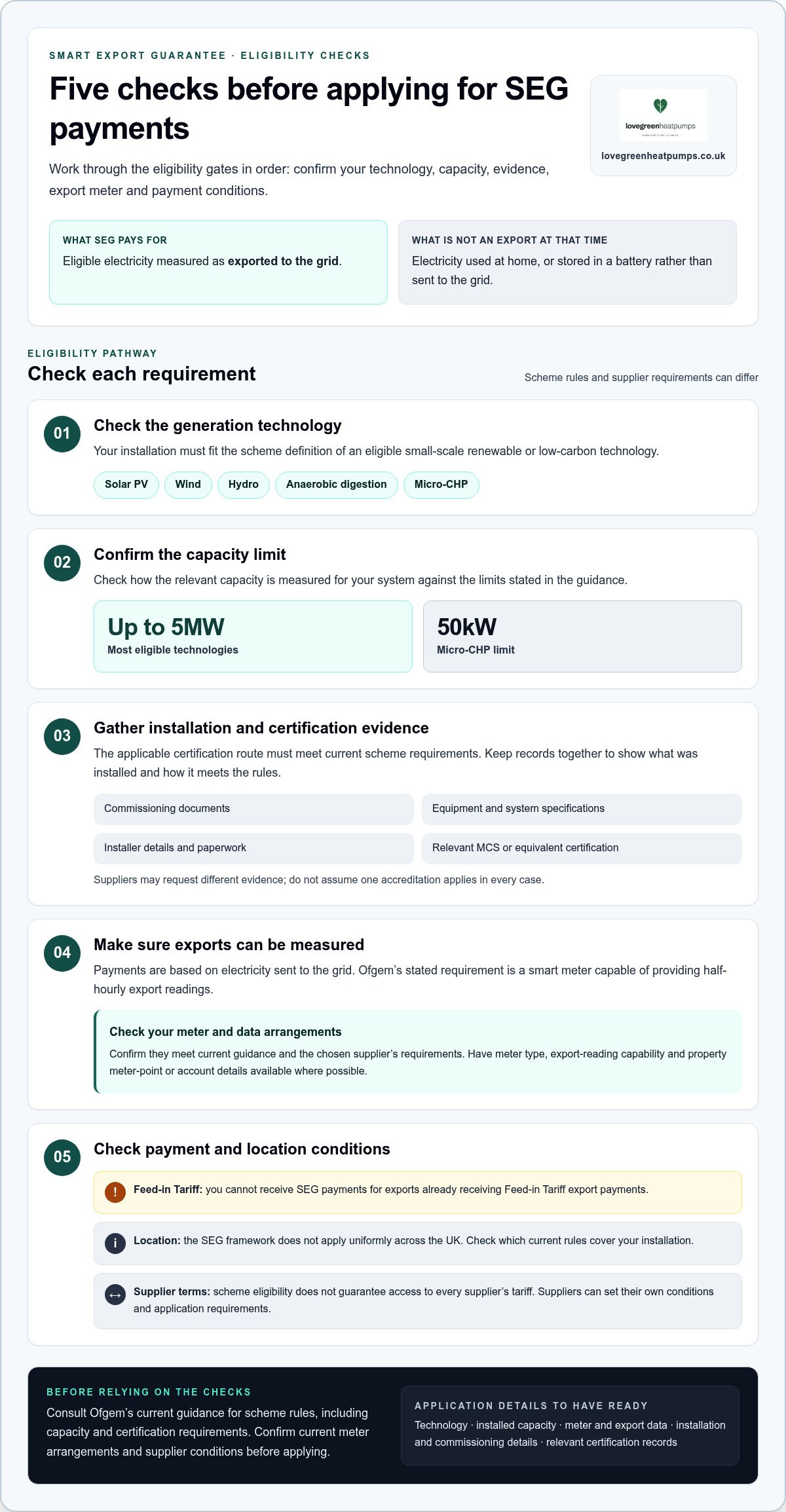
Use this checklist to organise the main eligibility checks before you apply. Consult Ofgem’s current guidance for scheme rules, including capacity and certification requirements, before relying on them for your installation.
- Check the technology. Eligible technologies include solar PV, wind, hydro, anaerobic digestion and micro combined heat and power (micro-CHP). Make sure your installation fits the scheme’s definition of an eligible technology.
- Confirm the capacity. The limits in the current guidance are up to 5MW for most eligible technologies and 50kW for micro-CHP. Check how the relevant capacity is measured for your system.
- Find your installation evidence. Gather commissioning records, system specifications and installer paperwork. The applicable certification route must meet current scheme requirements, so don’t assume one accreditation applies in every case.
- Check how exports are measured. SEG payments are based on electricity sent to the grid. Ofgem’s stated requirement is a smart meter capable of providing half-hourly export readings. Confirm that your meter and export data arrangements meet current guidance and the supplier’s requirements.
- Check other payment and location conditions. You cannot receive SEG payments for exports already receiving Feed-in Tariff export payments. The SEG framework does not apply uniformly across the UK, so check the current rules that cover your installation.
What installation and certification evidence might be needed?
Keep your paperwork together, even before choosing a supplier. Useful records include commissioning documents, equipment and system specifications, installer details, and any MCS or equivalent certification relevant to your installation. These records help show what was installed and how it meets applicable scheme rules. Suppliers may request different evidence, and some tariffs have extra conditions beyond the general eligibility checks.
What meter and export details should you check?
A supplier needs reliable readings for the electricity your system sends to the grid. Have these details ready, where available:
- Meter type and export-reading capability, including half-hourly data arrangements.
- Meter point or account details associated with the property.
- Generation technology and total installed capacity.
- Installation and commissioning details, plus relevant certification records.
If you’re planning a new system, include export measurement and eligibility in the design discussions. Explore solar PV design and installation as part of planning how your household will use, store and export electricity.
How to compare Smart Export Guarantee tariffs beyond the headline rate
Supplier rates can change, so treat these figures as examples reported in 2026, not a guarantee of what’s available now. Compare each supplier’s current tariff, eligibility rules and payment terms. A rate may depend on whether you also take your electricity supply from that supplier or meet other conditions.
| Supplier and tariff | Reported export rate | Payment frequency | Eligibility and key conditions |
|---|---|---|---|
| Good Energy Solar Savings Exclusive | 25p/kWh | Check current terms | For customers whose solar panels and battery were installed by Good Energy, and who also take their import supply from Good Energy. |
| EDF Export Exclusive | 24p/kWh | Check current terms | For EDF import customers; the reported rate is fixed for 12 months. |
| So Energy So Bright Export | 20p/kWh | Check current terms | Check the supplier’s current customer eligibility and tariff conditions. |
| Ecotricity Smart Export Tariff | 16p/kWh | Check current terms | Reported for customers with both their import and export supply with Ecotricity. |
| Good Energy Solar Savings | 15p/kWh | Check current terms | Reported as a flat rate open to import customers. |
Payment frequency, minimum export thresholds, contract length, exit terms and rate-change conditions vary. Read the tariff terms for each detail. Some export deals require you to move your import supply to the same company, while others have installation or battery conditions. A higher export rate may not be worthwhile if a linked import tariff costs more overall.
How can you compare likely value for your household?
Use estimated annual exports, not total solar generation. Electricity used at home or stored in a battery is not exported at that time. For example, exporting 1,000kWh at 25p/kWh would produce £250 before any tariff conditions. Your actual export volume depends on your system, household use and the supplier’s terms.
The highest headline rate may not suit every home. It could require a particular installation, battery or import-supply arrangement, while a lower rate may have terms that better fit your circumstances. Compare likely export payments with import costs, contract conditions and seasonal electricity use. Once you understand how to qualify for smart export guarantee payments, your expected exports and the full tariff terms can help you judge which offer makes sense for your household.
How to apply for SEG payments and prepare your information
Once you’ve checked the scheme requirements and compared suitable tariffs, apply to the supplier offering the export deal. Each supplier sets its own process and may request different documents or apply tariff-specific conditions. Use its current application guidance as your checklist.
- Confirm eligibility. Check that your technology, installation evidence, capacity and export measurement meet current scheme requirements.
- Gather your records. Bring together system and installation details, relevant certification and meter information.
- Compare suppliers. Review the export rate alongside eligibility rules, import tariff conditions and other contract terms.
- Submit the application. Complete the supplier’s process and provide the evidence it requests.
- Check export readings. Once your account is set up, understand how readings are collected and review your first statement against the meter data and agreed tariff.
Approval, payment timing and the amount you receive depend on your eligibility, the supplier’s checks and its tariff terms. An application does not guarantee a particular payment or income.
What information should you prepare before applying?
Keep a simple record of the details suppliers commonly need. The exact evidence varies by provider, so use this as a preparation list rather than a universal document requirement:
- Generation technology, system specifications and installed capacity.
- Installation and commissioning records, installer details and relevant certification.
- Meter type, meter or account identifiers, and information about export readings.
- Your current contact details and the property details linked to the installation.
Accurate meter information helps the supplier identify how export data will be provided. Keep copies of everything you submit, along with application references and supplier correspondence. This gives you a clear record if details need correcting or a document is requested again.
What happens after an SEG application?
The supplier reviews the application and supporting evidence against its scheme and tariff requirements. It may request more information before setting up an export account. There is no single timeline or payment arrangement for every supplier, so refer to the confirmation you receive for the relevant details.
Export readings are used to calculate payment under the agreed tariff. When your first statement arrives, compare its export units and rate with your meter information and tariff terms. Use the supplier’s stated process to report any mismatch, and keep a note of the readings and dates you’ve checked.
If you’re planning solar PV and want the system design to account for household use, export and potential battery storage, explore a tailored solar PV project.
Plan solar PV around SEG exports, household use and your next steps
SEG payments are one part of a solar PV system’s value. Electricity used at home can reduce how much you need to import, while a battery can store surplus generation for later use. Only electricity sent to the grid counts as export. A good design considers all three: household use, storage and any surplus available for export.
Should you prioritise exporting electricity or using it at home?
There isn’t one right balance for every household. Using solar electricity as it’s generated may help reduce imports; storing some in a battery can make it available when panels produce less. Exporting surplus may bring SEG payments, but the value depends on your tariff and its terms.
Think about when electricity is used in your home, not just how much is generated. If demand is concentrated in the evening, storage may be worth considering. If much of your use happens during daylight hours, more generation may be used directly. A household planning to add an air source heat pump should consider its expected electricity demand alongside solar generation. Read more about pairing solar PV panels with an air source heat pump as part of that wider decision.
How can a solar installation support SEG readiness?
Start with the roof and the household. Roof direction, available space and shading affect how much electricity panels may generate and when. Your daily and seasonal usage patterns help show how much could be used at home, stored or exported. Battery choices also affect when and how much electricity is sent to the grid, so consider them alongside the export tariff rather than as a separate afterthought.
Planning for SEG from the outset can also make the paperwork easier to organise. Keep system specifications, commissioning records and relevant installation documents together. Include export metering arrangements in the project plan, then compare them with the supplier’s current application requirements. A well-documented installation gives you useful information when preparing an application, although it does not guarantee supplier approval.
For households coordinating solar with a heat pump, planning the upgrades together can help account for expected demand and how electricity will be used across the home. The heat pump installation homeowner guide can support that broader planning.
Love Green Heat Pumps Ltd provides turnkey solar PV design, procurement and installation. Explore a tailored solar PV project and consider household use, storage and export from the start. This is a practical next step after learning how to qualify for smart export guarantee payments.
Make your next solar decision with confidence
Knowing how to qualify for smart export guarantee payments starts with checking your system, installation evidence and export meter arrangements. Then compare tariffs on more than the headline rate: import conditions, contract terms and the electricity your household is likely to export all matter.
Solar PV planning is about the whole home, too. A well-considered design can balance household use, battery storage and potential exports, with the right records organised for a future application.
Love Green Heat Pumps Ltd provides turnkey solar PV design, procurement and installation, backed by HEIS-accredited expertise. If you’re considering an installation, explore solar PV design and installation and request a free, no-obligation quote.
Take the time to compare your options and plan around how you use electricity. A clear, considered approach can make the next step feel straightforward.
Frequently Asked Questions
Who is eligible for the Smart Export Guarantee?
Small-scale generators may qualify if they use an eligible technology, meet the scheme’s capacity and certification requirements, and can provide suitable export readings. Eligible technologies include solar PV, wind, hydro, anaerobic digestion and micro combined heat and power. The installation must meet current scheme rules, and you cannot receive SEG payments for electricity already receiving Feed-in Tariff export payments. Suppliers may also set conditions for their individual tariffs.
Do I need an MCS certificate to qualify for SEG?
Your installation and installer must meet the applicable MCS or equivalent certification requirements under current scheme rules. That does not mean every application follows an identical evidence route. Keep commissioning records, system specifications, installer paperwork and any relevant certification together. Before applying, consult the latest Ofgem guidance and the chosen supplier’s requirements, as a supplier may request particular documents or set extra conditions for its export tariff.
Can I get SEG payments without a smart meter?
SEG payments require export electricity to be measured in a way the supplier accepts. Current scheme guidance specifies a smart meter capable of providing half-hourly export readings. If you don’t have one, or aren’t sure your meter records exports correctly, review the latest requirements and the supplier’s published guidance on accepted arrangements before applying. A standard import reading does not show how much electricity your solar system sends to the grid.
How much does the Smart Export Guarantee pay in 2026?
There’s no single SEG rate. Suppliers set their own tariffs, and offers can depend on your import supplier, system or battery conditions, and whether the rate is fixed or variable. For example, rates reported in 2026 included 25p/kWh for Good Energy Solar Savings Exclusive, with specific installation and import-customer conditions, alongside other competitive fixed and variable export tariffs available on the market. Check current terms before comparing, as rates may change.
Can I switch SEG supplier after joining?
You can consider switching to another supplier’s SEG tariff, but the practical steps depend on the agreements involved. Check your current export contract for its notice period, exit terms, rate-change rules and any conditions linking export to your import supply. Then review the new supplier’s eligibility criteria and application process. Keep copies of meter readings and account correspondence so you can track the changeover and identify which supplier is responsible for each payment period.
What happens if my solar panels are not exporting electricity?
If your system isn’t exporting, your home may be using the electricity as it’s generated, or a battery may be storing it. Check your inverter or energy-monitoring display and compare its export readings with your meter, if available. If readings remain unexpectedly at zero, review your system documentation and use the relevant support process to investigate. SEG payments are based on eligible electricity actually exported, not total generation.
Does the Smart Export Guarantee apply across the whole UK?
The SEG framework does not apply uniformly across the UK, so don’t assume the same scheme or supplier tariffs cover every part of the country. Check the current rules that apply to your installation, including eligible technologies, metering requirements and participating suppliers. If you’re considering solar PV, request a free, no-obligation quote from Love Green Heat Pumps Ltd and plan household use, storage and export together.


