

An air source heat pump shouldn’t sound like a constant disturbance. Typical air source heat pump noise levels are around 40 to 60 decibels, depending on how hard the unit is working, and careful placement can help limit the sound reaching your home and neighbours.
It’s understandable to wonder whether an outdoor unit will be noticeable, especially if it’s near a bedroom, patio or neighbouring window. Some low-level sound is expected close to the unit, and it may be more noticeable when the heat pump works harder in colder weather.
This guide explains the sounds you might hear, how UK noise rules and MCS 020 apply, and what thoughtful positioning can do to reduce disturbance. It also covers practical measures such as a stable base, vibration control and keeping airflow clear around the unit.
Knowing what to expect helps you weigh noise alongside comfort and make a more informed decision about installing a heat pump at home.
Key Takeaways
- Expect a steady outdoor-unit sound, with changes in volume as the heat pump works harder in colder weather.
- Understand how UK noise requirements apply and why the unit’s position in relation to nearby homes matters.
- A stable base and vibration-damping measures can help limit sound travelling through walls or the ground.
- Thoughtful placement and a suitable sound barrier can reduce disturbance, provided airflow around the unit remains clear.
- See how professional heat pump installation can account for noise as well as your home’s heating needs.
What does an air source heat pump sound like?
An air source heat pump makes a steady outdoor sound as its fan and compressor run. Its tone and volume can change with the weather, the unit’s workload and its operating cycle.
Comparing Heat Pump Sounds
An air source heat pump is sometimes compared with a running dishwasher or microwave. These familiar sounds offer a more practical picture than a technical rating alone. Near the outdoor unit, you may hear a low hum and moving air rather than loud bursts. The comparison can help you picture its everyday presence around a patio, garden or neighbouring home.
Comparisons with Boiler Sounds
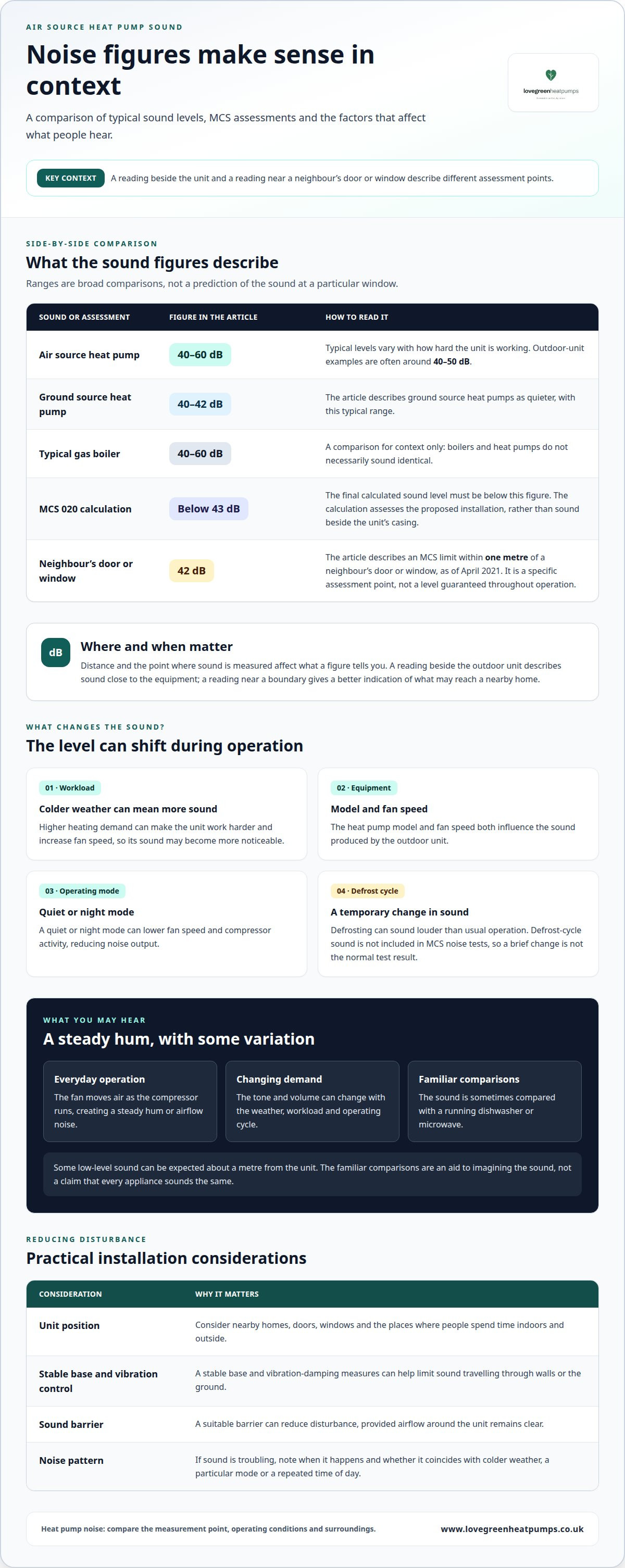
Heat pump sound is often compared with a boiler’s flue exhaust, while a typical gas boiler operates at 40-60 dB. These comparisons offer context, but they don’t mean every boiler and heat pump will sound identical. Their sound depends on operation and distance from the listener. For a fair impression, consider where the outdoor unit will sit and where people spend time indoors and outside.
Normal Operating Sounds
During normal operation, the outdoor unit’s fan moves air while the compressor runs. This can create a steady hum, airflow noise or a slight change in pitch as heating demand shifts. Some low-level sound can be expected about a metre from the unit. During colder weather, the heat pump may work harder and increase fan speed, so its sound may become slightly more noticeable.
Defrost-Cycle Sounds
A defrost cycle can sound louder than the heat pump’s usual operation. The unit temporarily changes how it runs to clear frost from its outdoor components, which can cause a shift in sound. This differs from the steady hum of ordinary heating. Defrost-cycle sound is not included in MCS noise tests, so a brief change does not represent the normal test result.
MCS 020 Sound Pressure Calculations
MCS 020 uses a sound pressure calculation to assess whether a UK air source heat pump meets noise standards. Installers must comply with MCS 020, helping to limit disturbance for householders and neighbours. The final sound level calculated under MCS 020 must be below 43 dB. This calculation assesses the proposed installation, rather than simply describing how loud a unit sounds beside its casing.
Will my heat pump be a noise nuisance to my neighbours?
The model, fan speed and operating mode all affect noise. Colder weather can increase demand and fan speed. If the sound seems excessive, note when it occurs, speak calmly with your neighbour, and contact your local council if needed.
Typical Noise Levels by Heat Pump Type
Air source heat pumps typically produce between 40 and 60 decibels, with outdoor-unit examples often around 40 to 50 decibels. Ground source heat pumps are quieter, with a typical range of 40 to 42 dB. These figures give a broad comparison between heating systems, but they don’t predict the sound at a particular neighbour’s window.
Distance and the point where sound is measured matter. The MCS limit described for a heat pump is 42 decibels within one metre of a neighbour’s door or window, as of April 2021. That is a specific assessment point, not a promise that every unit produces the same level throughout its operation. Temperature and heating demand also affect how hard an air source unit works.
A reading beside the outdoor unit and one near a boundary answer different questions. The first describes sound close to the equipment; the second better indicates what may reach a nearby home. Keep these contexts in mind when comparing figures or discussing an installation.
Factors Affecting Noise Levels
The heat pump model, fan speed and operating mode all influence its sound. A unit working harder may run its fan faster, and colder weather can increase demand. The operating mode matters too: a quiet or night mode can lower fan speed and compressor activity, reducing noise output.
Sound can vary over time rather than staying at one level. For example, a neighbour may hear more during a cold spell than in milder weather. The unit’s position and its distance from nearby doors or windows also affect what people hear. A decibel figure makes more sense when considered alongside these details.
Consider the pattern as well as the volume. Note whether the sound is steady, changes with the temperature or occurs only in a particular mode. These observations can help distinguish normal variation from a persistent concern and provide a clearer starting point for a conversation.
Responding to Noise and Neighbour Disputes
If noise is troubling you or a neighbour, note when it happens and what the unit is doing. A short log can show whether it coincides with colder weather, a particular operating mode or a repeated time of day. Share your observations calmly, then arrange an assessment if the sound remains disruptive.
In the UK, local authorities can investigate noise complaints and decide whether they amount to a statutory nuisance. If discussion does not resolve a neighbour dispute, contacting the environmental health team is a practical next step. Describe when the noise occurs and how it affects you, rather than relying only on a single decibel reading.
For an installation, careful planning can address neighbour-facing noise from the outset. Heat pump installation planning can take account of the unit’s location and nearby homes.
UK noise regulations for air source heat pumps
UK noise rules depend on the installation, its location and the sound reaching nearby homes. Requirements differ across the UK, so rules for England should not be assumed to apply in Wales or Scotland.
Whether an installation can proceed without planning permission depends on the applicable requirements being met. In England, permitted development rules include a limit of 37 decibels (dB) within one metre of a neighbour’s windows. The relevant criteria must be met for this route to apply.
That figure applies at a defined measurement position, not as a universal noise limit for every situation. The planned unit, its location and the nearest neighbour’s windows all matter. A heat pump can sound louder close to its outdoor unit than at a boundary, so an assessment needs to consider where people may hear it.
Rules also vary by nation. Planning requirements in Wales and Scotland include more stringent conditions on where a heat pump can be placed in relation to the property boundary. Siting is therefore a practical part of compliance, not simply a matter of finding a convenient spot beside the house.
Cumulative Noise from Multiple Heat Pumps
Cumulative noise is the combined sound of several heat pumps operating near one another. It matters on streets or in developments where neighbouring homes have outdoor units, because individual sound assessments may not describe the overall background.
A Nesta-commissioned report found that multiple air source heat pumps would be no louder cumulatively than typical urban night-time noise. It also concluded that, even in a worst-case scenario, several units were unlikely to be individually distinguishable from background noise. This provides context for neighbourhood concerns, but does not replace an assessment of a particular installation.
For example, sound from units in a built-up area blends with existing activity differently than it does in a quiet setting. The number and position of units, nearby buildings and background conditions all shape what residents experience.
Siting Heat Pumps to Reduce Noise
Siting means choosing where the outdoor unit will go to limit sound reaching neighbouring homes. This matters for both planning requirements and everyday comfort, particularly when a boundary or neighbour’s window is close.
In England, the permitted development noise criterion is measured within one metre of a neighbour’s windows. In Wales and Scotland, placement in relation to the property boundary is also subject to more stringent requirements. The nation and site layout therefore matter when planning an installation.
Environmental health rules also apply broadly to noise-generating equipment, including heating systems. Local authorities can investigate complaints and decide whether the noise amounts to a statutory nuisance. If a dispute arises, the timing, effect and circumstances of the sound may inform that assessment.
Outdoor unit positioning and vibration damping
The outdoor unit’s position affects how its sound carries around a property. A stable installation can also help limit vibration reaching nearby rooms or structures.
Outdoor Unit Positioning
Positioning means choosing where the outdoor unit will sit in relation to the home, boundaries and nearby windows. This matters because sound can reflect off walls and become more noticeable in particular parts of a garden or home.
Where possible, avoid placing the unit in a corner of the property. Nearby walls can reflect sound back into the space rather than allowing it to disperse. Consider the rooms and outdoor areas beside a proposed location, too. A bedroom window, patio or neighbour’s door may be more sensitive to operating noise than a less-used part of the garden.
Colder weather can make a heat pump work harder, so its sound may change with demand. Choosing a position with nearby homes in mind can limit the effect of that sound. It also leaves practical access around the outdoor unit.
Reducing Installation Vibration
Vibration reduction means limiting movement from the operating unit and preventing it from transferring into its support. This matters because vibration can create a separate low-frequency noise, particularly if the unit sits on an unsuitable or unstable surface.
A solid, stable base can help reduce vibration noise. If the unit moves or rocks against its support during operation, that movement can add unwanted sound. A firm, level surface provides a steadier foundation and helps prevent unnecessary movement.
Consider the structure beneath and around the installation. If a unit is close to a wall or attached structure, vibration may be more noticeable indoors if it transfers through the building. The aim is not just to find a convenient space, but to support the outdoor unit securely and consider how nearby rooms may be affected.
Anti-Vibration Feet
Anti-vibration feet are supports fitted beneath an outdoor unit to minimise mechanical vibration and nuisance noise. They can help when the unit’s movement might otherwise transfer into its base or a nearby structure.
These feet work alongside a solid, stable surface; they do not replace one. If the base shifts or the unit is poorly supported, vibration may still be a concern. The feet should sit securely beneath the unit, helping separate its operating movement from the supporting surface.
Positioning, base stability and vibration damping work best together. For example, placing a unit away from a property corner, on a firm base with anti-vibration feet, addresses both reflected sound and mechanical movement. This is particularly useful when a nearby room or neighbour’s outdoor space makes noise a concern.
Placement and acoustic noise mitigation
Placement and acoustic measures influence how much outdoor-unit sound reaches a household. Consider the ground, nearby windows and airflow before settling on a position.
Heat Pump Placement
Heat pump placement means choosing an outdoor position that takes account of both the home and neighbouring properties. Sound can travel differently across an open garden than beside a wall or enclosed space.
Start by looking at the available ground and the direction of nearby windows. A position facing a neighbour’s window may bring sound closer to their living space. Where the layout allows, choose a spot with distance and, if possible, the building between the outdoor unit and sensitive areas.
Check how the pump’s position relates to boundaries and the home’s everyday use. In England, permitted development criteria include a noise limit measured near a neighbour’s window; Wales and Scotland have more stringent placement requirements. The applicable regulations depend on the nation and the site.
Access and airflow matter too. The outdoor unit needs clear space around it to operate, so a quiet position must not block its air intake or outlet. A fence placed directly against the unit, for example, could obstruct airflow.
Acoustic Noise Mitigation
Acoustic noise mitigation uses a barrier, such as a fence or hedge, to absorb or deflect sound between the heat pump and neighbours. It matters where sound has a clear path towards a garden, patio or window.
For example, a barrier between the unit and a neighbour’s sitting area can interrupt that direct path. Position it between the sound source and the area to protect, while leaving airflow around the outdoor unit unobstructed. A barrier that blocks the fan’s airflow is not suitable.
Consider the whole arrangement rather than relying on a single screen. The ground beneath the unit, nearby walls, the boundary and the direction of windows all affect how sound travels. A fence or hedge may help, but the installation must still meet relevant regulations and allow the pump to operate correctly.
Good acoustic planning starts before the unit is installed. A site-specific heat pump installation plan can consider unit position, nearby windows and practical noise-reduction measures together.
Love Green Heat Pumps: Heat Pump Installation
Love Green Heat Pumps Ltd installs heat pumps, taking unit position and noise into account as part of planning for your home. If you’re considering an installation or want to understand how an outdoor unit could fit your property, the team manages the process from survey and design through to commissioning.
Noise can be considered alongside your home’s heating requirements, available outdoor space and nearby windows or boundaries. A carefully planned installation also accounts for practical details such as a stable base and clear airflow around the unit.
For a tailored next step, contact Love Green Heat Pumps Ltd to discuss a home survey and heat pump installation.
Plan a quieter fit for your home
Understanding air source heat pump noise levels is one part of planning a comfortable home. Next, consider how the outdoor unit will fit your household’s layout and future plans, including any changes to heating or energy use.
Love Green Heat Pumps Ltd offers heat pump installation, air conditioning and Solar PV & Other Renewables. If you’re considering a heat pump alongside other home improvements, thinking about the whole project early can help keep practical needs in view.
Share what matters to you, such as the rooms you use most, the available outdoor space or nearby windows. These details can help shape a conversation about an installation that suits your home.
Start a conversation with Love Green Heat Pumps Ltd about your plans, and take the next step at a pace that feels right.
Frequently Asked Questions
Are heat pumps noisy?
Heat pumps make some sound, but an air source unit is often likened to a running dishwasher or microwave. What you hear depends on the unit’s workload, its surroundings and how close you are. Ground source heat pumps are typically quieter because they do not use an outdoor fan unit in the same way. In a home with limited outdoor space, the location of an air source unit is especially relevant.
How loud are air source heat pumps in dB at 1 metre and at typical garden distances?
Air source heat pumps commonly produce around 40 to 60 dB, but there isn’t one sound level for every model or distance. Some low-level noise can be heard about a metre away. At a garden seating area or boundary, distance, walls and other surroundings change what reaches you. A figure measured beside the unit therefore won’t tell you precisely what you’ll hear elsewhere in the garden.
How do air source heat pump noise levels compare with gas boilers, air conditioners and everyday sounds?
A typical gas boiler operates at 40-60 dB, while an air source heat pump is often compared with a dishwasher or microwave. These comparisons are useful for imagining the sound, but readings depend on the equipment and where sound is measured. An air conditioner’s sound also varies by model and operation, so a direct comparison needs equivalent measurement conditions rather than a general label such as “quiet”.
How far should an air source heat pump be from a neighbour’s window or boundary to reduce noise?
There is no single distance that suits every property. The relevant assessment considers sound at a neighbour’s window or another defined point, alongside the unit, its position and surrounding surfaces. In England, permitted development criteria refer to a measurement within one metre of a neighbour’s window. This is a measurement location, not a required gap between the heat pump and the boundary.
What are the UK permitted development rules and noise limits for air source heat pumps?
In England, a heat pump may be installed under permitted development rights if the relevant criteria are met. Those criteria include a noise limit of 37 dB within one metre of a neighbour’s windows. MCS standards also apply to installations seeking permitted development status. Wales and Scotland have more stringent placement requirements in relation to property boundaries, so rules depend on where the home is located.
How is air source heat pump noise assessed under UK planning guidance and MCS standards?
MCS 020 uses a sound pressure calculation to assess a proposed air source heat pump installation. The calculation considers the unit and its position in relation to nearby properties; it’s not simply a reading taken beside the casing. Planning requirements also depend on the UK nation and permitted development criteria. A defrost cycle is louder than normal operation and isn’t included in MCS noise tests.
How can you reduce air source heat pump noise with siting, barriers, vibration isolation or maintenance?
Choose a position that avoids reflecting sound from a property corner, and use a stable base to limit vibration. Anti-vibration feet can help reduce mechanical vibration. A fence or hedge may absorb or deflect sound between the unit and a neighbour, but must not obstruct airflow. Regular servicing can help identify developing issues. These measures address different causes, so combining suitable siting with sound and vibration control can be useful.
Are air source heat pumps noisier in winter, during defrost cycles or at night?
In colder weather, a heat pump may work harder and increase its fan speed, making its sound more noticeable. A defrost cycle can also be louder than normal operation, though that sound is not included in MCS noise tests. Some units have a quiet or night mode that reduces fan speed and compressor activity. The effect depends on the unit’s settings and operating conditions.
Disclaimer
Disclaimer
The information published on this website is provided by Love Green Heat Pumps for general information and educational purposes. As a specialist provider of heating and renewable energy solutions, we strive to ensure that our content is accurate, relevant and up to date. However, heating requirements, system suitability, installation specifications, costs and performance can vary depending on individual property characteristics, usage and other site-specific factors.
Information provided in our articles should not be regarded as a substitute for a professional property assessment, technical survey or tailored recommendation. Any decisions regarding the selection, installation, replacement or maintenance of heating systems should be made with appropriate professional guidance.
Love Green Heat Pumps accepts no responsibility for decisions made solely on the basis of general information published in these articles. For advice specific to your property or project, we encourage you to contact our team for professional guidance and an assessment of your requirements.


