

An EPC assessment doesn’t have one fixed price. There’s no government-set fee for a domestic EPC, and the cost of an EPC certificate in 2026 depends on the property’s size, type, location and complexity. So a quote for a compact flat may differ from one for a larger or less straightforward home.
It’s sensible to want a clear idea of the cost before arranging an assessment, especially when you’re selling or letting a property. The final quote reflects the work involved in inspecting the home and recording its energy features, rather than a single price that applies to every property.
This guide explains what can affect an EPC assessment quote, how long the certificate remains valid and what has changed in the assessment process. You’ll also learn what to expect from the visit and when a new EPC may be useful after energy improvements.
Key Takeaways
- Domestic EPC assessments have no government-set fee, so the quote depends on the property and the work involved.
- Size, property type, location and complexity can all affect the assessment cost.
- Find out how long an EPC remains valid and when a new assessment may be useful after home improvements.
- Changes to the assessment process can affect the information an assessor records about a property.
- Landlords’ improvement spending limits are separate from the cost of commissioning an EPC assessment.
EPC assessment costs and the compliance investment cap
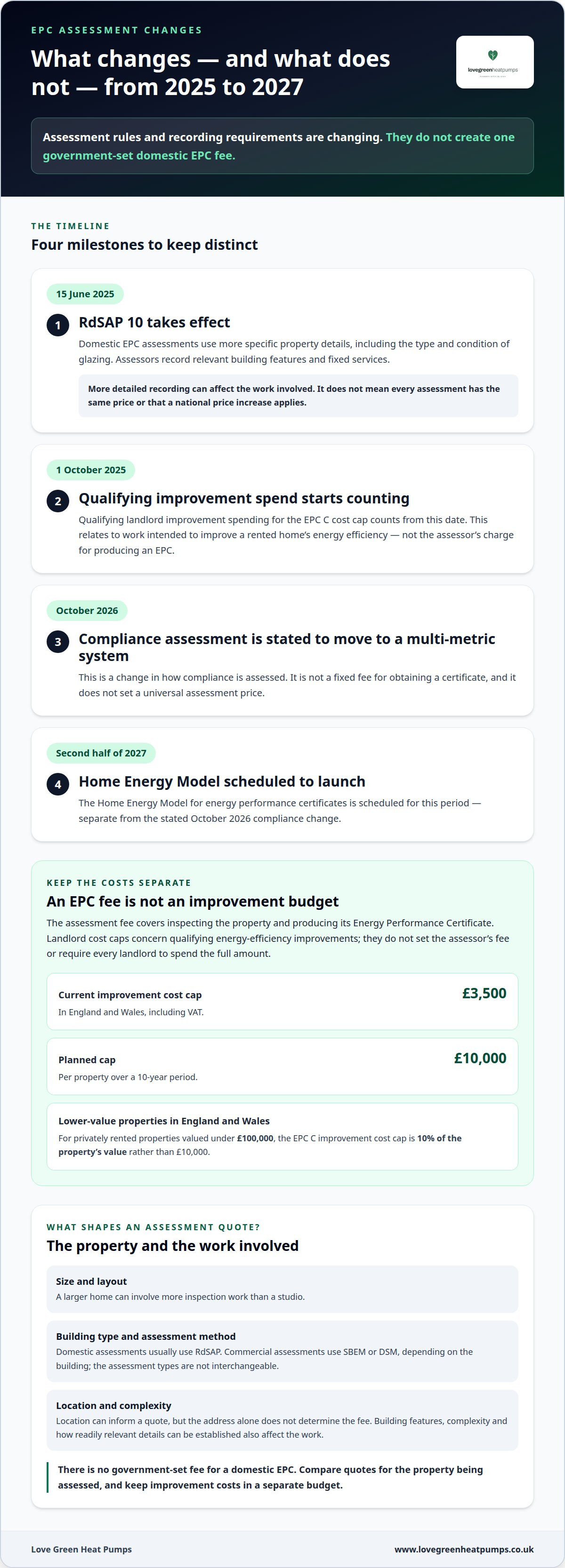
The assessment fee and a landlord’s improvement spending cap are separate costs. The fee covers inspecting a property and producing its Energy Performance Certificate. The cap concerns qualifying work intended to improve a rented home’s energy efficiency. It does not set the assessment price or mean every landlord must spend the full amount.
In England and Wales, the current landlord cost cap for improvements needed to meet the minimum EPC standard is £3,500 including VAT. The planned cap is £10,000 per property over a 10-year period. Qualifying landlord improvement spending for the EPC C cost cap counts from 1 October 2025. These limits relate to improvement costs, not the assessor’s fee.
The assessment method depends on the building. Domestic EPC assessments in the UK usually use RdSAP. Commercial assessments use SBEM or DSM, depending on the building and assessment. These methods reflect different building types and information needs, so a domestic assessment and a commercial assessment are not interchangeable.
For a valid certificate, the property must be assessed by an accredited energy assessor. To find one, ask the assessment provider for the relevant accreditation details before booking. In England, the Ministry of Housing, Communities and Local Government can be contacted on 020 3829 0748 for help finding an energy assessor.
What gets recorded can affect the work involved. RdSAP 10 took effect for EPC assessments on 15 June 2025. The updated assessment requires more specific property information, including glazing type and condition. An assessor also records relevant features of the building and its fixed services to produce an energy performance rating. If details are difficult to access or establish, the assessment may take more time.
From October 2026, EPC compliance assessment is stated to move to a multi-metric system. This changes how compliance is assessed, rather than setting one universal assessment fee. Property size, layout, building type, location and the availability of relevant information can all influence the assessor’s work and quote. A commercial building using SBEM or DSM may involve different assessment requirements from a straightforward domestic home using RdSAP.
For landlords, the practical distinction matters: budget separately for the certificate and any improvements. A cost cap limits qualifying improvement spending under the relevant rules; it is not a fixed EPC assessment price. The assessment records a property’s energy efficiency, while the cap concerns the cost of work that may follow.
How much does an EPC cost in 2026?
In the UK, domestic EPC quotes vary with property size, type and assessment complexity. The cost of an EPC certificate in 2026 is best understood through typical ranges, not as one fixed national fee.
Typical domestic and commercial prices
These ranges help indicate the likely scale of the fee, but the building’s size and complexity affect the work involved. The assessment report records energy performance and a rating, not the cost of insulation or other improvements.
Prices across the UK
These figures show that prices can vary even within one city, and they aren’t a fixed tariff for every London postcode. A home in the City of London and one in Croydon may differ in size, layout and assessment requirements, so the address alone doesn’t determine the fee.
The EPC price range
The lower end mainly reflects domestic assessments, while commercial EPCs account for higher quotes. A market snapshot collected on 21 November 2026 placed domestic assessments between £71 and £90, with a median of about £85. This gives another comparison point, rather than a guaranteed quote. The cost of an EPC certificate in 2026 still depends on the property being assessed.
Factors affecting EPC prices
Property size, type, location and assessment complexity influence the quote. A larger home can involve more inspection work than a studio, and commercial buildings have different assessment requirements from domestic properties. In London, the postcode provides useful location context, while the building’s layout and features help determine the work needed. The EPC records the property’s energy performance; it doesn’t include upgrade work. If you’re considering solar PV and other renewable options, treat that as a separate project from the assessment fee.
Changes to EPC pricing in 2025-2026
Changes to assessment methods can affect the information an assessor records, but they don’t create a government-set domestic EPC fee. There is no government-fixed fee for a domestic EPC in the UK. The assessment price is separate from any landlord spending on energy-efficiency improvements.
RdSAP 10 took effect for EPC assessments on 15 June 2025. Assessors now collect and record more specific property details, including glazing type and condition. This means the visit involves recording the home’s features in greater detail. It doesn’t mean every assessment has the same price or that a single national price increase applies.
From October 2026, EPC compliance assessment is stated to move to a multi-metric system. That describes a change in how compliance is assessed, not a set fee for obtaining a certificate. The Home Energy Model for energy performance certificates is scheduled to launch in the second half of 2027, so it is separate from the October 2026 change.
Landlords should also distinguish assessment charges from improvement spending caps. In England and Wales, the current landlord cost cap for improvements needed to meet the minimum EPC standard is £3,500 including VAT. The planned cap is £10,000 per property over a 10-year period. Qualifying spending for the EPC C cost cap counts from 1 October 2025. These figures concern improvements, such as wall insulation, rather than the energy assessor’s fee.
For privately rented properties in England and Wales valued under £100,000, the EPC C improvement cost cap is 10% of the property’s value rather than £10,000. Landlords whose properties still fall short of EPC C after spending up to the applicable cap can register a cost-cap exemption valid for 10 years. This is about compliance spending, not an automatic discount on an EPC assessment.
Support schemes have separate dates and purposes. ECO4 in Great Britain was extended to 31 December 2026, while the Great British Insulation Scheme closed on 31 March 2026. Neither date sets an EPC certificate price. A scheme may relate to eligible energy efficiency work, whereas the EPC fee pays for the assessment and certificate.
For a property owner, the useful distinction is straightforward: changes to assessment requirements can affect what the assessor records, while the fee depends on the property and assessment work. A certificate remains valid for 10 years unless a newer EPC is produced for the property. A new assessment may therefore be needed sooner if another EPC is produced, but improvement spending limits remain a separate matter.
Average EPC certificate cost
An average is a reference point, not a guaranteed quote for an individual property. It helps frame the likely assessment expense, but the property’s size, type, location and assessment requirements determine the final price.
That figure combines different homes and locations, so it won’t necessarily match a particular property. A separate market snapshot of domestic assessment offers gives a typical range of £71 to £90, with a median of about £85. The figures use different sources and measures, which is why averages are best read as guides rather than fixed tariffs.
The mix of properties makes a difference. An average drawn from home movers reflects the properties and quotes represented in that data. A small flat, a larger house and a commercial building require different assessment work. The average provides context, while the property itself determines the assessor’s task.
Before booking, confirm whether the property already has a usable certificate. Around 40% of sellers already have a valid EPC and may not need to pay for a new one. An existing EPC can be checked online free of charge. A certificate is valid for 10 years unless a newer EPC is produced for the property, so its age and any later assessment matter.
A new Energy Performance Certificate may be useful after changes to heating, insulation, glazing or renewable energy systems. It records the property’s energy performance at the time of assessment, giving buyers, tenants or lenders an updated report. The certificate shows the assessed rating; it does not guarantee that an improvement will produce a specific result.
For landlords, a low rating and an exemption are separate matters from the average assessment fee. In England and Wales, most privately rented homes currently need at least an E rating unless a valid exemption applies. The Ministry of Housing, Communities and Local Government states this minimum. An EPC assessment provides current evidence of the rating; an exemption relates to the applicable letting requirements.
Use the average to set a sensible expectation, then compare the quote with the property being assessed. Check that it covers the assessment and certificate, and that the EPC will be lodged on the register. This keeps the focus on the service being booked, rather than assuming one national average applies to every home.
Do EPC prices vary by region or postcode in the UK?
Yes. Location can affect an EPC quote, but the postcode is only one part of the assessment. The property’s size, type and complexity also shape the work involved. In London, a flat in Tower Hamlets and a house in Croydon may need different inspection work, even though both are in the same broad area.
Postcode comparisons are most useful when the properties are similar. Compare like with like: a flat with another flat, or a house with one of comparable size. A quote for a home in Southwark may not be directly comparable with one for a larger property in Bromley. Layout and building features can affect the assessment alongside location.
Travel can also influence a quote. In areas such as Lewisham, Greenwich, Merton and Hackney, the property type and access remain important details to share. A full postcode helps identify the location, while the property description clarifies the assessment required.
For a more meaningful comparison, give each assessor the same details: full postcode, property type and size. Mention any access considerations that could affect the visit. This helps show whether quotes cover comparable work, rather than judging them by the headline figure alone.
Love Green Heat Pumps Ltd offers EPC assessments. If you’re arranging one for a property in Westminster, Wandsworth, Islington or another local area, include its postcode and property type in your enquiry. Arrange an EPC assessment with Love Green Heat Pumps Ltd to discuss the assessment for your property.
Love Green Heat Pumps Ltd
Love Green Heat Pumps Ltd offers EPC assessments and can help you consider practical home energy improvements alongside your plans. If an assessment points to heating or renewable energy as areas to explore, the team also offers heat pump installation, heating engineering, air conditioning, and solar PV and other renewables. The right option depends on your property and priorities. Keep the assessment fee separate from any improvement decisions.
If you’d like to discuss your home’s energy needs, contact Love Green Heat Pumps Ltd.
Turn your EPC into a practical next step
An EPC can help you decide which questions to explore about your home’s energy use. If you’re considering changes, start by connecting the assessment findings with your priorities for comfort, heating and future plans. The cost of an EPC certificate in 2026 is only one part of that decision; the useful next step is understanding what the report means for your property.
Love Green Heat Pumps Ltd can discuss energy improvements in context, including heat pump installation, air conditioning, and solar PV and other renewables. The right option depends on the home and project aims, so a straightforward conversation can help clarify what to consider before planning work. The company also offers EPC assessments if you need one.
Contact Love Green Heat Pumps Ltd to talk through your next step and move forward with a clearer plan for your home.
Frequently Asked Questions
How long is an EPC valid?
An EPC is valid for 10 years unless a newer certificate is produced for the property, according to the Ministry of Housing, Communities and Local Government. If you’re preparing to sell or let a home, an existing certificate may still cover the transaction. Check the property’s record and certificate date before arranging another assessment. A newer EPC replaces the earlier one, so use the latest certificate when sharing the rating.
Do I need to pay for a new EPC if I already have one?
Not necessarily. If the existing EPC is still valid and there isn’t a newer certificate, you may not need another assessment. You can check the property’s EPC record online free of charge before booking. A fresh assessment may make sense after energy improvements if you want an updated rating for buyers or tenants. The decision depends on whether you need a current record, not simply on the home’s age.
Are EPC cost calculators accurate?
An EPC cost calculator can give a rough indication, but it can’t inspect your property. The final assessment fee depends on details such as property type, size, location and complexity. For example, a calculator may not fully account for a rural journey or an unusual building layout. Treat an online estimate as a starting point, then use a quote based on the property and assessment required.
Can I get a cheaper EPC through my estate agent?
An estate agent may help arrange an assessment, but that doesn’t automatically mean the fee will be lower. The quote still depends on the property and work involved. If an agent offers to organise it, ask what the fee covers and whether the certificate will be lodged on the EPC Register. Compare the same assessment scope rather than choosing solely by how it was arranged.
Do I legally need an EPC to sell my house?
In England and Wales, sellers must have a valid EPC before marketing a property for sale under the Energy Performance of Buildings (England and Wales) Regulations 2012. This means the certificate needs to be available at the marketing stage, rather than only when the sale completes. If the property already has a valid EPC, a replacement may not be necessary. Check its record before arranging another assessment.
Do I need an EPC?
An EPC is usually required in the UK when a property is sold, rented out or newly built. The exact situation depends on the property and transaction, so establish which applies before arranging an assessment. In Scotland, a seller’s Home Report includes an EPC. For a privately rented home in England and Wales, the EPC also records the rating relevant to minimum energy-efficiency requirements, subject to applicable exemptions.
How can I choose an affordable, accredited EPC assessor near me?
Choose an accredited assessor, as accreditation is required for a valid domestic EPC assessment and lodging. For a useful comparison, provide each assessor with the same property type, size and postcode, then compare what the quote includes. Rural travel and a complex layout can affect the work involved. Love Green Heat Pumps offers EPC assessments, so you can enquire about an assessment for your property and provide its details.
How does a professional EPC assessment work, and what do I need to provide?
A professional assessor visits the property, records its relevant features and uses them to produce the energy performance certificate. The visit typically takes 30 to 60 minutes, depending on size and complexity. Provide the property address and arrange access to the areas being assessed. Details about heating, insulation and glazing can help the assessor build an accurate picture. The certificate is usually lodged on the EPC Register within 24 to 48 hours.
Disclaimer
Disclaimer
The information published on this website is provided by Love Green Heat Pumps for general information and educational purposes. As a specialist provider of heating and renewable energy solutions, we strive to ensure that our content is accurate, relevant and up to date. However, heating requirements, system suitability, installation specifications, costs and performance can vary depending on individual property characteristics, usage and other site-specific factors.
Information provided in our articles should not be regarded as a substitute for a professional property assessment, technical survey or tailored recommendation. Any decisions regarding the selection, installation, replacement or maintenance of heating systems should be made with appropriate professional guidance.
Love Green Heat Pumps accepts no responsibility for decisions made solely on the basis of general information published in these articles. For advice specific to your property or project, we encourage you to contact our team for professional guidance and an assessment of your requirements.


