

An air source heat pump for an older house can be a practical option: age alone does not determine whether it will work well. Insulation, radiators, pipework and hot-water arrangements all affect the system design and its efficiency. The key is to understand what the property needs, rather than assume its age rules out a heat pump.
It is reasonable to wonder whether a heat pump can keep an older home comfortable, particularly if it has traditional radiators or draughty rooms. The basic principle is straightforward: the system takes heat from outdoor air and transfers it into the home for heating and hot water. How well it works in practice depends on the property and its heating system.
This article explains how air source heat pumps work, what affects their efficiency in older homes, and which parts of an existing heating system may need attention. It also covers planning and noise considerations, helping you understand the practical details before deciding whether a heat pump is right for your home.
Key Takeaways
- An older home isn’t automatically unsuitable for a heat pump. Insulation, radiators and the existing heating system all shape what installation will work well.
- Eligible homeowners replacing a fossil fuel heating system can receive up to £7,500 towards an air source heat pump installation through the Boiler Upgrade Scheme, according to the UK Government.
- A heat pump transfers heat from outdoor air into the home. Existing pipework and hot-water cylinder arrangements matter when planning how the system will fit.
- Efficiency depends on how the system is designed and runs, including the heat needed by the home and the temperature at which the radiators operate.
- Outdoor unit placement and noise levels can affect planning requirements, so these are important parts of considering an installation.
Can heat pumps be installed in older properties?
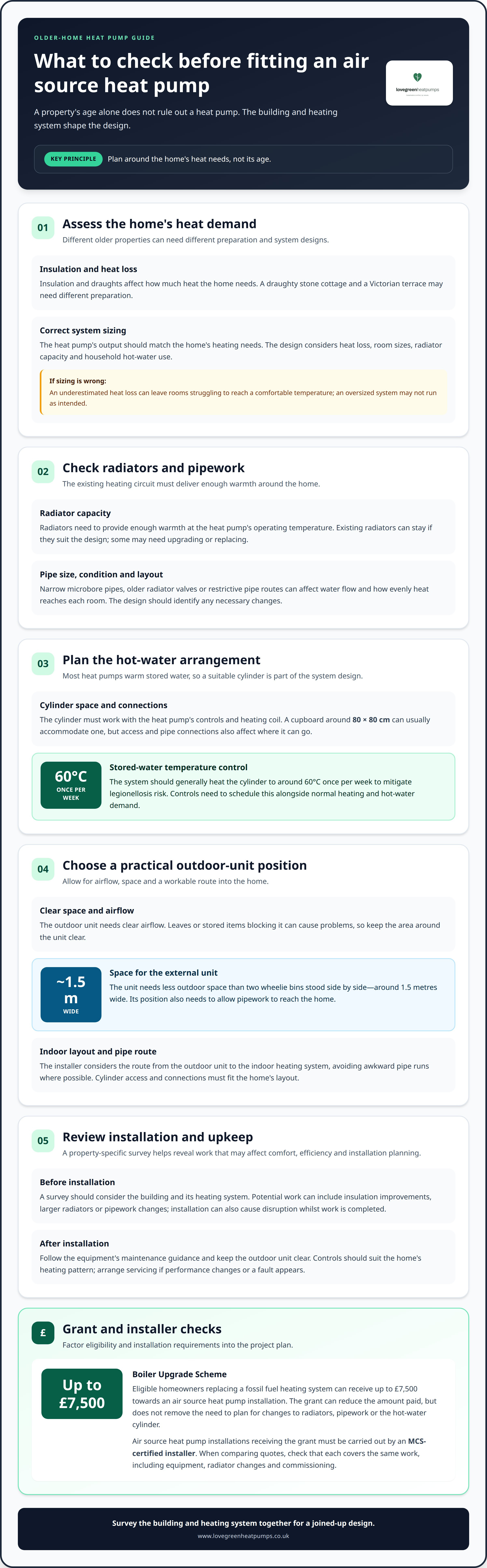
Yes. An older home can have an air source heat pump, but its insulation, radiators, pipework and hot-water arrangements shape the design. A Victorian terrace and a draughty stone cottage, for example, may need different preparation.
Installation costs and available grants
Installation costs depend on the system and the work needed to connect it to the home. Air source systems draw heat from outdoor air, while ground source systems use heat collected underground. Because ground source projects involve groundworks, the site and design affect the quote. Love Green Heat Pumps Ltd provides a property-specific quote after a home survey, rather than a generic price.
According to the UK Government, eligible homeowners replacing a fossil fuel heating system can receive up to £7,500 towards an air source heat pump installation through the Boiler Upgrade Scheme. The grant can reduce the amount the homeowner pays, but it doesn’t remove the need to plan for any changes to radiators, pipework or the hot-water cylinder.
EU forecasts offer wider context, rather than a prediction for UK homes. Annual heat pump installations in the EU were expected to rise from 2 million in 2021 to more than 4 million by 2025. The International Energy Agency forecast almost 7 million a year by 2030.
System sizing and installation quality
System sizing means matching the heat pump’s output to the home’s heating needs. If the design underestimates heat loss, rooms may struggle to reach a comfortable temperature; an oversized system may not run as intended. Insulation, room sizes, radiator capacity and household hot-water use all inform the design. Older radiators may need upgrading if they cannot provide enough warmth at the system’s operating temperature.
To choose an MCS-certified installer and compare UK quotes, check that each quote covers the same work, including equipment, radiator changes and commissioning. Air source heat pump installations receiving a Boiler Upgrade Scheme grant must be carried out by an MCS-certified installer.
Maintenance, installation problems and risks
The main considerations when installing a heat pump in an older house are possible insulation improvements, larger radiators or pipework changes, and disruption while work is completed. If the system is poorly sized or the existing heating network cannot deliver enough warmth, comfort and efficiency may suffer. A survey that considers the building and its heating system helps identify these issues before installation.
After installation, maintenance helps keep the system working properly. The outdoor unit needs clear space for airflow, so leaves or stored items blocking it can cause problems. Controls also need to suit the home’s heating pattern. Follow the equipment’s maintenance guidance and arrange servicing if performance changes or a fault appears.
How does a heat pump work?
An air source heat pump moves heat rather than creating it by burning gas. Its outdoor unit draws in air, and a refrigerant absorbs heat from it. Compression raises the refrigerant’s temperature, then heat passes into water circulating through the home’s radiators and hot-water cylinder. Electricity powers the process. The cycle repeats as the system responds to the home’s heating needs.
A heat pump connects to the existing heating circuit, so pipework matters. Older homes may have narrow microbore pipes, older radiator valves or pipe routes that restrict water flow. These can affect how evenly heat reaches each room. The system design takes account of pipe sizes, condition and layout, with any necessary changes included. Radiators must also provide enough warmth at the water temperature supplied by the heat pump. Existing radiators can stay if they suit the design, but some may need replacing or upgrading.
Hot water needs a cylinder because most heat pumps warm stored water rather than supplying it instantly like a combi boiler. The cylinder must work with the heat pump’s controls and heating coil. A cupboard measuring around 80x80cm can usually accommodate a hot-water cylinder, although access and pipe connections also affect placement. In a home with no suitable cylinder space, the design must account for where one could be installed before the heating system is changed.
Outdoor space needs planning too. The heat pump’s external unit needs clear airflow and a position that allows its pipework to reach the home. It needs less outdoor space than two wheelie bins stood side by side, around 1.5 metres wide. The installer also considers the route from the unit to the indoor heating system, avoiding awkward pipe runs where possible. Inside, cylinder access and connections need to fit the property’s layout.
Stored hot water needs temperature control as part of safe system operation. The system should generally heat the cylinder to around 60°C once per week to mitigate legionellosis risk. The controls need to schedule this alongside normal heating and hot-water demand. For an older home, reviewing the pipework, cylinder position and radiator circuit together helps produce a joined-up design. A professional heat pump system design considers these connections before installation begins.
Heat pump efficiency and coefficient of performance
A heat pump’s coefficient of performance (CoP) compares its heat output with the electricity it uses. At a CoP of 3.0, it provides three units of heat for each unit of electricity. A heat pump can generate 3−4 kWh of heat output from 1 kWh of electrical energy. The CoP describes performance at a particular point; seasonal performance reflects how the system performs across changing conditions.
A typical heat pump seasonal performance factor is 3.1. That figure isn’t a promise for every older home: insulation, outdoor conditions and the system’s flow temperature all influence results. The flow temperature is the temperature of the water sent around the radiators. Heat pumps generally operate more efficiently at lower flow temperatures, provided they can still keep the rooms warm. The system must still provide enough warmth for the rooms.
Research into existing buildings shows why preparation matters. The Fraunhofer Society monitored buildings aged 15 to 150 years that had received energy-saving measures and heat pumps. Between 2018 and 2019, the air-source systems achieved an average seasonal performance rating of 3.1. A study a decade earlier found an average rating of 2.6 for systems in mainly older, non-renovated buildings. These results illustrate how a building’s condition can affect performance.
Insulation helps reduce the heat that escapes through the roof and walls, lowering the amount the heating system needs to replace. Between 2013 and 2023, homes in Great Britain with loft insulation increased by 16%, or 2.4 million homes. Over the same period, cavity wall insulation increased by 25%, or 3 million homes. In an older property, draughts and uninsulated areas can mean greater heat demand, so insulation improvements may support comfort and system efficiency.
Flow temperature links the heat pump’s output to the radiators’ ability to warm each room. If radiators are too small, they may struggle to deliver enough warmth at a lower water temperature. The system may then need a higher flow temperature, which can reduce efficiency. Good design balances radiator capacity, room heat loss and the temperature needed for comfortable heating.
Efficiency and running cost are related, but they aren’t the same measure. In 2025, UK electricity prices per kWh were about four times higher than gas prices per kWh. A CoP above one means the heat pump delivers more heat energy than the electricity it consumes, but the household’s energy use and tariffs still affect the bill. Insulation, suitable radiators and a well-adjusted flow temperature help the system make better use of its electricity.
Planning permission and noise limits
For a UK heat pump installation, the outdoor unit’s noise and position may affect planning requirements. Considering these details alongside other home improvements can help avoid design changes later.
Planning permission requirements
A heat pump installation normally needs planning permission if its noise level exceeds 42dB when measured one metre from a neighbouring window. The measurement point matters, so the proposed unit position should be considered against nearby windows. A heat pump typically operates between 40 and 60 decibels when on, making the model and installation layout relevant to this assessment.
For an older property, the system design should account for the outdoor unit’s location and noise. Most heat pump installations are permitted development, but flats, listed buildings and conservation areas may need planning permission. Love Green Heat Pumps considers these requirements as part of planning the installation.
Noise limits and retrofit planning
Noise limits and wider retrofit planning both affect where the outdoor unit can go. A unit beside a neighbouring window may raise different concerns from one placed farther away, while walls and access routes can also shape the layout. Noise should be assessed at the specified measurement point, not judged only from inside the home.
Older properties may need several changes to work well with a heat pump. Planning insulation, radiator upgrades and outdoor equipment as one coordinated project can help avoid repeating work. For example, reducing heat loss may change the heating demand used to size radiators and the system. This can support comfort and energy efficiency, while switching from fossil-fuel heating can contribute to lower household carbon emissions.
Discuss the proposed outdoor unit position as part of the wider retrofit design. The survey considers how the unit will connect to the heating system, where pipework will enter the building and how nearby windows affect noise assessment. If insulation or radiator work is also planned, coordinating the sequence with the heat pump installation can create a more coherent design.
Noise is only one part of a suitable installation. The outdoor unit needs a position that works for airflow, access and the route into the home, while also accounting for the 42dB threshold. Bringing these factors together early gives the project a clearer basis for deciding whether planning permission is required and how the installation should be arranged.
How air source heat pumps work
An air source heat pump uses a refrigerant circuit to move heat from outdoor air into a home. Its key parts work together in a repeating cycle, rather than producing heat by burning fossil fuel. This affects how the heating system responds to the weather and household demand.
The process follows four main stages. First, a fan draws outdoor air across an evaporator, where refrigerant absorbs heat and changes from liquid to gas. Next, a compressor squeezes the gas, raising its pressure and temperature. A condenser transfers that heat into water for the home’s heating circuit. An expansion valve then lowers the refrigerant’s pressure, ready for the cycle to begin again.
The refrigerant can absorb heat from air even when it feels cold outdoors. The compressor uses electricity to raise the refrigerant’s temperature, making it warm enough to transfer heat indoors. Most current heat pump models work in temperatures down to about -25°C. Output and efficiency still vary with outdoor conditions, so the system’s design and controls matter through colder weather.
Inside the home, the condenser transfers heat to water rather than sending warm air directly into each room. That water circulates through radiators or underfloor heating. A separate circuit can heat water stored in a cylinder. These are different demands: heating keeps rooms comfortable, while hot-water controls bring stored water to the required temperature. Sensors and control settings coordinate the system.
Controls help match heat delivery to the home’s needs. For example, weather compensation adjusts the water temperature in response to outdoor conditions. On a milder day, the system can supply less heat; in colder weather, it can increase output. This steady adjustment differs from switching a boiler on briefly at a high temperature. The result depends on the home’s insulation, radiator capacity and each room’s heating needs.
Outdoor air contains moisture, which can form frost on the heat exchanger in cold conditions. The heat pump can temporarily reverse its cycle to clear the frost, then return to heating. This is part of normal operation, but the unit needs clear airflow. Leaves, fencing or stored items close to the casing can obstruct air movement and affect heat exchange.
For an older home, the practical takeaway is that replacing a fossil-fuel boiler involves more than swapping appliances. The heat pump, controls and indoor heating circuit must work as one system. Discuss a heat pump system for your home when you’re considering an upgrade.
Love Green Heat Pumps: Heat Pump Installation
Love Green Heat Pumps Ltd installs heat pumps for homeowners considering a change from a boiler. Each installation follows a home survey and heat-loss calculation, with the system designed around the property’s heating needs and existing setup, then installed and commissioned.
A survey is a useful next step if you are weighing insulation, radiator capacity, pipework, cylinder space or outdoor unit placement. These details influence how a heat pump will fit an older home, so they belong in the design discussion rather than being treated as afterthoughts. Love Green Heat Pumps also offers heating and plumbing, solar panel installation, and air conditioning.
If you’re ready to discuss a heat pump for your home, contact Love Green Heat Pumps Ltd.
Plan the right next step for your home
Choosing an air source heat pump for an older house is best treated as a home-design decision, not simply a boiler replacement. Your priorities matter too: you may want to improve comfort in colder rooms, coordinate heating work with planned renovations or reduce reliance on fossil fuels over time. A clear discussion can connect those aims with the practical realities of the property.
Before deciding, consider what you want your heating system to do day to day. Which rooms feel least comfortable? Are renovations already planned? Is keeping the existing radiators important to you? These points help shape a useful conversation about the design, installation and changes that may suit your home.
Love Green Heat Pumps Ltd can discuss heat pump installation for your property and the factors that influence its design. If you’re ready to explore the next step, contact Love Green Heat Pumps Ltd to talk through your plans. A well-considered design can make the transition feel manageable and bring dependable comfort within reach.
Frequently Asked Questions
Do heat pumps cost more to run than a gas boiler?
Not necessarily. Running costs can be similar to or lower than gas when the heat pump is correctly sized and used with a heat-pump electricity tariff. The comparison also depends on the home’s heat demand, system settings, and household use of heating and hot water. Compare bills over the same period and include both heating fuels, rather than judging costs by electricity’s unit price alone.
Do heat pumps make your EPC rating lower?
No, installing a heat pump does not automatically lower an EPC rating. An Energy Performance Certificate assesses the home as a whole, so the result depends on several property details, not just the heating appliance. The heating system and its estimated energy use can affect the assessment, along with features such as insulation. Any change in rating depends on the overall assessment, not simply on replacing a gas boiler with a heat pump.
Is the incoming electrical power supply sufficient?
Most UK homes have a single-phase electricity supply of up to 100 amps, but that fact alone doesn’t establish whether a particular installation has enough capacity. The heat pump’s electrical requirements must be considered alongside existing appliances and the property’s supply. For example, an older consumer unit or other high-demand equipment may affect the installation design. Electrical capacity is one of the practical details assessed for the home.
What are the most common issues with heat pumps?
Common problems include incorrectly set controls, restricted airflow around the outdoor unit and a system that does not match the home’s heating needs. For example, the household may think the heat pump is not warming rooms properly when its schedule or temperature settings do not suit daily routines. Unusual noises, persistent faults or a sudden change in heating performance need attention. Regular servicing can help identify developing issues.
Is an air source heat pump suitable for an older UK house?
Yes, an air source heat pump for an older house can be suitable, but the property’s features shape the design. A solid-wall terrace, a listed home and a cottage with later extensions can each present different practical constraints. The survey considers heat loss, the existing heating system, space for equipment and household hot-water needs. The result is a property-specific design, not a decision based on age alone.
What insulation and draught-proofing does an older house need before installing a heat pump?
There is no single insulation package that suits every older home. Start by identifying where heat escapes, such as an uninsulated loft, gaps around doors or poorly sealed windows. Improvements should reduce draughts without blocking ventilation the building needs. For example, sealing a door gap can improve comfort, while ventilation still needs consideration. The home’s heat loss determines which upgrades matter most.
How do heat pumps work with radiators in older homes, and do radiators need replacing?
Heat pumps can work with existing radiators if they can meet each room’s heating needs. Replacement is not automatic. For example, a small radiator in a large, exposed room may need upgrading, while a larger radiator in a compact room may already be suitable. A room-by-room assessment matters because radiator output, room heat loss and system settings interact. This helps determine whether changes are needed.
What size air source heat pump does an older house need, and how is heat loss calculated?
The correct size depends on the home’s heat loss, not simply its floor area or bedroom count. A heat-loss calculation considers room dimensions, external walls, windows, insulation and the required indoor temperatures. An older home with a large extension may have different needs in each area. The calculation informs the system design and helps avoid equipment that cannot meet demand or is poorly matched to the property.
Disclaimer
Disclaimer
The information published on this website is provided by Love Green Heat Pumps for general information and educational purposes. As a specialist provider of heating and renewable energy solutions, we strive to ensure that our content is accurate, relevant and up to date. However, heating requirements, system suitability, installation specifications, costs and performance can vary depending on individual property characteristics, usage and other site-specific factors.
Information provided in our articles should not be regarded as a substitute for a professional property assessment, technical survey or tailored recommendation. Any decisions regarding the selection, installation, replacement or maintenance of heating systems should be made with appropriate professional guidance.
Love Green Heat Pumps accepts no responsibility for decisions made solely on the basis of general information published in these articles. For advice specific to your property or project, we encourage you to contact our team for professional guidance and an assessment of your requirements.


