

An air cooler can make a room more comfortable, but it won’t cool it like an air conditioner. Among the alternatives to portable air conditioners, evaporative coolers use water to chill the air by around four degrees, while fans simply circulate it. Neither works in the same way as an air conditioner, which removes heat from the room.
If you’re choosing between a cooler and a fan, think about the room and the kind of relief you need. A fan may suit everyday use when you want a breeze. An air cooler can make airflow feel cooler, but it also adds moisture to the air.
This guide compares air coolers and fans with air conditioning, looking at room size, cooling performance, energy use and running costs. You’ll learn when each option makes sense, what to expect in warmer weather and when a fitted air-conditioning system may be worth considering.
Key Takeaways
- Match the cooling option to the room and the level of temperature control you need.
- Air coolers can suit smaller spaces, but their added moisture affects where they work best.
- Fans create a breeze by moving air around; air conditioners remove heat from the room.
- Compare energy use and likely hours of operation to understand what running costs depend on.
- Consider whether a room-by-room solution or a more permanent cooling system better fits your home.
1. Cooling performance and suitable room sizes
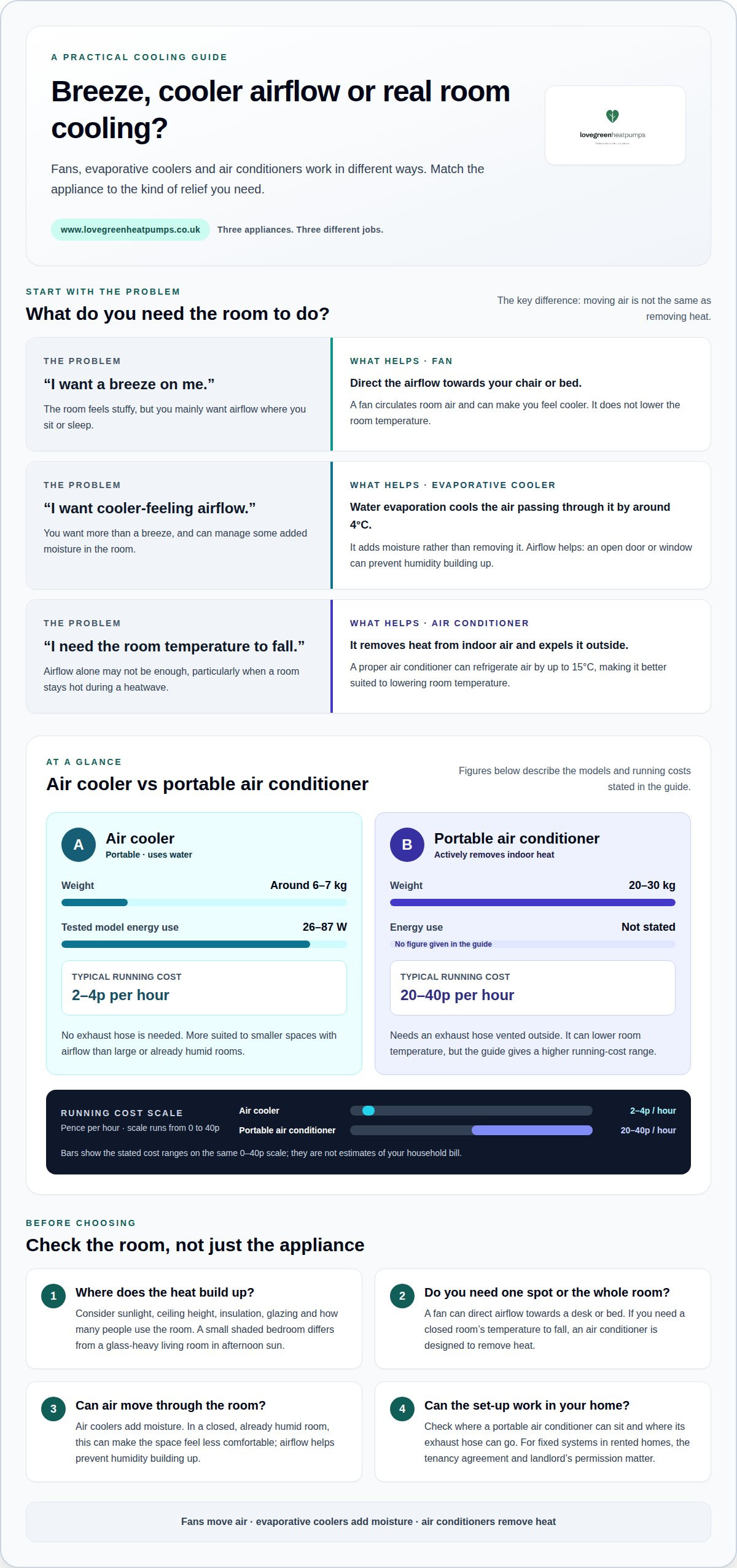
Cooling capacity matters more than the unit’s appearance. A proper air conditioner can refrigerate air by up to 15°C, making it better suited to lowering room temperature during heatwaves. Fans work differently: they circulate air rather than creating cool air, so their airflow may feel pleasant without reducing the heat in the room. A fan can still help if you want a breeze directed at your chair or bed.
Room size is only one factor when choosing a cooling option. Sunlight, ceiling height, insulation, glazing and the number of people in the room all affect heat build-up. A small, shaded bedroom has different needs from a glass-heavy living room in strong afternoon sun. A portable air conditioner with a low BTU rating may struggle in a warm space, so don’t rely on room size alone when judging whether it will keep the room comfortable.
Match the cooling option to the result you need. For personal comfort at a desk, a fan aimed towards you can improve airflow without cooling the whole room. If you need the temperature in a closed room to fall, an air conditioner is designed to remove heat. Air coolers sit between the two, but their performance depends on room conditions and they add moisture to the air.
Climate also affects your choice. In the UK, cooler nights can make ventilation useful, while a heatwave can leave upper rooms warm after sunset. Shading windows and reducing indoor heat sources can help, but they won’t replace active cooling if a room stays uncomfortably hot. Consider when it overheats, how long you use it and whether you need whole-room cooling or relief in one spot.
An air-to-air heat pump can provide cooling as part of a fitted system by moving heat from indoors to outside. Unlike a fan, it actively cools the room and may suit homes looking for a permanent solution. Room layout and intended use matter too: a home office may need cool air directed towards a desk, while a living space may benefit from more even airflow.
Before choosing, note the room’s sun exposure, how quickly it heats up and whether you need cool air across the whole space. Compare the appliance’s stated cooling capacity with those conditions instead of relying on room size alone. Check where the unit can sit, how airflow will reach the people using the room and whether doors are usually open or closed. These details help you judge whether the option will suit everyday use.
2. Evaporative coolers
Evaporative coolers, often called air coolers, use water to lower the temperature of passing air. Evaporation cools the airflow, but the cooler adds moisture instead of removing it. Air coolers may suit people looking for a gentler change in a small space, but they don’t provide the same temperature control as an air conditioner.
Air coolers may be most effective in smaller rooms, but their performance depends on the conditions. That makes one a practical option for a small bedroom or home office during summer, provided the room has airflow. Leaving a door or window open helps prevent humidity building up and reducing the cooler’s effectiveness. In a closed, already humid room, the added moisture can make the space feel less comfortable.
Unlike a portable air conditioner, an air cooler doesn’t need an exhaust hose vented outside. That makes it easier to move between rooms and avoids having a window occupied by a hose. Air coolers also weigh around 6kg to 7kg on average, compared with 20kg to 30kg for portable air conditioners. They use between 26 and 87 watts in tested models, and typically cost two to four pence per hour to run, compared with 20 to 40 pence for portable air conditioners.
Air coolers can be useful alternatives when portability, lower energy use and simple set-up matter more than strong cooling. They’re less suitable for large rooms, persistently humid spaces or anyone who needs a substantial drop in room temperature. A fan may be the simpler choice if you only want moving air directed at one person.
Before cleaning an air cooler, switch it off and unplug it. Empty the water tank, then clean it and any removable filters as directed in the appliance manual. Let the parts dry before storage. Regular cleaning helps prevent stale water and dust from building up. At the end of its life, follow the manufacturer’s disposal instructions and your local council’s guidance for electrical items.
Window and split-system air conditioners aren’t automatically suitable for rented homes because installation may alter the property. The tenancy agreement and the landlord’s permission determine whether fitting one can proceed. For a room that needs fixed cooling, explore home heating and cooling guidance before choosing equipment.
Each alternative has drawbacks and practical safety considerations. Air coolers need water and regular cleaning, fans don’t lower room temperatures, and portable air conditioners need an exhaust route. Keep electrical appliances away from spilled water, place them on a stable surface and keep cables clear of walkways. These precautions make a summer cooling set-up safer without changing what each appliance can do.
3. Fans versus air conditioners
A fan moves air across your skin, helping sweat evaporate and making you feel cooler. It doesn’t remove heat from the room. A portable air conditioner does: it draws heat from indoor air and expels it outside through an exhaust hose. The difference matters during heatwaves, when airflow alone may not make a hot room comfortable.
For personal comfort, a standard fan can be an efficient choice. Direct airflow towards where you’re sitting or sleeping, rather than expecting the fan to cool every corner. A bladeless fan works on the same basic principle: it circulates room air, even though its blades are enclosed in the base. Its shape doesn’t make it an air conditioner or lower room temperature.
Outdoor misting fans combine airflow with a fine spray of water. In a suitable outdoor space, such as a patio on a dry summer afternoon, evaporation can make the moving air feel cooler. Humidity affects the result: water evaporates less readily when the air already contains more moisture. Misting can also dampen nearby surfaces, so keep it away from furniture and areas where wet floors could cause a slip.
An attic fan works differently from a desk or pedestal fan. It helps move hot air out of the roof space, which can reduce heat build-up above the rooms below. Its purpose is roof-space ventilation, not direct cooling of a bedroom or living room.
Choose between a fan and air conditioning by deciding what needs to change. If you want a breeze on one person, a portable fan can provide it without cooling the whole room. If you need the room’s temperature to fall, an air conditioner is designed to remove heat. In a large or persistently warm space, a fan may circulate warm air without addressing the heat build-up.
Room layout also affects how well a fan works. A fan placed in a doorway can help move air between spaces, while one aimed at a bed provides more focused airflow overnight. In cooler weather, open windows to bring outdoor air through the home. During hot daytime periods, the same approach may bring warmer air inside, so adjust your ventilation as outdoor temperatures change.
Fans suit targeted comfort and ventilation; air conditioners provide active room cooling. Consider the room’s humidity, the weather and whether you need cooler-feeling airflow or lower indoor temperatures. This distinction helps you match the appliance to the space without expecting a fan to do the work of an air conditioner.
4. Energy use and running costs
Air coolers typically cost two to four pence per hour to run, compared with 20 to 40 pence for portable air conditioners. A typical portable unit uses about 1,000 watts, giving an estimated cost of about 26 pence per hour using the July 2026 price cap. A fan’s cost depends on its wattage and how long it runs.
The UK price-cap guide for electricity is 26.11 pence per kilowatt-hour from 1 July to 30 September 2026. At that rate, a 1,000-watt appliance uses one kilowatt-hour in an hour. Multiply its kilowatt rating by the hours used, then by your electricity rate, to estimate its running cost. Your own tariff and actual usage affect the final bill.
For a more precise comparison, check each appliance’s wattage label or manual. Convert watts to kilowatts by dividing by 1,000, then multiply by the hours you expect to use it. For example, a 30-watt air cooler running for five hours uses 0.150 kilowatt-hours. This calculation gives energy use; applying your unit rate estimates the cost.
The simplest way to cool a room without air conditioning is to limit heat entering before relying on powered cooling. During sunny periods, close curtains or blinds on sun-facing windows. Switch off lights and appliances you don’t need, particularly those that release heat indoors. Then use a fan to direct airflow where someone is sitting or sleeping.
How long an appliance runs matters as much as its type. A powerful air conditioner used for a short period may use less electricity than a lower-wattage appliance left running for longer. Set a practical schedule around when the room is occupied, and switch equipment off when it’s not needed. Cooling an empty room adds energy use without improving anyone’s comfort.
Air coolers generally use less energy than air-conditioning units, but they don’t cool air in the same way. They add moisture, which can make them less suitable in a humid indoor space. A fan uses electricity to move air, not to remove heat. Choose according to the cooling effect you need, not just the appliance’s wattage.
To compare electricity use, note each appliance’s wattage, expected hours of use and your electricity unit rate. Calculate the energy use, then estimate the cost. This gives you a consistent comparison between a fan, air cooler and portable air conditioner, even though their cooling performance differs. Revisit the estimate if your usage pattern or electricity rate changes.
5. Energy use and bills
Cooling bills depend on how much heat enters your home, not just which appliance you use. South-facing windows can admit strong sunlight, so closing blinds during the sunniest part of the day can reduce heat gain. This may limit how often powered cooling needs to run, particularly in rooms that heat up quickly.
Window performance can also affect indoor temperatures. A window’s G-value, also called its Solar Factor, uses a scale from 0 to 1. A value of 1 means it lets in all the sun’s heat; 0 means it blocks it out. Heat-reflective film is recommended for south-, east- or west-facing windows to help block sunlight.
Roof choices can influence cooling demand too. Cool roofs can reduce roof temperatures by up to 30°C and lower cooling needs by 10-30%. These figures describe potential benefits, rather than a guaranteed bill reduction for every home. The result depends on the building, roof and weather, as well as how much cooling occupants use.
Insulation is usually discussed as a way to retain warmth, but it can also help keep a home cool in hot weather. A UK home insulation scheme is intended to help some households improve insulation and lower their energy bills. Better insulation can slow heat moving through the building, although shading and ventilation still matter during hot spells.
Indoor heat sources are another part of the equation. Incandescent bulbs emit up to 90% of their energy as heat, so replacing them with cooler-running lighting can reduce unnecessary warmth. Switch off lights and appliances when they’re not needed, then use window shading to limit incoming solar heat. These steps can reduce the load on cooling equipment.
Consider the whole home before buying a powerful cooling appliance. A bedroom that overheats in direct sun may benefit from window shading first, while a top-floor room may also gain heat through the roof. Reducing these sources can lower the amount of cooling needed. If room temperatures remain uncomfortable, a suitable air-conditioning system offers a more direct way to cool the space.
To plan a lasting response to summer heat, explore home air-conditioning options. The right approach depends on the room’s heat sources, insulation and window exposure. Combining practical changes with appropriately chosen cooling can help manage energy use without expecting one appliance to solve every cause of overheating.
Love Green Heat Pumps Ltd
Love Green Heat Pumps Ltd can help you compare room-by-room cooling with a fitted solution. If a fan or air cooler doesn’t provide the comfort you need, the company’s air-conditioning and heat-pump services offer alternatives to consider. The right choice depends on how you use the space, where heat builds up and whether you want cooling alone or a wider home energy improvement.
For a home that stays uncomfortable during warm weather, discuss the room and the kind of cooling you need. Love Green Heat Pumps Ltd can explain suitable options and, for installations, manage the process from design to commissioning. If you’d like help deciding what may suit your home, contact Love Green Heat Pumps Ltd.
Choose a cooling plan that suits your home
The right choice fits how you use each room, rather than simply adding another appliance. Consider whether you need occasional personal comfort or a longer-term change to your home. The best alternatives to portable air conditioners depend on that distinction, along with your plans for the property and the comfort you want in warmer weather.
If cooling is part of a wider home improvement, consider it alongside your heating and energy plans. Love Green Heat Pumps Ltd offers air conditioning, heat pump installation and Solar PV & Other Renewables, so you can explore options in context rather than treating each decision in isolation. Discuss what matters in your home and decide what to explore next, without pressure to choose a solution before you understand your options.
Ready to talk through your options? Contact Love Green Heat Pumps Ltd and take a practical next step towards a home that feels more comfortable.
Frequently Asked Questions
Are air coolers effective?
Yes. Air coolers can make nearby airflow feel cooler, especially in a small, well-ventilated room. Their usefulness depends on how much moisture is already in the air and whether fresh air can circulate through the space. In a home office, point the outlet towards your desk and leave a route for air to escape. If you need the room temperature itself to fall, choose another type of cooling.
What alternatives to traditional air conditioning are available?
Options include fans, evaporative air coolers, external shading and careful window management. Fans provide personal airflow, while coolers use water to change how the air feels. Passive measures, such as closing blinds against strong sun, reduce heat entering the room rather than cooling it mechanically. Air-to-air heat pumps can also provide cooling as part of a fitted system. The right choice depends on whether you need local relief or a lasting change.
What features should I look out for?
Start with the room the appliance will serve, then check its stated coverage and cooling method. For an air cooler, look at tank access, cleaning instructions and whether the controls suit your routine. For a fan, consider where its airflow can reach and whether it fits the available floor or desk space. Check noise information too, particularly if you plan to use it while sleeping or working.
What is passive cooling and how does it work?
Passive cooling reduces heat entering or remaining in a home without a powered cooling appliance. For example, close blinds while direct sunlight falls on a window, then ventilate with cooler outdoor air when conditions allow. Shading, insulation and limiting indoor heat sources can all help. These measures manage heat gain and air movement rather than actively extracting heat like an air conditioner.
What are the best alternatives to portable air conditioners in the UK?
There isn’t one best option for every UK home. Choose a fan for a breeze directed at one person, or an air cooler for a small, ventilated room where added moisture is acceptable. For rooms that stay hot, consider reducing sunlight through windows and improving ventilation. If you need reliable control over room temperature, a fitted cooling system may suit you better than a portable appliance.
How do portable air conditioners compare with air coolers, fans and evaporative coolers?
A portable air conditioner removes heat from indoors and sends it outside through an exhaust hose. An evaporative cooler uses water to cool passing air, while a fan simply circulates the air already in the room. Air coolers are a type of evaporative cooler. Compare them by the result you need: lower room temperature, cooler-feeling airflow, or a breeze directed at a person.
How effective are ceiling fans and tower fans at cooling a room?
Ceiling and tower fans can improve comfort by moving air, but they don’t lower room temperature. A ceiling fan circulates air across a broader area, while a tower fan directs airflow towards a particular seating or sleeping spot. Use either to create a breeze where it matters, and switch it off when the room is empty. Moving air doesn’t remove stored heat.
Do evaporative air coolers work in humid UK weather?
Air coolers can still move air in humid conditions, but water evaporates less readily, so the cooling effect may be less noticeable. They also add moisture, which can make a closed or already damp-feeling room less comfortable. In a humid space, try ventilation and a fan instead. An evaporative cooler is better suited to a room where air can circulate and moisture won’t build up.
Disclaimer
Disclaimer
The information published on this website is provided by Love Green Heat Pumps for general information and educational purposes. As a specialist provider of heating and renewable energy solutions, we strive to ensure that our content is accurate, relevant and up to date. However, heating requirements, system suitability, installation specifications, costs and performance can vary depending on individual property characteristics, usage and other site-specific factors.
Information provided in our articles should not be regarded as a substitute for a professional property assessment, technical survey or tailored recommendation. Any decisions regarding the selection, installation, replacement or maintenance of heating systems should be made with appropriate professional guidance.
Love Green Heat Pumps accepts no responsibility for decisions made solely on the basis of general information published in these articles. For advice specific to your property or project, we encourage you to contact our team for professional guidance and an assessment of your requirements.


