

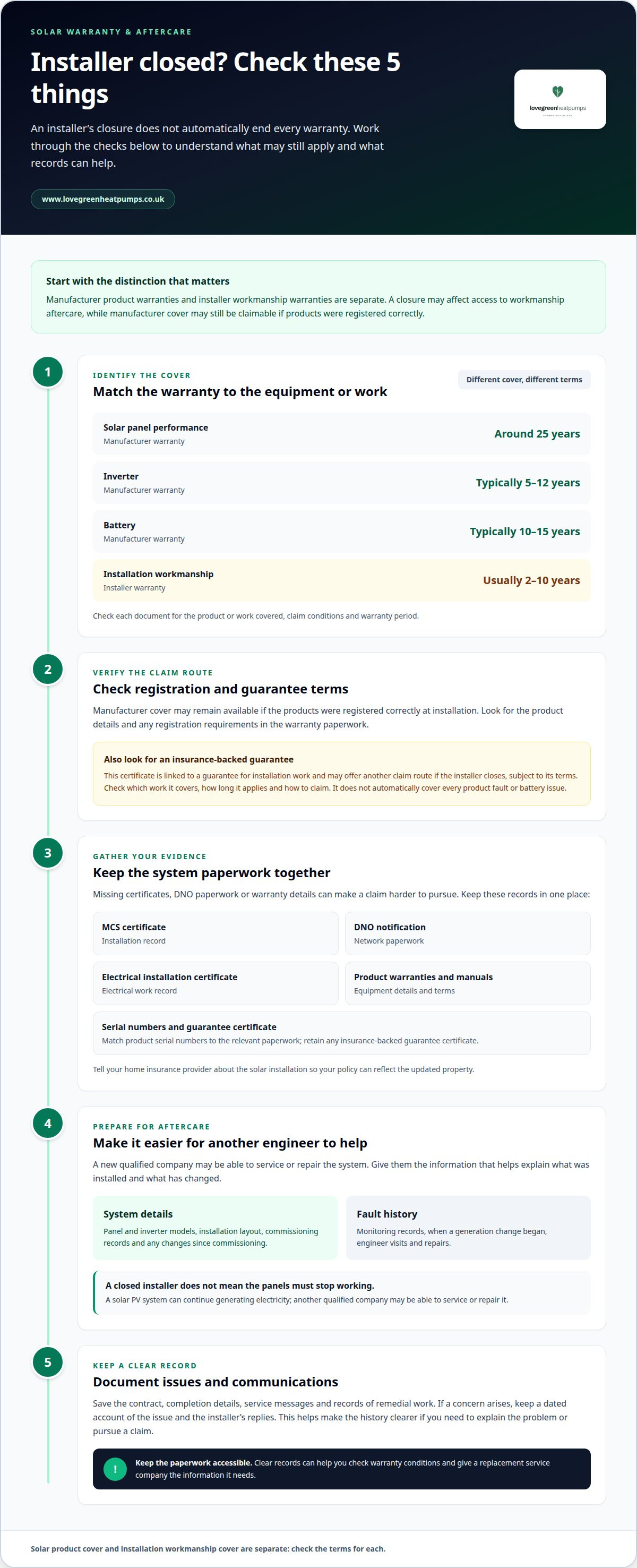
An installer going bust doesn’t automatically end every solar warranty. The risk of a solar panel installer going bust matters most for workmanship cover and aftercare, because the installer may no longer be available to put faults right. Manufacturer warranties are separate and may still be claimed if the products were registered correctly. Panel performance warranties typically run for around 25 years, while installer workmanship warranties are usually 2-10 years.
It’s understandable to worry that your panels may stop working or that promises in the paperwork will no longer be honoured. In many cases, a solar PV system can continue generating electricity, and another qualified company may be able to service or repair it. This article explains which warranties may still apply, what documents can support a claim, how to arrange aftercare, and what to check in a written contract. Clear records are especially useful if the original installer closes.
Key Takeaways
- An installer’s closure doesn’t automatically end manufacturer cover; identify which warranty applies to the panel, inverter, battery or installation work.
- Keep the certificates, product details and warranty documents together, as missing paperwork can make a claim harder to pursue.
- A solar system can continue generating electricity after its installer closes, and another qualified company can service or repair it.
- According to UK Parliament, the Consumer Rights Act 2015 requires services to be carried out with reasonable care and skill, in a reasonable time, and for a reasonable price.
- A written quotation can clarify what installation work, warranties, certificates and aftercare arrangements are included.
Can I still claim warranty on my solar panels?
Often, yes. A manufacturer’s product warranty is separate from the installer’s workmanship warranty, so the installer’s closure may affect each differently.
Company experience, qualifications and insurance
An installer’s experience, relevant qualifications and insurance can help you understand how it approaches solar work and what protection may apply. Product faults and installation faults can fall under different warranties, so check both. Before signing, review the installer’s experience, qualifications, insurance and customer reviews. Check whether it is MCS-certified and belongs to a consumer code such as RECC or HIES. These checks help you assess the business as well as the equipment.
Insurance-backed guarantees
An insurance-backed guarantee is a certificate linked to a guarantee for installation work. If the installer closes, it may offer another route to make a claim, subject to its terms. Keep the certificate with your contract and workmanship warranty. Check which work it covers, how long it applies and how to claim. The wording matters: an insurance-backed guarantee does not automatically cover every product fault or battery issue.
Checking financial health and complaints history
Company records and complaint information can help you assess an installer before signing. Search the company’s legal name on Companies House and review its filed accounts and current status. For complaints history, read customer reviews and check whether the installer belongs to a consumer code, such as RECC or HIES. MCS-certified installers must belong to a consumer code. These checks provide useful context, but do not replace reviewing the contract and warranty documents.
Panel product warranties typically cover performance for around 25 years. Inverter manufacturer warranties typically cover 5-12 years, while battery warranties typically cover 10-15 years. These are separate from workmanship cover, which is usually 2-10 years. Check each document for the covered product, claim conditions and registration requirements. Manufacturer warranties may remain available if the products were registered correctly at installation.
Keep the MCS certificate, DNO notification, electrical installation certificate, product warranties and manuals together. Match product serial numbers to the relevant paperwork, and retain any insurance-backed guarantee certificate. Missing certificates, DNO paperwork or warranty details can make a claim harder to pursue. Tell your home insurance provider about the solar installation so your policy can reflect the updated property.
Installer reliability and aftercare
Reliable aftercare means knowing who handles faults after commissioning and how to report them. For homeowners, this matters because the installer may be the first contact for workmanship problems. If it closes, a clear service process and complete installation records can help another qualified company understand the system.
Before signing, ask what happens if the system develops a fault after installation. A useful answer explains how to report the issue, what information to provide and who assesses whether it concerns equipment or workmanship. Ask whether the installer has a service team and provides ongoing support. These details distinguish aftercare from a warranty document alone.
Check the installer’s consumer-code membership as well as its installation credentials. MCS-certified installers must belong to a consumer code. From January 2026, complaints about Renewable Energy Consumer Code member installers are handled by Green Homes Dispute Resolution. This free, independent service investigates complaints about renewable energy systems and EV chargepoints. It can make decisions and set deadlines for businesses to put things right when it finds against them.
According to UK Parliament, the Consumer Rights Act 2015 requires services to be carried out with reasonable care and skill, in a reasonable time, and for a reasonable price. This gives homeowners a standard for assessing the installation service, separate from a manufacturer’s promise about equipment. Keep records of the agreed work, completion details and communications. If a concern arises, a dated account of the issue and the installer’s replies can make the history clearer.
- Clarify the fault process: Find out how to report a drop in output or a suspected installation fault.
- Understand the handover: Ask what commissioning records and system details you receive.
- Keep a written trail: Save the contract, service messages and records of any remedial work.
- Know the complaint route: Record the installer’s consumer-code membership and the relevant complaints process.
Aftercare also depends on the system information available. A new engineer may need the panel and inverter models, installation layout and details of any changes since commissioning. A sudden change in generation is easier to investigate if you can provide monitoring records and say when it began. Keep these details with the handover documents, and record visits and repairs.
If you’re planning future work, consider aftercare arrangements in the written proposal alongside the installation details. Clear expectations make it easier to understand who to contact if something needs attention later.
Seeking legal advice when an installer becomes insolvent
Section 75 of the Consumer Credit Act can make a card provider jointly liable with a supplier for qualifying purchases over £100, subject to conditions on timing and payment method. Chargeback is separate from Section 75 and follows the card provider’s process, so keep payment records and the installation contract together.
Insolvency can leave different issues: unfinished work, a faulty installation, an unpaid refund or a warranty claim. Legal advice may be useful if the installer has stopped trading, the amount at stake is substantial or the documents appear to conflict. A solicitor experienced in consumer or insolvency disputes can assess the contract, payment route, correspondence and any insurance-backed guarantee.
Prepare a clear record before seeking advice. Gather the signed contract, written quotation, invoices, card or bank statements, emails, warranty documents and a timeline of events. Note when you paid a deposit, when installation was due and what work remained incomplete. Keep copies of messages showing your attempts to resolve the issue. This can help distinguish a claim about unfinished services from a separate product warranty claim.
Be clear about the practical outcome you are seeking: recovering a payment, addressing incomplete work or finding out whether a warranty still applies. The right route depends on the agreement and evidence. A manufacturer’s warranty concerns its product terms, while an installer’s workmanship promise concerns installation work. An insurance-backed guarantee has separate certificate and claim conditions, so include that paperwork in your file.
For Section 75, the purchase must qualify and the payment method and timing matter. The threshold is a purchase over £100. A deposit paid by card can be relevant even if the remaining balance was paid another way, but the legal conditions still apply. Keep the card statement and invoice showing what the payment covered. A bank transfer alone does not create a Section 75 card claim.
Legal advice can also clarify how to handle correspondence after an insolvency announcement. Keep communications factual, retain original records and seek advice before accepting a settlement that may waive other claims. If the installer belonged to a consumer code, keep its membership details and any complaint correspondence.
There is no single remedy for every failed installation. A solicitor can explain how the contract, payment evidence, product warranty and insolvency position fit together. That assessment can help you choose a proportionate next step instead of treating every issue as the same claim.
Written quotations and contract questions
A detailed written quotation gives you a record of the proposed solar installation. It should explain the equipment, system size, installation work, warranties and any additional costs. If the installer later closes, the quotation can help show what was agreed and what work remained outstanding. Keep it with the signed contract and any later amendments.
Read the equipment description carefully. A proposal might name the panels, inverter and battery, and explain how each fits the system. Clear product details help distinguish a component fault from a concern about the installation itself. The quotation should describe the work, rather than relying on a broad phrase such as “solar package”. Ask for unclear descriptions to be clarified in writing before agreeing.
Check how the contract describes warranties. Separate the manufacturer’s product cover from the installer’s workmanship cover, and identify any insurance-backed guarantee. The documents should explain which equipment or work each covers, how to start a claim and what records you need. A panel warranty and a workmanship promise may cover different problems, even on the same system.
- System scope: Which panels, inverter, batteries and mounting equipment are included?
- Installation work: What work is included, and what is excluded from the agreed scope?
- Paperwork: Which certificates, manuals and warranty documents will be provided at handover?
- Aftercare: Who receives fault reports, and what happens if the installer stops trading?
- Changes and payments: How will changes to the original proposal be recorded, and when are payments due?
Pay close attention to the payment terms. Make sure the contract links each payment to a clear stage or item of work. If the proposal changes, ask for a written record of the revised equipment, work and payment schedule. This gives you a consistent account of the agreement if a disagreement arises or the installer becomes insolvent.
Check that the legal business name on the contract matches the name on invoices and payment instructions. A trading name can differ from the registered company name, so the contract should clearly identify the business you are contracting with. Keep emails confirming agreed changes, such as a different inverter model or amended installation date. These records can help establish which version of the proposal applies.
Make handover documents part of the agreed process. Ask for the certificates and product paperwork listed in the quotation, along with instructions for monitoring the system. The handover should enable you to identify the installed equipment and locate its warranty terms. Clear written terms cannot prevent a company closure, but they make the agreed work and your next steps easier to establish.
What happens to solar panels when an installer closes
An installer’s closure doesn’t automatically stop a solar PV system generating electricity. The key questions are whether the equipment works, what paperwork you have and whether another qualified company can help.
Solar panels after installer closure
A solar array can continue producing electricity after its installer closes, provided the system is operational. The closure itself doesn’t switch off the panels or disconnect them from the home. A fault, damaged wiring or inverter problem may still need attention, but the former installer is no longer available to investigate it.
If the monitoring display shows that generation has stopped, note the message and when it appeared. Keep the inverter model and system records ready for an assessment. Don’t assume the panels themselves have failed; the issue may involve another part of the system.
Insolvency among UK solar installers
There isn’t a single useful figure showing how common installer insolvency is for London homeowners. Company records may relate to different legal businesses, and a trading name may not identify the registered company. A closure also doesn’t, by itself, tell you whether a particular system is faulty or its paperwork is still usable.
Focus on the installer’s legal name, your system documents and your current needs. An owner with a working system and complete handover records is in a different position from someone with unfinished work or missing certification. The risk of a solar panel installer going bust is best considered in light of these specific circumstances.
Repairs and certification after insolvency
If repairs or certification are needed after the installer has gone bust, gather the system paperwork and arrange an assessment by another qualified solar company. That company can service, repair or upgrade an existing system. Have the MCS certificate, DNO notification, electrical installation certificate, product details and warranty documents ready for review.
Missing records can make it harder to establish what was installed or how it was connected. Write down the issue, including any inverter warning or change in output, and share that account with the documents you have. A qualified professional can assess the system and identify any work or records needed.
Certification can matter beyond repairs. If you need a certificate for an export arrangement or other system administration, explain which document is missing and what paperwork you do have. A professional assessment can distinguish a missing record from an electrical or equipment fault. Replacement paperwork is not a substitute for checking the installation itself.
Keep a record of every later inspection or repair, including the work completed and equipment involved. If a battery or inverter is replaced, add its product information to the existing system file. This creates a clearer history for future maintenance, warranty enquiries and any change of ownership.
If you’re considering a new or replacement system, explore solar PV and renewable energy options for your property.
Love Green Heat Pumps: Solar PV & Other Renewables
Love Green Heat Pumps Ltd provides solar panel installation, with the process covering design through to commissioning. If you’re planning a new solar PV system or considering renewable energy for your property, a property-specific survey and clear quotation can help you understand the proposed work before deciding how to proceed.
If your existing installer has closed, Love Green Heat Pumps Ltd is most relevant when you’re considering a replacement or planning further solar work. Keep your system documents available so its equipment and installation history can inform the discussion. Love Green Heat Pumps Ltd provides a tailored quotation after understanding your property, with no pressure to decide before you understand your options.
For a calm next step, contact Love Green Heat Pumps Ltd to discuss your solar PV plans.
Plan your next energy decision with confidence
The risk of a solar panel installer going bust is one reason to think beyond the original installation. Your home’s energy needs may change, and future work should take the existing equipment into account. Treat the system as part of a wider household plan rather than assuming every change requires a fresh start.
Before making your next decision, consider what you want your home to do differently. You may be planning a new solar project or considering how renewable energy fits with other home improvements. A clear sense of your priorities can help shape a practical conversation about suitable next steps.
Love Green Heat Pumps Ltd offers Solar PV & Other Renewables, Heat Pump Installation and Air Conditioning. If you’re ready to explore a solar project or discuss your plans, talk through your next steps with Love Green Heat Pumps Ltd.
Frequently Asked Questions
What Happens If Your Solar Installer Goes Bust?
Your solar panels don’t automatically stop working if the installer closes. The system can continue generating electricity, but you may need another qualified company for repairs or changes. If you’re concerned about the risk of a solar panel installer going bust, keep the handover paperwork and product details together. An inverter fault, for example, may need attention even when the panels remain intact. Check which warranty applies before arranging paid work.
Can I get a copy of my MCS certificate if the installer has closed?
Look for a copy in your installation paperwork or email records. Search for the handover pack, completion messages and documents saved by the person who arranged the installation. If you can’t find it, contact MCS with the installer’s business name, property address and installation details to ask what record or replacement evidence may be available. Keep the DNO notification and electrical installation certificate too, as they serve different purposes.
Does losing your installer affect a future property sale?
The installer’s closure doesn’t automatically prevent you from selling your property, but missing system records can make buyer enquiries harder to answer. Keep the MCS certificate, warranties, electrical paperwork and equipment details ready for your conveyancer. If a buyer asks about a fault or repair, provide the relevant report and explain what work was completed. Clear records help show what was installed and support a straightforward discussion about the system.
What happens to a UK solar installation if the installer goes bust before work is complete?
Unfinished work remains unfinished, and the equipment already supplied may not form a complete, working system. Keep the contract, payment records and messages showing what work was agreed and completed. Don’t assume another installer can simply continue from the same point: they’ll need to assess the existing equipment, wiring and installation. A written assessment can identify remaining work and any safety or certification issues.
What happens to solar panel warranties and workmanship guarantees if the installer closes?
Manufacturer warranties and installer workmanship guarantees are separate, so the installer’s closure doesn’t automatically cancel product cover. Check each document for its named provider, covered equipment, claim conditions and registration details. A panel’s performance warranty, for example, may be handled differently from a guarantee covering installation work. Keep serial numbers and proof of purchase available. If the installer issued a separate guarantee, its wording identifies who handles claims.
Can a homeowner claim under an installer’s insurance-backed guarantee after the company goes bust?
You may be able to claim if the certificate covers the problem and you meet its stated conditions. Find the insurance-backed guarantee certificate and check who administers it, what work it covers and how to submit a claim. A workmanship guarantee, for example, may not cover a failed inverter. Send the administrator the certificate and supporting installation records, and keep a copy of your claim and any replies.
Does the UK consumer have protection under the Consumer Rights Act if a solar installer becomes insolvent?
The Consumer Rights Act 2015 requires services to be carried out with reasonable care and skill, in a reasonable time, and for a reasonable price, according to UK Parliament. Insolvency can affect how a complaint or remedy is pursued, so retain evidence of the agreed work, payments and any faults. A written timeline can help explain what happened. For advice about a specific dispute, a solicitor can assess the contract and available evidence.
Can a homeowner recover a deposit or payment if a solar installer goes bust?
Recovery depends partly on how you paid and whether the transaction meets the relevant conditions. Section 75 of the Consumer Credit Act can make a card provider jointly liable with a supplier for qualifying purchases over £100, subject to conditions on timing and payment method. Keep invoices and card statements showing what the payment covered. Chargeback is a separate card-provider process. Contact your card provider promptly with the contract and payment evidence.
Disclaimer
Disclaimer
The information published on this website is provided by Love Green Heat Pumps for general information and educational purposes. As a specialist provider of heating and renewable energy solutions, we strive to ensure that our content is accurate, relevant and up to date. However, heating requirements, system suitability, installation specifications, costs and performance can vary depending on individual property characteristics, usage and other site-specific factors.
Information provided in our articles should not be regarded as a substitute for a professional property assessment, technical survey or tailored recommendation. Any decisions regarding the selection, installation, replacement or maintenance of heating systems should be made with appropriate professional guidance.
Love Green Heat Pumps accepts no responsibility for decisions made solely on the basis of general information published in these articles. For advice specific to your property or project, we encourage you to contact our team for professional guidance and an assessment of your requirements.


