

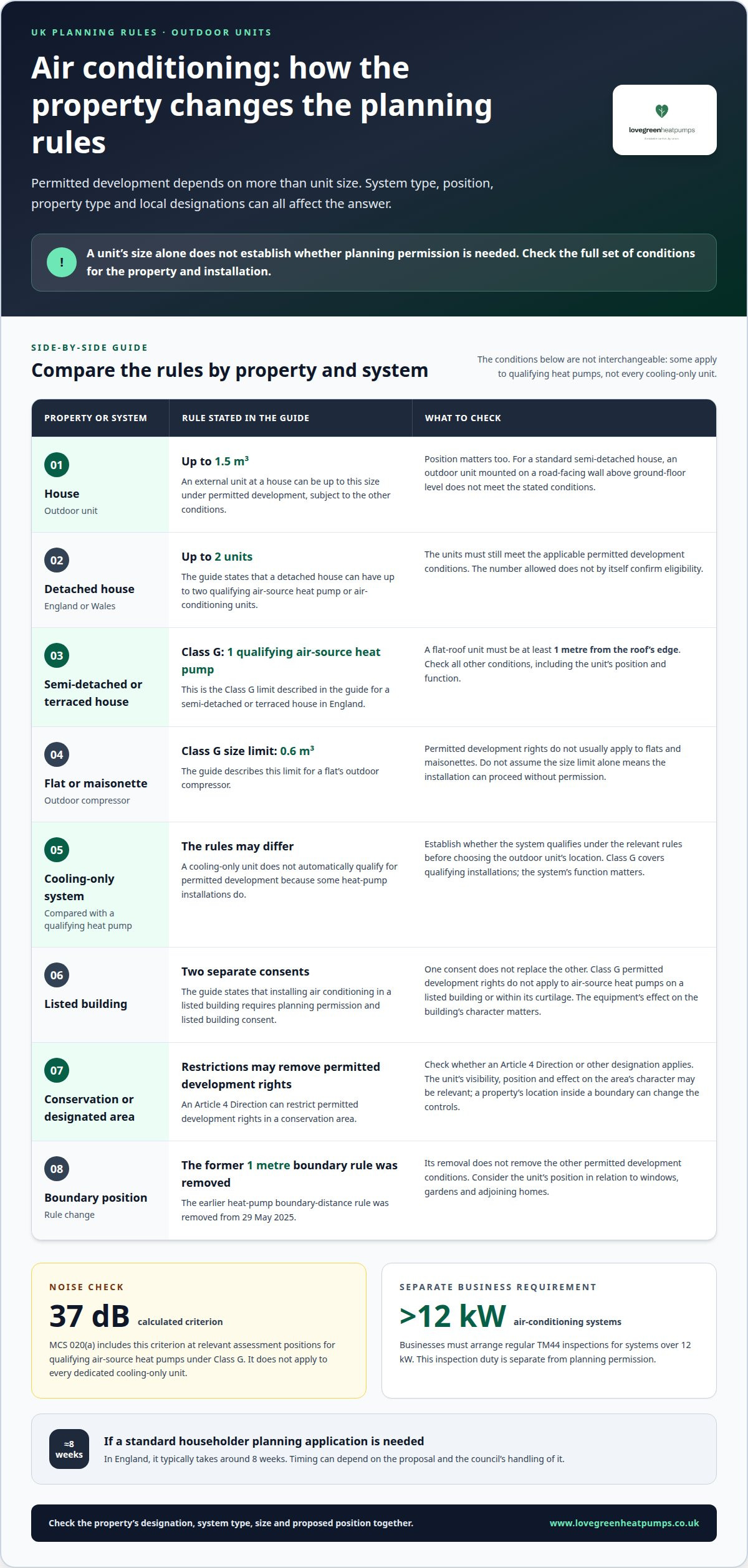
Not every home air-conditioning installation needs planning permission, but the outdoor unit’s size, position and property type matter. Under permitted development rules, an external unit at a house can be up to 1.5 m³, subject to other conditions. So planning permission for air conditioning in the UK isn’t decided by size alone.
Cooling-only air conditioning needs particular care: a unit does not automatically qualify for permitted development rights just because some heat-pump installations do. In England, Class G covers qualifying installations, while flats and listed buildings can face different consent requirements. Conservation area restrictions may also affect what you can install.
If you are considering a cooler home, establish the planning position before choosing where the outdoor unit will go. This guide explains when permission may be needed, how listed buildings and conservation areas affect the rules, and which other compliance checks matter. The distinction between a dedicated cooling unit and a qualifying heat pump can change the answer.
Key Takeaways
- Planning permission depends on the unit’s type, size, position and the property it serves, so a standard house and a flat may face different rules.
- In a conservation area, an Article 4 Direction can restrict permitted development rights and affect where outdoor equipment may be installed.
- Listed buildings have extra consent requirements. The location and effect of the equipment on the building’s character matter.
- Noise is part of compliance too. An acoustic assessment can help show how the outdoor unit may affect neighbouring properties.
- Cooling-only systems may not qualify under the same permitted development rules as qualifying heat pumps, so the distinction matters before installation.
Q1: Do all air conditioning units need planning permission?
Not always. In England, some external units can be installed under permitted development rights, but eligibility depends on the system and its position. The rules differ between houses and flats, and other planning conditions still apply.
Outdoor unit size and placement
Size and placement rules determine whether an outdoor unit can qualify as permitted development. For a house, the external unit can be up to 1.5 m³, subject to the other conditions. A detached house in England or Wales can have up to two qualifying air source heat pump or air-conditioning units, according to the UK Government.
Position matters as much as volume. For example, an outdoor unit mounted on a road-facing wall above ground-floor level does not meet the stated permitted development conditions for a standard semi-detached house. A flat-roof installation also has a specific placement rule: the unit must sit at least 1 metre from the roof’s edge.
Boundaries and neighbouring properties
Boundary position can affect which rules apply and how an installation affects a neighbour. The earlier 1 metre boundary-distance rule for heat pumps was removed from 29th May 2025, but that change does not remove the other permitted development conditions.
Consider the unit’s position in relation to windows, gardens and adjoining homes, as well as the building itself. Noise can matter too: the MCS 020(a) sound-calculation standard for qualifying air-source heat pumps under Class G includes a calculated 37 dB criterion at relevant assessment positions. That criterion relates to qualifying heat pumps, not every dedicated cooling-only unit.
Permitted development conditions
Permitted development depends on the equipment’s function, size, position and number, so one measurement cannot establish eligibility. In England, Class G permits one qualifying air-source heat pump at a semi-detached or terraced house. A flat’s outdoor compressor has a 0.6 m³ size limit under the described Class G rules, but permitted development rights do not usually apply to flats and maisonettes.
A standard householder planning application in England typically takes around 8 weeks. The exact timing can depend on the proposal and the council’s handling of it. Installing equipment before resolving whether permission is needed can create a lasting planning issue.
Business systems have a separate ongoing requirement: according to the UK Government, businesses must arrange regular TM44 inspections for air-conditioning systems over 12 kW. This inspection duty is distinct from planning permission, which concerns whether the proposed installation can proceed in that location.
Q5: Can I install air conditioning in a listed building or a conservation area?
Possibly. A property’s designation can change which consents are needed. The local planning authority considers the proposal against the protections that apply to the building or area.
Conservation area restrictions
A conservation area is a designated place where controls can protect the character of buildings and their surroundings. An Article 4 Direction can remove permitted development rights, meaning an installation that might otherwise proceed without planning permission may need an application.
Being in a conservation area does not, by itself, establish every requirement for every unit. The local planning authority’s controls, along with the equipment’s visibility and position, are relevant. For example, an outdoor unit on a prominent elevation may affect the area’s appearance differently from one positioned discreetly. Check the applicable restrictions and proposed location with the council before installing.
Where permitted development rights are severely curtailed in a designated area, planning permission is required for the proposal. This makes it important to establish whether an Article 4 Direction applies, rather than relying only on the property’s conservation-area boundary.
Protected and designated areas
Protected landscapes and other designated areas may have planning controls that affect external equipment. The key questions are whether the property is within a designation and whether permitted development rights remain available for the proposed work.
A boundary can matter: a home just inside a designated area may face different controls from a nearby property outside it. The local planning authority can identify the relevant designation and explain the restrictions that apply to the proposed installation. Describe the outdoor unit’s position and appearance clearly so the council can assess its effect in context.
In designated areas where permitted development rights are severely curtailed, planning permission is required. This is separate from listed building consent. If your property has more than one designation, consider each applicable control before work begins.
Listed building considerations
Installing air conditioning in a listed building requires both planning permission and listed building consent. These are separate consents, so obtaining one does not replace the other. In England, Class G permitted development rights do not apply to air-source heat pumps installed on a listed building or within its curtilage.
The equipment’s effect on the building’s character is central to planning the proposal. An external unit, pipework, fixings or changes to the building fabric may all affect how the installation is assessed. Make clear where the equipment would sit and how the system would connect to the building.
Before settling on a position, discuss the building’s listed status, the installation design and any conservation-area controls with the local planning authority. A carefully planned air-conditioning installation can then take account of the property’s designation and required consents.
Listed buildings and listed building consent
Air-conditioning work involves separate planning, building-control and property considerations. For listed buildings, flats and shared buildings, homeowners need to consider each before installation begins.
In England, installing air conditioning in a listed building requires both planning permission and listed building consent. These permissions serve different purposes, so one does not replace the other. Class G permitted development rights do not apply to air-source heat pumps installed on a listed building or within its curtilage. The usual route for qualifying heat pumps therefore cannot be relied on at these locations.
The proposed design should show where the external unit, pipework and internal equipment would sit. A discreet position may reduce visual prominence, but it does not remove the consent requirements. If the listed building is also in a conservation area, that designation may bring additional planning controls. Set out the equipment’s location and appearance clearly in the planning application so the local planning authority can assess the proposal against the building’s protected character.
Flats and shared buildings raise a separate issue. Permitted development rights do not usually apply to flats and maisonettes, so installations there usually require planning permission. In a block, the outdoor unit’s proposed position may also involve shared walls or parts of the building beyond an individual flat. Planning permission, listed building consent, building regulations approval and private property consent are separate matters in England. Treat each as its own requirement rather than assuming one approval covers the others.
Building regulations apply independently of planning permission. Part F covers ventilation performance, while Part L sets standards for conserving fuel and power in buildings. These requirements concern how the installation works within the building, not whether an outdoor unit is acceptable in planning terms. A proposed location may meet planning controls but still need to be assessed against ventilation and energy-efficiency requirements.
Electrical work has a separate building-regulations consideration. Part P standards apply to electrical work associated with an air-conditioning installation in the UK. This is distinct from listed building consent and planning permission, even when electrical connections form part of the same project. The design should account for electrical work alongside the unit’s position and the building’s ventilation needs.
For homeowners in a listed flat, several checks can overlap: listed building consent, planning permission, private property consent and building regulations may all be relevant. Identifying the property’s status and ownership arrangements early helps clarify which approvals apply before work affects the building fabric.
How Do You Ensure Compliance with Air Conditioning Regulations?
Compliance involves more than a planning application. Noise, the outdoor unit’s position and local planning records all need attention.
Submit the proposal to the local planning authority with clear details of the air-conditioning unit and its position. Application costs depend on the application and the applicable council fee category; the council’s process sets out the fee.
Neighbours and noise nuisance
A noise assessment considers how an outdoor unit may affect people nearby. Its position, operation and surroundings matter because sound reaching a neighbour’s home can affect everyday comfort.
BS 4142 is a standard referenced in assessments of noise from air-conditioning equipment. An acoustic assessment can help describe the expected sound and its effect at relevant locations, such as a neighbouring property. It can also inform the proposed position before an application is submitted.
Consider the unit’s position in relation to nearby rooms and outdoor spaces. For example, placing it close to a neighbour’s bedroom window may raise a different concern from positioning it away from shared boundaries. The assessment should reflect the actual installation, not the equipment in isolation.
Planning applications and costs
A planning application explains what will be installed and where. Include the property address, the outdoor unit’s proposed position and drawings showing how it relates to the building. Clear information helps the authority assess the specific proposal.
There is no single application cost for every air-conditioning proposal. The fee depends on the application type and the relevant council’s fee category. Allow for this distinction when planning the work, and use the council’s application process to establish the charge.
Supporting details can include the unit’s dimensions, appearance and noise information. If an acoustic assessment is relevant, include it with the application so the authority can consider the equipment’s likely effect alongside its position.
Checking local planning rules
Local planning rules set the requirements for a particular property and proposal. Search the local planning authority’s records using the property address, then read any decision notice and approved plans for earlier applications.
A previous application helps explain the site only if its records relate to the property and installation being considered. Compare the approved drawings with the current proposal, including the outdoor unit’s position and design. Permission for a different location or arrangement does not cover the new proposal.
If the records leave a practical question, contact the relevant council with the property address and proposed details. This can clarify whether planning permission is needed and what supporting information the authority expects for that location.
Cooling-only air conditioning and planning permission
A dedicated cooling-only air-conditioning unit should not automatically be treated as permitted development. The rules distinguish qualifying installations from outdoor equipment installed solely for cooling, so the system’s function matters alongside its size and position. To understand the rules for planning permission for air conditioning in the UK, start by identifying what the proposed system actually does.
In England, Class G of the Town and Country Planning (General Permitted Development) (England) Order 2015 provides permitted development rights for qualifying air-conditioning installations. Those rights apply only when the relevant conditions are met. Since 29th May 2025, combined air-conditioning and air-source heat-pump units can be installed under permitted development in England and Wales, subject to applicable limits.
This distinction matters because an air-to-air heat pump can both heat and cool a home, while a dedicated air-conditioning unit provides cooling. A system’s ability to cool does not, by itself, mean it qualifies under Class G. Before deciding on an installation, identify whether the proposed outdoor equipment is a qualifying heat pump or a cooling-only unit. This helps determine which permitted development rights may apply and whether planning permission for air conditioning in the UK is needed.
For a cooling-only unit, consider the property and proposed position as well as the system type. Flats and maisonettes usually do not have permitted development rights, and listed buildings have separate consent requirements. In England, Class G does not apply to air-source heat pumps installed on a listed building or within its curtilage. Where both are required, planning permission and listed building consent are distinct approvals.
Installing a dedicated outdoor air-conditioning unit without planning permission can leave a homeowner subject to enforcement for 10 years, according to The National Archives (legislation.gov.uk). Establish the planning position before installation, rather than treating permission as an issue to resolve afterwards. The local council can explain the relevant process for the property and proposed equipment.
A practical assessment starts with three details: whether the system only cools or also heats, where the outdoor unit will sit, and whether the property’s designation or type affects permitted development rights. The council’s decision depends on the proposal and applicable conditions, not simply the equipment’s label. Keeping these details clear supports a compliant installation.
If you’re planning a cooling-only system, discuss your air-conditioning installation before settling on the equipment and outdoor-unit position.
Love Green Heat Pumps: Air Conditioning
Love Green Heat Pumps Ltd installs air conditioning for homes where comfort and planning compliance both matter. If you are considering a cooling-only system or need to plan an outdoor unit’s position, the installation design can account for your property’s requirements.
Love Green Heat Pumps Ltd manages heat-pump installations from design through commissioning. If heating and cooling are both priorities, an air-to-air heat pump may also be worth considering.
If you’re ready to discuss air conditioning for your home, contact Love Green Heat Pumps Ltd.
Plan your next step with confidence
Bring the practical and planning questions together before choosing equipment. The unit’s intended function, proposed position and your property’s character all shape the right design. Start by describing how you want the space to feel and identifying any features that may affect where outdoor equipment can go. This gives the project direction before installation decisions are made.
Planning permission for air conditioning in the UK is one part of a wider home-comfort decision. Love Green Heat Pumps Ltd offers air conditioning, heat pump installation and Solar PV & Other Renewables. If you’re ready to discuss your plans, contact Love Green Heat Pumps Ltd. A straightforward conversation can help you move towards a more comfortable home with a clearer plan.
Frequently Asked Questions
Q3: Do I need Building Regulations approval for an AC installation?
Building Regulations apply separately from planning permission, but whether formal approval is needed depends on the work. An installation must meet relevant requirements, including Part F for ventilation and Part P for associated electrical work. Part L covers conserving fuel and power in buildings. Adding a new electrical circuit, for example, may raise different considerations from positioning an outdoor unit. Treat planning consent and building-control compliance as separate checks.
At a glance: Does your property need planning permission?
It depends on the property and proposed installation. A house may qualify for permitted development if the equipment meets the relevant conditions. Flats and maisonettes usually do not have those rights, while listed buildings and some designated areas face additional controls. A house outside a conservation area and a flat in a listed block may need different planning routes, even for similar equipment.
How close to a neighbour's boundary can an outdoor unit go?
There is no single boundary distance that answers every planning question. The previous 1 metre boundary-distance rule for heat pumps was removed from 29th May 2025, but other conditions still apply. The unit’s position, type and effect on neighbouring homes remain relevant. For example, placing equipment beside a neighbour’s quiet outdoor seating area may raise practical noise concerns, even if a specific boundary distance is not prescribed.
How do London boroughs treat air conditioning applications?
London boroughs assess proposals through the local planning authority responsible for the property. The outcome depends on the address, equipment and applicable planning controls, not a single rule for all of London. A home in Camden, for instance, may have different site constraints from one in Bromley. Identify the borough and provide the proposed unit’s position and appearance when discussing an application.
How loud is an air conditioning unit allowed to be?
There is no single noise figure in the available rules that applies to every air-conditioning unit. Noise assessments consider the equipment and relevant assessment positions. For qualifying air-source heat pumps under Class G, the MCS 020(a) sound-calculation standard includes a calculated 37 dB criterion at relevant assessment positions. That figure is not a universal allowance for every cooling-only unit or every site.
Q2: What happens if I install air conditioning without permission when it was required?
You may face planning enforcement if the installation needed permission and proceeded without it. According to The National Archives (legislation.gov.uk), installing an outdoor dedicated air-conditioning unit without planning permission can leave a homeowner subject to enforcement for 10 years. The practical position depends on the installation and applicable planning controls. If work has already started, contact the local planning authority promptly to discuss the property and proposal.
Do you need planning permission for air conditioning in England, Scotland, Wales and Northern Ireland?
Do not assume that one permitted development rule applies across all four nations. The cited Class G rights relate to England, while the stated change allowing combined air-conditioning and air-source heat-pump units under permitted development from 29th May 2025 covers England and Wales. For Scotland and Northern Ireland, the rules need to be considered under their own planning systems. Check the relevant local authority for the property.
Do air conditioning units need planning permission on flats or leasehold properties?
Flats and maisonettes usually do not benefit from permitted development rights, so planning permission is usually needed for an installation. Leasehold ownership also makes private property consent a separate consideration. Fixing pipework or an outdoor unit to a shared wall, for example, may affect parts of the building outside your flat. Check the lease and building arrangements alongside the planning position before work begins.
Disclaimer
Disclaimer
The information published on this website is provided by Love Green Heat Pumps for general information and educational purposes. As a specialist provider of heating and renewable energy solutions, we strive to ensure that our content is accurate, relevant and up to date. However, heating requirements, system suitability, installation specifications, costs and performance can vary depending on individual property characteristics, usage and other site-specific factors.
Information provided in our articles should not be regarded as a substitute for a professional property assessment, technical survey or tailored recommendation. Any decisions regarding the selection, installation, replacement or maintenance of heating systems should be made with appropriate professional guidance.
Love Green Heat Pumps accepts no responsibility for decisions made solely on the basis of general information published in these articles. For advice specific to your property or project, we encourage you to contact our team for professional guidance and an assessment of your requirements.


