

A dependable heating system doesn't rely on oversized machinery; it succeeds through precise, room-by-room engineering. If you're researching a heat pump installation UK advice can quickly feel conflicting and confusing. You're likely wondering whether low-temperature heating can genuinely handle a freezing British winter, or worrying that making the switch requires ripping up floorboards to replace every radiator and pipe in the house.
That caution is completely natural. Upgrading your home's heating is a practical domestic decision, and you deserve straight, unhurried answers rather than aggressive sales talk. In this guide, you'll discover how a modern heat pump installation works in UK homes, from initial survey to lifetime efficiency. We'll walk you through the complete turnkey process from start to finish, helping you determine your home's true suitability and giving you the confidence to arrange an accurate professional survey.
Key Takeaways
- Learn how steady, low-temperature water circulation provides dependable comfort throughout freezing British weather without the sharp temperature spikes of traditional boilers.
- Follow the five stages of a turnkey heat pump installation UK homeowners navigate, showing why accurate room-by-room heat loss calculations must come before ordering hardware.
- Discover why many existing radiators and pipework runs can remain in place, avoiding unnecessary domestic disruption when transitioning your property.
- Find out how government grant schemes work in practice and why working with accredited heating engineers protects your home investment.
- Equip yourself with practical questions for prospective installers so you can easily distinguish between thorough trade surveys and rushed desktop sales estimates.
Understanding Heat Pump Installation in Modern UK Properties
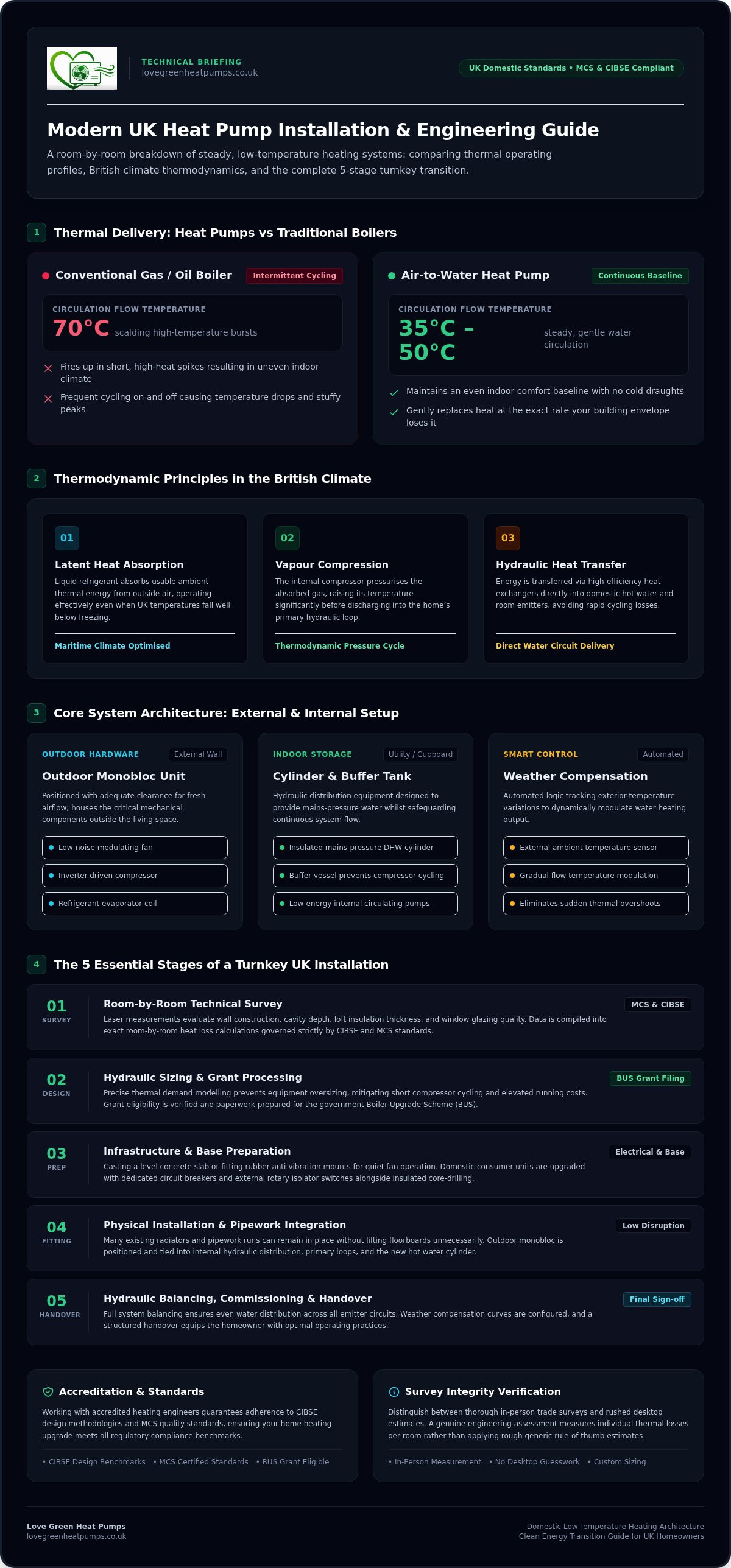
An air-to-water heat pump serves as the central heating and hot water engine for your property. Unlike conventional gas or oil boilers that fire up in short, scalding bursts at 70°C, a domestic heat pump circulates water at a steady, lower temperature, usually between 35°C and 50°C. This continuous, low-temperature distribution creates an even indoor climate without cold draughts or stuffy spikes. For anyone planning a heat pump installation UK homes benefit most when the system is set to maintain a constant, comfortable baseline rather than cycling on and off throughout the day.
How Air Source Technology Suits the British Climate
British winters are famously damp and chilly, yet these conditions provide plenty of usable thermal energy. Heat pump technology relies on a thermodynamic vapour compression cycle, using liquid refrigerant to absorb latent heat from outside air even when ambient temperatures fall well below freezing. The compressor pressurises this gas, raising its temperature significantly before transferring the heat directly into your home's water circuit. Because maritime British winters rarely drop to sustained sub-zero extremes, an air source unit operates within its ideal performance range across autumn and winter. It behaves as a steady heating partner, gently replacing heat as quickly as your building envelope loses it.
Core System Components Inside and Outside Your Home
A standard setup divides the heating process between external heat collection and internal hydraulic distribution. Understanding this layout keeps the project clear and manageable:
- The outdoor unit: Positioned on a firm base against an external wall, this cabinet houses the fan, compressor, and evaporator coil. It requires adequate clearance to draw in fresh air without obstruction.
- The indoor cylinder and buffer tank: A dedicated, well-insulated cylinder provides mains-pressure domestic hot water. An adjoining buffer vessel maintains sufficient system volume, preventing compressor short-cycling and protecting circulation.
- Controls and weather compensation: An external sensor tracks outdoor temperature changes, telling the digital controller to adjust radiator flow temperatures gradually.
Arranging the system this way keeps mechanical noise outdoors while tidy pipework, quiet pumps, and familiar water storage remain inside. When designed around your property's dimensions, a heat pump installation UK homeowners choose delivers reliable, domestic comfort for decades to come.
The 5 Essential Stages of a Turnkey UK Heat Pump Installation
A professional heating transition follows a structured, predictable roadmap. Dividing a heat pump installation UK project into manageable milestones removes the guesswork and keeps domestic disruption to an absolute minimum. Homeowners typically progress through five distinct phases: an initial room-by-room survey, hydraulic design, property preparation, physical installation, and final commissioning with a clear handover.
Room-by-Room Survey and Hydraulic Design
A dependable system begins with precision surveying rather than rough guesswork. A qualified heating engineer inspects your property with a laser measure, evaluating wall construction, cavity depth, loft insulation thickness, and window glazing quality. These measurements feed directly into room-by-room heat loss calculations governed by CIBSE and MCS standards. Accurate heat loss modelling identifies the precise thermal demand of every individual space. This fundamental design step prevents troublesome equipment oversizing, which otherwise leads to short compressor cycles and higher running costs. During this design review, your engineer also verifies eligibility and prepares the paperwork for the government-backed Boiler Upgrade Scheme (BUS) grant.
Property Preparation, Pipework, and Electrical Infrastructure
Before new equipment arrives, engineers prepare your property infrastructure so the physical changeover runs smoothly:
- Outdoor mounting: Setting a level concrete slab or heavy-duty rubber anti-vibration mounts to ensure stable, whisper-quiet fan operation.
- Electrical supply: Checking the domestic consumer unit to install a dedicated circuit breaker and external rotary isolator switch.
- Pipework routing: Core-drilling external walls to route heavily insulated primary pipework neatly into your utility space or airing cupboard.
Physical Fitting, Hydraulic Balancing, and Commissioning
The physical installation starts with the safe decommissioning and recycling of your legacy boiler and redundant hot water tanks. Technicians perform an intensive chemical flush on your existing pipework to clear lingering sludge, installing magnetic system filters to protect new internal valves. Once the heat pump, buffer cylinder, and hot water tank are plumbed into place, engineers balance the water flow across every radiator so each room warms at an even rate. Finally, the engineer commissions the weather compensation controls and walks you through the digital thermostat. If you want straight answers about what your property needs, booking an unhurried turnkey heat pump survey gives you an honest, trade-backed foundation.
Evaluating Property Suitability: Radiators, Pipework, and Insulation
Many homeowners worry their property is simply too old or draughty for modern heating. The reality is that British homes from almost any era can run an air-to-water system effectively, provided the heat distribution network matches the building's thermal envelope. Whether you live in a 1930s semi-detached house or a stone-built Victorian terrace, a successful heat pump installation UK depends on practical balance between heat emitter size, water flow rates, and sensible heat retention.
Assessing Existing Heat Emitters and Surface Areas
Lower water circulating temperatures require greater surface area to transfer warmth into a room. You do not always need to tear out existing radiators, however. Many British homes already have oversized single-convector radiators installed during boiler replacements. In rooms where thermal demand outstrips output, switching a single-panel unit to a double-panel, double-convector (Type 22) radiator delivers roughly double the heat emission within the exact same wall footprint. Ground-floor underfloor heating acts as an ideal companion, using broad surface area to heat living zones smoothly at low flow temperatures.
Pipework Diameter, Flow Rates, and System Resistance
Heat pumps shift thermal energy by circulating higher volumes of warm water rather than small amounts of scalding water. This demands manageable hydraulic resistance across your central heating circuit:
- 22mm and 15mm copper circuits: The backbone of most British properties, these pipe sizes handle standard flow rates comfortably without producing water noise or excessive pumping resistance.
- 8mm and 10mm microbore pipework: Narrow plastic or copper lines create higher resistance. A thorough survey checks overall circuit lengths; often, upgrading only the central distribution manifolds while retaining room drop-pipes maintains sufficient flow.
Fabric-First Efficiency Improvements That Maximise Comfort
You don't need a radical structural overhaul or deep retrofit to keep your home warm. Straightforward, inexpensive improvements often yield the biggest returns. Topping up loft insulation to a depth of 270mm, sealing chimney flues, and fitting high-grade draught-proofing around external doors instantly cuts your property's heat loss. Making these modest adjustments reduces overall thermal demand, which in turn allows an engineer to specify a smaller, quieter heat pump that runs efficiently under rigorous MCS certification standards. Sensible domestic preparation delivers steady seasonal comfort without unnecessary construction upheaval.
Standards, Accreditations, and Financial Grants in the UK
Navigating heating regulations and subsidy schemes shouldn't feel like a legal exam. For any heat pump installation UK standards exist to protect your household, verify thermal efficiency, and safeguard your deposit. Knowing which accreditations matter helps you separate trusted domestic engineers from unqualified sub-contractors.
Why MCS Certification and Quality Frameworks Matter
The Microgeneration Certification Scheme (MCS) sets the technical benchmark for British renewable energy systems. Certification confirms that both your heat pump hardware and the installer's hydraulic designs comply with rigorous building and electrical codes. Beyond ensuring system longevity, an MCS certificate provides formal proof of quality. Buyers' solicitors routinely request this certification during property transactions, protecting your home's future market value.
Navigating the Boiler Upgrade Scheme Without Hassle
Government subsidies make upgrading to low-temperature heating far more accessible, but you don't have to shoulder the administrative burden. Under the Boiler Upgrade Scheme, an accredited turnkey installer manages the entire voucher application on your behalf. The grant value is deducted directly from your final invoice rather than paid as a retrospective rebate, so you never have to chase paperwork or manage portal claims yourself.
HEIS Consumer Protection and Workmanship Warranties
Technical credentials verify engineering competence, but consumer protection standards safeguard your financial peace of mind. Working with an accredited heating specialist backed by the Home Energy and Insulation Scheme (HEIS) offers distinct legal protections:
- Deposit protection: Your initial deposit is fully insured from the moment of payment until work begins on site.
- Insurance-backed warranties: HEIS coverage guarantees your installer's workmanship warranty remains valid even in the unlikely event the business ceases trading.
- Independent dispute resolution: Access to free, binding mediation ensures domestic contracts are delivered to promised standards.
Upgrading your central heating should always feel dependable and transparent. If you're ready to explore an accredited system designed specifically around your home, request your free heat pump quote with our friendly engineering team.
Selecting a Dependable Heat Pump Installer for Your Home
Choosing the right heating partner is just as critical as selecting the machinery itself. When organising a heat pump installation UK homeowners are often met with fast-talking sales representatives pitching online estimates without stepping foot through the front door. A desktop estimate cannot evaluate hidden pipe runs, sub-floor insulation, or existing radiator valve performance. Securing steady domestic comfort requires working with dedicated tradespeople who prioritise on-site engineering over automated sales quotas.
Key Questions Every Homeowner Should Ask Prospective Installers
You can quickly separate seasoned engineers from high-pressure brokers by asking direct, practical questions about their technical process:
- How do you calculate our heat loss? Ensure they conduct an in-person room-by-room survey rather than relying on rough square-metre approximations.
- What Seasonal Coefficient of Performance (SCOP) do you expect for this property? An honest tradesperson will provide a realistic seasonal efficiency rating based on your emitter sizes and target flow temperatures.
- Who handles system commissioning and aftercare? Check whether the company provides direct technical support and routine maintenance, or merely subcontracts the labour and walks away.
The Value of Dedicated Turnkey Engineering Support
Disjointed projects cause unnecessary domestic friction. When one company sells the hardware, an independent subcontractor fits the pipework, and an external third party signs off the electrics, accountability quickly evaporates if a radiator stays cold. Turnkey delivery removes that stress entirely. Having a single team handle your property survey, EPC assessment, hydraulic system design, physical installation, and final balancing ensures total engineering continuity from start to finish.
Love Green Heat Pumps Ltd operates as an unhurried, reassuring domestic engineering partner. Our HEIS-accredited heating engineers take complete responsibility for your installation, delivering plain-speaking advice, transparent workmanship, and dependable year-round warmth. We believe in doing the job right the first time, without corporate jargon or pushy tactics. When you are ready for clear, honest guidance tailored to your property, you can request your tailored heat pump proposal with complete confidence.
Take the Next Step Towards Dependable Home Heating
A successful transition to low-carbon heating doesn't demand disruptive building work or stressful compromises. With accurate room-by-room heat loss calculations, sensible radiator choices, and steady flow temperatures, modern systems deliver reliable comfort through every British cold snap. When planning a heat pump installation UK homeowners can leave the complex details behind, from grant paperwork to hydraulic balancing.
Love Green Heat Pumps makes upgrading straightforward through complete turnkey system design, equipment supply, and precision commissioning. As HEIS-accredited domestic heating specialists, our team provides honest trade advice backed by comprehensive consumer protection and insurance-backed workmanship guarantees. You get unhurried guidance and a heating setup built to last. When you are ready to see how low-temperature heating can transform your everyday comfort, book your free, no-obligation heat pump survey to get started with total confidence.
Frequently Asked Questions
Do heat pumps work effectively in older UK houses during freezing winters?
Yes, modern systems heat older properties reliably, even during sub-zero British weather. The secret lies in conducting an accurate room heat loss survey rather than guessing. When the unit is correctly sized to replace thermal loss as it occurs, it maintains a comfortable, steady indoor temperature day and night. Solid-wall and period homes throughout Britain stay warm throughout winter when paired with appropriately engineered heat emitters.
Will I need to replace all the existing radiators in my home?
You rarely need to replace every radiator across the property. Many existing radiators in UK homes were oversized when traditional boilers were fitted, meaning they already possess sufficient surface area for lower water flow temperatures. During your survey, an engineer assesses each room individually. Usually, only a few select radiators in high heat loss rooms need swapping to double-panel models to ensure balanced, room-by-room comfort.
How disruptive is the domestic heat pump installation process?
Domestic disruption is far lower than most homeowners expect during a turnkey heat pump installation uk project. The major outdoor base preparation, core drilling, and internal electrical work are completed while your current heating remains active. Legacy boilers are decommissioned near the end of the schedule, meaning you typically spend only a single day or two without central heating or hot water before the new system is fully commissioned.
How loud is an outdoor heat pump unit during normal daily operation?
Outdoor heat pump units are remarkably quiet, typically producing between 40 and 50 decibels at a distance of one metre. This sound level is comparable to a quiet domestic refrigerator or gentle background rain. Compliant installations adhere strictly to MCS noise standards. When mounted on anti-vibration rubber feet and positioned away from bedroom windows, you'll rarely notice the unit running from inside your home.
How does an air source heat pump provide domestic hot water?
An air-to-water heat pump warms domestic hot water by diverting heated refrigerant energy into an insulated, pre-plumbed water cylinder. Inside the cylinder, a large-surface heat exchanger coil transfers thermal energy directly to your mains water. The system stores ample hot water for multiple bathrooms at mains pressure. An internal electric immersion element periodically raises the temperature past 60°C to maintain clean, hygienic domestic supply.
Do I need formal planning permission to install a heat pump in the UK?
In most instances across England, an air source unit falls under Permitted Development rights, removing the need for a full planning application. The installation must simply comply with size limits, keeping the unit under 1.5 cubic metres, and pass MCS acoustic criteria. Listed properties, conservation areas, or flats may have specific local planning restrictions, which an accredited installer checks before proceeding with any site work.
Who handles the Boiler Upgrade Scheme grant application process?
Your certified installer manages the entire Boiler Upgrade Scheme process on your behalf. Homeowners don't have to submit paperwork or navigate government portals. When scheduling a heat pump installation uk heating engineers confirm property eligibility, submit the voucher request to Ofgem, and deduct the full grant amount directly from your initial quote. You simply sign a straightforward consent declaration to authorise the claim.