

A heat pump does not actually create heat. Instead, it captures ambient warmth already present in the outside air and transfers it indoors. If you have ever wondered how do heat pumps work when the lawn is covered in frost, you are certainly not alone. It can feel counterintuitive to trust an external fan unit to keep a British home warm through a freezing January, especially if you have concerns about oversized radiators, disruptive pipework, or rising electricity bills.
The good news is that the underlying engineering is far simpler than thermodynamics textbooks suggest. In this guide, you will discover the straightforward mechanics behind domestic heat pumps, see how vapour compression delivers dependable warmth in sub-zero weather, and learn the practical steps to assess your home's radiators and insulation.
Here is an unvarnished, trade-level look at how the technology functions, giving you the clear facts you need to make a sensible decision for your household.
Key Takeaways
- Discover the simple engineering behind how do heat pumps work, capturing ambient outdoor warmth rather than burning fossil fuels to heat your home.
- Follow the four-stage vapour compression cycle step by step to see how specialised refrigerants produce domestic heat even during freezing weather.
- Compare the practical installation demands and spatial requirements of air-to-water, ground source, and air-to-air systems.
- Learn how efficiency ratings like COP and Seasonal Performance Factor translate into steady, reliable performance across a British winter.
- Find out why a professional room-by-room heat loss survey is the essential first step for evaluating radiators, pipework, and insulation.
What Is a Heat Pump and How Does It Warm Your Home?
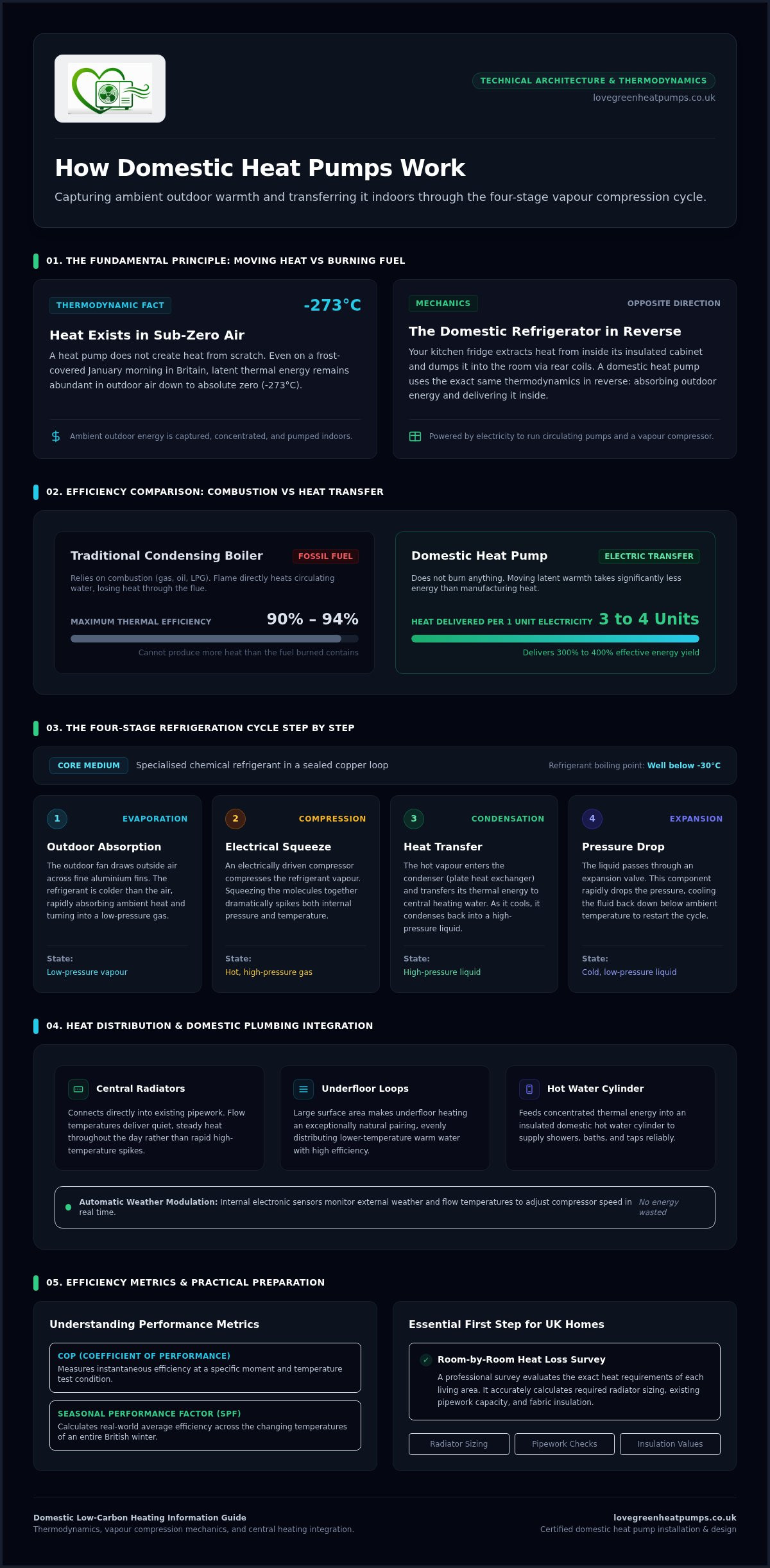
At its core, a domestic heat pump is an electrically powered device that moves existing thermal energy from the outside environment into your living space. Rather than creating warmth from scratch, it gathers low-grade heat from the outdoor air or ground, compresses it to a higher temperature, and transfers it to your central heating pipework and hot water cylinder. In a standard British home, an outdoor fan unit connects directly to your existing plumbing, feeding warm water into radiators, underfloor heating loops, and an insulated hot water cylinder.
The Refrigerator in Reverse: The Basic Concept
To grasp how do heat pumps work, picture the domestic fridge sitting in your kitchen. A refrigerator continually extracts heat from the sealed food compartment and expels it into the room via the small radiator coils on the back. A heat pump relies on identical thermodynamic principles, simply operating in the opposite direction. It pulls latent thermal energy from outdoor air, concentrates that heat using electrical compression, and pushes it indoors. Even when the morning air feels bitingly cold, plenty of ambient energy remains in the atmosphere; scientifically speaking, heat exists in the air right down to absolute zero (-273°C).
Heat Pumps vs Traditional Boilers: Moving Heat vs Burning Fuel
The difference between a heat pump and a traditional boiler comes down to physics. Standard gas, oil, or LPG boilers rely entirely on combustion. They ignite fossil fuel inside a burner box to produce a flame, transferring that heat directly into circulating water. Because a boiler must burn fuel to generate energy, it can never produce more heat than the fuel contains. In practice, even a high-performing modern condensing boiler tops out around 90% to 94% efficiency, losing the rest through the flue.
A heat pump does not burn anything. Electricity powers an internal compressor and circulating pumps, moving heat rather than manufacturing it. This allows a properly designed heat pump to deliver three to four units of usable heat for every single unit of electricity it consumes. Learning how do heat pumps work clarifies why they are so effective: transporting ambient warmth through a sealed refrigeration loop takes substantially less energy than setting fire to fossil fuels.
The Four-Stage Refrigeration Cycle Step by Step
To demystify how do heat pumps work, you only need to look at what happens inside the sealed copper pipework. The system relies on a continuous closed-loop cycle driven by a specialised chemical refrigerant. This liquid has an exceptionally low boiling point, often dropping well below -30°C. By manipulating internal pressure, the system forces this fluid to change back and forth between liquid and gas, quietly absorbing and releasing thermal energy along the way.
Stage 1 and 2: Evaporation and Compression
The cycle begins at the outdoor evaporator coil. An external fan pulls outdoor air across fine aluminium fins. Because the circulating refrigerant is colder than the outside air, it immediately absorbs ambient heat and evaporates into a low-pressure gas. Next, an electrically driven compressor pulls this gas in and squeezes the molecules together. Compressing the gas increases its pressure and causes its temperature to spike dramatically, creating a hot, high-pressure vapour ready to heat your home.
Stage 3 and 4: Condensation and Expansion
That hot refrigerant vapour then enters the condenser, typically a plate heat exchanger. Here, the refrigerant transfers its concentrated heat directly into the circulating water of your central heating system, warming the flow for your radiators or underfloor loops. As the refrigerant gives up its thermal energy, it condenses back into a high-pressure liquid. Finally, it passes through an expansion valve. This component rapidly drops the pressure, cooling the liquid back down so it can return to the evaporator and repeat the entire loop.
Internal electronic sensors constantly monitor flow temperatures and outdoor weather, automatically modulating compressor speed to match your home's exact heating demands without wasting power. Understanding these mechanics helps explain why independent guides to heat pumps for UK homes highlight their quiet, steady reliability. If you want to see how this engineering fits your current layout, you can explore professional design options through a certified heat pump installation survey.
Main Types of Domestic Heat Pumps Compared
While the thermodynamic principles stay the same across every system, the practical hardware varies depending on how heat is sourced and distributed. Exploring how do heat pumps work across different domestic formats comes down to two factors: where they gather energy and what they feed inside. For British homes, systems fall into three primary categories, each with distinct installation footprints.
Air Source Heat Pumps: Air-to-Water vs Air-to-Air
Air-to-water units represent the standard choice for residential replacements across the UK. These external monobloc or split units extract warmth from the outside air and circulate hot water into existing radiators, underfloor heating loops, and an unvented hot water cylinder. They integrate directly with traditional wet central heating pipework.
Air-to-air systems use a similar external collector, but they heat indoor air directly via internal wall-mounted blower units rather than warming circulating water. They provide rapid warm air in winter alongside active cooling during summer heatwaves, but they do not produce domestic hot water for taps and showers.
Ground Source Heat Pumps: Trenches and Boreholes
Ground source systems gather solar energy naturally stored beneath your garden soil, using buried collector loops filled with a water and glycol brine mixture. The underlying engineering relies on how the refrigeration cycle works to boost low ground warmth into usable room heat. Homeowners typically choose between two collector designs:
- Horizontal ground arrays: Coiled pipework (slinkies) laid out in shallow trenches roughly one to two metres deep, requiring substantial garden surface area.
- Vertical boreholes: Deep holes drilled between 50 and 150 metres down, ideal for compact gardens where surface area is restricted.
Sub-surface soil temperatures stay between 8°C and 12°C all year round, giving ground source systems remarkable seasonal stability regardless of freezing surface weather.
Hybrid Heat Pump Systems
A hybrid configuration pairs a compact air-to-water heat pump with a conventional gas or LPG boiler. An intelligent control unit calculates the most efficient option in real time based on outdoor temperatures and fuel tariffs. The heat pump delivers baseline heating throughout mild autumn and spring days, while the boiler fires up automatically during deep winter cold snaps or peak hot water demand. This dual-fuel arrangement offers an intermediate pathway for older properties where homeowners plan to upgrade fabric insulation gradually over time.
Understanding Heat Pump Efficiency and British Winter Performance
Scepticism about British winters is common among homeowners considering a low-carbon upgrade. When outdoor temperatures plunge below freezing, people naturally wonder whether an external fan can genuinely keep their living room warm. The answer lies in how system efficiency is measured and managed under real-world conditions.
Decoding COP and Seasonal Efficiency (SCOP)
Heat pump performance is measured through the Coefficient of Performance (COP). A system running at a COP of 3.5 generates 3.5 kW of heat for every 1 kW of electricity it draws. In comparison, a well-maintained condensing boiler converts fuel at roughly 90% efficiency, delivering just 0.9 kW of heat per unit of energy consumed. Because outdoor conditions fluctuate constantly, engineers rely on the Seasonal Coefficient of Performance (SCOP). This metric averages efficiency across all four seasons, giving you an honest appraisal of annual running capability rather than a single mild-weather snapshot.
Operating in Sub-Zero British Temperatures
Understanding how do heat pumps work during a frosty cold snap comes down to refrigerant chemistry. Because domestic refrigerants boil at temperatures below -30°C, outdoor air at -3°C carries plenty of usable heat to vaporise the fluid. Modern units use variable-speed inverter compressors, which automatically ramp up to pull in extra ambient energy as outside temperatures tumble.
Cold, damp British weather can cause frost to gather across the outdoor coil. When this happens, the unit initiates an automated reverse defrost cycle. It temporarily diverts a fraction of heat back to the outdoor fins, melting away any ice accumulation in two or three minutes before resuming standard heating.
Low Flow Temperatures and Continuous Heating Behaviour
Unlike traditional gas boilers that blast scorching water at 65°C to 75°C in short bursts, heat pumps operate most efficiently with steady, low flow temperatures between 45°C and 50°C. They gently circulate warm water over longer periods, maintaining a stable indoor temperature without sudden chills or stuffy overheating.
An external weather compensation sensor continually monitors ambient conditions, subtly raising or lowering the water temperature before your rooms even register the weather shift. To discover how a tailored system can maintain dependable warmth in your property, book a domestic heating survey with our accredited team.
Is Your Home Heat Pump Ready? Survey and Practical Steps
Moving from the mechanical theory of how do heat pumps work to preparing your own property requires a sensible look at your existing plumbing and insulation. Modern heat pumps can heat almost any British home comfortably, but tailoring the system design to your building fabric is essential for reliable, quiet operation.
The Room-by-Room Heat Loss Survey
Traditional boiler installations often relied on crude guesswork, frequently fitting an oversized 24 kW or 30 kW unit regardless of actual demand. Heat pumps require precise engineering. A professional installer conducts a room-by-room heat loss survey aligned with British heating standards. This survey inspects your external wall construction, loft insulation depth, window glazing, ceiling heights, and room orientations. Calculating exact heat loss room by room guarantees that your heat pump is sized accurately, preventing inefficient stop-start cycling and ensuring steady indoor comfort.
Checking Radiators, Pipework, and Cylinders
Because heat pumps deliver lower, steady water temperatures, your distribution network needs careful evaluation:
- Heat emitters: Standard radiators can often stay in place, but rooms with higher heat loss may require larger double-panel radiators or fan convectors to deliver adequate warmth. Underfloor heating is naturally ideal due to its expansive surface area.
- Pipework diameters: Heat pumps require higher water flow rates than boilers. Engineers inspect existing copper and microbore pipework to ensure water moves freely without causing flow restrictions or pump strain.
- Hot water cylinders: If you are removing a combi boiler, you will need a dedicated space, such as an airing cupboard, for an unvented hot water cylinder. These units feature an enlarged internal coil specifically engineered to transfer low-temperature heat rapidly.
Taking the Next Practical Step
Preparing your property begins with an objective technical survey rather than guesswork. Working with a turnkey specialist ensures every phase, from initial heat-loss calculations and pipe sizing to final HEIS-accredited commissioning, is handled under one roof. For maximum household independence, many homeowners also pair their heat pump installation with rooftop solar PV, using self-generated clean electricity to run the compressor throughout the year.
Making Modern Heat Pump Technology Work for Your Home
Demystifying how do heat pumps work strips away the uncertainty around low-carbon heating. You aren't burning fossil fuels to generate short bursts of high heat; you're simply transferring abundant environmental warmth through a proven, closed-loop refrigeration cycle. When engineered properly with steady flow temperatures, these systems deliver quiet, dependable comfort right through the dampest, coldest British winters.
Achieving dependable year-round performance comes down to sound engineering. Love Green Heat Pumps delivers HEIS-accredited turnkey installations nationally across the UK, handling the entire process under one roof. Our experienced heating specialists oversee every detail, from accurate room-by-room heat loss surveys and radiator sizing to full system commissioning and handover. If you're ready to enjoy reliable, efficient warmth tailored specifically to your property, request your free, no-obligation heat pump survey and quote today and take the next step with confident, trade-backed advice.
Frequently Asked Questions
Do heat pumps work effectively during freezing British winters?
Yes, domestic heat pumps operate reliably even when outside temperatures drop well below freezing. Modern units utilise low-boiling refrigerants that easily vaporise in sub-zero air, extracting usable thermal energy in weather as cold as -15°C or lower. Variable-speed compressors and automatic defrost cycles ensure consistent heat delivery during cold spells, keeping your home warm throughout the winter months without interruption.
Will I need to replace all the radiators in my house?
No, you rarely need to replace every radiator in your home. A professional room-by-room heat loss survey identifies exactly which emitters provide sufficient surface area for lower water flow temperatures. Often, many existing double-panel radiators can remain untouched. Installers typically only upgrade undersized single-panel radiators in larger, draughtier rooms to ensure adequate heat distribution across the property.
How is a heat pump different from a conventional combi boiler?
A combi boiler burns gas or oil intermittently to generate intense, high-temperature water on demand. In contrast, understanding how do heat pumps work reveals that they run steadily at lower temperatures, gently moving ambient environmental heat into your home using electricity. While combis produce hot water instantly inside the boiler casing, a heat pump requires a separate, well-insulated cylinder to store domestic hot water.
Can an air source heat pump provide domestic hot water as well as heating?
Yes, an air-to-water heat pump supplies all your domestic hot water as well as central heating. The system diverts heated water into a dedicated unvented cylinder featuring an enlarged internal coil, warming water for taps and showers up to 50°C to 55°C. Most systems also run a weekly, automated immersion cycle to boost stored water past 60°C for complete legionella protection.
Are domestic heat pumps noisy when running outside?
Modern air source heat pumps run very quietly, producing roughly 40 to 50 decibels of sound at a distance of one metre. That volume is comparable to a quiet domestic refrigerator or a gentle conversation. Sound-dampening fan blades, insulated compressor casings, and anti-vibration mounting feet keep noise levels low, easily satisfying British permitted development planning standards.
How long does a professionally installed heat pump typically last?
A professionally installed and commissioned heat pump typically lasts between 15 and 20 years. That lifespan exceeds the 10-to-15-year average of a standard condensing gas boiler. Because heat pumps run without combustion chambers, burner plates, or intense flame degradation, routine annual servicing of filters, refrigerant pressure, and electrical connections keeps the machinery running smoothly for decades.
Can I install a heat pump in an older or poorly insulated UK home?
Yes, older properties can successfully transition to heat pump technology with the right engineering design. While adding basic loft insulation and draught-proofing helps lower running costs, an older house simply requires an accurately sized unit and appropriate radiator dimensions. Seeing how do heat pumps work in practice shows that tailoring water flow rates to your specific building fabric guarantees reliable warmth in any era of housing.
