

A low quote is only useful if the installer can show the right credentials and explain the work clearly. In England, finding a trustworthy renewable energy installer starts with checking MCS membership and comparing quotes from at least three installers. For solar panels or a heat pump, those checks help you weigh the proposal as well as the price.
It’s sensible to want confidence before work begins. You should understand what the quote covers, how the system is designed for your property and who will carry out the installation. A proper survey and clear answers matter just as much as a polished presentation.
This guide explains how to check installer credentials, compare quotes and spot warning signs, then shows how to find local solar or heat pump specialists. You’ll have a practical way to assess your options and decide what to do next.
Key Takeaways
- Compare at least three installer quotes, looking beyond the total to the work included, payment terms and performance estimates.
- Check that the installer’s MCS accreditation covers the technology you’re considering, then verify its membership in the scheme’s records.
- Look for a proper site survey and advice based on your home, rather than rushed promises or claims of unrealistic savings.
- For eligible air-source and ground-source heat pumps, the Boiler Upgrade Scheme provides an upfront discount of £7,500, according to the Department for Energy Security and Net Zero.
- Check consumer code and electrical trade body memberships, and make sure the agreement and complaint route are clear before work begins.
Comparing quotes from certified installers
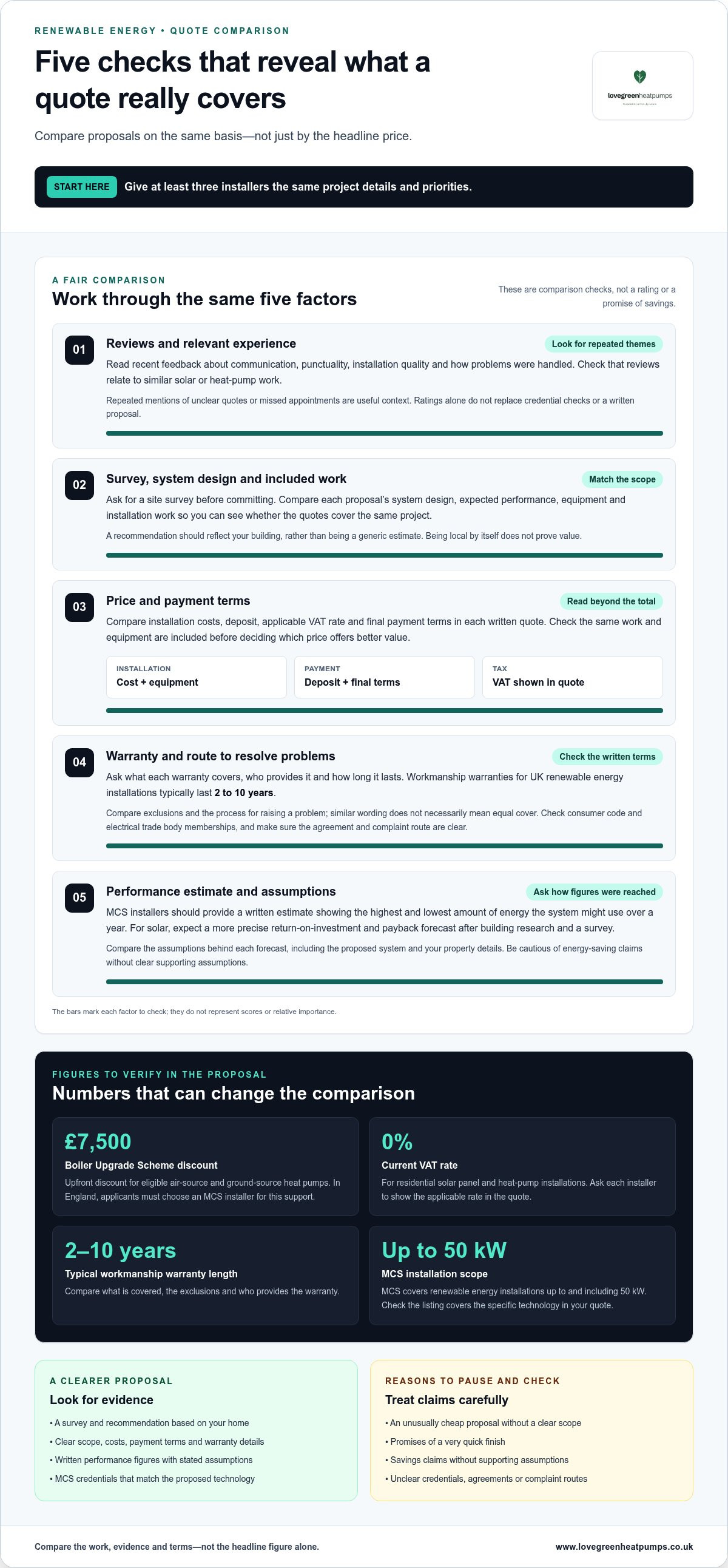
Compare at least three quotes to assess the work, costs and terms, not just the headline figure. Use the same project details for each installer so the proposals are easier to judge fairly.
-
Compare Installer Ratings and Reviews
Read recent reviews for each installer and compare the detail behind the ratings. Look for examples describing communication, punctuality, installation quality and how problems were handled. A rating alone won’t show whether the reviewer had solar panels or a heat pump installed, so check that the feedback relates to similar work.
Look for repeated themes across reviews rather than relying on one glowing comment or complaint. If customers repeatedly mention unclear quotes or missed appointments, factor that into your comparison. Reviews provide context, but they don’t replace checking credentials and the written proposal.
-
Gather Multiple Local Quotes
Request quotes from at least three installers serving your area. Give each the same information about your home, proposed system and priorities. Ask for a site survey before committing, so the recommendation reflects the building rather than a generic estimate.
Compare each proposal’s system design, expected performance and included work. A local installer may be familiar with properties in your area, but location alone doesn’t prove value. Be cautious of an unusually cheap proposal, promises of a very quick finish or energy-saving claims without clear supporting assumptions.
-
Compare Quote Costs and Warranties
Compare the installation costs, deposit, applicable VAT rate and final payment terms in each written proposal. Check that the same work and equipment are included before deciding which price represents better value. Don’t judge proposals by the headline cost alone.
Ask what each warranty covers, who provides it and how long it lasts. Workmanship warranties for UK renewable energy installations typically last 2 to 10 years. Compare the written terms, exclusions and process for raising a problem, rather than assuming similar wording means equal cover.
To compare proposals and warranties, match the scope and payment terms first, then review warranty length, cover and exclusions. A clear written breakdown makes differences easier to spot.
- Check which support scheme applies before accepting a proposal. The UK Boiler Upgrade Scheme provides an upfront discount of £7,500 for air-source and ground-source heat pumps, according to the Department for Energy Security and Net Zero. In England, applicants must choose an MCS installer for this support, according to the Department for Energy Security and Net Zero.
For residential solar panel and heat pump installations, the current VAT rate is 0%, according to HM Revenue & Customs. Ask each installer to show the applicable VAT rate in the quote, rather than assuming all proposed work receives the same treatment.
- Review the performance estimate alongside the price. MCS installers should provide a written estimate showing the highest and lowest amount of energy the system might use over a year. For solar, expect a more precise return-on-investment and payback forecast after the installer has researched the building and completed a survey.
Compare the assumptions behind any forecasts, such as the proposed system and your property details. A proposal that explains its figures gives you a better basis for weighing options than a savings promise without supporting detail.
Technology-specific installer accreditations
For solar panels and heat pumps, check that the installer holds relevant accreditation for the technology proposed. In England, solar panels and heat pumps usually fall under permitted development, with exceptions that can include listed buildings, conservation areas and national parks.
-
Verify Technology-Specific Accreditations
Match the installer’s accreditation to the equipment in your proposal. The Microgeneration Certification Scheme (MCS) covers renewable energy installations up to and including 50 kW, including heat pumps, solar panels that generate electricity, electricity storage batteries and solar water heating.
Check the specific technology, not just whether a business says it is accredited. A solar proposal should identify credentials relevant to solar PV, while a heat pump proposal should show coverage for that technology. MCS certification is required for schemes such as the Boiler Upgrade Scheme and the Smart Export Guarantee, subject to each scheme’s rules.
-
Review MCS Credentials
Look up the installer in MCS’s own Find an Installer records and match the business details to the name on your proposal. Confirm that the listing covers the technology you’re considering, and that the accreditation applies to the installation work, not just a product or different service.
Ask for the MCS certificate or relevant credential details if they’re not clear in the paperwork. Compare those details with the scheme’s records before accepting a quote. For a heat pump grant application in England, the installer must be MCS-certified.
- Check other technology-specific approval where relevant. If you’re considering an electric vehicle charger and want to claim a relevant government grant, the installer must be approved by the Office for Zero Emission Vehicles (OZEV). This approval is separate from MCS, so check the credential that matches the job.
Don’t assume one accreditation covers every part of a project. A proposal combining solar panels, a battery and an EV charger may involve different approval requirements. Ask the installer to identify which accreditations apply to each technology and how those credentials appear in the supporting documents.
- Clarify planning and electrical requirements for the proposed work. Solar-panel and heat-pump installations usually fall under permitted development in England, but listed buildings, conservation areas and national parks are exceptions to consider. The property’s location and status can affect the planning position.
Electrical wiring for renewable energy systems must be signed off and notified to local building control under Part P of the Building Regulations. Ask how this will be recorded in the project paperwork, and keep the completion documents with the MCS records.
Once you know which technology and credentials your project requires, you can explore solar PV and heat pump installation options alongside your accreditation checks.
Need to find a solar installer near you?
Choose how to approach local installers, then assess their advice before agreeing to work. A measured process helps you spot pressure tactics and keep control of the contract.
-
Watch for Overselling and Poor Advice
Ask the installer to explain how its recommendation suits your property. For solar panels, expect advice to account for the building and a survey before you commit. Treat a proposal based only on a brief doorstep conversation as incomplete, especially if it promises savings without showing its assumptions.
Compare the recommendation with your priorities, such as generating electricity or using a Smart Export Guarantee tariff. A reliable installer explains what the system is designed to do and how its estimates were reached. Be wary of advice that pushes extra equipment without linking it to your needs.
-
Resist Pressure to Purchase
Take time to read the written contract before signing. In England, an agreement can be a contract even if it isn’t written down, so ask for written terms if the installer hasn’t provided them. Check the scope, payment schedule, expected finish and what happens if the agreed work changes.
Don’t let a same-day offer decide for you. Compare the proposal with your other options and check the upfront payment against the stated limit: householders in England shouldn’t agree to pay more than 25% of the cost upfront. Keep the quote and any changes in writing.
-
Look Out for Installer Scams
Find installers yourself rather than agreeing to work after an unsolicited cold call. A caller’s claim of government backing isn’t proof of approval. Independently check the installer’s MCS credentials and the relevant scheme records before proceeding.
For a solar or heat pump project, confirm that the business named on the quote matches the business in its records. Check that any deposit request matches the written contract, and resolve any discrepancy before sending money to a different person or account. Keep copies of messages and payment details.
- For a heat pump, make sure the installer has surveyed your home and completed a heat-loss calculation before you commit. For solar panels, ask how the survey assesses whether the roof and property suit the proposed system. In either case, find out how the survey findings shape the design and performance estimate.
If you’re considering the Smart Export Guarantee, establish whether the installer’s MCS status meets the scheme’s requirements. Keep the paperwork together, including the survey, quote, contract and accreditation details. These records make it easier to follow what was agreed and raise a concern through the relevant scheme.
- Use the written proposal to test whether the advice is specific to your home. A solar quote, for example, should connect its recommendations to the surveyed building, your electricity use and your goals. Ask for unclear points to be explained in writing before accepting the work.
If a problem arises after an agreement, keep the installer’s response with your contract and messages. In England, customers unhappy with how an installer handles a complaint can ask the relevant scheme for help. Clear records give the scheme a practical account of the issue.
Checking consumer code and electrical trade body memberships
Ask which consumer code covers the installer, whether it belongs to an electrical trade body and how complaints are handled. Compare the answers with membership records, written warranty terms and examples of relevant completed work.
- Check the consumer protection code linked to the installer’s MCS membership. An MCS-certified installer must belong to a consumer protection code such as the Renewable Energy Consumer Code (RECC) or HIES. Confirm the business appears in the relevant membership records rather than relying on a logo on its paperwork.
Ask what the code’s complaints process covers and how to use it. In England, MCS or TrustMark scheme members must work correctly and professionally, and make it easy for customers to complain if something goes wrong. Keep the code name with your quote and contract.
- Check whether the business belongs to an electrical trade body, such as NAPIT or NICEIC. Use the organisation’s membership records to compare the registered business name with the installer’s details. Ask which electrical work the membership relates to, particularly if the project includes wiring or connections to your home’s electricity supply.
Membership is one part of the picture, not a substitute for reviewing the proposed work. Ask who will carry out the electrical tasks, what relevant qualifications they hold and how the work will be documented. A clear answer should identify responsibilities rather than rely on a general claim of being certified.
- Check the installer’s experience against your specific project. Ask how the team approaches similar systems, what role the named installer will have and whether it can describe a comparable job. Experience with solar panels, for example, does not necessarily demonstrate the same track record with heat pumps.
Ask for examples that explain the property type, system design and work completed. Check that they relate to the technology in your proposal. Specific details help you assess relevant experience more meaningfully than broad claims about time in the trade.
- Read the workmanship warranty and any product guarantees as separate documents. UK renewable energy installers’ workmanship warranties typically last 2 to 10 years. Check what the workmanship cover includes, its exclusions, how to make a claim and whether it identifies the responsible business.
Ask who handles a fault involving the equipment rather than the installation. Don’t assume a product guarantee covers labour or remedial work. Keep the warranty, product documents and installation records together so the terms are easy to find if needed.
- Verify the MCS listing and consumer code details against the business named in your paperwork. Check that the installer’s membership matches the technology and work proposed. Compare the listing, quote and contract, and ask for any difference in business names to be explained in writing.
Before hiring, ask: “Which consumer code and electrical trade body cover this work, who will install it, and what do the workmanship warranty and complaint process include?” Keep the written answers with your contract so you can refer to them if questions arise during or after installation.
How to check whether a renewable energy installer is trustworthy in the UK?
Judge trustworthiness by how clearly the installer explains the project, its decisions and the work from survey to handover. A sound process should make the technical details understandable, not leave you guessing.
- Ask how the installer will assess your home and turn the findings into a design. For solar, the explanation should connect roof conditions and your electricity use to the proposed panel layout. For a heat pump, ask how the design accounts for your heating needs and existing system.
Look for reasoning that relates to your property, rather than a recommendation that could apply to any home. Ask the installer to explain what information shaped the design and which assumptions could affect system performance.
- Ask who will manage the project from the initial assessment to installation. Find out who is responsible for design decisions, site work and coordinating any other trades. A clear explanation helps you know who to speak to if the work involves several people or stages.
Request a straightforward outline of the installation sequence. Ask when equipment will be delivered, what access the team needs and which parts of your home may be affected. Specific answers help you prepare without relying on a rushed verbal summary.
- For a system that connects to the electricity network, ask how the installer handles the Distribution Network Operator (DNO) application. Ask the installer how the application will be timed in relation to the installation work. Ask what information is needed and how the application fits into the project schedule.
For a commercial solar project, discuss how the proposal reflects your site’s electricity use, roof and business goals. Ask how project planning accounts for those details and whether the installation should be mentioned to your insurer.
- Ask what commissioning involves and what you’ll receive at handover. The installer should explain how the completed system is checked, how to operate it and which documents you’ll receive. Confirm that you’ll be shown the controls and given the relevant system information.
Use the handover discussion to clarify everyday operation and who to approach with technical questions after the work. A useful explanation should make the controls and basic operation clear, rather than assume you already know how to use the system.
- Before work begins, put together the project information you’ll rely on: the design, installation sequence, network application details and handover expectations. Read through them in order and note any points that don’t match the installer’s explanation. This gives you a practical record of how the project is meant to proceed.
A careful process should leave you understanding what happens next and why. If you’re planning solar or another renewable energy project, you can explore renewable energy installation options as part of deciding what suits your home.
Love Green Heat Pumps Ltd: Heat Pump Installation
Love Green Heat Pumps Ltd can help when you’re ready to move from comparing installers to planning a heat pump project. Its Heat Pump Surveys & Installation service begins with a full home survey and heat-loss calculation, then covers system design, installation and commissioning. Request a free, no-obligation quote to understand the proposed work.
If you’re weighing solar alongside home heating, Love Green Heat Pumps Ltd also provides Solar Panel Installation. Start with the technology you’re considering and what you want it to do for your property. A survey and clear project details help shape a proposal around your requirements.
For a straightforward next step, visit the Love Green Heat Pumps Ltd website to discuss your renewable energy plans.
Take the next step towards a home energy plan
Finding a trustworthy renewable energy installer is about more than feeling confident in the workmanship. It means having a plan that fits your home, comfort priorities and energy use. Turn what you’ve learned into a practical conversation about what you want a system to achieve.
You don’t need to settle every detail at once. Start with your main priority, whether you’re exploring lower-carbon heating, generating electricity at home or understanding which options suit your property. Clear aims make it easier to discuss a project and decide whether the proposed approach feels right.
Love Green Heat Pumps Ltd can help you explore the next step for your home energy plans. If you’re ready to discuss your project, contact Love Green Heat Pumps Ltd. A calm, informed start can make the decisions ahead feel much more manageable.
Frequently Asked Questions
How can you verify a solar installer’s credentials?
Match the business name on the quote to its entry in the MCS Find an Installer records. Check that the listing covers solar PV, rather than another technology, and compare the details with any certificate supplied. Confirm which consumer code applies. If the trading name differs from the legal business name, ask for the relationship to be set out clearly in the contract before agreeing to the work.
How long will the installation process take?
The physical installation of a renewable energy system typically takes 1 to 3 days, depending on the technology. That is different from the full project timeline, which also includes steps such as assessment, design and arranging the work. A solar panel installation, for example, may need a roof survey and system design before the fitting dates are agreed. Check that the proposal explains the expected sequence and finish date.
How to verify an installer’s MCS certification and consumer reviews?
Use MCS’s installer records to check the business name and technology covered, then compare those details with the quote. For reviews, look for comments describing the same kind of installation, such as solar PV rather than general building work. Read the detail behind both praise and criticism. Comments about communication, commissioning or resolving issues give more context than an unexplained rating.
What are the risks of choosing an unqualified or dishonest installer?
An installer without the relevant MCS status may prevent access to schemes that require an MCS-certified installer, including the Smart Export Guarantee, subject to the scheme’s rules. Poorly documented work can also make it harder to establish what was agreed or who should address a fault. Check credentials, contract terms and complaint arrangements before paying. If an MCS or TrustMark member handles a complaint poorly in England, customers can ask the relevant scheme for help.
Where to find trusted local renewable energy installers in the UK?
For a London property, begin with MCS’s installer records and filter your search by the technology you need. Then compare local firms’ scheme memberships, project examples and written proposals. Ask whether the survey and design account for your property, such as roof condition for solar panels or heating requirements for a heat pump. A London address alone doesn’t establish suitability, so match documented experience to your project.
Disclaimer
Disclaimer
The information published on this website is provided by Love Green Heat Pumps for general information and educational purposes. As a specialist provider of heating and renewable energy solutions, we strive to ensure that our content is accurate, relevant and up to date. However, heating requirements, system suitability, installation specifications, costs and performance can vary depending on individual property characteristics, usage and other site-specific factors.
Information provided in our articles should not be regarded as a substitute for a professional property assessment, technical survey or tailored recommendation. Any decisions regarding the selection, installation, replacement or maintenance of heating systems should be made with appropriate professional guidance.
Love Green Heat Pumps accepts no responsibility for decisions made solely on the basis of general information published in these articles. For advice specific to your property or project, we encourage you to contact our team for professional guidance and an assessment of your requirements.


