

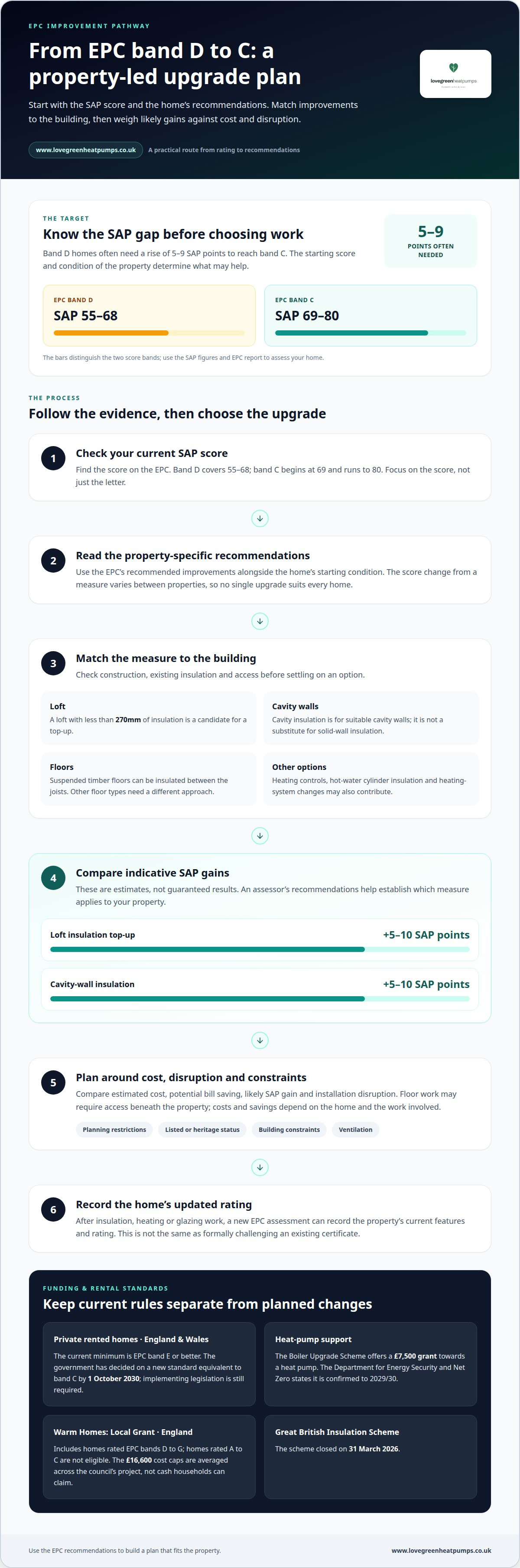
An EPC band D home has a SAP score of 55-68; band C starts at 69 and runs to 80. To understand how to get from EPC band D to C, focus on the score and the improvements recommended for the property, rather than the letter alone. Many D-rated homes need a rise of 5-9 SAP points to reach band C.
If you’re asking how to get from EPC band D to C, start with your EPC recommendations and the property’s current SAP score. The right upgrades depend on the home: loft or wall insulation, heating controls and changes to the heating system may all help, but no single measure suits every property.
This guide explains the band C threshold, how to assess EPC recommendations, and the indicative costs and potential savings of common insulation and heating upgrades. It also outlines current landlord rules in England and Wales and the planned move towards a higher rental standard, so you can see what may matter for your property.
Key Takeaways
- Use the EPC’s SAP score and property-specific recommendations to understand which improvements may make a difference.
- Loft, cavity wall and floor insulation are potential options, but the right measure depends on the home’s construction and existing insulation.
- Heating controls, hot water cylinder insulation and heating upgrades may also contribute to a better rating.
- Indicative costs and potential savings vary with the work needed, so consider the full upgrade plan rather than one measure in isolation.
- Landlords should separate current minimum energy-efficiency rules from announced future standards that still require implementing legislation.
Indicative costs of insulation and heating upgrades
Improvement costs depend on the work required, while the SAP score change depends on the home’s starting condition. Compare both to identify upgrades that suit the property and your budget.
Comparing Upgrade Costs and Disruption
Compare each measure by its estimated cost, likely SAP gain, potential bill saving and installation disruption. Some jobs are relatively straightforward; floor work may require access beneath the property. Weighing access and disruption alongside price helps you build a practical plan.
How much do common EPC improvements cost in the UK? Actual costs depend on the property and the measures selected.
SAP Gains from Common Upgrades
Estimated SAP gains show how much some insulation measures may contribute towards a higher band. A loft insulation top-up may add 5-10 SAP points, while cavity wall insulation may add 5-10. These gains are estimates, not a fixed result for every home. An assessor’s recommendations help identify which measure applies to the property.
Use these figures to compare upfront spending with possible savings, allowing for differences between homes.
A new heating system can affect an EPC, but costs vary by the system and work involved. The Boiler Upgrade Scheme offers a £7,500 grant towards a heat pump, with the Department for Energy Security and Net Zero stating it is confirmed to 2029/30.
Running-cost estimates offer useful context, but these are London estimates, not a promise of savings for another property.
Before upgrading insulation, heating or windows, consider planning restrictions, listed or heritage status, building constraints and ventilation. These factors can affect which work is suitable or permitted, particularly in older homes. For privately rented homes in England and Wales, the current minimum is EPC band E or better, according to the Department for Energy Security and Net Zero.
The cost and potential savings of home improvements
Costs and savings depend on the home’s current condition and the recommended work. Compare likely rating gains with disruption and any support you may be eligible for.
Cheaper Routes to a Better EPC Rating
Lower-cost improvements can address straightforward heat loss before you consider larger projects. These measures may suit homes with obvious gaps or an uninsulated hot-water cylinder, but their value depends on the EPC recommendations. Prioritise work that addresses a specific weakness rather than spending on upgrades unlikely to help the property.
Heating Controls and Glazing
Heating controls help manage when and where warmth is used, while glazing reduces heat loss through windows. The difference in cost makes it useful to compare each option’s EPC impact, comfort benefits and disruption before planning work.
Funding for Home Energy Improvements
Funding can reduce the amount a household pays directly, subject to the scheme’s eligibility rules. In England, the Warm Homes: Local Grant includes homes rated EPC bands D to G; homes rated A to C are not eligible. Its £16,600 cost caps apply to energy performance and low-carbon heating, averaged across the council’s project. They are not amounts households can claim as cash. The Great British Insulation Scheme closed on 31 March 2026.
For private rented homes in England and Wales, the current minimum standard is EPC band E or better. The government has decided on a new standard equivalent to band C by 1 October 2030, but implementing legislation is still required. Landlords can use the planned deadline to consider improvements, while distinguishing announced policy from current requirements.
Commercial buildings follow a separate policy path. In England and Wales, an EPC B requirement from 2031 for commercial buildings over 1,000 square metres is a proposal requiring legislation. Domestic homes and commercial premises therefore shouldn’t be treated as having the same target or timetable.
Can a professional challenge an EPC rating or arrange a new assessment in the UK? An assessor can carry out a new EPC assessment, particularly after changes such as insulation, heating or glazing work. A fresh assessment records the home’s current features; it isn’t the same as a formal challenge to an existing certificate. An EPC assessment can document the rating after improvements.
Insulation measures for moving from band D to C
Insulation reduces heat escaping through the roof, walls and floors. The right measure depends on the home’s construction, existing insulation and EPC recommendations.
Loft, Cavity-Wall and Floor Insulation
Loft insulation limits heat loss through the roof, cavity-wall insulation fills the gap between wall layers, and floor insulation reduces heat escaping below living spaces. Each addresses a different part of the building fabric, so the EPC report helps identify the relevant weakness. In UK homes, a loft with less than 270mm of insulation is a candidate for topping up.
Cavity insulation suits homes with appropriate cavity walls; it is not a substitute for solid-wall insulation. Floor options also vary: suspended timber floors can be insulated between the joists, while other floor types require a different approach. The EPC recommendations can help match the home’s construction to measures likely to affect its SAP score.
Solid-Wall and Underfloor Insulation
Solid-wall insulation adds an insulating layer inside or outside the wall, while underfloor insulation targets heat loss through the floor.
External wall insulation changes the building’s outer finish, while internal insulation affects room interiors. Listed or heritage homes and properties with planning restrictions may face limits on some improvements. Ventilation matters too: insulation work should not leave vents blocked. These practical considerations can influence which measures are suitable in England and Wales, especially in older homes.
Combining Loft Insulation with Heating Controls
Combining insulation with heating controls addresses both heat loss and how the heating system operates. EPC recommendations may include a room thermostat, programmer, thermostatic radiator valves, smart controls or zoned heating. Whether these work well together depends on the home’s insulation and existing controls, as well as the assessor’s recommendations.
Solar panels may also feature in an improvement plan, but they do not replace insulation. Before installation, consider roof direction and condition, shading, available space, planning constraints, the electrical setup and the likely EPC impact. The right sequence depends on the home’s priorities, roof space and how long you plan to own the property.
A joined-up plan weighs these measures against access, disruption and the EPC’s potential rating. A home with a poorly insulated loft may need a different combination from a solid-wall property with limited roof space. Keep photos and invoices for completed work, as they can provide useful evidence for a future EPC assessment.
What is the EPC score for band C?
A domestic EPC uses a SAP score to place a property in an energy-efficiency band. The score shows how far a band D home is from the band C threshold.
Current and Potential SAP Scores
The current SAP score reflects the home’s recorded features, including insulation, heating and controls. The potential score estimates the rating if all cost-effective EPC recommendations are completed. Compare the two scores to understand the potential improvement and which measures contribute to it.
For example, a current score in the upper part of band D may need fewer SAP points to reach C than a score near the bottom. The potential rating gives a useful direction, but it assumes the listed work is completed. RdSAP 10 has been in use since mid-2025, so EPC assessments use the current methodology.
SAP Thresholds for Bands C and D
Band D covers 55-68 SAP points, while band C covers 69-80. A score of 68 therefore needs one additional point to enter band C; a score of 55 needs 14. Most EPC D-rated homes are estimated to need a 5 to 9 SAP-point increase, but the starting score matters.
These thresholds show why the letter alone is not enough. Two homes with a D rating can have different SAP scores, features and recommendations. Check the exact score and recorded details, including wall insulation and heating, to understand the gap.
A boiler change may contribute to that gap. A new condensing boiler is estimated to add 5-15 SAP points, while replacing an old non-condensing boiler with a condensing model is estimated to add 5-12 points. The effect depends on the existing heating system and the EPC details. Boiler replacement may be worth considering if the current boiler is over 15 years old.
Heating controls may also appear in the EPC recommendations. A room thermostat, programmer, thermostatic radiator valves, smart controls or zoned heating may improve the home’s recorded efficiency. The assessor considers the existing setup, so adding a measure absent from the recommendations may not deliver the expected SAP change.
The government’s EPC potential rating assumes that all cost-effective recommendations are implemented. Treat it as a guide to possible improvements, then compare it with the current score and each recommended measure. If the report recommends wall insulation and heating changes, for example, their combined contribution may matter more than focusing on one upgrade alone.
To understand how to get from EPC band D to C, focus on the points between the current score and 69. That makes the target concrete and helps connect the EPC’s recommendations with the work required.
Which home improvements most effectively raise an EPC from D to C?
The strongest plan matches improvements to the EPC recommendations and the home’s existing features. Before deciding what to include, compare each measure’s likely SAP contribution, cost, practical suitability and effect on comfort.
Start with the gap between the current score and band C, then focus on recommendations relevant to the property. Most EPC D-rated homes need a 5 to 9 SAP-point increase to reach C. A measure that addresses a recorded weakness is more useful than an upgrade chosen simply because it is popular.
Loft insulation can be a practical option where the existing layer is below 270mm. Its potential energy-bill savings are estimated at £150-£250 per year. Those figures make loft insulation a useful comparison point when weighing improvements, rather than a guaranteed result for every home.
Cavity wall insulation can make a substantial difference when a property has suitable cavity walls. The SAP gain depends on the home’s construction and recorded details. Solid-wall homes need a different approach, with internal or external insulation bringing more cost and disruption.
Smaller upgrades can complement insulation. Controls may include a thermostat, programmer or thermostatic radiator valves. They help manage heating more effectively, but the EPC recommendations indicate whether they address a gap in that particular home.
For homes with an older non-condensing boiler, replacement with a condensing boiler is estimated to add 5 to 12 SAP points. A boiler over 15 years old is a reason to consider replacement as part of a wider plan. The heating system, controls and insulation should be considered together, rather than treating one upgrade as a complete solution.
Solar PV may contribute to an improvement plan if the roof and electrical setup are suitable. Roof direction, shading and available space affect the practical design.
Choose a combination that addresses the home’s specific recommendations and fits its construction. A heat pump involves a different heating-system decision from a simple insulation upgrade. Discuss a heat pump installation as part of a considered EPC improvement plan.
Love Green Heat Pumps
Love Green Heat Pumps Ltd can help you connect EPC recommendations with practical home energy improvements. Its EPC assessments establish the property’s current rating, while heating engineering, heat pump installation and solar PV services may suit specific recommendations. The right option depends on the home’s construction, existing heating system and the improvements identified in the assessment.
Consider Love Green Heat Pumps Ltd when weighing heating changes or renewable energy alongside insulation work. The company’s property-specific advice can help you understand how different measures fit together before deciding what to do next.
Contact Love Green Heat Pumps Ltd to discuss your EPC improvement plans.
Make your next improvement count
Treat an EPC improvement plan as part of the home’s wider maintenance, not as a separate project. If you are already planning renovation or heating work, coordinating suitable energy upgrades can help avoid repeating disruption. Keep a clear record of completed work and supporting documents, then arrange an updated assessment when you need the new rating recorded.
For landlords, planning ahead can help align property improvements with tenancy decisions. For homeowners, it can make future maintenance choices more joined-up. Start by turning the EPC recommendations into a considered plan for the property, rather than selecting upgrades in isolation. This is a practical approach to how to get from EPC band D to C.
Love Green Heat Pumps Ltd can help you consider the next step for your home’s energy improvements. Talk with Love Green Heat Pumps Ltd about your plans and move forward with a clearer direction.
Frequently Asked Questions
What is an EPC Rating?
An EPC rating shows a property’s energy efficiency, from band A at the top to band G at the bottom. The assessment uses a SAP score on a scale from 1 to 100, alongside details such as heating and insulation. For example, the rating helps a buyer, tenant or owner compare a property’s recorded energy performance and see recommendations for potential improvements.
How many SAP points do I need to go from D to C?
You need a score of at least 69 SAP points for band C. Band D covers 55-68, so the exact increase depends on your current score. A home at 68 needs one more point; one at 55 needs 14. Check the precise score on the certificate, since the band letter alone doesn’t show how close the property is to C.
How much will it cost to go from D to C?
A home needing only a modest insulation or controls upgrade may fall towards the lower end, while more extensive work can cost more. Treat estimates as planning figures, not a quote. The EPC recommendations, construction and access requirements determine the final scope.
What are the cheapest ways to move from D to C?
Start with measures that match the EPC recommendations and address an existing weakness. These costs do not mean every measure will improve every home’s rating: the property’s existing features determine whether a recommendation is relevant.
Do I need a new EPC after the work?
A new EPC is useful if you need the certificate to show the home’s rating after improvements. Insulation, heating changes or upgraded lighting can alter the recorded details, but only a fresh assessment records the property as it stands after the work. An EPC is valid for 10 years, so the need for an updated certificate depends on why you need current evidence.
Does a new boiler move a D to a C?
A new boiler can improve a SAP score, but it does not automatically move a property into band C. The result depends on the old boiler, its replacement and the home’s other recorded features. A boiler upgrade may contribute points, while insulation or heating controls may also matter. The EPC recommendations show whether boiler replacement addresses a relevant weakness.
What EPC rating is required to move from band D to band C in the UK?
The threshold for band C is 69 SAP points. Band D runs from 55 to 68 points, so a property must reach 69 to be rated C. There isn’t a separate score for making the transition beyond that band boundary. The precise points needed depend on the property’s current SAP score and the measures reflected in its assessment.
Do landlords need to reach EPC band C, and what exemptions or deadlines apply?
In England and Wales, the current minimum for rented homes is EPC band E or better, according to the Department for Energy Security and Net Zero. The government has decided on a future standard equivalent to band C by 1 October 2030, but implementing legislation is still required. Under the current rules, a valid registered exemption may apply to a property below E.
Disclaimer
Disclaimer
The information published on this website is provided by Love Green Heat Pumps for general information and educational purposes. As a specialist provider of heating and renewable energy solutions, we strive to ensure that our content is accurate, relevant and up to date. However, heating requirements, system suitability, installation specifications, costs and performance can vary depending on individual property characteristics, usage and other site-specific factors.
Information provided in our articles should not be regarded as a substitute for a professional property assessment, technical survey or tailored recommendation. Any decisions regarding the selection, installation, replacement or maintenance of heating systems should be made with appropriate professional guidance.
Love Green Heat Pumps accepts no responsibility for decisions made solely on the basis of general information published in these articles. For advice specific to your property or project, we encourage you to contact our team for professional guidance and an assessment of your requirements.


