

A better EPC rating starts with reducing heat loss and following the recommendations in your property’s assessment. Improving your home’s EPC rating may involve loft, wall or floor insulation, more efficient glazing and draught-proofing. An EPC grades a property from A, the most efficient, to G, the least efficient, so the right improvements depend on what the assessment identifies.
It’s easy to focus on one upgrade, but insulation and glazing work best as part of a considered plan for your home. This guide explains how different improvements can help, what landlords should know about grants and how to use EPC recommendations to set priorities. You’ll also learn how a professional EPC assessment can clarify the next steps, helping you make practical choices for a warmer, more efficient home.
Key Takeaways
- Use your EPC recommendations to identify which improvements are likely to make the biggest difference to your home.
- Compare insulation options for the loft, walls and floors, taking the property’s construction into account.
- Understand how draught-proofing and upgraded glazing can help reduce heat loss without blocking essential ventilation.
- Landlords can use current requirements and available support to plan energy-efficiency work in stages.
- Professional advice can help turn EPC recommendations into a practical order of improvements.
1. Window, loft, floor and wall insulation
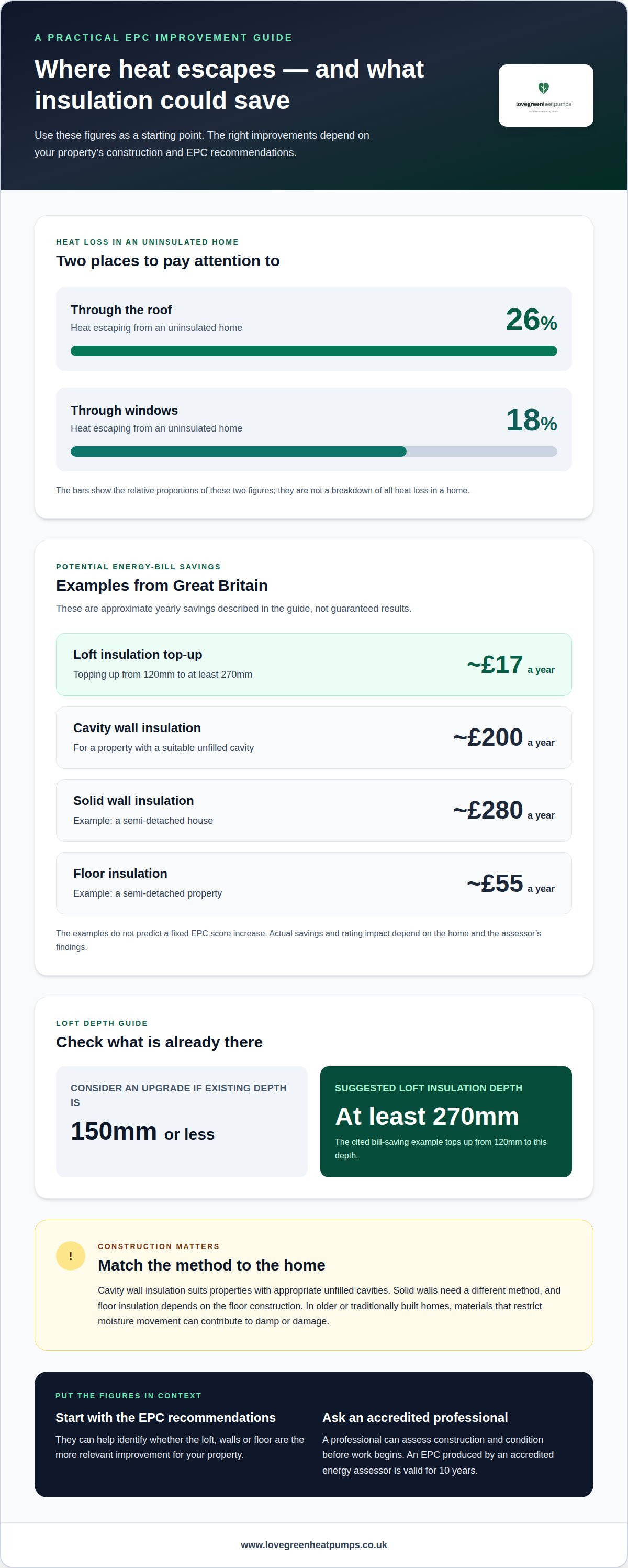
Loft insulation is often a practical starting point. Topping it up from 120mm to at least 270mm can reduce heat loss, and around 26% of heat in an uninsulated home escapes through the roof. If the existing depth is 150mm or less, upgrading it may be worth considering.
The same example does not establish a typical price or a fixed EPC score increase: the rating impact depends on the home’s starting point and the assessor’s findings. Topping up from 120mm to at least 270mm can save around £17 a year on energy bills in Great Britain.
Walls need a different approach. Cavity wall insulation can suit properties with suitable unfilled cavities, and filling cavity walls could save around £200 a year on energy bills in Great Britain. Most homes built after 1983 already have cavity wall insulation, while it can be a significant improvement for some mid-century properties. Solid walls require another method; insulating them in a semi-detached house could save around £280 a year in Great Britain.
Floor insulation may help reduce heat loss through a suspended floor, although the construction affects the suitable method. In a semi-detached property in Great Britain, floor insulation could save around £55 a year. An assessor’s recommendations can help identify whether the loft, cavity wall, solid wall or floor is the more relevant gap for that property.
Insulation needs particular care in older or traditionally built homes. Materials and methods that restrict a building’s ability to manage moisture can contribute to damp or damage, so the wall construction and existing condition matter before work begins. A professional can assess these features and recommend an approach suited to the building, rather than applying a modern cavity-wall solution to a solid-wall home.
For an EPC assessment, an accredited assessor records the property’s energy features and produces its rating; according to the UK Government, an EPC is valid for 10 years if produced by an accredited energy assessor. If the rating appears inaccurate, provide the assessor with relevant evidence, such as details of insulation or glazing, and ask them to review the assessment. An EPC assessment can also document completed improvements.
Solar panels are a separate energy upgrade to consider alongside insulation: residential solar panel installation in the UK is subject to 0% VAT, according to HM Revenue & Customs.
2. Are energy efficiency grants available for landlords?
Landlords can plan energy-efficiency work around current minimum standards and upcoming requirements. In England and Wales, a domestic private rented property covered by the minimum energy efficiency rules must have an EPC rating of at least E, according to the UK Government. Under the Warm Homes Plan, landlords in England will need to upgrade properties to EPC Band C across two metrics by October 2030, unless a valid exemption applies, according to the UK Government.
The current cost cap matters when planning work. According to the UK Government, you are not currently required to spend more than £3,500 (including VAT) on energy efficiency improvements. This is not a grant: it limits the amount a landlord is required to spend under the current rules. Keep records of improvement costs and completed work, as these help explain the property’s energy performance and support future planning.
Support depends on the scheme and the property. The Boiler Upgrade Scheme offers eligible households grants of up to £7,500 towards installation, according to the Department for Energy Security and Net Zero. The Warm Homes Plan may offer support for energy-efficiency upgrades to eligible homeowners. Check the relevant eligibility criteria before building grant funding into a renovation budget, as support is not automatic for every landlord or improvement.
Solar panels and other renewable measures can affect an EPC by improving the property’s energy performance. Solar panels generally improve an EPC rating by one band. A renewable heating system can also form part of an efficiency plan, but the recommended measures depend on the property’s existing heating, insulation and assessment findings.
Extensions and renovations are a useful opportunity to consider energy efficiency alongside planned work. For example, a roof extension can include suitable roof insulation and efficient roof windows, while replacement windows can address heat loss as part of a wider upgrade. The design should account for how the new space connects to the existing home, including insulation continuity and the heating system serving each area.
Improvements need maintenance to keep working as intended. After fitting efficient windows or roof windows, look out for damaged seals, condensation or draughts, and arrange repairs when needed. Keep access points and ventilation clear, and investigate signs of damp promptly. These checks help landlords maintain comfort and identify faults before they affect the building fabric or the energy performance recorded at a later assessment.
3. Windows, doors and draught-proofing
Gaps around a front door, window frame or letterbox can let cold air into living spaces. Draught-proofing targets those uncontrolled gaps, helping rooms feel more comfortable and reducing heat escaping from the home. Around 18% of heat in an uninsulated home is lost through windows, so their condition and fit matter alongside the glazing itself.
A professional survey can identify where draughts enter and which seals need attention. Common locations include the edges of opening windows, the meeting rails of sash windows, door frames and letterbox openings. Seals must suit the window or door: a poor fit can make an opening difficult to operate, while worn or compressed material may leave gaps untreated.
Keep ventilation routes clear. Draught-proofing must not block extractor fans, wall vents, underfloor grilles, airbricks or trickle vents. These features help provide ventilation, so sealing them can interfere with airflow. A professional should distinguish between an unwanted gap around a frame and a designed vent before recommending work.
Glazing and draught-proofing address different sources of heat loss. Upgrading single-glazed windows can reduce heat loss, while sealing frame gaps limits cold air movement around them. If a room remains uncomfortable after new glazing, poor seals or an ill-fitting external door may still be contributing. Assessing the whole opening helps avoid treating only the glass.
Doors need attention at the threshold and around the frame. A draught at the bottom may call for a suitable threshold seal; gaps along the sides or top need a compatible frame seal. A fitted brush or flap on a letterbox can reduce air movement without making it unusable. The right detail depends on the door’s design and daily use.
These measures can sit alongside other EPC improvements, but draught-proofing is not a substitute for efficient heating or lighting. An EPC may also recognise heating controls: smart thermostats and thermostatic radiator valves can help tenants heat rooms more efficiently and may improve the score under heating-control criteria. Thermostatic radiator valves should be fitted to at least 50% of a property’s radiators.
Use the EPC recommendations to decide whether window seals, door adjustments or a wider glazing upgrade should take priority. The property’s existing condition and the assessor’s recorded features shape the likely benefit. A careful assessment also protects essential ventilation while targeting draughts, giving your improvement plan a clearer basis than sealing every opening indiscriminately.
4. Double and triple glazing
Replacing single-glazed windows with double or triple glazing can reduce heat loss. Double glazing has two panes, while triple glazing has three. The added panes create additional layers between the room and outdoors. The suitable choice depends on the existing windows, the home’s construction and the wider improvement plan.
More panes do not automatically make triple glazing the right option. A professional assessment considers the window frames, opening style, condition and space available for replacement units. For example, the condition of a sound frame can affect whether a replacement will fit properly. Poorly fitted glazing can leave gaps, so installation quality matters as much as the glass specification.
Double glazing can be a practical upgrade where single-glazed windows contribute to heat loss. Triple glazing may suit some homes, but its value depends on the property and the wider work planned. An EPC assessor records the glazing present during an assessment. The rating reflects the property’s overall energy performance, not a single window upgrade in isolation.
Roof glazing can bring natural daylight into a loft conversion or extension. A roof window is also part of the building envelope, so its glazing, frame and installation affect how well the space retains heat. A designer should consider its position and size alongside roof insulation and the heating system. This helps balance daylight with comfort.
Existing windows can also shape the decision. Sash windows, bay windows and rooflights each have different frame and fitting requirements. Before installing replacements, a professional can assess their condition and identify whether the main issue is the glass, the frame or draughts around the opening. This helps avoid replacing glazing when a different repair may address the problem.
Regulations and property constraints can also shape a glazing project. A professional can consider relevant building requirements and the home’s features before specifying replacement windows. For example, a listed building may need a more sensitive approach to preserving its character. A government energy-efficiency grant may have eligibility conditions, so check the scheme rules before including support in your project plan.
After installation, check that each window opens and closes properly and that seals sit evenly. These practical checks can help identify fitting issues early. Keep the installation details with the property’s EPC records, then arrange a new assessment after the upgrade if you want the certificate to reflect the improved glazing. This gives the assessor current information about the home.
5. Using EPC recommendations to plan improvements
Your EPC certificate provides a starting point: it records the home’s energy performance and lists recommended improvements. Use those recommendations to identify the biggest opportunities, rather than choosing upgrades by appearance alone. The rating runs from A to G, but reaching a higher EPC depends on the property’s current features and the measures recorded in its assessment.
Begin by grouping recommendations according to the part of the home they address. Wall insulation, loft insulation, glazing and heating controls each tackle different causes of energy loss or use. A professional can explain how the property’s construction affects each option. For example, the suitable wall treatment depends on whether the building has cavity or solid walls.
Then consider how the recommendations work together. Improving insulation can reduce heat loss, while heating controls help manage when and where heat is used. A new heating system needs to suit the home’s layout and insulation. An assessor can explain which recorded features influence the score and how proposed work relates to the certificate’s recommendations.
Use the EPC band as context, not as a promise of a particular result. A SAP score from 55 to 68 corresponds to Band D, while 69 to 80 corresponds to Band C. Those ranges show why a small score change may not move a home into another band. Prioritise the work that addresses the property’s specific weaknesses, then review the likely sequence with a professional.
Practical constraints also affect the order of work. Access, existing finishes and the building’s condition can influence when insulation or window work is carried out. A professional can help coordinate related improvements so completed work does not need to be undone for a later upgrade. For example, consider how radiator controls fit into the wider heating plan before finalising heating-system changes.
Keep records of completed work and product details, then arrange a new EPC assessment after major improvements if you want the certificate to reflect them. This creates an updated record for future decisions, including further upgrading. If your recommendations point towards changes to the home’s heating, discuss your heating plans with a qualified heating engineer.
Love Green Heat Pumps Ltd
Love Green Heat Pumps Ltd can help you turn EPC recommendations into a practical plan for your home. If suggested work involves heating or renewable energy, its team can advise on options such as heat pump installation, solar PV and other renewables, or air conditioning. A heating engineer can help assess how proposed changes fit with your existing system and the property’s needs. This is useful when you’re weighing up several upgrades and want clear guidance on the next step.
Share the relevant EPC recommendations and details of your home to discuss what may suit your plans. For a straightforward conversation, contact Love Green Heat Pumps Ltd.
Plan your next improvement with confidence
Turn your EPC recommendations into a clear decision about what happens next. Identify the outcome you want, such as a more comfortable room or a heating system that suits your home, then consider which work supports it. A phased plan can help organise improvements around your property and priorities, rather than trying to do everything at once. Focus on practical changes that make sense for the way you live.
Improving your home’s EPC rating is a process, not a single decision. If you’re unsure how an energy upgrade fits into your plans, a professional discussion can help you understand the options and choose a sensible starting point. Love Green Heat Pumps Ltd can help you consider the next step for your home. Contact Love Green Heat Pumps Ltd to talk through your plans and move forward with clarity.
Frequently Asked Questions
How can a professional help improve the EPC rating of your home?
Professional support for improving your home's EPC rating starts with an assessment of its existing energy features. An accredited assessor records details such as the heating system, insulation and windows, then issues an EPC with recommendations. For example, if the certificate identifies an inefficient heating system, a heating specialist can assess suitable alternatives. Love Green Heat Pumps Ltd also provides EPC assessments to help homeowners understand their property’s recorded performance.
What is an EPC rating and why does it matter?
An EPC rating shows how energy efficient a property is, using a scale from A, the most efficient, to G, the least efficient. It gives buyers, tenants and owners a standard way to understand a home’s energy performance. The certificate can also help guide decisions about upgrades. According to the UK Government, an EPC produced by an accredited energy assessor is valid for 10 years, unless a new assessment is completed sooner.
What do EPC ratings mean?
The letter is a band based on the property’s calculated energy performance, with A representing the most efficient homes and G the least efficient. In the UK, a SAP score from 55 to 68 corresponds to Band D, while a score from 69 to 80 corresponds to Band C. A home near the top of one band may need a smaller score improvement to reach the next band than a home near its bottom.
Are grants for energy efficiency improvements available for landlords?
Some support may be available, but eligibility depends on the scheme and property. The Boiler Upgrade Scheme offers eligible households grants of up to £7,500 towards installation, according to the Department for Energy Security and Net Zero. In England, the Warm Homes Plan requires landlords to upgrade properties to EPC Band C across two metrics by October 2030, unless a valid exemption applies, according to the UK Government. The current cost cap is £3,500 (including VAT), according to the UK Government.
I have electric heating. How does that affect my EPC rating?
Electric heating can affect an EPC because the assessment considers the heating system’s energy performance and the home’s heat demand. The result depends on the installed system and controls, as well as insulation and other property features. For example, a home with electric heaters may receive different recommendations from one with a heat pump. An EPC assessment can show how the current system is represented and which upgrades could improve the overall rating.
How is a home’s EPC rating calculated in England, Scotland, Wales and Northern Ireland?
An accredited energy assessor records the property’s construction, insulation, heating, hot water and other energy features, then applies the assessment method used for that nation. England, Scotland, Wales and Northern Ireland have distinct assessment arrangements, so the exact calculation and certificate format can differ. Share accurate details of completed upgrades, such as new heating controls or insulation, so the assessment reflects the property as it stands.
What are the most effective improvements to raise a home’s EPC rating?
The most effective approach to improving a home's EPC rating depends on the main weaknesses identified in its certificate. Insulation, glazing, heating controls, a more efficient heating system and solar panels can all contribute, but their effect varies by property. For instance, replacing an older heating system may be more relevant in one home, while another may benefit more from addressing heat loss. Use the EPC recommendations to set priorities instead of choosing upgrades by habit.
What are the costs and EPC benefits of cavity wall, solid wall and floor insulation?
Installation costs depend on wall construction, access and the type of insulation work required. In Great Britain, cavity wall insulation could save around £200 a year on energy bills; insulating solid walls in a semi-detached house could save around £280 a year. Floor insulation could save around £55 a year in a semi-detached property. These are estimated bill savings, not EPC score changes; the rating benefit depends on the home and assessment.
Disclaimer
Disclaimer
The information published on this website is provided by Love Green Heat Pumps for general information and educational purposes. As a specialist provider of heating and renewable energy solutions, we strive to ensure that our content is accurate, relevant and up to date. However, heating requirements, system suitability, installation specifications, costs and performance can vary depending on individual property characteristics, usage and other site-specific factors.
Information provided in our articles should not be regarded as a substitute for a professional property assessment, technical survey or tailored recommendation. Any decisions regarding the selection, installation, replacement or maintenance of heating systems should be made with appropriate professional guidance.
Love Green Heat Pumps accepts no responsibility for decisions made solely on the basis of general information published in these articles. For advice specific to your property or project, we encourage you to contact our team for professional guidance and an assessment of your requirements.


