

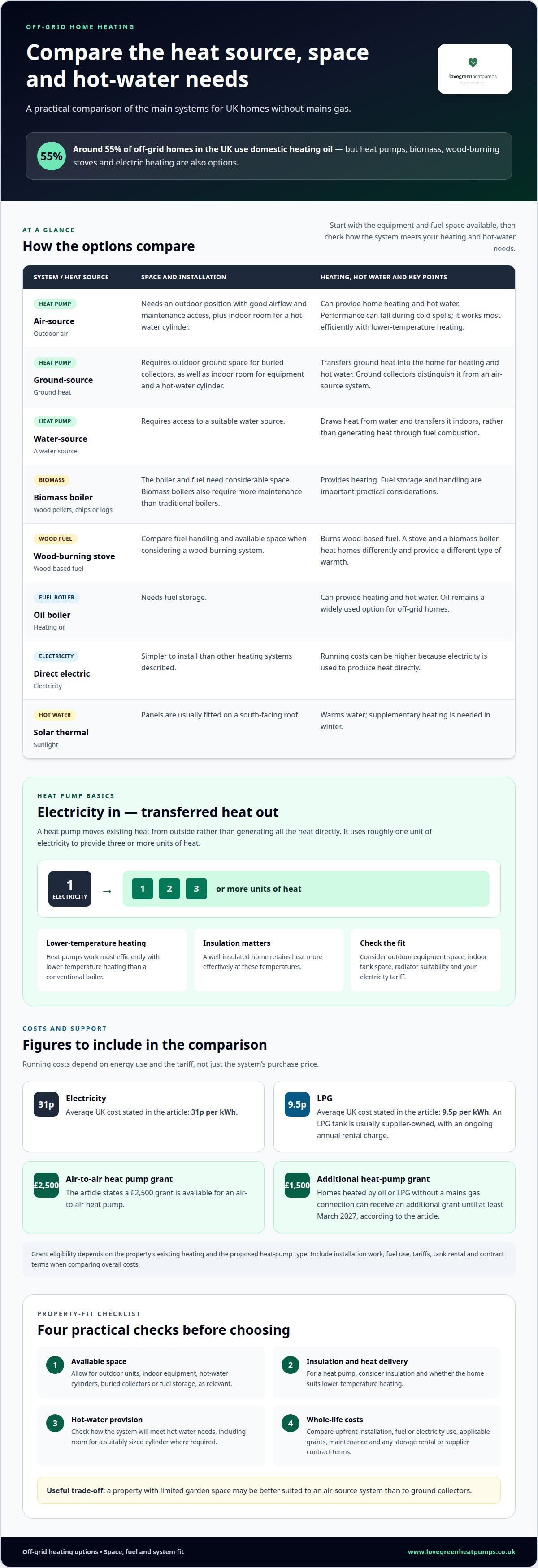
Around 55% of off-grid homes in the UK use domestic heating oil, but it’s only one of several heating options for homes off the gas grid in the UK. Heat pumps, biomass boilers, wood-burning stoves and electric heating are also choices, each with different demands on your budget, available space and hot-water system.
Choosing heating options for off-gas-grid homes in the UK involves more than comparing fuel bills. Upfront costs, fuel storage, installation needs and reliable hot water all affect whether a system suits your home. A heat pump, for example, needs space for equipment and works best when the property is suitable for lower-temperature heating.
This comparison explains how the main options differ in cost, space, installation and hot water, including when oil heating may still make practical sense. Use these trade-offs to narrow down the systems that fit your property and how you want to heat it.
Key Takeaways
- Compare upfront costs with ongoing fuel costs to see which heating system may suit your household budget.
- Factor in space for equipment, fuel storage and hot-water provision before settling on an option.
- Understand how heat pumps work and what your home needs to support lower-temperature heating.
- See where biomass and wood-burning systems differ, including their fuel and space requirements.
- Explore oil heating alongside the alternatives, then learn which grants and installation rules may apply.
What heating options are available off the grid?
A home without mains gas can use a heat pump, biomass boiler, wood-burning stove, oil boiler or electric heating. Solar thermal can support hot water, and some households combine technologies for flexibility.
Air-source heat pumps
An air-source heat pump takes heat from outdoor air and transfers it indoors for heating and hot water. It needs an outdoor position with good airflow and maintenance access, as well as indoor space for a suitably sized hot-water cylinder. Unlike a ground-source system, it does not need buried ground collectors, but its performance can fall during cold spells.
Ground-source heat pumps
A ground-source heat pump collects heat through buried pipes, then transfers it into the home. These ground collectors distinguish it from an air-source unit, which takes heat from outdoor air. Installation requires suitable outdoor ground space, as well as indoor room for the heating equipment and hot-water cylinder.
Water-source heat pumps draw heat from a water source. Like air-source and ground-source systems, they move existing heat rather than generating it through fuel combustion. A heat pump uses roughly one unit of electricity to provide three or more units of heat. It works most efficiently with lower-temperature heating than a conventional boiler, so insulation matters: a well-insulated home retains heat more effectively at these temperatures.
Thermal energy storage holds heat for later use, helping match heating demand to when energy is available. Storage also takes up space and adds equipment, so consider it alongside the heat source.
| Option | Heat source | Space and installation | Heating and hot water |
|---|---|---|---|
| Air-source heat pump | Outdoor air | Outdoor unit and indoor tank | Home heating and hot water |
| Ground-source heat pump | Ground | Buried collectors and indoor equipment | Home heating and hot water |
| Water-source heat pump | Water | Requires access to a suitable water source | Transfers heat indoors |
| Biomass boiler | Wood pellets, chips or logs | Boiler and fuel need considerable space | Provides heating |
| Oil boiler | Heating oil | Needs fuel storage | Can provide heating and hot water |
| Solar thermal | Sunlight | Panels are usually fitted on a south-facing roof | Warms water; needs supplementary winter heating |
Insulation is a practical early consideration for a heat pump, alongside room for its equipment and hot-water tank. The Standard Assessment Procedure (SAP) was first published in 1993 in the UK, according to UK Government. SAP provides a way to assess a home’s energy performance.
Match the heat source and equipment to your home’s insulation, outdoor space, fuel-storage options and hot-water needs. For example, a property with limited garden space may be better suited to an air-source system than to ground collectors.
Heat-pump installation costs and space requirements
Oil and LPG systems need fuel storage, while biomass boilers require space for fuel and more maintenance than traditional boilers. Heat pumps need an outdoor position, indoor equipment and hot-water storage. Whichever system you choose, routine attention helps keep it working properly.
Heat-pump installation costs depend on the property and the work required. An air-source system needs an outdoor unit with airflow and maintenance access, plus indoor space for a hot-water cylinder. Ground-source systems also need room for buried collectors. These requirements affect which system suits a home, especially if garden or utility-room space is limited.
Grants can reduce the amount a household pays towards eligible work. According to UK Government, a £2,500 grant is available for an air-to-air heat pump. Homes heated by oil or LPG without a mains gas connection can receive an additional £1,500 heat-pump grant until at least March 2027, according to UK Government. The property’s existing heating and the proposed heat-pump type matter when considering these grants.
Running costs depend on energy use and the tariff, not just the system’s purchase price. Electricity in the UK costs 31p per kWh on average. LPG costs 9.5p per kWh on average, and an LPG tank is usually owned by the supplier, with an ongoing annual rental charge for the customer. Long supplier contracts can affect flexibility, so include rental charges and contract terms in the overall comparison.
Direct electric heating is simpler to install, but running costs can be higher because it uses electricity to produce heat. Compare systems by type and by how much heat the home needs, rather than treating different equipment as like-for-like.
Heat pumps use electricity differently: they transfer heat from outside instead of producing all the heat directly. They work most efficiently with lower-temperature heating, so insulation, radiator suitability and the household’s electricity tariff all affect running costs. A well-insulated home can retain heat more effectively and support this approach.
- Space: allow for the outdoor unit, indoor tank or fuel storage.
- Upfront outlay: account for installation work and any grant that applies.
- Ongoing costs: compare electricity or fuel use, tariffs and LPG tank rental.
For a property where a heat pump may fit, explore heat-pump installation as part of weighing the system’s layout and running costs.
How do biomass boilers and wood-burning stoves work?
Biomass boilers and wood-burning stoves both burn wood-based fuel, but they heat homes differently. Compare fuel handling, available space, maintenance and the type of warmth each provides.
Biomass boilers
A biomass boiler burns wood pellets, chips or logs to heat a home. Unlike a wood-burning stove, it is a whole-home boiler system rather than an appliance focused on one room. Fuel choice affects how it is delivered and stored. Pellets, chips and logs each need suitable storage close to the boiler.
Biomass boilers can take up considerable space because both the appliance and its fuel need room. They are more practical in properties with space for storage. They also generally need more maintenance than traditional boilers, so ongoing care and fuel handling are part of the ownership decision.
Costs vary by boiler type and installation. Treat different cost measures separately, rather than adding them together as if they made up one quote.
Fuel costs are another part of the comparison: biomass boiler fuel costs around 9.55p per kWh in the UK. The total spent depends on the home’s heat demand and the amount of fuel used. An automatic boiler differs from a manual one in how it handles fuel, but both still require storage and maintenance.
Wood-burning stoves
A wood-burning stove burns wood to provide heat directly in the room where it is installed. This differs from a biomass boiler, which serves as part of a home heating system. Stoves rely on sustainably sourced wood, so the source and supply of logs are practical considerations.
A stove may suit a household seeking heat for one room, while a biomass boiler is designed to heat the home. Both require fuel planning: logs need storage, and boilers need room for the equipment and fuel. The right fit depends on whether you want room-focused warmth or a broader heating system.
Smoke-control rules also affect which fuels you can burn. In a UK Smoke Control Area, only authorised fuels published by DEFRA or smokeless fuels can be burned. Check this when choosing fuel for a stove or other solid-fuel appliance. It is separate from whether a biomass boiler suits the property.
For a practical comparison, first consider storage space, then weigh fuel costs, maintenance and heating coverage. Biomass boilers need considerable room, particularly for fuel. A wood-burning stove avoids a boiler-based setup but mainly heats the room where it is installed. Sustainable fuel sourcing and local smoke-control requirements also matter.
Oil heating for off-grid homes
Domestic heating oil remains a major choice for properties without mains gas. Around 55% of off-grid homes in the UK use it, and liquid fuel heating serves around one million homes in Great Britain. An oil-fired boiler can provide central heating and hot water, making it a familiar alternative where a property already has radiators and fuel storage.
The latest liquid fuel-fired condensing boilers have efficiency ratings of over 90%. Fuel costs around 11.36p per kWh on average, but the household’s total bill depends on heat demand and the price paid for each delivery.
Oil gives households control over when to order fuel. You can choose when to fill the tank and compare suppliers. Some oil suppliers offer automatic refilling, which may help prevent the tank from running dry. The trade-off is practical: you need suitable space for the tank and must keep an eye on fuel levels to plan deliveries.
Oil is a fossil fuel, and an oil boiler can directly produce up to 5 tonnes of carbon per year in a home. HVO, a lower-carbon alternative fuel, can reduce CO2 emissions by up to 90% compared with standard domestic heating oil. That figure describes potential emissions reduction, not a guaranteed change in every property’s overall carbon footprint.
Oil heating may suit a home with an established boiler and central heating, particularly if replacing the whole system would require wider changes. Radiators and underfloor heating distribute warmth differently, so their layout and the home’s heat demand matter when considering alternatives. A heat pump is another option for households moving away from oil, but suitability depends on the property and the work required.
For a fair comparison, separate the boiler purchase cost from ongoing fuel costs, then account for tank space and delivery planning. A rural home with an existing oil system and room for a tank may benefit from the familiar setup and control over delivery timing. A household seeking lower-emission heating may consider renewable alternatives. Government support for heat pumps may also be relevant, but eligibility is not guaranteed and should be confirmed with the scheme administrator before work begins.
Oil remains a common option for homes without mains gas, but its suitability depends on the existing system, storage space and fuel budget. Compare these factors with the installation needs and costs of alternatives before deciding whether to keep oil heating or switch to another system.
What are the UK rules and eligibility requirements for installing a heat pump or biomass boiler?
For off-grid homes, grant eligibility depends on the heating technology and property details. The Boiler Upgrade Scheme provides a £7,500 voucher towards the purchase and installation of an air-source or ground-source heat pump, according to UK Government. Biomass boiler support has a rural-location condition: the scheme offers £5,000 for a biomass boiler if the property is in a rural area.
These amounts are contributions towards eligible work, not full installation prices. The heat-pump voucher applies to the specified air-source and ground-source types, not automatically to every heat pump or other heating system. The biomass grant’s stated rural condition is another key difference when comparing support.
Start by identifying the system you are considering. An air-source heat pump takes heat from outdoor air, while a ground-source model uses buried collectors. A biomass boiler burns wood pellets, chips or logs. These distinctions matter because grant categories name specific heat-pump types, while the biomass grant condition relates to the property’s rural location. Confirm eligibility with the relevant scheme administrator before work begins.
Next, compare the grant with the full project budget. Installation costs depend on the property and the work required, including the heating equipment and any changes to the home. A grant may reduce the amount to fund, but other project costs remain relevant. For biomass, allow for the space needed for the boiler and fuel storage.
Before settling on an option, organise the decision around these points:
- System type: distinguish air-source and ground-source heat pumps from biomass boilers.
- Existing fuel: note whether the home currently uses oil or LPG, as off-grid status is relevant to heat-pump support.
- Property location: establish whether the property is rural when considering the biomass grant.
- Project scope: account for installation work, indoor equipment, outdoor space and fuel storage.
- Grant amount: treat the voucher or biomass contribution as part of the budget, not the total cost.
These checks help separate grant rules from practical suitability. For example, a rural property considering a biomass boiler should weigh the stated location condition alongside fuel-storage needs. If you are considering a heat pump, identify whether it is air-source or ground-source, then account for the work needed to install it.
For a heat-pump project, explore heat-pump installation and how the system could fit your property.
Love Green Heat Pumps: Heating Engineer
Love Green Heat Pumps Ltd can assess whether a heat pump suits your off-grid home and its heating needs. Every installation follows a home survey and heat-loss calculation, with system design, installation and commissioning tailored to the property.
This is a useful next step if you are comparing a heat pump with oil or electric heating, or want to understand how your property’s layout affects installation. Love Green Heat Pumps also installs solar PV, which can be considered as part of a wider renewables plan. Biomass and wood-burning systems remain separate options in this comparison.
For a tailored view of your home’s heating needs, contact Love Green Heat Pumps Ltd.
Plan a heating change around your home
Choosing heating options for off-gas-grid homes in the UK works best as part of a whole-home plan. Consider how you want your home to feel through winter and whether changes to its energy setup could support that goal. This wider view helps you choose a system that fits daily life, not just the equipment already in place.
Love Green Heat Pumps Ltd offers heat pump installation and Solar PV & Other Renewables, with air conditioning also available. If you’re ready to explore how these services might fit your plans, contact Love Green Heat Pumps Ltd to start a conversation. A clear next step can make planning your home’s future heating feel manageable.
Frequently Asked Questions
How do heat pumps work?
A heat pump uses electricity to move heat from outside into your home instead of generating all its heat by burning fuel. Air-source models take heat from outdoor air; ground-source models collect it from the ground. Roughly one unit of electricity can provide three or more units of heat. The system can supply warmth to radiators and heat water in a cylinder for household use.
How can I heat my house without gas?
You can heat a home without mains gas using a heat pump, an oil or LPG boiler, direct electric heating, a biomass boiler or a wood-burning stove. Solar thermal can contribute to hot water but needs supplementary heating in colder months. The practical choice depends on your existing system, available space, insulation and hot-water needs. A home with an oil tank has different constraints from a compact property.
How do electric radiators and boilers work?
Electric radiators convert electricity into heat at the point of use, warming rooms directly. An electric boiler heats water that circulates through radiators or another wet heating system. Radiators can be added room by room, while a boiler may use existing pipework. Both rely on the home’s electricity supply, so the tariff and the property’s heat demand affect running costs.
Sustainable heating systems: what are the options?
Options include heat pumps, solar thermal for hot water, solar PV paired with electric heating, and biomass using sustainably sourced wood. Each has different practical requirements. Solar thermal needs supplementary heating in colder winter months, while biomass needs space for the boiler and fuel. Solar PV can supply electricity to a heat pump. The right combination depends on the property’s layout, energy use and available space.
What does “off-grid” mean?
In home-heating discussions, “off-grid” usually means a property is not connected to the mains gas network. It does not necessarily mean the home is disconnected from the electricity grid. A house heated by an oil tank may still have mains electricity. This distinction matters because heat pumps and electric radiators need electricity even when a property has no mains gas connection.
What heating systems are available for off-gas-grid homes in the UK?
Heating options for off-gas-grid homes in the UK include air-source, ground-source and water-source heat pumps, oil or LPG boilers, electric heating, biomass boilers and wood-burning stoves. Solar thermal can help heat water, while solar PV can work alongside electric systems. A home with limited outdoor space may need a different setup from a larger rural property. Consider heating coverage and hot water as well as space for equipment.
How do air-source and ground-source heat pumps compare for off-grid homes in the UK?
Among heating options for off-gas-grid homes in the UK, heat pumps mainly differ in where they collect heat. An air-source unit takes heat from outdoor air and needs a suitable position with airflow and maintenance access. A ground-source system uses buried collectors, so the property needs suitable ground space. For example, limited garden space can make ground collectors difficult to accommodate. Indoor room for equipment matters too.
How much does heating oil or LPG cost in the UK, and how do prices vary by region?
Average fuel costs are 11.36p per kWh for heating oil and 9.5p per kWh for LPG in the UK. These are average rates, not a household’s full bill: total spending depends on fuel use and the price paid for each delivery. Homeowners using oil can choose when to fill their tank and shop among suppliers. LPG customers may also pay an annual tank rental charge.
Disclaimer
Disclaimer
The information published on this website is provided by Love Green Heat Pumps for general information and educational purposes. As a specialist provider of heating and renewable energy solutions, we strive to ensure that our content is accurate, relevant and up to date. However, heating requirements, system suitability, installation specifications, costs and performance can vary depending on individual property characteristics, usage and other site-specific factors.
Information provided in our articles should not be regarded as a substitute for a professional property assessment, technical survey or tailored recommendation. Any decisions regarding the selection, installation, replacement or maintenance of heating systems should be made with appropriate professional guidance.
Love Green Heat Pumps accepts no responsibility for decisions made solely on the basis of general information published in these articles. For advice specific to your property or project, we encourage you to contact our team for professional guidance and an assessment of your requirements.


