

The installer’s promise matters most if they can no longer honour it. An insurance-backed guarantee for a solar installation can protect you if the installer ceases trading and cannot fulfil its written guarantee. The cost depends on the cover and guarantee period. Installer guarantee periods can range from 2 to 10 years, while solar panel warranties typically last a decade or longer.
It’s sensible to look beyond the headline warranty when assessing protection for a solar PV system. An insurance-backed guarantee supports the installer’s original workmanship guarantee, subject to the insurer’s terms. Cover begins only once you’ve received the certificate.
This guide explains what can affect the cost, how long protection may last and what the certificate and installer’s written guarantee mean in practice. It also outlines what to do if an installer stops trading, so you can understand the protection before proceeding with a solar installation.
Key Takeaways
- Understand what the guarantee protects: it backs the installer’s original workmanship guarantee, subject to the insurer’s terms.
- See which documents matter, including a valid contract, the written workmanship guarantee and a certificate naming the installer.
- Learn how the cover’s scope and guarantee period affect the cost, and what details to look for in the terms.
- Find out why payments must go directly to the installer named on the certificate and what needs to be in place for protection to apply.
- Explore how solar PV installation and its protection fit together, including what completion and defect-free work mean for cover.
Protection if an installer ceases trading
If a solar installer ceases trading, they may no longer be able to honour their written workmanship guarantee. An insurance-backed guarantee can provide financial protection in that situation. It backs the original guarantee, rather than making a separate promise about every part of the system. Cover depends on the certificate and the insurer’s terms.
For example, imagine a fault appears in work covered by the installer’s workmanship guarantee after the installer has stopped trading. The guarantee may provide a route to financial protection for that covered work. The certificate and policy terms determine what is included and how to make a claim. It doesn’t automatically cover every fault, repair or loss connected with the installation.
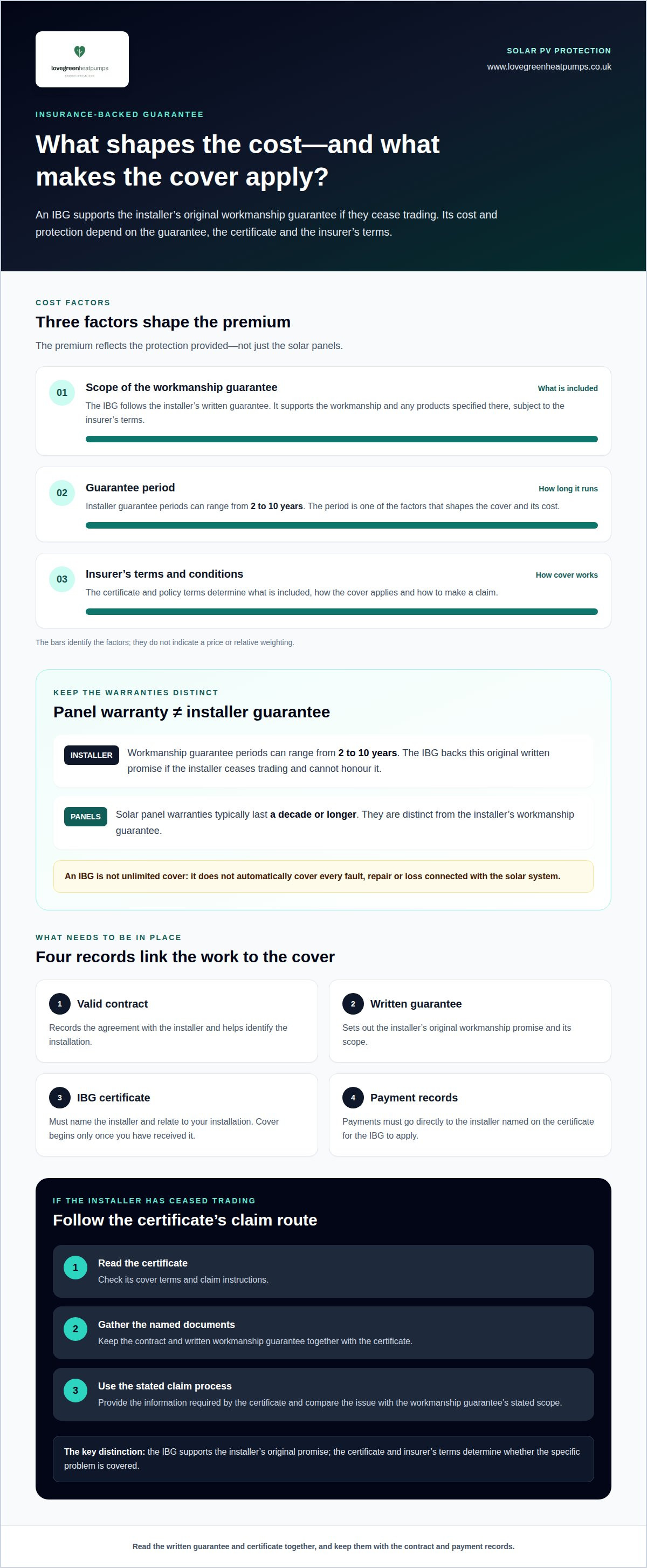
To benefit, the paperwork needs to link the solar installation, the installer and the cover. You need a valid contract and workmanship guarantee, and the installer must be named on the certificate. The certificate is important for confirming when cover applies. Keep these documents together so you can find the relevant guarantee if the installer later ceases trading.
- Keep the contract: It records the agreement with the installer and helps identify the installation.
- Save the written guarantee: This shows the original workmanship covered by the installer’s promise.
- Retain the certificate: Check that it names the installer and relates to your installation.
- Keep payment records: Payments must be made directly to the installer named on the certificate.
If the installer stops trading, gather your records and read the certificate’s claim instructions. Compare the issue with the written workmanship guarantee, then follow the process set out in the policy. For instance, a problem with work described in the guarantee is different from an issue outside its stated scope. The terms determine whether the specific problem is covered.
An insurance-backed guarantee for a solar installation is a back-up for the installer’s written workmanship promise, not a substitute for understanding it. Before work begins, read the guarantee and check what work it covers. After installation, keep the certificate with the contract and proof of payment. These documents will help you understand the protection if the installer can no longer trade or respond to a warranty issue.
How much does an insurance backed guarantee for solar PV cost?
The cost depends on the cover’s terms and the workmanship guarantee it supports. To make a claim, follow the certificate’s instructions and provide the specified documents, including your contract and workmanship guarantee.
Warranty terms and IBG certificates
An insurance-backed guarantee, or IBG, backs the installer’s original workmanship guarantee. Its cover applies to the products and workmanship included in that guarantee, subject to the insurer’s terms and conditions. Read both documents together: the workmanship guarantee sets out the original promise, while the certificate identifies the insurer-backed protection.
Before work begins, read the written guarantee and check that the contract names the installer. Once the installation is complete, make sure you receive a certificate naming the same installer. Cover starts only when you’ve received the certificate, so keep it with your contract and guarantee.
Workmanship warranty insurance
Workmanship warranty insurance provides financial protection if the installer ceases trading and can’t honour its written guarantee. It doesn’t replace the installer’s original promise with unlimited cover. Instead, it supports the workmanship and any products specified in that guarantee, within the insurer’s terms.
That distinction matters if a fault appears. For example, a problem with work covered by the installer’s guarantee differs from a product issue outside its stated scope. The IBG follows the original guarantee, so its scope and conditions determine what the insurance covers.
The premium reflects the protection provided, not just the solar panels. The scope and period of the installer’s workmanship guarantee, along with the insurer’s terms, shape the cover and its cost. Compare the written guarantee with the certificate to understand what the protection is designed to support.
Keep the claim documents together. You need a valid contract and workmanship guarantee, and the installer must be named on the certificate. Payments must also go directly to that named installer for the IBG to apply. These details link the insured work to the correct contract and certificate.
If the installer is still trading, refer first to the workmanship guarantee, which sets out the original promise. If the installer has ceased trading and can’t honour it, the IBG may provide financial protection for work within the guarantee’s scope. In either case, the certificate’s terms explain how the cover works.
- Find the certificate and read its claim instructions and cover terms.
- Gather the contract and written workmanship guarantee named in the certificate.
- Use the certificate’s claim route and provide the information it requires.
For a solar project, reviewing the solar PV installation planning alongside the contract can help keep the installation details and guarantee paperwork aligned.
Solar installation insurance-backed guarantee protection
An insurance-backed guarantee supports the installer’s original workmanship guarantee if they can’t honour it. It covers the products and workmanship included in that guarantee, subject to the insurer’s terms, not every fault or loss connected with the solar system.
Financial protection products
Financial protection for a solar contract can address different stages of the installation. An insurance-backed guarantee relates to the installer’s workmanship guarantee, while deposit protection concerns money paid before work is complete. These protections aren’t interchangeable, so read the contract and product terms to see which risk each one addresses.
For deposit protection, look for the maximum amount covered and the circumstances that allow a claim. The contract should explain how payment stages relate to the installation work. For the IBG to apply, all payments must go directly to the installer named on its certificate.
MCS financial protection
Fully compliant MCS financial protections became available from March 2026. MCS financial protections for renewable energy contracts remained mandatory after IWA insurance stopped being purchasable through the MCS MID system. The named insurance product and the wider financial protection requirement are distinct matters; the change to IWA insurance did not remove that requirement.
Before agreeing to a solar contract, identify the financial protection provided and read its terms. Check who provides it, what event it protects against and how to make a claim. Homeowners should also ensure the financial protection product is regulated. These details help clarify whether the protection relates to a deposit, the installer’s workmanship promise or another contractual risk.
Guarantee cover and exclusions
The guarantee covers the products and workmanship included in the installer’s workmanship guarantee, subject to the insurer’s terms and conditions. The original guarantee sets the boundaries. For example, a defect in covered installation work may fall within its scope, while a fault outside the written guarantee isn’t covered simply because an IBG exists.
Read the exclusions and claim conditions alongside the description of cover. Note any requirements relating to completion, defects, payment and documents. To benefit from an IBG, the installation must be fully completed to your satisfaction and free from defects. You also need a valid contract and workmanship guarantee, with the installer named on the certificate.
Before signing, compare the contract, deposit protection terms and workmanship guarantee. Confirm that each document describes the same installation and installer. Keep copies of the contract, payment records and protection documents together. If a concern arises, follow the relevant product’s claim instructions: deposit protection and workmanship cover may involve different processes and protect against different events.
Guarantee durations
Installer guarantee periods can range from 2 to 10 years. Solar panel warranties typically last a decade or sometimes longer. These periods describe different promises, so compare the written terms rather than treating them as one shared guarantee. An insurance-backed guarantee supports the installer’s workmanship guarantee, making that original period central to understanding its duration.
Start with the installer’s written workmanship guarantee. Find its stated duration, the work it covers and when the period begins. Then compare those details with the insurance-backed guarantee certificate. The certificate should identify the installer and the relevant cover. Reading both documents together helps clarify how long the workmanship protection lasts and which conditions apply.
A solar panel warranty lasting a decade or longer doesn’t automatically mean the installer’s workmanship guarantee lasts just as long. For example, the panel warranty and installer’s guarantee may cover different things for different periods. The IBG backs the workmanship guarantee, subject to its terms. It doesn’t extend the installer’s original promise just because a separate panel warranty continues.
Use this document check before agreeing to the installation:
- Find the period: Note the duration written in the installer’s workmanship guarantee.
- Identify the start point: Read how the guarantee defines when its period begins.
- Compare the certificate: Check the installer’s name and the cover period against the written guarantee.
- Separate the warranties: Record the solar panel warranty period separately from workmanship cover.
That comparison matters as the system ages. If a concern arises, its timing can help you identify which written terms to read. Assess a workmanship issue against the installer’s guarantee and supporting certificate. Assess a panel issue against the panel warranty. For either, the relevant document sets the period and scope; a longer period in one document doesn’t change another.
Keep the contract, certificate and warranties together, with a note of the relevant dates. If the installer ceases trading, the IBG is intended to support the original workmanship guarantee, not create a new duration. The certificate’s terms and the original written promise therefore remain important throughout the stated period.
Before proceeding, make sure the paperwork gives you a clear view of each protection period. Compare the 2-to-10-year range seen in installer guarantees with the separate panel warranty stated for your system. Focus on the written duration, the work covered and the certificate’s terms. That simple comparison makes it easier to understand which promise applies at each stage of ownership.
Insurance-backed guarantees for solar PV installation
UK solar installers can arrange insurance-backed protection for their workmanship guarantees. There isn’t one named provider for every installation, so check the certificate and contract to identify the arrangement for your project.
The key distinction is what the protection is designed to do. An insurance-backed guarantee supports the installer’s original workmanship guarantee if the installer ceases trading and can’t honour it. It doesn’t automatically cover every solar panel fault, deposit, delay or financial loss. The written guarantee and protection terms define its scope.
For MCS-related protection, fully compliant MCS financial protections became available from March 2026. MCS financial protections for renewable energy contracts remained mandatory after IWA insurance stopped being purchasable through the MCS MID system. That change concerns the availability of IWA insurance through that system; it doesn’t mean the wider MCS financial protection requirement ended.
Check the actual documents for your installation rather than relying on a general statement that cover is included. The installer named on the certificate should match the installer in your contract and workmanship guarantee. Payments must go directly to the installer named on the certificate. These details link the protection to the relevant agreement.
- Before signing: Read the contract and request the written workmanship guarantee.
- Before paying: Identify the financial protection provided and check that the product is regulated.
- After installation: Keep the certificate with the contract, guarantee and payment records.
- Before claiming: Follow the certificate’s instructions and compare the issue with the guarantee’s scope.
Completion also matters. To benefit from an insurance-backed guarantee, the installation must be fully completed to your satisfaction and free from defects. For example, that condition isn’t met if the installation remains unfinished. Keep the completion paperwork with the certificate so the documents for the same solar project stay together.
When comparing protection, separate three questions: who arranged the cover, which written workmanship guarantee it supports, and what financial risks another product addresses. Deposit protection and an installer’s workmanship guarantee serve different purposes. The certificate identifies the relevant cover, while its terms explain the conditions and claim process.
There’s no single provider name that answers the question for every UK household. Identify the arrangement attached to your contract, then match its certificate to the named installer and written guarantee. For MCS contracts, distinguish the wider financial protection requirement from IWA insurance’s former availability through the MCS MID system.
No specific UK provider is identified; the applicable arrangement depends on the installation. Check the certificate and contract to see who arranged the protection.
Love Green Heat Pumps: Heat Pump Installation
Love Green Heat Pumps Ltd provides solar PV and other renewable energy solutions for homes and businesses. If you’re planning a solar installation, the team manages the process from design through to commissioning, helping take the project from its initial plan to a completed system.
The guarantee information in this article can help you understand what to look for in your installation paperwork. Keep the written workmanship guarantee and insurance-backed guarantee certificate with your contract, and check that the documents relate to the same installer and project. This gives you a clear record alongside the solar PV work.
For a solar PV project, contact Love Green Heat Pumps Ltd to discuss your installation.
Take the next step with confidence
Planning a solar project is a good time to consider how the installation and its paperwork fit together. An insurance-backed guarantee for a solar installation is one part of the decision, alongside the system design and the terms in your documents. Understanding these elements can help you move forward with a clearer picture of the project.
Love Green Heat Pumps Ltd can help you explore solar PV as part of your plans for your home or business. If you’re ready to discuss what you have in mind, contact Love Green Heat Pumps Ltd. A straightforward conversation is a practical place to begin shaping your next step.
Frequently Asked Questions
What is an insurance-backed guarantee (IBG) for a solar installation in the UK?
An IBG is insurance protection that supports an installer’s written workmanship guarantee if the installer can’t honour it. It doesn’t replace the original guarantee or cover every issue with a solar system. For example, a panel fault may fall under a manufacturer’s warranty, while an installation defect may relate to the workmanship guarantee. The documents define which protection applies to each problem.
How long do UK solar installation IBGs typically last?
The IBG generally follows the period and scope of the installer’s workmanship guarantee. Installer guarantee periods can range from 2 to 10 years, while solar panel warranties typically last a decade or sometimes longer. These are separate protections, so compare the dates in each document. For example, a panel warranty may continue after the workmanship guarantee period has ended.
How much does an insurance-backed guarantee for solar panels cost in the UK?
There isn’t a single standard cost for an IBG on every solar installation. The amount depends on the cover provided, the period supported and the insurer’s terms. Compare the guarantee and certificate to understand what protection the cost relates to. The key question is whether the policy backs the workmanship promise you need, not simply whether an IBG is mentioned in the installation paperwork.
Is an IBG required for MCS-certified solar installers or consumer protection schemes?
An IBG and MCS financial protection aren’t interchangeable terms. Fully compliant MCS financial protections became available from March 2026, and those protections remained mandatory for renewable energy contracts after IWA insurance stopped being purchasable through the MCS MID system. This doesn’t establish that every installer must provide an IBG specifically. Look at the financial protection attached to the contract and the product’s terms.
How can I check whether a solar installer’s IBG is valid and financially protected?
Match the certificate to your contract and workmanship guarantee. Check that the installer named on the certificate is the one you contracted with, and that the documents relate to your installation. Confirm that the financial protection product is regulated, and retain proof that payments went directly to the named installer. Cover starts only once you’ve received the certificate, so keep a copy safely.
What happens to a solar panel guarantee if the installer closes down?
If the installer closes and can’t honour its written workmanship guarantee, an IBG can provide financial protection for the covered work, subject to the insurer’s terms. It doesn’t automatically take over a manufacturer’s panel warranty. For example, consider a panel defect under the manufacturer’s separate terms, while an installation-work issue relates to the installer’s guarantee and supporting certificate.
How do IBGs compare with manufacturer warranties and workmanship guarantees?
A manufacturer’s warranty concerns the product, such as a solar panel, while a workmanship guarantee concerns the installer’s work. An IBG backs the installer’s original workmanship guarantee if they can’t honour it. These documents serve different purposes. For an inverter product fault, consult its manufacturer’s warranty; for defective installation work, check the workmanship guarantee and its supporting insurance cover.
What should I check in the IBG policy before signing a solar installation contract?
Read the policy’s covered work, exclusions, claim instructions and conditions alongside the proposed workmanship guarantee. Check that the contract identifies the installer who will appear on the certificate, and understand how the certificate will be issued. Confirm how payment must be made: payments need to go directly to the installer named on the certificate. Keep copies of all signed documents and payment records.
Disclaimer
Disclaimer
The information published on this website is provided by Love Green Heat Pumps for general information and educational purposes. As a specialist provider of heating and renewable energy solutions, we strive to ensure that our content is accurate, relevant and up to date. However, heating requirements, system suitability, installation specifications, costs and performance can vary depending on individual property characteristics, usage and other site-specific factors.
Information provided in our articles should not be regarded as a substitute for a professional property assessment, technical survey or tailored recommendation. Any decisions regarding the selection, installation, replacement or maintenance of heating systems should be made with appropriate professional guidance.
Love Green Heat Pumps accepts no responsibility for decisions made solely on the basis of general information published in these articles. For advice specific to your property or project, we encourage you to contact our team for professional guidance and an assessment of your requirements.


