

What if the lowest call-out fee doesn’t lead to the lowest final bill? Heating engineering call out rates can cover different things, so the headline figure alone may not show what you’ll pay for diagnosis and any work needed to fix the fault.
It’s reasonable to want to know whether the first charge includes travel, an assessment or time spent on site. It may cover an initial diagnosis, while labour, parts or further work could be charged separately. A diagnostic visit and a repair are not always the same job, so don’t assume the initial fee is the full repair price.
This guide explains the billing structures you may encounter in 2026 and what can affect a call-out rate. It shows how to compare a call-out fee with hourly or fixed-price quotes, and what to look for in writing: what’s included, what may cost extra and how further work will be priced. Love Green Heat Pumps Ltd provides heating engineering services, including diagnostics, troubleshooting, routine servicing, plumbing and pipework adjustments. Clear cost details help you understand the work before it goes ahead.
Key Takeaways
- Heating engineering call out rates can use different billing structures, so compare the type of charge as well as the amount.
- Fault complexity, time needed and access to the equipment can all affect the scope of work.
- Use a written quote to see how labour, parts, travel, VAT and follow-up visits are handled, where applicable.
- Separate the cost of diagnosing a problem from the price of any work needed to resolve it.
- Love Green Heat Pumps provides heating diagnostics, plumbing, routine servicing, pipework adjustments and troubleshooting. Installation project fees are separate from call-out charges.
Heating engineering call-out rates: what the first visit is for
A call-out rate is a charge associated with an engineer attending your home to assess a reported heating issue. The visit gives the engineer an opportunity to understand the symptoms, examine relevant parts of the system and identify a suitable next step. What the charge covers depends on the agreed terms, so heating engineering call out rates shouldn’t automatically be treated as repair prices.
A call-out fee describes an attendance charge, not necessarily the full cost of a repair. Diagnosis may identify the likely fault, but further labour, parts or a separate visit may be needed to put it right. Keep the task in view: routine servicing, plumbing work, fault-finding and remedial work have different scopes, even when they involve the same heating system.
What happens during a heating engineer’s call-out?
The engineer starts by reviewing what you’ve noticed, such as a heating system that isn’t responding as expected or a room that isn’t warming up. They can then examine relevant components and use heating troubleshooting and system diagnostics to narrow down possible causes. The checks depend on the symptoms and the system involved.
This assessment helps establish what should happen next. It may show that more detailed fault-finding or repair work is needed. Diagnosis doesn’t guarantee the fault can be resolved during the first visit, and it isn’t the same as a routine service, which is a separate type of appointment.
Why an initial visit may not resolve every heating fault
The cause of the problem, access to the affected equipment and the parts required can all affect what’s practical to complete on site. A straightforward issue may become clear after an assessment. If the fault is harder to trace, or the necessary parts aren’t available during the visit, the next step may need to be arranged separately.
That’s why it helps to distinguish the diagnostic visit from any work that follows. The engineer may identify a need for pipework adjustments, plumbing or other remedial work, but those tasks aren’t automatically included in the attendance charge. Servicing is also a separate job scope, not an assumed part of troubleshooting. A clear explanation of the findings and proposed work makes it easier to understand what you’re agreeing to.
For a broader look at how engineers investigate heating faults, UK heating system diagnostics provides useful context. Once the assessment has clarified the likely issue, consider the proposed work as a separate stage, with its scope and cost set out clearly.
What heating engineering call-out rates may include
Heating engineering call out rates can describe different charging arrangements. One quote may combine attendance and some time on site; another may list travel, labour and parts separately. There isn’t one arrangement that applies to every business or job, so compare the stated inclusions instead of assuming a familiar label means the same thing each time.
Check whether each quoted charge covers attendance, time on site, labour, parts or a later visit. The table shows common ways charges may be presented, not a standard set of inclusions.
| Charge type | What it may describe | What to clarify |
|---|---|---|
| Attendance fee | The engineer attending to assess the issue. Travel may be included or listed separately. | Whether the fee covers travel, assessment or any time on site. |
| Hourly labour | Time spent carrying out agreed work, charged by the hour. | When the clock starts, how time is recorded and whether there’s a minimum charge. |
| Fixed-price task | An agreed price for a defined piece of work once its scope is understood. | Which labour, parts and materials are included, and what falls outside the task. |
| Follow-up visit | A later attendance to continue or complete work. | Whether another attendance or travel charge applies under the quote. |
Call-out fee versus hourly labour
A call-out fee and hourly labour may appear as separate line items or be combined under the agreed terms. Neither format is automatically cheaper or better. To compare fairly, find out when time-based labour begins and how time on the job is recorded. A clear quote should distinguish the attendance charge from the work carried out after assessment.
Fixed work, parts and follow-up visits
Once the work is understood, a fixed quote may set out the price for a defined task. Parts and materials can be itemised separately from labour, making it easier to see what contributes to the total. If work needs to continue on another day, a second visit may carry a separate charge if the terms say so. Check this before agreeing, especially if the plan could involve more than one stage.
For a useful comparison, read each quote as a list of possible cost components: attendance, labour, parts, materials, travel and any additional visit. Check whether VAT is stated, where applicable, and note any exclusions. This helps show whether two quotes cover the same work, even if their billing formats differ.
If you need heating diagnostics, plumbing, routine servicing, pipework adjustments or troubleshooting, Love Green Heat Pumps Ltd’s heating engineering services cover these practical needs. Installation project pricing is separate from call-out or repair charges.
What makes heating engineering call-out rates vary?
Heating engineering call out rates can reflect more than the time spent at your home. The work may involve a quick adjustment, careful fault-finding or several tasks that need to be priced separately. A fair comparison starts by matching the work scope and the charges included.
Before comparing quotes, describe what the system is doing and when the problem occurs. For example, a fault that appears intermittently may take more investigation than one with an obvious cause. Clear details help the engineer understand the reported problem, though the full scope may only become clear after assessment.
Job scope, access and time on site
A simple adjustment differs from tracing a fault that comes and goes or may involve several parts of the heating system. Access matters too. If relevant equipment is difficult to reach, additional work may be needed. The system’s condition and the information available before the visit can also affect what can be assessed and completed. There’s no reliable fixed diagnosis time for every fault.
When reviewing a quote, note whether it covers assessment alone or describes specific work to be carried out. If the engineer identifies a need for further troubleshooting, plumbing or pipework adjustments, the scope may change. A written explanation of the proposed task helps you understand why its price may differ from a quote for a simpler job.
Urgency, parts and additional work
Requested timing can affect the terms offered for an appointment. A routine, planned visit and a request for more urgent attention may not be priced or arranged in the same way. This doesn’t mean every heating issue needs urgent attendance. Focus on the terms for the particular request, including any stated charges, rather than assuming an out-of-hours rate or availability.
Parts and materials should be distinguishable from attendance and labour. For instance, a quote might show the engineer’s time separately from a component needed to complete a repair. If further work is recommended after diagnosis, treat it as a separate scope: look at what the work involves, whether parts are included and whether another visit is expected.
For a clearer comparison, check that each quote describes the same task and accounts for the same possible cost elements. Consider:
- What symptoms and equipment the assessment covers.
- Whether the stated work is diagnosis, adjustment, repair or servicing.
- How parts, materials and any extra labour are presented.
- Whether further attendance may be charged separately under the terms.
These details make a headline fee easier to interpret. They also help distinguish a difference in price from a difference in what’s being offered. If the scope changes after the issue has been assessed, a revised outline of the work and charges can help you decide how to proceed.
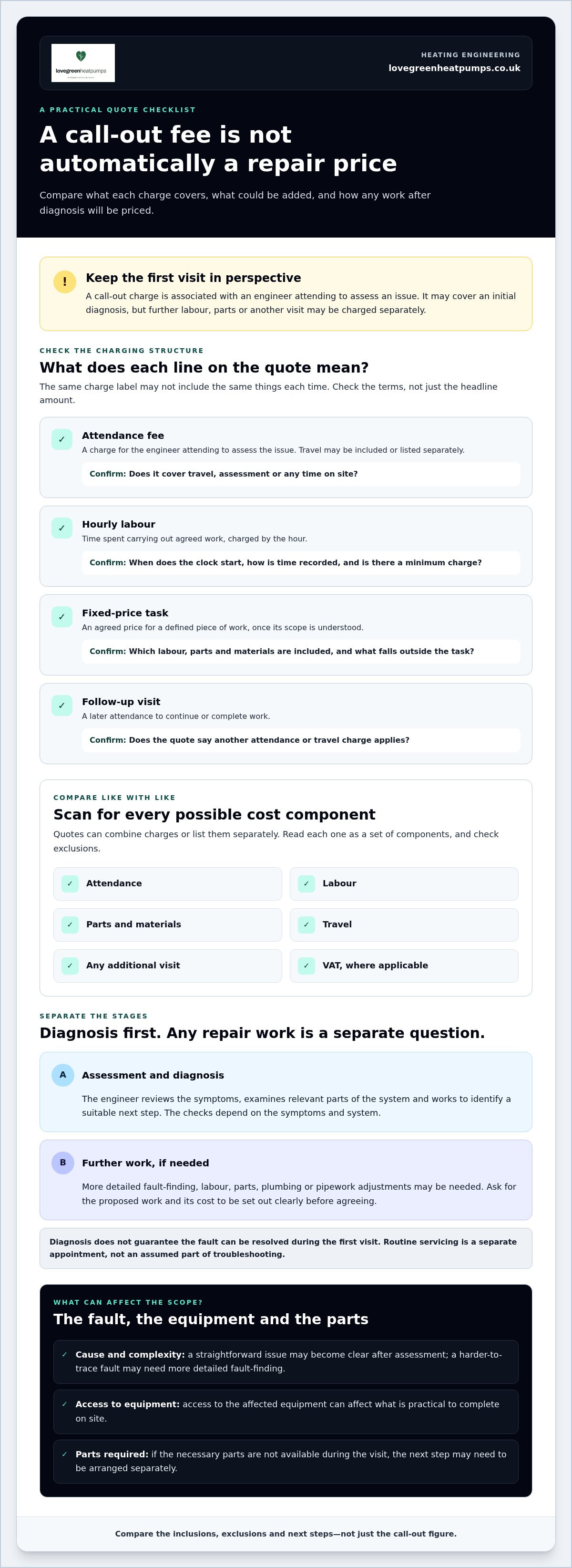
How to compare heating engineering call-out quotes
A headline attendance charge only tells part of the story. To compare heating engineering call out rates clearly, line up what each quote covers and what could be added if the engineer identifies further work. A written, itemised quote makes the scope easier to understand and helps prevent an initial fee being mistaken for the total job cost.
A practical checklist before agreeing to a visit
Start with the fault and the task. Check that the written terms describe the issue you’ve reported and whether the visit is for diagnosis, servicing or a specific repair. Then review the attendance charge and note which possible costs sit outside it. Keep the agreed terms to hand in case the proposed work changes after assessment.
Work through these checks in order:
- Identify the job. Make sure the symptoms and requested service are described clearly.
- Check the fee. See what the attendance charge covers, including any stated travel or time on site.
- Compare inclusions. Look for labour, parts, materials and VAT, where applicable, and whether each is included or listed separately.
- Review possible extras. Check the terms for additional labour, another visit or other charges if the work needs to continue.
These details matter because two quotes with different headline figures may cover different tasks. One might price an assessment, while another sets out a defined repair. Comparing like with like gives you a clearer view of the proposed cost and the work involved.
How to assess a quote if more work is needed
If the assessment identifies additional work, review the revised scope before it proceeds. The updated terms should make clear what has been found, what work is proposed and how its charges are presented. Compare that scope with the original agreement, rather than judging the total only by the first attendance charge.
For example, a reported heating fault may lead to a recommendation for a pipework adjustment or a replacement part. Check whether the new figure separates labour from parts and materials, and whether another attendance is included or charged separately under the terms. Keep the original quote alongside the updated one. That makes changes easier to follow and gives you a useful record of what you’ve agreed.
If the issue concerns a recently installed heat pump, the system’s design and commissioning information may help frame the discussion. The phrase heat pump system design and commissioning describes the relevant context, but the call-out quote should still set out the investigation and any follow-on work as distinct items, where applicable.
Love Green Heat Pumps Ltd provides heating diagnostics, plumbing, routine servicing, pipework adjustments and troubleshooting. To explore heating engineering support, describe the issue and proposed work. Installation project quotes are separate from call-out and repair charges.
Heating engineering support from Love Green Heat Pumps
A heating problem can be unsettling, especially when it's not clear whether you need fault-finding, a service or work to put something right. Love Green Heat Pumps Ltd provides heating engineering support across the UK, including system diagnostics, heating troubleshooting, plumbing, routine servicing and pipework adjustments. Start with a clear description of what's happening and what you need the system to do.
Understanding the difference between an assessment and follow-on work can also help you make sense of heating engineering call out rates. A diagnostic visit investigates the reported issue. Any repair or additional task has its own scope and shouldn't be assumed to form part of an attendance charge. Heat-pump installation projects are separate from call-out or repair work, with their own project scope and pricing.
Which heating engineering issues can the team help with?
Support can include investigating a heating fault, routine servicing and troubleshooting when a system isn't behaving as expected. Plumbing and pipework adjustments may also be relevant to a heating system. The work depends on the issue and the task required, so describing the symptoms clearly helps establish what needs to be assessed.
For example, note when the problem occurs, which parts of the system seem affected and whether anything has changed. This practical context can help the engineer understand the concern and explain a suitable next step. Diagnosis and the work that follows remain distinct: identifying a likely cause doesn't automatically mean every repair can be completed as part of the initial assessment.
Take the next step with a clear understanding of the work
Before arranging support, describe the heating issue in everyday terms and explain the result you're looking for, such as restoring heating to an affected area or investigating unusual system behaviour. You don't need to know the technical cause. A clear account of what you've noticed gives the conversation a useful starting point.
As the work is discussed, keep the agreed scope and charge terms clear. Check what the visit is intended to cover and how any further work will be set out before it proceeds. If the assessment points to a separate repair, servicing task or pipework adjustment, understanding that distinction helps you decide on the next step without treating the initial attendance charge as the full job price.
Love Green Heat Pumps Ltd offers heating engineering support for diagnostics, plumbing, routine servicing, pipework adjustments and troubleshooting. Installation projects have a separate scope and pricing from call-out or repair charges. Talk to Love Green Heat Pumps Ltd about heating engineering support and describe the issue you'd like help with.
Take a clear next step for your heating system
A heating fault can feel easier to manage once the next step is clear. Use the written terms as your reference point, and keep any updated scope with the original quote. That gives you a practical record as the work moves from assessment to any agreed follow-on task.
Understanding heating engineering call out rates is less about choosing the smallest first charge and more about knowing what you’re agreeing to. If something changes after the issue has been assessed, take time to understand the revised work and charges before deciding how to proceed. Clear terms help you make a considered choice.
Love Green Heat Pumps supports householders with heating engineering needs. If you’re ready to discuss an issue with your system, get in touch about your heating problem. Describe what’s happening to get the conversation started, then review the work and charges before agreeing to the next step.
Frequently Asked Questions
Does a heating engineer’s call-out fee include labour?
Not always; it depends on the written terms. One quote might include a stated amount of on-site time, while another charges separately for attendance and labour. Before agreeing, check how the fee is described and whether any included time applies to assessment, repair work or both. If the engineer recommends additional work, review its scope and charges separately before deciding whether to proceed.
Is a call-out fee the same as an hourly rate?
No. A call-out fee relates to attendance at the property, while an hourly rate is based on time spent working. A business may combine the charges or show them separately. For example, a quote might list attendance first, then charge for a later adjustment by time. Compare when labour begins and whether any further attendance is treated as a separate charge.
Are parts and materials included in heating engineering call-out rates?
Not necessarily. Heating engineering call out rates may relate to the visit, while replacement components or materials are listed separately. If a repair is proposed, check whether the quote identifies the parts, related labour and any additional materials. This is useful when comparing a repair involving a replacement component with one involving adjustment or investigation, as the scopes may differ.
Can a heating engineer diagnose a fault during the first visit?
Often, the first visit is intended to assess the reported issue and identify a likely cause, but some faults need further investigation. If the problem appears intermittently, note when it happens and any display messages or changes in system behaviour. That information can help inform the assessment. A diagnosis is a finding, not a promise that the repair can be completed during the same visit.
Do heating engineering call-out rates change for urgent appointments?
They can, depending on the appointment terms and timing requested. Don’t assume every business provides out-of-hours or emergency attendance. If you’re considering an urgent appointment, review the stated timing terms and any related charge before confirming it. Keep attendance costs distinct from later repair labour or parts, so you can understand which charges relate to the visit and which relate to resolving the fault.
Should I check whether VAT is included in a heating engineer’s quote?
Yes. Check whether the written quote says VAT is included or will be added, where applicable. Then compare the resulting total with the listed work, rather than relying on a headline figure. Make sure you can see how the quote treats labour, parts and any proposed follow-up work. This helps you compare the amount payable on a like-for-like basis.
Can a heating engineer repair a fault during the call-out visit?
Sometimes, if the cause is clear and the required work, parts and access allow it. Other issues need more investigation or a separate repair appointment. If work is recommended, check that the proposed task and any extra charge are set out before it goes ahead. This lets you understand the repair and agree to its scope, rather than assuming it’s part of the visit.
Disclaimer
Disclaimer
The information published on this website is provided by Love Green Heat Pumps for general information and educational purposes. As a specialist provider of heating and renewable energy solutions, we strive to ensure that our content is accurate, relevant and up to date. However, heating requirements, system suitability, installation specifications, costs and performance can vary depending on individual property characteristics, usage and other site-specific factors.
Information provided in our articles should not be regarded as a substitute for a professional property assessment, technical survey or tailored recommendation. Any decisions regarding the selection, installation, replacement or maintenance of heating systems should be made with appropriate professional guidance.
Love Green Heat Pumps accepts no responsibility for decisions made solely on the basis of general information published in these articles. For advice specific to your property or project, we encourage you to contact our team for professional guidance and an assessment of your requirements.


