

What if a cold room isn’t caused by a failing boiler, but by another part of the heating system? Uneven warmth and rooms that never quite reach the right temperature can be frustrating, especially when the cause isn’t obvious. If you’ve been searching for “heating system diagnostics uk”, you’re likely looking for a clear explanation before agreeing to repair work.
That’s the purpose of a proper diagnostic process. An engineer investigates the symptoms, inspects relevant parts of the system and carries out suitable checks to narrow down the cause. The aim is to replace guesswork with findings you can understand.
This guide explains what heating diagnostics may involve, what details to share before an assessment and how to interpret the results. Clear findings can point towards a targeted repair, further investigation or, where the evidence supports it, wider heating improvements. Heating engineering diagnostics and troubleshooting can help you choose a proportionate next step with greater confidence.
Key Takeaways
- Heating system diagnostics uk can help trace uneven warmth or unusual system behaviour to a likely cause before you decide what to do next.
- The engineer’s checks depend on your heating system, the symptoms you describe and what they find during the visit.
- Fault finding, planned servicing and an EPC assessment answer different questions, so choosing the right approach matters.
- Note when the problem occurs and which rooms are affected. Clear observations can help connect the symptoms with the diagnostic findings.
- Use the findings to consider a proportionate next step, from targeted engineering work to wider heating improvements where appropriate.
Heating system diagnostics UK: what they are and when they help
Heating system diagnostics is a structured investigation into a reported problem. An engineer considers the symptoms, how the system behaves and what might explain the difference between expected and actual performance. The aim is to build a picture from evidence, rather than jump straight to replacing equipment.
Fault finding investigates why a heating system is behaving unexpectedly; a repair addresses an identified fault, whilst a routine service is planned maintenance. Keeping these steps distinct helps you understand what a visit is intended to establish and why a particular next step may be recommended.
Which heating problems may need investigation?
Heating system diagnostics uk may be useful when a specific concern persists or keeps returning. Perhaps the living room warms quickly but a bedroom stays chilly, or the controls show the desired temperature while the home still feels uncomfortable. You might notice unusual operation or repeated changes in system pressure. None of these symptoms, on its own, proves that a major component has failed.
A sudden change calls for a different line of investigation from a recurring pattern. A room that has become cooler since yesterday may need different checks from one that has always lagged behind the rest of the house. In either case, a single symptom can have several possible explanations. Controls, heat distribution and conditions in the property may all be relevant. An engineer’s checks help narrow down the possibilities; diagnosis is not automatic replacement advice.
Before the visit, note what you noticed and when. Record which rooms are affected, whether the issue happens at particular times and whether it comes and goes. Include any changes you’ve observed in the controls or system pressure, but don’t dismantle equipment or attempt tests yourself. These everyday details help focus the investigation on the behaviour you’re experiencing.
Diagnostics, servicing and energy assessments: different purposes
Diagnostics starts with a particular concern or unexpected behaviour. The investigation explores what may be causing it and what the available evidence supports. A finding may point towards a targeted engineering response, further investigation or a wider look at how the heating works as a whole. It doesn’t, by itself, mean the system needs replacing.
Servicing has a different purpose. It is planned maintenance for heating equipment, rather than an investigation prompted by a specific symptom. A service may be useful as part of ongoing care, but it shouldn’t be treated as a substitute for fault finding when something isn’t working as expected.
An Energy Performance Certificate (EPC) assessment looks at a property’s energy performance. It assesses the home, rather than diagnosing why a particular room is cold or why a heating system is behaving unusually. Understanding how central heating systems distribute heat can provide helpful background, but an EPC and a heating diagnostic answer different questions. Choose the assessment that matches the concern you want to understand.
How heating system diagnostics work: from symptoms to likely cause
A useful investigation moves from what you’ve noticed to what the evidence can support. Heating system diagnostics uk isn’t a single fixed test. The engineer’s approach depends on the type of heating system, the reported behaviour and what can be observed at the property.
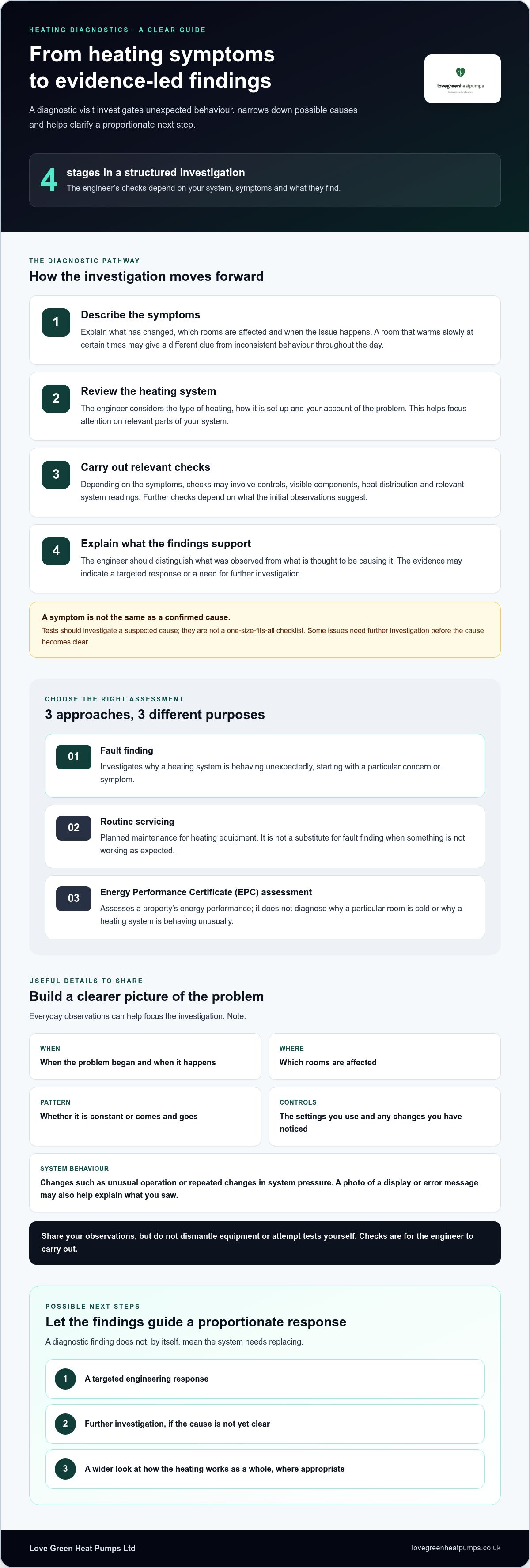
- Describe the symptoms. Explain what has changed, where you notice it and when it happens. A room that warms slowly at certain times may provide a different clue from a system that behaves inconsistently throughout the day.
- Review the system. The engineer considers the type of heating and how it is set up, alongside your account of the problem. This helps focus the investigation on relevant parts of the system rather than treating every home as if it has the same arrangement.
- Carry out relevant checks. The engineer may inspect controls and visible components, observe how the heating responds and take readings where appropriate. Further checks depend on what the initial observations suggest.
- Explain the findings. The engineer should distinguish what was observed from what is thought to be causing it. Findings can show whether a targeted response is appropriate or whether more investigation is needed.
Diagnostic tests should be chosen to investigate a suspected cause, not applied as a one-size-fits-all checklist. A test can add evidence, but a symptom and a confirmed cause are not the same thing. Some issues need further investigation before the cause becomes clear.
What information helps an engineer investigate?
A short record can make it easier to describe a fault clearly. Note when it began and whether it happens constantly or comes and goes. Include the rooms affected, the control settings you use and any recent changes in system behaviour. Photos of a display or error message may help explain what you saw. Share your observations, but leave equipment checks to the engineer.
What might an engineer inspect or test?
Depending on the system and symptoms, checks may include controls, visible components, how heat reaches different parts of the home and relevant system readings. Water quality or circulation checks may be useful for some setups, but they aren’t universal requirements. The aim is to select checks that test a likely explanation, then make sense of the results together.
For instance, if one area heats differently from another, an engineer may consider the system’s response and relevant controls before deciding whether a more specific check is warranted. A reading or visual observation is one piece of evidence, not necessarily a complete explanation. The findings should make clear what was checked, what it showed and where uncertainty remains.
Love Green Heat Pumps Ltd provides heating engineering diagnostics and troubleshooting to clarify reported problems and inform a proportionate next step. If you’d like to explore heating diagnostic support, start by describing the symptoms you’ve noticed.
Heating diagnostics compared: fault finding, servicing and system review
The right approach depends on the question you need answered. If one part of the heating behaves differently, targeted fault finding may be the clearest starting point. If you’re planning routine upkeep or considering the energy performance of the whole property, another type of visit may fit better. Heating system diagnostics uk investigates a heating concern; it doesn’t mean every concern needs the same test or intervention.
| Approach | Question it answers | Purpose and typical outcome |
|---|---|---|
| Targeted fault finding | What may be causing this specific symptom? | Investigates an unexpected change or fault. Findings can narrow down possible causes and inform a proportionate response. |
| Planned servicing | What maintenance does the heating equipment need? | Provides routine upkeep. It is not a substitute for investigating a particular problem. |
| Energy performance assessment | How does the property perform in terms of energy use? | Assesses the home’s energy performance, rather than testing a specific heating-system fault. |
These approaches can complement one another, but they aren’t interchangeable. A service may be due even if there’s no reported fault. An energy assessment may help inform wider property improvements, but it won’t necessarily establish why a radiator or heating control is behaving unexpectedly.
When is targeted fault finding the right starting point?
Choose this route when you can describe a particular symptom or change, such as one area heating differently or the system responding unexpectedly. The investigation focuses on relevant checks to narrow the possibilities before a repair decision is made. The exact checks depend on the heating setup and evidence available, so there’s no universal fault-finding checklist.
When might a wider heating or energy review help?
A wider review may be useful when concerns span several rooms or seem to involve more than one part of the heating setup. It can help consider how the system and home work together, rather than focusing on one isolated symptom. An EPC assessment has a different focus: it evaluates the property’s energy performance, not the cause of a particular heating fault. A home energy performance audit guide explains the broader, property-focused perspective.
Some proposed work is an intervention, not a diagnostic method. Power flushing, for example, is a specific treatment for a heating system. It isn’t a universal step in fault finding or a guaranteed fix for every heating problem. The evidence from an investigation should guide whether any intervention is appropriate.
Before and after a heating diagnostic visit: prepare and understand findings
A little preparation can help make a diagnostic visit more focused. You don’t need to investigate the equipment yourself. Your role is to describe what the household has noticed and make relevant information easy to find. This gives the engineer useful context and helps you understand how the checks relate to the concern.
What should you prepare before the visit?
Before the engineer arrives, gather details and make relevant access easier:
- Note when the problem began and whether it is constant, occasional or linked to a particular time.
- Record which rooms or areas are affected and what household members have observed.
- Write down the control settings you use and any recent changes in system behaviour.
- Make available any relevant system information or control instructions you have to hand.
- Keep the area around accessible heating equipment clear, without moving connected parts or attempting tests.
A simple timeline can be more useful than trying to identify the fault in advance. For example, note whether the behaviour changed after an adjustment or whether it has happened under different settings. Photos of a control display or an error message can show what you saw. Don’t remove covers or handle equipment to collect information.
How should you read a diagnostic explanation?
A clear explanation should link the reported symptoms with the checks performed and the evidence gathered. It should state the likely cause in plain language, while distinguishing a confirmed finding from a possibility that needs further investigation. In heating system diagnostics uk, that distinction matters: a symptom may point towards a cause without proving it on its own.
A useful diagnostic summary connects the evidence to the recommended next step. Look for an account of what was inspected or tested, what the results indicate and how they relate to the original concern. If a recommendation is unclear, ask which finding supports it and whether the proposed action addresses an identified issue or is an optional improvement. Understand what remains uncertain before deciding how to proceed.
Separate corrective work from wider suggestions. A specific issue may call for targeted engineering work, whilst broader changes to the heating setup may be a longer-term consideration. These are different decisions, and one does not automatically require the other. Where findings relate to a heat pump project, understanding the stages of heat pump system design and commissioning can help put recommendations in context.
Love Green Heat Pumps Ltd provides heating engineering diagnostics and troubleshooting to clarify reported issues. If you’re ready to discuss a heating concern, arrange heating diagnostic support and use your notes to explain what you’ve observed.
Heating system diagnostics with Love Green Heat Pumps Ltd: clear findings, sensible next steps
Heating problems can leave you unsure whether the answer is a targeted repair, a closer look at the system or a wider improvement. Love Green Heat Pumps Ltd provides heating engineering diagnostics and troubleshooting to help make sense of reported issues. The purpose is practical: understand the concern, consider relevant findings and use the evidence to inform what happens next.
Heating system diagnostics uk should lead to a clearer view of the problem, not an automatic recommendation to replace equipment. A proportionate response may be a specific piece of engineering work. If the findings suggest that broader system performance needs attention, they can also inform a wider discussion about your home’s heating.
From a heating concern to a considered plan
Start with the issue you’re experiencing and what you’ve gathered about when it occurs. Diagnostic findings can help distinguish an isolated fault from concerns that may involve several parts of the system. That distinction matters. A repair may be appropriate for a defined issue, while broader patterns could justify discussing how the heating is set up and performing.
Not every fault leads to a heat pump installation or replacement project. If the evidence points towards a wider heat pump solution, Love Green Heat Pumps Ltd’s projects can include a home survey, system design, equipment supply and commissioning. These stages help shape a project around the property and its heating requirements. For a relevant upgrade discussion, the UK heat pump installation guide offers further context on what homeowners may consider.
Clear findings help keep the decision in proportion. They may support focused engineering work or provide a basis for discussing wider improvements where the system’s performance points that way. The next step should follow the evidence, rather than assume one solution suits every home.
What happens when you get in touch?
Describe the symptoms in your own words. Mention which areas are affected, when the issue began and whether it is constant or intermittent. Include relevant details about your property and heating system if you know them. You don’t need to diagnose the cause yourself; a straightforward account of what you’ve noticed is a useful starting point.
From there, you can discuss relevant heating engineering support and, if appropriate, possible project options. If a wider heat pump project is being considered, its survey and design stages help inform the system approach before commissioning. The right route depends on the concern and the findings, so there’s no need to decide on an upgrade before the issue has been understood.
If you’d like to talk through your heating concern, request a free, no-obligation quote and share what you’ve observed. Clear information can help start a practical conversation about a sensible next step.
Take the next step towards dependable home comfort
A heating concern doesn’t have to become a major project before it’s understood. Start with what you’ve noticed, then let the evidence guide the decision. A proportionate next step could be targeted engineering work, further investigation or a broader conversation about how your home is heated. The aim of heating system diagnostics uk is to give you a clearer basis for choosing, not to push you towards an unnecessary change.
Love Green Heat Pumps Ltd brings HEIS-accredited expertise to heating engineering diagnostics and troubleshooting. If you’re considering a relevant project, a free, no-obligation quote offers a straightforward way to discuss the possibilities without committing to work.
Share your heating concern in your own words and explore a sensible way forward with the team. Discuss your heating system with our team and take the next step with greater clarity and confidence.
Frequently Asked Questions
What is heating system diagnostics?
Heating system diagnostics investigates why a heating system isn’t behaving as expected. Rather than treating one visible symptom as the whole problem, an engineer considers how the system responds and what the available evidence suggests. For example, a control that appears to call for heat while rooms remain cool may need a different investigation from a system that won’t respond at all.
What does an engineer check during heating system diagnostics?
The checks depend on the system and the reported concern. An engineer may look at relevant controls, visible components and how the heating responds, then take readings to test a possible explanation. Comparing the control settings with the system’s response, for example, can help assess whether the issue relates to a setting or another part of the setup. Not every system needs the same checks.
Can heating diagnostics find the cause of every heating problem?
No. Heating system diagnostics uk can narrow down possible causes, but some faults are intermittent or need further investigation before the evidence is conclusive. A result may identify a likely cause, rule out one possibility or show that more checks are needed. A useful explanation separates what the engineer observed from what remains uncertain, so you can decide on a reasonable next step without assuming the worst.
How should I prepare for a heating diagnostic visit?
Make a brief note of what happens, including any pattern you’ve noticed, such as the issue appearing after the heating has been off overnight. If different household members use the controls, ask what they’ve observed too. Keep any system paperwork or control instructions nearby if available. You don’t need to change settings, open equipment or recreate a fault; explain what you’ve seen and let the engineer carry out the checks.
Is heating system diagnostics the same as a service?
No. Diagnostics investigates a particular concern, whilst a service is planned maintenance for heating equipment. A service may not explain a new symptom, such as a control responding differently from usual. Equally, investigating a specific fault doesn’t automatically cover routine maintenance. If you have both a service due and a separate problem, describe each clearly so the purpose of the work is understood.
Why is my heating not warming every room evenly?
Uneven warmth can have several possible explanations, including how heat circulates, control settings or differences between rooms. A chilly room doesn’t automatically mean a component has failed. Note whether the same rooms are affected each time and whether the pattern changes with the heating settings. That context helps an engineer assess the system’s behaviour rather than relying on the room temperature alone.
Can heating system diagnostics help with a heat pump?
Yes. Diagnostics can investigate reported concerns with a heat pump by considering its operation, controls and the way the heating responds. The relevant checks depend on the particular system and the evidence available. Findings may help distinguish an operating issue from a broader question about how the system serves the property. If a wider project is appropriate, survey and design considerations can inform the next discussion.
Disclaimer
Disclaimer
The information published on this website is provided by Love Green Heat Pumps for general information and educational purposes. As a specialist provider of heating and renewable energy solutions, we strive to ensure that our content is accurate, relevant and up to date. However, heating requirements, system suitability, installation specifications, costs and performance can vary depending on individual property characteristics, usage and other site-specific factors.
Information provided in our articles should not be regarded as a substitute for a professional property assessment, technical survey or tailored recommendation. Any decisions regarding the selection, installation, replacement or maintenance of heating systems should be made with appropriate professional guidance.
Love Green Heat Pumps accepts no responsibility for decisions made solely on the basis of general information published in these articles. For advice specific to your property or project, we encourage you to contact our team for professional guidance and an assessment of your requirements.


