

Eligibility depends on both who owns the property and what heating system will replace the existing one. The Boiler Upgrade Scheme eligibility criteria generally cover property owners in England and Wales replacing fossil fuel or electric heating with an eligible low-carbon system. A standard air-source heat pump grant is £7,500. Eligible off-grid properties using heating oil or LPG can receive £9,000 from 21 July 2026 to 31 March 2027.
The grant amount matters, but the Boiler Upgrade Scheme eligibility criteria also depend on the property, its location and its existing heating system. This guide explains who can apply, which homes and technologies qualify, and how the funding works. It also covers self-build properties, EPC requirements and conditions that can affect an application, helping you assess your home before planning a heating upgrade.
Key Takeaways
- See which property owners and building types may qualify, including the conditions that apply to self-build homes.
- Learn which low-carbon heating systems can be supported and what they must replace.
- Understand how the higher grant applies to eligible off-grid homes using heating oil or LPG, and when it is available.
- Find out how EPC details, insulation recommendations and installation requirements can affect an application.
- Explore how heat pump installation can fit into your plans once you understand the scheme’s requirements.
Heating system replacement and performance requirements
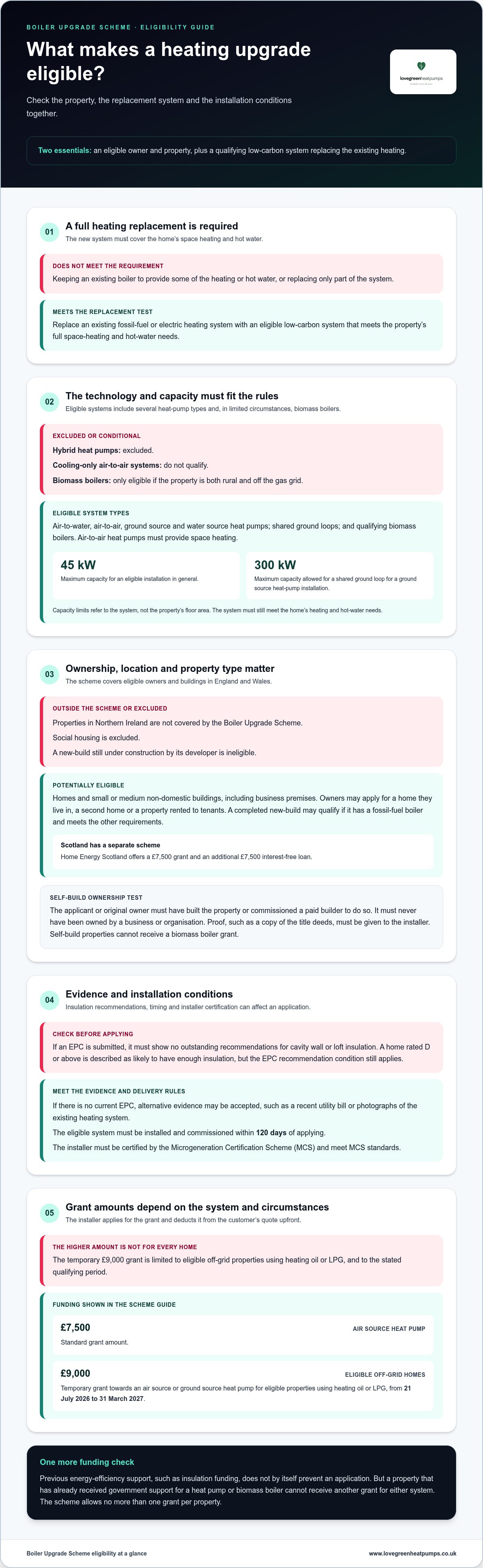
An eligible installation must replace an existing fossil-fuel or electric heating system, not an existing low-carbon system. The new system must meet the property’s full space-heating and hot-water needs, rather than heating only one room or part of the home. If an existing boiler remains responsible for some of those needs, the installation would not meet the full-replacement requirement.
Eligible technologies include air-to-water and air-to-air heat pumps, ground source heat pumps, water source heat pumps, shared ground loop heat pumps and biomass boilers. An air-to-air heat pump must provide space heating; a cooling-only system does not qualify. Hybrid heat pump systems are excluded. For a biomass boiler grant, the property must be both rural and off the gas grid. Meeting only one of these conditions is not enough.
The installation must have a capacity of no more than 45kW. The exception is a shared ground loop for a ground source heat pump installation, which may have a capacity of 300kW. These limits concern system capacity, not the floor area of the property. A suitably sized system must still meet the home’s heating and hot-water needs.
An EPC can help establish whether a property meets the scheme’s eligibility requirements. If an EPC is submitted, it must show no outstanding recommendations for cavity wall or loft insulation. Homes rated D or above are described as likely to have enough insulation for a heat pump, but the EPC recommendation condition still applies. If there is no current EPC, alternative evidence may be accepted, such as a recent utility bill or photographs of the existing heating system.
Installation timing and installer standards also affect eligibility. The heat pump or other eligible system must be installed and commissioned within 120 days of applying for the grant. According to the UK Government, the installer must be certified by the Microgeneration Certification Scheme (MCS) and meet MCS standards. Certification covers the installer’s work against scheme requirements; it does not replace the need for the property and proposed system to meet the other conditions.
These rules distinguish a complete heating replacement from a partial upgrade. Replacing an oil-fired system with an eligible heat pump may meet the replacement rule; replacing an existing heat pump with another low-carbon system does not. Assess the proposed technology, capacity, EPC evidence, location and installation plan together when applying the Boiler Upgrade Scheme eligibility criteria.
Can I get the grant if I have a self-build property?
A self-build home can qualify, but the scheme also limits eligibility by location, ownership and property type. The Boiler Upgrade Scheme covers eligible properties in England and Wales. Scotland has a separate Home Energy Scotland scheme, which offers a £7,500 grant and an additional £7,500 interest-free loan. The Boiler Upgrade Scheme does not cover properties in Northern Ireland.
Eligible properties include homes and small or medium non-domestic buildings, such as business premises. The maximum installation capacity is 45 kWth. A business owner can apply for a property they own, as can someone who owns a second home or a property rented to tenants. The property’s use does not remove the ownership requirement.
Eligible replacements include air-to-water and air-to-air heat pumps, ground source heat pumps, water source heat pumps, shared ground loops and biomass boilers. The new system must replace existing fossil-fuel or electric heating. For biomass funding, the property must be both rural and off the gas grid.
Landlords can apply for eligible properties they own and rent out. Small business owners can apply for eligible premises, but social housing is excluded. A new-build home still under construction by its developer is ineligible. A completed new-build may qualify if it has a fossil-fuel boiler and meets the scheme’s other requirements.
Self-build properties must meet a specific ownership test. The applicant or original owner must have built the property, or commissioned a paid builder to do so, and it must never have been owned by a business or organisation. An owner who built the home must give the installer proof of its self-build status, such as a copy of the title deeds. Self-build properties are not eligible for a biomass boiler grant.
Previous support for energy-efficiency improvements, such as insulation funding, does not by itself prevent an application. However, a property that has already received government funding or support for a heat pump or biomass boiler cannot receive another grant for either system. The scheme allows no more than one grant per property, so previous support for a heating system matters.
These distinctions help separate a qualifying home from an excluded building. For example, an owner-occupied self-build in Wales may meet the ownership test, while a developer-owned home still being built does not. The heating technology and previous funding also affect eligibility, regardless of whether the applicant is an individual landlord or business owner.
If you’re weighing up a heat pump for an eligible property, a heating system assessment can help relate the home’s needs to the scheme requirements.
How much funding can I get with the Boiler Upgrade Scheme?
In England and Wales, grants depend on the heating technology and, for some homes, their fuel and location. The installer applies, then deducts the grant from the customer’s quote upfront.
Higher grants for eligible off-grid homes
Eligible off-grid properties using heating oil or LPG can receive a temporary £9,000 grant towards an air source or ground source heat pump. This higher amount applies from 21 July 2026 to 31 March 2027, for eligible homes and small businesses in England and Wales.
Outside that temporary uplift, an air source heat pump grant is £7,500. The £9,000 amount is therefore not a general grant for every property without a gas connection. Eligibility depends on the property relying on heating oil or LPG and meeting the scheme’s other requirements. A ground source heat pump can also qualify for the uplift in the stated period.
Grant amounts vary by the chosen system. Biomass grants have separate rural and off-gas-grid restrictions. Air-to-air systems must provide space heating, not cooling alone.
Grant restrictions and installation costs
The grant contributes towards installation costs; it does not set the total price of a low-carbon heating system. The installer applies on the property owner’s behalf and deducts the grant from the quote upfront. The remaining cost depends on the system and installation requirements, including the home’s hot-water tank and radiator needs. A property-specific quote sets out the cost.
A property can receive no more than one Boiler Upgrade Scheme grant. If it has already received government funding or support for a heat pump or biomass boiler, it cannot receive another grant for either system. Previous funding for energy-efficiency work, such as insulation, does not by itself rule out an application.
Deadlines matter too. The system must be installed and commissioned within 120 days of the grant application. The owner has 14 calendar days after the application to confirm consent and eligibility, or Ofgem may reject it. According to the UK Government, the installer must be certified by the Microgeneration Certification Scheme and meet its standards. Ofgem administers the scheme on behalf of the Department for Energy Security and Net Zero, so the installer’s application and the owner’s timely consent are both key parts of the process.
Replacement of existing heating systems
The Boiler Upgrade Scheme supports replacing an existing fossil-fuel or electric heating system with an eligible low-carbon alternative. The new system must meet the property’s full space-heating and hot-water needs. It cannot simply supplement the old system or heat selected rooms. For example, a replacement that leaves the existing boiler to supply the home’s hot water would not meet the full-replacement condition.
Eligible existing systems include heating that uses gas, oil, LPG or electricity. The replacement must use a technology approved by the scheme: air-to-water or air-to-air heat pumps, ground source heat pumps, water source heat pumps, shared ground loops or biomass boilers. Both the system being replaced and the proposed technology must meet the rules; changing the fuel source alone is not enough.
Heat pumps deliver heat in different ways. An air-to-water heat pump supplies a water-based heating system, while an air-to-air model provides space heating directly. An air-to-air system used only for cooling does not qualify. Ground source and water source heat pumps draw heat from their respective sources, while a shared ground loop can serve more than one property. Each system must provide the required heating, not merely supplement another system.
A biomass boiler is eligible only if the property meets a specific location test: it must be rural and off the gas grid. Both conditions apply. A rural home connected to the gas grid, or an off-grid property that is not rural, does not qualify for a biomass grant. This restriction applies to biomass, not to every eligible heat pump.
Hybrid heat pump systems are excluded. An eligible replacement must meet the property’s full heating and hot-water demand, rather than relying on a fossil-fuel boiler as part of a combined system. The scheme also excludes replacing an existing low-carbon heating system. For example, replacing an existing heat pump with a different heat pump does not count as replacing fossil-fuel or electric heating.
The installation must also meet scheme standards. According to the UK Government, the installer must be certified by the Microgeneration Certification Scheme and meet its standards. The system must be installed and commissioned within 120 days of applying for the grant. These requirements connect the proposed replacement to the installation process, from choosing an eligible technology through commissioning the complete heating system.
Before assessing costs and installation plans, identify the current heating source, the proposed replacement and how the new system will provide hot water. This comparison helps distinguish a complete eligible replacement from a partial upgrade, an excluded hybrid system or a replacement of existing low-carbon heating.
Who can apply for the Boiler Upgrade Scheme
Homeowners and small business owners can apply for eligible properties in England and Wales. Applicants may own a main home, second home, business property or home rented to tenants. There are no income rules or benefit-claim requirements. Eligibility depends on the property, its existing heating and the proposed replacement.
Landlords can apply because they own the rented property, and small business owners may apply for eligible business premises. Social housing is excluded. A property can receive no more than one grant, and previous government support for a heat pump or biomass boiler prevents another grant for either system. Earlier energy-efficiency funding, such as insulation support, does not by itself rule out an application.
Homeowners apply through an installer, who submits the grant application rather than the property owner. The owner must then confirm consent and eligibility within 14 calendar days of the application.
The application involves the property owner, installer and scheme administrator. The installer applies on the owner’s behalf and deducts the grant from the quote upfront. The owner’s consent confirms agreement to the application and the eligibility information. Applications are usually processed within a few weeks when all required information has been supplied.
Use the proposed heating system to understand which installer requirements apply. According to the UK Government, installers must be certified by the Microgeneration Certification Scheme and meet its standards. The new system must be installed and commissioned within 120 days of applying. This applies to eligible heat pumps, including air source and ground source heat pumps, and other supported systems.
Owning an eligible property is only one part of qualifying for the grant. A landlord may meet the ownership test, for example, but the property and replacement system must also meet the scheme rules. Business owners face the same property-based conditions. Income and benefit claims do not determine eligibility.
The Boiler Upgrade Scheme covers England and Wales. Scotland has a separate grant and loan scheme, while Northern Ireland is outside the Boiler Upgrade Scheme. The property’s location determines which funding route applies before the heating system and ownership are assessed.
If you’re considering a heat pump for a property you own, discuss a heat pump installation as a practical next step.
Love Green Heat Pumps: Heat Pump Installation
Love Green Heat Pumps Ltd provides heat pump installation, from a full home survey and system design through to commissioning. If your property appears to meet the scheme requirements, a survey can help establish whether a low-carbon heating replacement is suitable. The assessment considers the home’s heating and hot-water needs, so the system design is tailored to the property.
A free, no-obligation quote gives you a way to discuss the project and understand the proposed work. Love Green Heat Pumps Ltd also provides heating engineering, air conditioning, solar PV and other renewables. If you’re ready to explore heat pump installation for your property, contact Love Green Heat Pumps Ltd. A clear conversation can help you move forward with a plan that makes sense for your home.
Plan a heating upgrade that suits your home
After reviewing the Boiler Upgrade Scheme eligibility criteria, consider how the heating system needs to work in your home. Think about hot-water routines and which rooms need steady warmth. Keeping these practical needs in view helps turn eligibility into a clear project plan.
Set out what you want the upgrade to achieve and which parts of the home may need attention alongside the heating. A clear brief helps you discuss design, installation and commissioning as one connected project. You can also consider how a heat pump, air conditioning or solar PV might fit your wider plans for the home.
Love Green Heat Pumps Ltd provides heat pump installation and renewable energy services. If you’re ready to discuss a suitable next step for your property, contact Love Green Heat Pumps Ltd. A clear conversation can help you move forward with a plan that makes sense for your home.
Frequently Asked Questions
Can I apply for the grant if I’ve had grants for other work?
Previous funding for other energy-efficiency work does not automatically prevent an application. For example, insulation funding does not by itself make you ineligible. The key distinction is whether the property has already received government funding or support for a heat pump or biomass boiler. Previous support for either heating system prevents another grant for it. Keep records of earlier funded work so the installer can distinguish it from heating-system support.
Who is eligible?
Property owners in England and Wales can apply for eligible homes and small or medium non-domestic buildings. The property may be a main residence, second home, business premises or a home rented to tenants. There are no income rules or benefit-claim requirements. The scheme assesses the property and proposed heating replacement as well as ownership, so owning a building does not make every system or installation eligible.
Are there any exclusions?
Social housing cannot receive a grant, and a new-build still under construction by its developer is ineligible. A property cannot receive another grant if it has already had government support for a heat pump or biomass boiler. Existing low-carbon heating cannot be replaced under the scheme. Biomass has an additional location restriction, and hybrid heat pump systems are excluded.
Can I apply for funding for both A2A and A2W systems?
No, the scheme awards no more than one grant per property, so you cannot claim separate grants for air-to-air (A2A) and air-to-water (A2W) systems at the same property. The choice should reflect how the home needs heat delivered. A2A must provide space heating, not cooling alone; A2W connects with a water-based heating system. The funded installation must also replace the existing heating system and meet the scheme’s requirements.
Can I get the grant if I already have a heat pump?
No. The grant does not cover replacing an existing heat pump. It supports replacing fossil-fuel or electric heating, not one low-carbon system with another. For example, changing an air-source heat pump to a ground source model would not meet the replacement rule. If you are considering a heat pump for a different property, eligibility depends on that property’s existing heating and ownership.
Who is eligible for the Boiler Upgrade Scheme in England and Wales?
Homeowners and small business owners can apply for eligible properties in England or Wales. Landlords may apply for properties they own, including rented homes, and owners of second homes may also apply. The scheme covers eligible homes and small or medium non-domestic buildings, but excludes social housing. The applicant must own the property, and the proposed system must meet the relevant technology and replacement conditions.
Do applicants need an Energy Performance Certificate (EPC), and what insulation requirements apply?
In England and Wales, an EPC forms part of the property evidence for an application. If an EPC is submitted, it must show no outstanding recommendations for cavity wall or loft insulation. Homes rated D or above are described as likely to have enough insulation for a heat pump, but insulation is not a separate eligibility requirement. If there is no current EPC, alternative evidence, such as a utility bill or photographs of the heating system, may be used.
Which heating systems and fossil-fuel boilers are excluded from the Boiler Upgrade Scheme?
Gas, oil and LPG boilers are not excluded as existing systems; they can be replaced with an eligible low-carbon system. Electric heating can also be replaced. The scheme excludes hybrid heat pump systems and replacing an existing low-carbon heating system, such as a heat pump. Biomass boilers are restricted to rural properties off the gas grid, so they are not eligible everywhere.
Disclaimer
Disclaimer
The information published on this website is provided by Love Green Heat Pumps for general information and educational purposes. As a specialist provider of heating and renewable energy solutions, we strive to ensure that our content is accurate, relevant and up to date. However, heating requirements, system suitability, installation specifications, costs and performance can vary depending on individual property characteristics, usage and other site-specific factors.
Information provided in our articles should not be regarded as a substitute for a professional property assessment, technical survey or tailored recommendation. Any decisions regarding the selection, installation, replacement or maintenance of heating systems should be made with appropriate professional guidance.
Love Green Heat Pumps accepts no responsibility for decisions made solely on the basis of general information published in these articles. For advice specific to your property or project, we encourage you to contact our team for professional guidance and an assessment of your requirements.


