
Solar funding in 2026 depends on where you live and the condition of your home. In England, the Warm Homes: Local Grant can provide up to £15,000 for eligible energy improvements, including solar panels. The rules for UK renewable energy grants for homeowners in 2026 can also depend on household income, property ownership and your EPC rating.
It’s understandable to want a clear answer before arranging work. A grant may help with the cost, but every scheme has its own eligibility rules and application process.
This guide explains which support may suit your income, property and EPC rating, and how surveys, applications and approvals fit together. You’ll also learn why choosing an accredited installer matters, so you can follow the route from checking eligibility to agreeing and completing the work.
Key Takeaways
- Match schemes to your household income, property type and EPC rating before focusing on a particular technology when applying for UK renewable energy grants for homeowners 2026.
- Households meeting specific income thresholds usually qualify for targeted property upgrade grants, according to the Department for Energy Security and Net Zero.
- Off-gas-grid properties may have different routes to support, so check which measures a grant can fund and how the building is heated.
- Prepare for an application to involve supporting documents, a home survey and formal approval before work begins.
- Accredited installers and scheme standards matter: understand how the survey, system design and installation fit together with Love Green Heat Pumps Ltd.
Eligibility based on income, property type and EPC rating
For homeowners comparing UK renewable energy grants for homeowners 2026, eligibility depends on the scheme, location and proposed work. Household income, property ownership, heating type and the home’s Energy Performance Certificate (EPC) rating can all affect the available options.
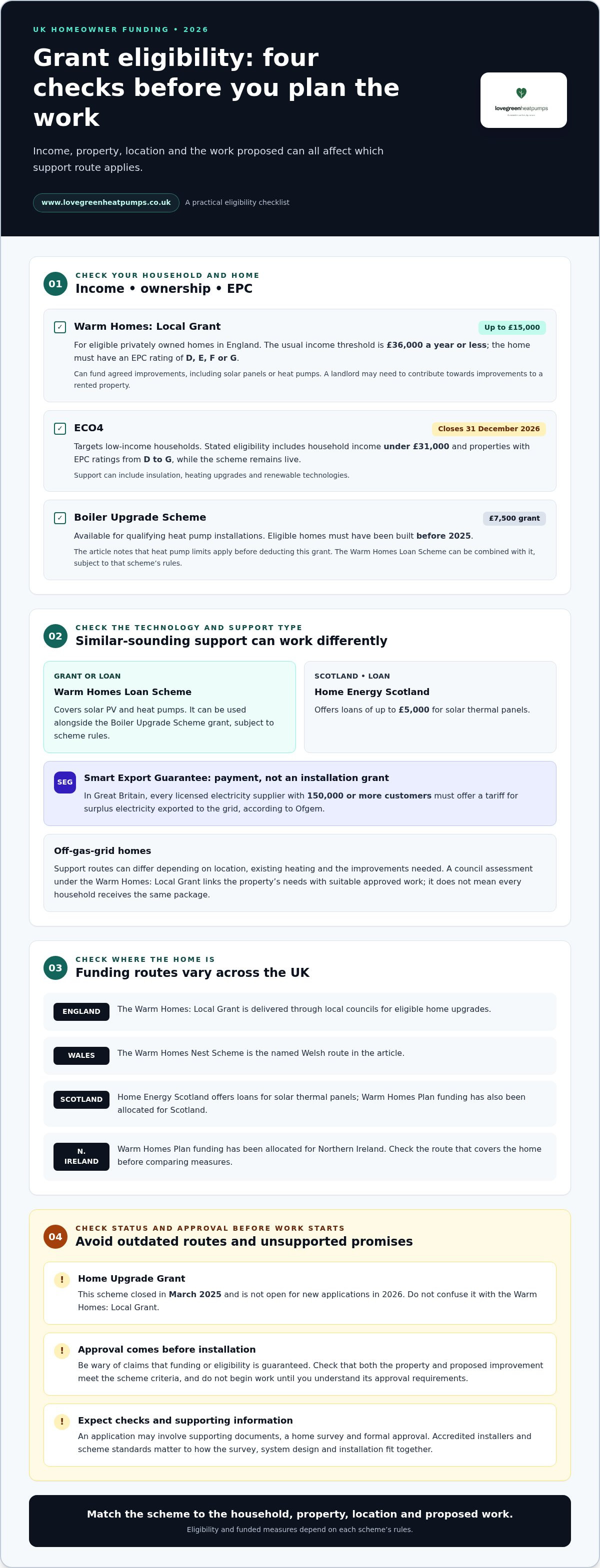
Households in England with an income of £36,000 a year or less usually meet the Warm Homes: Local Grant income threshold, according to the Department for Energy Security and Net Zero. The grant is for privately owned homes in England with an EPC rating of D, E, F or G. It can fund agreed improvements, including heat pumps or solar panels. A landlord may need to contribute towards improvements to a rented property.
ECO4 targets low-income households and can support insulation, heating upgrades and renewable technologies. Its stated eligibility includes household income under £31,000 and properties with EPC ratings from D to G while the scheme remains live. ECO4 closes on 31 December 2026.
Other qualifying heat pump installations through the Boiler Upgrade Scheme receive £7,500. Eligible homes must have been built before 2025.
The heat pump limits apply before deducting the Boiler Upgrade Scheme grant. The Warm Homes Loan Scheme can be combined with that grant, subject to the scheme’s rules.
Can homeowners combine renewable energy grants with ECO4 or other energy-efficiency funding? Some support can be combined where scheme rules allow it. For example, the Warm Homes Loan Scheme can be used alongside the Boiler Upgrade Scheme grant, with additional guidance often provided by specialists like Love Green Heat Pumps Ltd.
Can homeowners get grants for solar thermal panels or other renewable heating systems? Support depends on the technology and location. The Warm Homes Loan Scheme covers solar PV and heat pumps, while Scotland’s Home Energy Scotland scheme offers loans of up to £5,000 for solar thermal panels.
What risks, exclusions or scams should homeowners watch for when seeking renewable energy grants? Be wary of claims that funding or eligibility is guaranteed, and don’t begin work until you understand the scheme’s approval requirements. Check that both the property and the proposed improvement meet the scheme criteria.
Among UK renewable energy grants for homeowners 2026, the Smart Export Guarantee is a separate route for payments on surplus electricity exported to the grid. In Great Britain, every licensed electricity supplier with 150,000 or more customers must offer a Smart Export Guarantee tariff, according to Ofgem. It is an export payment, not an installation grant.
Home Upgrade Grant support for off-gas-grid homes
Off-gas-grid households may have different routes to support, depending on their location and the improvements needed. In 2026, separate national and local schemes cover measures such as insulation, solar panels and low-carbon heating.
Local grant availability in England
The Warm Homes: Local Grant supports eligible privately owned homes in England with energy improvements. It can fund measures such as insulation, solar panels and air source heat pumps, with the local council arranging and paying for approved work. This can be relevant if your home is off the gas grid: the council’s assessment links your property’s needs with suitable improvements, rather than offering every household the same package.
The Home Upgrade Grant is not an open route for new applications in 2026: the scheme closed in March 2025. Earlier support was associated with improvements such as solar panels, insulation and air source heat pumps for eligible homes. For a current application, distinguish this closed scheme from the Warm Homes: Local Grant, which remains the relevant named route in England for eligible home upgrades.
Solar and battery funding
The Warm Homes Plan sets out support for home upgrades, including solar panels and battery storage. For homeowners, this indicates that solar and batteries are part of the wider funding approach, but eligibility still depends on the specific offer and property.
The Warm Homes Agency is expected to provide advice online and through a national phoneline from 2027. This gives households a planned route to guidance on home improvements, including how different measures may fit together. Until that service begins, keep the practical distinction clear: a grant, a loan and a payment for exported electricity are different forms of support.
Regional differences in grant access
Grant access varies across the UK because schemes may be specific to a country or delivered through local councils. The Warm Homes: Local Grant applies in England, while Wales has the Warm Homes Nest Scheme. The UK Government has also allocated Warm Homes Plan funding for Scotland, Wales and Northern Ireland, so your location can affect which route applies.
Do UK renewable energy grants vary by country, local council or region? Yes. England’s Local Grant is delivered through councils, while Wales has its own Nest scheme and other UK nations have separate funding routes. Check which country’s scheme covers your home before comparing measures or preparing an application.
For a solar project, reviewing solar PV and renewable options can help you understand how generation fits your home’s upgrade plans.
Fully funded grants for low-income and fuel-poor households
Support for lower-income households can cover insulation, heating upgrades and renewable technologies. Eligibility usually depends on household circumstances as well as the property’s condition and existing heating.
Grant options by household and property
ECO4 targets low-income households, while property type and energy efficiency help determine suitable improvements. Eligible measures can include cavity wall or loft insulation, boiler replacements and renewable technologies. Some households may qualify for first-time central heating support if their property lacks a central heating system. Owners and private renters can be eligible when they meet the relevant criteria, though the property’s ownership and tenancy affect the application.
For households receiving full ECO4 support, the scheme can cover 100% of an eligible solar installation. ECO4 can also fund insulation and heating measures, so the right package depends on the home’s needs. A home with poor insulation may need fabric improvements alongside a heating upgrade. A household considering solar panels should also distinguish an installation grant from Smart Export Guarantee payments for electricity exported to the grid.
Household income threshold
Income is a key factor, but there isn’t one threshold covering every UK scheme. ECO4 eligibility is stated as household income under £31,000, alongside other criteria. Many local authority-led schemes use combined household income thresholds between £31,000 and £36,000 a year for maximum funding. The Warm Homes: Local Grant in England usually uses an income threshold of £36,000 a year or less.
Some applicants above that Local Grant threshold may still qualify if they live in a qualifying postcode area or someone in their household receives certain benefits. The relevant scheme’s rules matter: income, benefits, property ownership and EPC rating can all affect the result. For ECO4, properties with EPC ratings from D to G are included while the scheme remains live; a property rated D or above is also described as ineligible under the stated ECO4 rules, so those criteria need careful interpretation alongside the scheme’s detailed assessment.
ECO4 closes on 31 December 2026. Households weighing an application should identify the scheme first, then match its income test and property rules to their circumstances. The UK Government aims to lift up to one million homes out of fuel poverty through the Warm Homes Plan. That wider goal does not make every home eligible for a grant, and individual funding routes still have their own criteria.
Where a grant funds an improvement, the approved measure and property conditions determine what can be included. A landlord’s property may require the landlord’s involvement, while first-time central heating support is intended for homes without an existing system. Before applying, compare the property’s EPC, heating type and ownership details with the chosen scheme’s rules.
Application documents and approval steps
Grant applications connect your household details, property and proposed improvement with a scheme’s rules. Before applying, identify the funding route and its evidence requirements. For example, a heat pump application may follow different steps from a solar panel or battery project. Keep copies of submitted information, and don’t treat proposed work as funded until approval is confirmed.
For the Boiler Upgrade Scheme, an Energy Performance Certificate (EPC) is no longer required for applications made since 28 April 2026. For the Boiler Upgrade Scheme, the Department for Energy Security and Net Zero says that since 28 April 2026, a recent energy bill and photos can be used as evidence where the home has no EPC. This change gives applicants another way to show details about the property. It does not remove the need to meet the scheme’s other eligibility requirements.
Organise the evidence in a clear folder, with files labelled by purpose. Depending on the scheme, useful information may include:
- Household income or benefit details for an income-based grant.
- The property address, ownership or private tenancy information.
- An existing EPC, where available, and the home’s current heating arrangements.
- For a home without an EPC, the energy bill and photographs used for a Boiler Upgrade Scheme application.
- A description of the proposed measure, such as a heat pump, solar panels or insulation.
These items link the application to the household and home. The scheme’s criteria determine which documents are required. For example, an income-based application must show how the household meets the relevant income or benefits test. A property-based application may require evidence of its EPC rating or existing heating system. Keep names, addresses and property details consistent across documents.
A Retrofit Assessment under PAS 2035 is often a prerequisite for grant applications. It considers the home as a whole, rather than treating one improvement in isolation. The assessment can help identify suitable measures and how they relate to insulation, heating and ventilation. This matters where a grant supports several upgrades, or where the proposed work needs to fit the property’s condition.
For the Warm Homes: Local Grant in England, the local council usually contacts applicants within 10 working days to request information and arrange a home survey. The survey informs which improvements may be agreed. The council arranges and pays for approved work under this grant, so distinguish its process from schemes where an installer submits an application on the household’s behalf.
Approval is the point to clarify the agreed work, evidence and next steps. Keep the written decision with your application records, and check that the approved measure matches the proposed installation before work begins. A boiler replacement, heat pump and solar system are separate projects, so documents for one should not be assumed to meet another scheme’s requirements.
Energy surveys and applying through accredited providers
A survey links a grant application to a property’s actual needs. For UK renewable energy grants, an assessment can help determine which measures are suitable, what evidence is required and how the installation must meet scheme standards.
For a heat pump, a home assessment considers the existing heating system, insulation and rooms to be heated. These details help shape the system design and identify preparatory work. For solar panels, an assessment considers the roof and household electricity use. Battery storage may also be considered if storing generated electricity suits the property.
Use the survey to understand the proposed work, not just to complete an application form. Ask for a clear explanation of the recommended measures and how they suit your home. For example, a survey may show that insulation should be addressed alongside heating, or that the roof layout affects the solar design. The findings link the grant request to a practical installation plan.
Grant-supported installations usually require accredited installers and must meet the technical standards set by the relevant scheme. Approval depends on more than household eligibility: the system and installation must also satisfy the funding rules. An installer involved in the application can help coordinate the technical details, but the scheme’s conditions determine which work qualifies.
Keep your assessment and application records together. A useful file can include:
- The survey findings and proposed measures for the property.
- The scheme’s approval and any conditions attached to the agreed work.
- Documents supporting household or property eligibility.
- Installation information showing the approved system and completed work.
Solar owners should also distinguish grant support from export payments. The Smart Export Guarantee pays eligible households for surplus electricity sent to the grid. Its system eligibility covers small-scale generation up to 5 MW. In Great Britain, every licensed electricity supplier with 150,000 or more customers must offer a Smart Export Guarantee tariff, according to Ofgem. The tariff is separate from a grant for installing panels or battery storage.
The Warm Homes Plan includes home upgrades intended to improve comfort and reduce energy use. A survey helps translate that broad aim into measures suited to individual properties, rather than assuming the same package works everywhere. The UK Government estimates eligible improvements could reduce energy bills by up to £850 a year compared with a gas boiler and no other upgrades. Actual savings depend on the measures installed and how the household uses energy.
For a practical discussion of solar generation and other renewable options, explore renewable energy options for your home.
Love Green Heat Pumps: Heat Pump Installation
Love Green Heat Pumps Ltd helps homeowners planning a heat pump installation, from the home survey and system design through to commissioning. Turn to the team once you’ve reviewed grant eligibility and want to understand how a heat pump could work in your home. The right design depends on your property, heating needs and any improvements required.
For households considering more than heating, Love Green Heat Pumps Ltd also offers air conditioning and solar PV and other renewable solutions. A free, no-obligation quote gives you a way to discuss the proposed work and its suitability before deciding how to proceed.
If you’re ready to explore your options, contact Love Green Heat Pumps Ltd to discuss your home.
Take the next step towards a more comfortable home
Finding a grant is only part of the decision. The improvement also needs to suit your home, heating needs and energy use. Treat funding as one part of the plan, alongside system design and the work needed to make it suitable.
For homeowners considering UK renewable energy grants in 2026, a useful next step is to turn the scheme’s requirements into a clear project brief. Note the work you’re considering, the documents you have and any questions raised by your property’s survey. That gives you a practical starting point for discussing installation options without assuming every home needs the same solution.
Love Green Heat Pumps Ltd provides heat pump installation, air conditioning, and solar PV and other renewable solutions. If you’re ready to discuss a project for your home, contact Love Green Heat Pumps Ltd.
A well-planned upgrade can make the next steps easier to manage, with clearer choices for your home and everyday comfort.
Frequently Asked Questions
What grants are available for solar panels in 2026?
Solar support can come from a grant, a loan, VAT relief or export payments, depending on your circumstances. In England, the Warm Homes: Local Grant may fund solar panels as part of eligible home improvements. ECO4 can support renewable technologies whilst it remains open. The Warm Homes Loan Scheme offers borrowing for solar PV, and the Smart Export Guarantee pays for eligible surplus electricity sent to the grid. These options work differently, so compare the type of support as well as eligibility.
When can I get funding?
You can apply when the scheme is accepting applications and your home and proposed work meet its criteria. Timing differs by route: ECO4 closes on 31 December 2026, while the Boiler Upgrade Scheme runs beyond 2026. For council-led support, the local authority’s application and survey process affects when work can proceed. Treat funding as available only once the relevant scheme has approved the application, rather than relying on a promised future payment.
Can I get a grant to replace my gas boiler?
Yes, eligible homeowners in England and Wales may receive a Boiler Upgrade Scheme grant towards replacing a gas boiler with an eligible heat pump. The grant is £7,500 for qualifying installations. The property must meet scheme requirements, including being built before 2025. A gas boiler replacement alone is not the funded measure: the support is for installing an eligible low-carbon heating system. A survey can establish whether a heat pump suits the home.
How do renewable energy grants work?
A grant contributes towards an approved home improvement; it doesn’t automatically cover every part of a project. Depending on the scheme, support may be paid through a council-arranged improvement or applied to eligible installation costs. The household, property and proposed system must meet the relevant conditions. Distinguish grants from loans and export payments: a loan is repaid, while Smart Export Guarantee payments relate to electricity exported to the grid.
How do the five schemes compare?
They serve different needs. The Boiler Upgrade Scheme supports eligible heat pump installations; ECO4 targets low-income households with insulation and heating measures; and the Warm Homes: Local Grant funds agreed improvements for eligible homes in England. The Warm Homes Loan Scheme provides borrowing for specified technologies. The Smart Export Guarantee pays for exported electricity, not installation work. Compare the measure, location, eligibility and whether support is a grant, loan or payment.
How do I apply and get approved without delays?
Start by matching the proposed improvement to a scheme, then prepare evidence supporting your household and property details. Use consistent names and addresses across forms, bills and certificates. If your home lacks an EPC for a Boiler Upgrade Scheme application, a recent energy bill and photographs can be used as evidence. Don’t book work on the assumption that funding is approved; wait for the scheme’s decision and follow its conditions.
How can I maximise my grant and savings with solar panels and a battery?
Plan panels and a battery around how your home uses electricity. Solar generation can meet daytime demand, while battery storage can hold surplus power for later. Check whether your chosen support covers both technologies: the Warm Homes Loan Scheme permits borrowing for battery storage, either alone or with solar. Also consider export payments for eligible surplus electricity. The benefits of a system depend on its design, household use and scheme rules.
What UK grants and government schemes help homeowners install renewable energy in 2026?
For UK renewable energy grants for homeowners in 2026, relevant routes include the Boiler Upgrade Scheme, ECO4, the Warm Homes: Local Grant in England and the Warm Homes Loan Scheme. Scotland has heat pump support through Home Energy Scotland, while Wales has the Warm Homes Nest Scheme. The Smart Export Guarantee is a payment for eligible exported electricity, not an installation grant. Check your country, property and proposed improvement to narrow the options.
Disclaimer
Disclaimer
The information published on this website is provided by Love Green Heat Pumps for general information and educational purposes. As a specialist provider of heating and renewable energy solutions, we strive to ensure that our content is accurate, relevant and up to date. However, heating requirements, system suitability, installation specifications, costs and performance can vary depending on individual property characteristics, usage and other site-specific factors.
Information provided in our articles should not be regarded as a substitute for a professional property assessment, technical survey or tailored recommendation. Any decisions regarding the selection, installation, replacement or maintenance of heating systems should be made with appropriate professional guidance.
Love Green Heat Pumps accepts no responsibility for decisions made solely on the basis of general information published in these articles. For advice specific to your property or project, we encourage you to contact our team for professional guidance and an assessment of your requirements.


