
Proposed interest-free loans for renewable energy in the UK are intended to help homeowners fund upgrades such as solar panels, batteries and heat pumps. These loans are planned to complement existing support, including the Boiler Upgrade Scheme.
It’s understandable to want clear answers before planning work or taking on borrowing. A loan is not a grant: repayment terms, eligibility and affordability checks affect how much a household can borrow and repay.
This article explains how the proposed loans may work, which home improvements they could cover and how they might combine with the Boiler Upgrade Scheme. It also covers affordability checks and what to consider when comparing borrowing with other support.
Key Takeaways
- Separate proposed UK-wide borrowing from schemes already available in parts of the UK, as eligibility and support can differ by location.
- The Consumer Loan Scheme is scheduled to launch in April 2027, with proposed support intended to cover several types of home energy upgrade.
- Plan how borrowing could fit alongside the Boiler Upgrade Scheme, including how the grant may reduce the amount left to fund.
- Compare repayment terms and affordability checks before deciding whether a loan suits your household budget.
- Check which upgrades a scheme may support, as funding for solar panels, batteries, heating and insulation can vary between schemes.
Planned low-interest and interest-free loans for home energy upgrades
The proposed loans are intended to be backed by the Government and offered through banks and lenders. They may cover solar panels, battery storage, heat pumps, smart heating controls, insulation and draught-proofing, with borrowing intended to fund more than one upgrade.
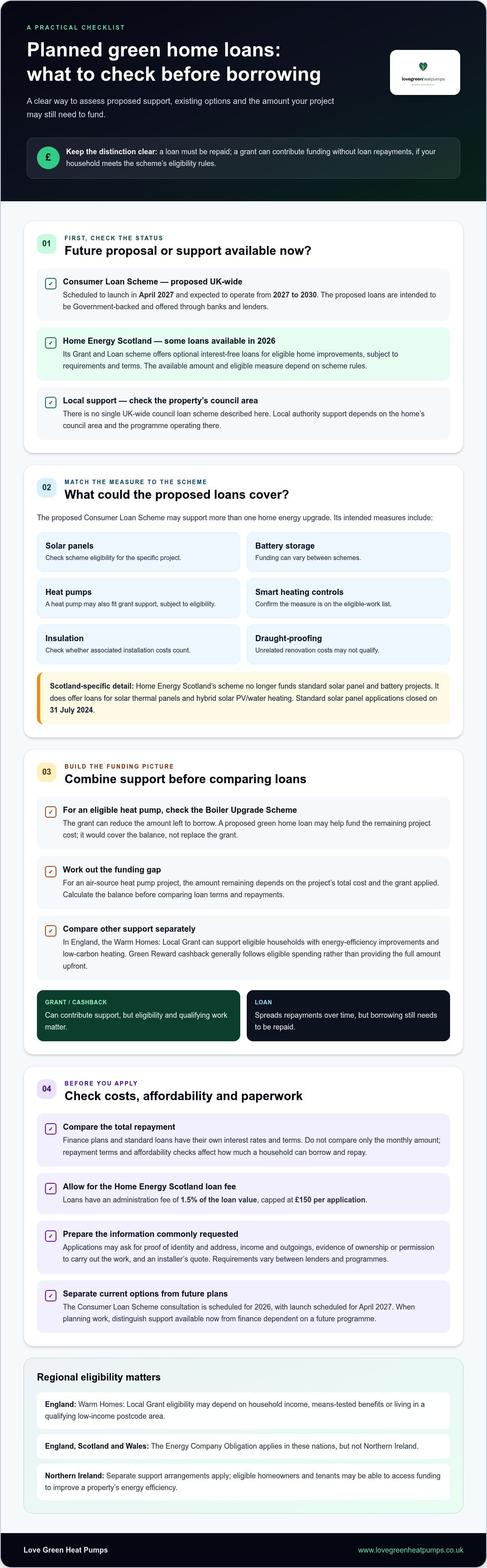
The Consumer Loan Scheme is scheduled to launch in April 2027 and is expected to operate from 2027 to 2030. These plans could reduce the upfront cost, but borrowing still needs repaying. Grants, by contrast, contribute funding without loan repayments when a household meets the scheme’s eligibility rules. Finance plans and standard loans have their own interest rates and terms, so compare the total repayment, not just the monthly amount.
Some interest-free renewable-energy loans are available in 2026, including through Home Energy Scotland. Its Grant and Loan scheme offers optional interest-free loans for eligible home improvements, subject to requirements and terms. The scheme no longer funds standard solar panel and battery projects, but it does offer loans for solar thermal panels and hybrid solar PV/water heating. Standard solar panel applications closed on 31 July 2024.
Loans have an administration fee of 1.5% of the loan value, capped at £150 per application. The available amount and eligible measure depend on the scheme’s rules.
Home Energy Scotland advisers can provide a written report outlining options for generating energy at home. This can help households compare renewable heating with other energy-efficiency improvements. Energy Saving Trust delivers the scheme through Home Energy Scotland on behalf of the Scottish Government.
The national programmes described here do not include one UK-wide council loan scheme. Local authority support depends on the property’s council area and the programme operating there, so the relevant council is the one responsible for the home’s address.
To apply for a loan, first identify the measure and scheme, then gather information about the property and planned work. Applications commonly ask for proof of identity and address, income and outgoings, evidence of ownership or permission to carry out the work, and an installer’s quote. Requirements vary between lenders and programmes, including those discussed through the Green Home Finance Strategic Partnership, so organise documents for the specific application.
Interest-free additional borrowing for energy-efficiency improvements
Additional borrowing can help spread the cost of home improvements beyond a single measure. Proposed UK-wide green home loans are intended for homeowners and could fund measures such as insulation, heat pumps, solar panels and draught-proofing. Their planned scope includes several upgrades, rather than only renewable energy equipment.
For landlords and businesses, eligibility depends on the programme. The proposed UK-wide loans are framed for homeowners; landlords should distinguish these from support for improving eligible residential properties. Businesses should look at finance designed for business projects rather than assume household loan terms apply.
In England and Wales, Government proposals require privately rented homes to reach at least EPC band C by 2030. This makes it useful to map required improvements, such as insulation or heating changes, before choosing finance.
Grants and loans work differently. A grant can reduce the amount a household needs to borrow, while a loan spreads repayments over time. In England, the Warm Homes: Local Grant can support eligible households with energy-efficiency improvements and low-carbon heating. Eligibility may depend on household income, means-tested benefits or living in a qualifying low-income postcode area.
Green Reward cashback is another type of support to compare with borrowing. Cashback generally rewards eligible spending after a qualifying purchase or improvement, rather than providing the full amount upfront. Before including it in a budget, check which energy-efficiency work qualifies and how the scheme calculates its reward.
Northern Ireland has separate support arrangements. Eligible homeowners and tenants may be able to access funding to improve a property’s energy efficiency. The Energy Company Obligation applies in England, Scotland and Wales, but not Northern Ireland, so distinguish regional schemes when planning improvements.
A loan scheme may cover eligible measures, but not every project cost automatically qualifies. The measure, property and programme rules determine which installation work can be funded. For example, a heat pump or insulation upgrade may fit a scheme’s purpose, while unrelated renovations may not. Check the eligible-work list and whether associated installation costs count before deciding how much to borrow.
For renewable projects, consider how a solar PV or renewable upgrade fits alongside insulation and heating improvements. A clear project plan helps separate grant-funded work, cashback and any remaining amount that would need borrowing.
Using loans alongside the Boiler Upgrade Scheme
The Boiler Upgrade Scheme can reduce the amount homeowners need to borrow for an eligible heat pump. Proposed UK green home loans may be used alongside this grant to help fund the remaining project cost. The loan would cover the balance, not replace the grant.
For example, an air-source heat pump project could leave a funding gap after the grant. The remaining amount depends on the project’s total cost and the grant applied. Work out the balance before comparing loan terms and repayments.
The Government’s Consumer Loan Scheme consultation is scheduled to take place in 2026. The scheme is scheduled to launch in April 2027 and is expected to operate from 2027 to 2030. This timeline matters if you’re planning a boiler replacement: separate work that can proceed under current support from finance that depends on a future programme.
Heat pump funding and insulation support serve different purposes. The Great British Insulation Scheme focuses on insulation and is designed to be open to more households than the Energy Company Obligation. It does not fund every type of heating upgrade. If you’re planning both insulation and a heat pump, check which measure each programme supports and avoid counting the same work twice.
Listing each measure separately can clarify a project plan. Set out the heat pump, any solar panels and insulation as separate items. Identify which work could qualify for a grant, which may fit a loan and what remains to fund. This keeps energy bills and repayments distinct, rather than assuming projected savings will cover every monthly payment.
Some green finance options have closed or changed scope. In Scotland, standard solar panel applications under Home Energy Scotland’s Grant and Loan Scheme closed on 31 July 2024. That scheme continues to offer support for other eligible measures, but standard solar panels and battery projects are no longer funded through it. A closed route should not be included in a new project budget.
Before applying, compare the grant and loan figures with the installer’s project breakdown. Confirm the heat pump type, eligible work, grant deduction and remaining amount to finance. Then compare the loan’s repayment period and interest with your household budget. Assess solar panels or insulation separately, as the Boiler Upgrade Scheme grant is for eligible heat pumps.
Affordability and credit checks
Eligibility and affordability are separate tests. Eligibility is about whether the household, property and planned work meet a scheme’s rules. Affordability is about whether repayments fit the household budget. A homeowner may meet a scheme’s property criteria but still need to show that borrowing is manageable.
For a loan application, prepare a clear picture of household finances. Lenders commonly consider income, regular commitments and existing borrowing when assessing repayments. Set out essential bills alongside the proposed loan payment to see what remains each month after usual household costs.
Credit checks also matter for some programmes. Green Homes Wales applications are subject to affordability and credit score checks. These checks apply to that programme, not as a universal rule for every UK home energy loan. The proposed UK-wide loans may have their own lender requirements and assessment process.
In England, the Warm Homes: Local Grant has a different eligibility route. A household may qualify if gross annual income is below £36,000, or in some cases through means-tested benefits or a low-income postcode area. This is grant support, not a general test for taking out a loan. A household’s income route should not be confused with a lender’s repayment assessment.
Understanding the difference can help homeowners choose their next step. If your income or benefits may qualify you for a grant, consider whether that support could reduce the amount left to finance. If a grant does not apply, compare the loan’s monthly instalment with your regular income and existing commitments. Plan an upgrade around a budget that does not rely on uncertain future savings.
The type of work can also affect eligibility. A heat pump, insulation measure or other improvement must meet the scheme’s eligible-work rules. An EPC rating may help describe a property’s energy performance, but it does not replace the programme’s household and project criteria. Keep the property details and proposed installation clear when applying.
Before accepting a loan, review the amount borrowed, interest rate, repayment period and total repayable amount. Interest-free borrowing still requires repayments, and an administration fee may apply under some schemes. For instance, Home Energy Scotland loans carry an administration fee of 1.5% of the loan value, capped at £150 per application.
A practical first step is to gather proof of income, regular household expenses, existing credit commitments and details of the planned work. Use these to build a realistic monthly budget before applying. This makes it easier to compare finance options and decide whether a grant, loan or smaller project better suits the household.
Proposed interest-free and low-interest renewable-energy loans
The main takeaway is that planned UK support includes both interest-free and low-interest borrowing. The proposed Warm Homes Fund is intended to offer low- and zero-interest loans for solar panels, batteries, heat pumps and insulation.
A separate Consumer Loan Scheme is scheduled to launch in April 2027 and run from 2027 to 2030. These are planned programmes, so households should distinguish them from schemes already operating in particular parts of the UK.
The proposed UK solar loan scheme has a different financing model. It could reach more than 8 million households with suitable rooftops, with loans at about 2% interest and repayments over 15 years. These are estimates, not a household-specific repayment or saving.
This shows why the interest rate alone does not tell the whole story. Compare the repayment period, monthly commitment and total borrowing alongside expected energy savings. Savings depend on how a home uses electricity and the system installed. A longer term can spread the upfront cost, but repayments continue for longer.
For readers researching interest free loans for renewable energy UK, the key distinction is whether a scheme is open now or planned for later. Home Energy Scotland provides eligible interest-free loans for some measures, but not standard solar panel or battery projects. The proposed UK-wide Warm Homes Fund includes those technologies, whilst the Consumer Loan Scheme is scheduled for 2027.
Home Energy Scotland’s ongoing loan support includes solar thermal panels and hybrid solar PV and water heating. That differs from standard solar PV, which the scheme no longer funds. Check the technology category carefully before including it in a home energy budget.
The proposed UK-wide loans are intended to cover multiple home improvements, rather than a single measure only. This could let households plan insulation alongside renewable generation or heating. The Consumer Loan Scheme consultation is due to take place in 2026, with further Warm Homes Fund details expected later that year. These are central details for anyone considering interest free loans for renewable energy UK households may be able to access.
For a practical next step, list the upgrade, funding route and expected repayment separately. Then compare the proposed terms with available grant support and household income. For help planning renewable work, discuss a solar PV or renewable energy project.
Love Green Heat Pumps: Heat Pump Installation
Love Green Heat Pumps installs heat pumps, managing each project from design through to commissioning. If you’re considering a heat pump alongside a proposed loan or grant, a property-specific quote can help you understand the work involved before deciding how to fund it.
Solar PV and other renewables may also form part of a home energy upgrade. The right combination depends on the property and planned improvements. Love Green Heat Pumps can provide a free, no-obligation quote, giving you a practical starting point for planning the work.
For a free, no-obligation quote, contact Love Green Heat Pumps Ltd or visit Love Green Heat Pumps Ltd.
Plan your next home energy step
Funding is only one part of a home energy decision. Start with the change that would make the biggest practical difference to your household, then consider how it fits your property and longer-term plans. Setting a clear priority helps keep borrowing decisions grounded in the work you actually want done.
Before committing, bring together your preferred improvements, the funding you’re exploring and the questions you still need answered. This gives you a useful basis for discussing the project and understanding how the work could be planned. Interest-free loans for renewable energy in the UK may change how an upgrade is funded, but the right starting point remains your home’s needs.
Love Green Heat Pumps Ltd can help you explore renewable energy work, including heat pump installation and solar PV. If you’re ready to discuss a project, contact Love Green Heat Pumps Ltd. A straightforward conversation can help you take the next step with a clearer plan and greater confidence.
Frequently Asked Questions
How will the loans work?
Eligible households would borrow through a participating lender and repay under agreed terms. The proposed UK-wide schemes are intended to support home energy upgrades, potentially alongside grants such as the Boiler Upgrade Scheme. For example, a grant could reduce the amount borrowed for a heat pump, while a loan could spread the remaining project cost. The lender’s offer would set the repayment schedule and any interest or fees.
How much money can you receive?
The amount depends on the scheme, eligible work and household assessment. In Scotland, Home Energy Scotland offers interest-free funding and cashback for qualifying renewable heating and energy efficiency improvements up to set caps.
Are interest-free loans available for renewable energy installations in the UK?
Yes, some interest-free options are available, although they vary by location and technology. Home Energy Scotland’s Grant and Loan scheme remains available for eligible measures, including solar thermal panels and certain renewable heating improvements. It no longer funds standard solar panel and battery projects. The proposed UK-wide loans are a separate route, with the Consumer Loan Scheme scheduled to launch in April 2027. Check that the specific installation fits the scheme.
What are the eligibility rules for UK renewable energy loan schemes?
Eligibility depends on the scheme, applicant and proposed work. Home Energy Scotland loans have their own eligibility requirements and terms. Green Homes Wales applications include affordability and credit score checks, and applicants must be homeowners in Wales. Grant eligibility is separate from loan eligibility: for example, the Warm Homes: Local Grant has income, benefits and postcode routes. Meeting one programme’s rules does not automatically qualify a property for another.
How much can homeowners borrow, and what are the loan terms and repayment periods?
Borrowing limits and repayment periods vary between schemes. The proposed solar loan model describes interest of about 2% with repayments over 15 years. Those terms are not a universal offer for every renewable project. Homeowners should compare the amount borrowed, interest rate, repayment period and total repayable amount. For a heat pump, calculate the funding needed after any grant, rather than treating the full installation amount as loan borrowing.
What risks, fees, credit checks or repayment conditions should borrowers consider?
Borrowers remain responsible for repayments, even if an installation produces less energy saving than expected. Home Energy Scotland charges an administration fee of 1.5% of the loan value, capped at £150 per application. Green Homes Wales includes affordability and credit score checks. Before accepting any offer, review the repayment schedule, fees, early repayment conditions and consequences of missed payments. Keep projected bill savings separate from the amount you can reliably repay.
Disclaimer
Disclaimer
The information published on this website is provided by Love Green Heat Pumps for general information and educational purposes. As a specialist provider of heating and renewable energy solutions, we strive to ensure that our content is accurate, relevant and up to date. However, heating requirements, system suitability, installation specifications, costs and performance can vary depending on individual property characteristics, usage and other site-specific factors.
Information provided in our articles should not be regarded as a substitute for a professional property assessment, technical survey or tailored recommendation. Any decisions regarding the selection, installation, replacement or maintenance of heating systems should be made with appropriate professional guidance.
Love Green Heat Pumps accepts no responsibility for decisions made solely on the basis of general information published in these articles. For advice specific to your property or project, we encourage you to contact our team for professional guidance and an assessment of your requirements.


