

Energy independence doesn’t have to mean disconnecting your home from the grid. The cost to become energy independent in the UK depends on what you want to achieve, from generating more of your own electricity to reducing reliance on gas for heating. For most homes, it’s a gradual shift, not an all-or-nothing change.
It’s natural to focus on upfront costs, but the right mix of improvements matters just as much. Solar panels generate electricity in daylight, batteries can store some of it for later, and insulation helps reduce the energy your home needs. Some households may also qualify for financial support for energy-efficiency improvements, depending on where they live and their circumstances.
This guide explains how solar, batteries, insulation and heat pumps affect costs and potential payback, and why matching annual electricity use doesn’t mean you can run independently in every season. It also compares reducing grid use with going off-grid, so you can weigh a practical level of independence against your home’s comfort and energy needs.
Key Takeaways
- Decide whether your aim is to reduce grid imports, match annual electricity use with renewable generation or go fully off-grid; each requires a different system.
- Plan solar and battery use around seasonal patterns: panels generate in daylight, while a battery shifts some electricity to later hours but cannot usually carry summer surplus into winter.
- Reduce your home’s heat demand with insulation and efficiency improvements before sizing a renewable energy system.
- Assess savings, carbon reduction and power-cut backup as separate goals, and consider monthly energy flows rather than annual totals alone.
- Include heating and hot-water needs in your plans, and explore whether financial support for home energy improvements may apply to your circumstances.
What do solar and batteries contribute?
Solar panels generate renewable electricity during daylight, so household use and generation won’t always coincide. A battery can store some surplus for later, such as for evening cooking or heating. It usually can’t shift summer surplus into winter, when daylight generation falls and heating demand can rise. Matching annual generation to annual electricity use therefore doesn’t mean a home can operate continuously without importing electricity.
Combining solar, a battery and a heat pump can shift more household energy use to electricity. A heat pump uses electricity to provide warmth and can deliver several units of warmth for each unit of electricity it consumes. Solar may supply some of that electricity, while a battery shifts some daytime generation to later hours. The balance changes with the season, household routines and heating demand.
Battery capacity, measured in kWh, affects how long stored energy can supply a home. Inverter output, measured in kW, limits the demand the system can meet at one time. This matters when several appliances run together. Annual totals alone won’t show whether a system can meet evening peaks or winter shortfalls. Monthly energy flows give a clearer picture of when generation and demand diverge.
Generation costs provide context, but they aren’t the same as a household’s installation cost or electricity tariff. These figures are in real 2021 prices. They compare generation costs, not the cost of a home solar system.
Contracts for Difference auction prices are another measure, not household prices. Wind and solar generation can displace gas-fired generation, reducing the amount of gas needed when renewable output is available. In 2025, wind reduced average UK day-ahead electricity prices by 31% compared with estimated prices without wind. The effect varies with generation across the electricity system.
Household installations show growing interest in these technologies, but don’t establish what a particular home needs. Almost 370,000 solar, heat pump and battery storage installations took place across UK homes and small businesses in 2025. For an individual home, the useful assessment is how solar generation, battery storage and heating demand fit together across the year. A system designed around summer output alone may leave winter electricity needs largely unchanged.
Home insulation and energy efficiency
Insulation reduces heat escaping through the roof, walls, floors and gaps around doors. Lower heat demand can help renewable electricity and heating systems meet more of the household’s needs.
Insulation and Draught-Proofing Costs
Insulation and draught-proofing limit heat loss through building materials and air gaps. Costs depend on the areas treated, the property’s construction, access and the work required. Loft, cavity wall and solid wall insulation involve different methods, so there is no single price that fits every UK home.
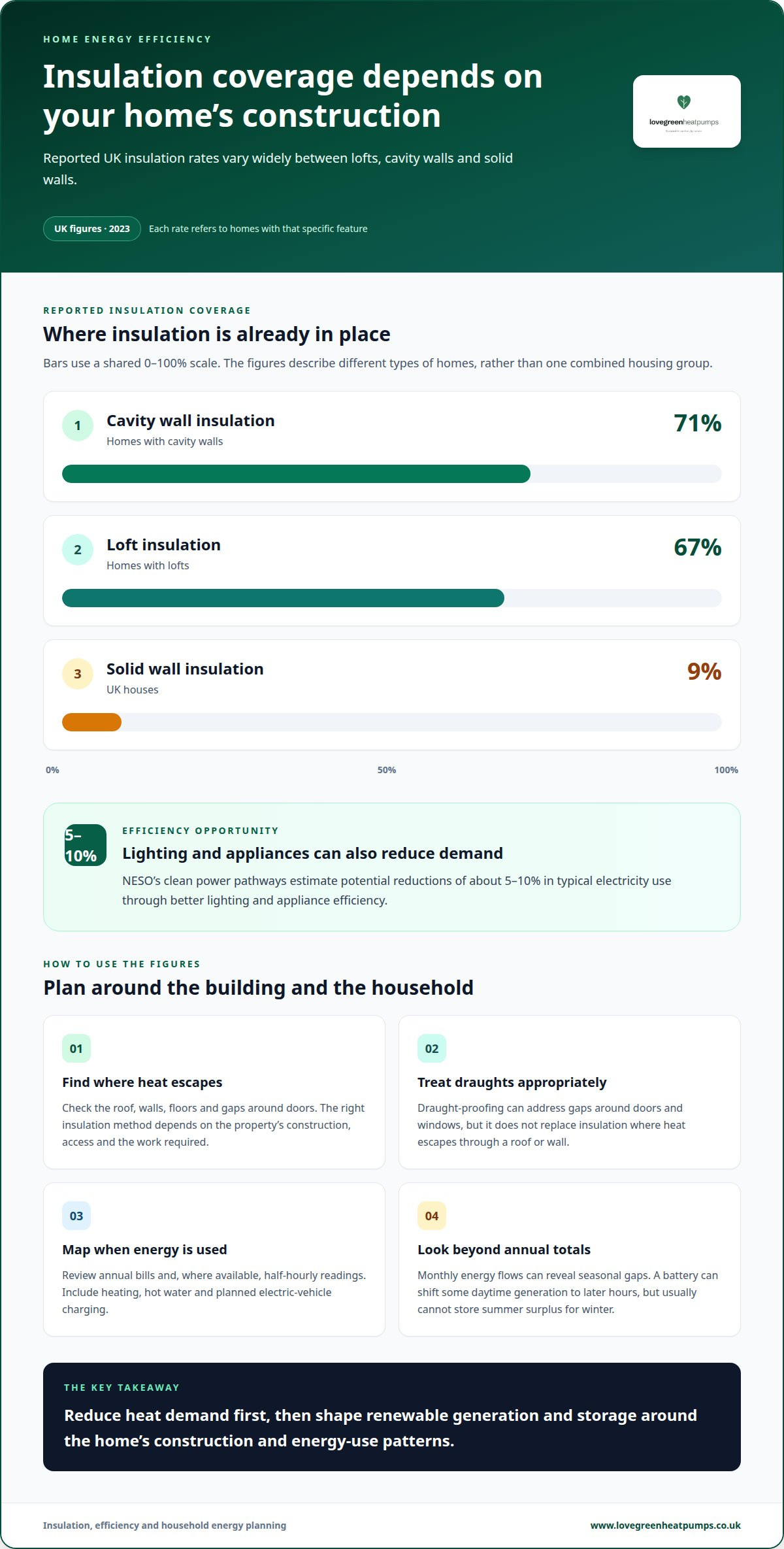
The starting point is to identify where heat escapes and which improvements suit the building. In 2023, 67 per cent of UK homes with lofts had loft insulation, while 71 per cent of homes with cavity walls had cavity wall insulation. The rate for solid wall insulation in UK houses was 9 per cent. These differences show why the home’s construction matters when planning work. Draught-proofing can address gaps around doors and windows, but it doesn’t replace insulation where heat escapes through a roof or wall.
The Warm Homes Plan is intended to help millions of people live in warmer, cheaper-to-heat homes. Financial support for energy-efficiency improvements depends on where a person lives and their circumstances. Better lighting and appliance efficiency can also reduce demand: NESO’s clean power pathways estimate potential reductions of about 5-10 per cent in typical electricity use.
Planning Home Energy Use
Home energy planning means mapping when a household uses electricity and heat, then matching improvements to that demand. Review annual bills and, where available, half-hourly readings. Include heating, hot water and planned electric-vehicle charging, then identify both total consumption and the highest simultaneous load.
For solar and battery storage, system size depends on roof generation, household demand, battery capacity and peak power needs. Annual totals alone can hide winter shortfalls, so monthly or more detailed energy flows are more useful. A battery shifts some renewable electricity to later hours, but it doesn’t usually store summer surplus for winter.
Planning permission, building regulations and grid connection requirements depend on the property, proposed equipment and work involved. Assess the roof and electrical arrangements alongside any building work, rather than assuming the same rules apply to every home.
Keep savings, carbon reduction and backup power as separate aims in the plan. A grid-connected system also needs suitable equipment and isolation arrangements to support household loads during a power cut. For a home considering solar PV and renewable energy, combining demand records with insulation needs helps shape a system around how the household actually uses energy.
Financial viability and payback
Financial viability depends on your aim: lower bills, lower carbon emissions, better energy security or complete grid independence. These goals can require different equipment and costs. A connected household might choose to reduce fossil-fuel heating and buy less grid electricity, while an off-grid home must also plan for prolonged periods with limited renewable generation.
Disconnection itself is only one part of the decision. The full comparison includes the renewable system, maintenance, grid-connection costs and any backup energy source.
Keeping the grid may be more practical than sizing a home system to cover prolonged winter shortages. A battery stores electricity for later use, but its capacity and household demand determine how long it can supply the home. A system designed for occasional evening use serves a different purpose from one expected to cover extended periods of low generation. The more ambitious the independence target, the more important storage, backup and seasonal supply become.
Location, roof direction and shading affect how much solar electricity a home can generate. Household use matters too: daytime consumption can use generation directly, while evening demand may require storage or grid electricity. These factors affect potential savings and payback, because a system’s value depends on how much generated electricity the household can use and how much it would otherwise import.
Assess the investment in stages rather than reducing every upgrade to one payback figure. First, compare annual energy bills and usage patterns. Then account for the complete system cost, maintenance and any backup supply. Finally, consider whether the expected bill saving, carbon reduction and energy security justify the spend for your household. A single payback estimate can obscure these different benefits.
- Bill saving: estimate how changes in grid electricity use affect annual household spending.
- Carbon: consider how renewable electricity and reduced fossil-fuel use change home energy demand.
- Energy security: weigh the value of stored electricity and backup against the cost of maintaining a grid connection.
These measures describe different outcomes, not interchangeable returns. A home focused on lower bills may retain grid support, while a property aiming for independence needs a broader assessment of seasonal generation, storage, maintenance and backup. Compare the total cost of the chosen setup with your household’s priorities and energy use.
Replacing gas boilers with heat pumps
Replacing a gas boiler with a heat pump changes how a home gets warmth. A boiler burns a fossil fuel, while a heat pump uses electricity to move heat into the home. It can deliver several units of warmth for every unit of electricity it uses. This can reduce reliance on fossil fuels, but the effect on bills depends on electricity use, heat demand and the home’s heating setup.
This support can reduce the upfront amount a household needs to fund. It doesn’t remove the need to consider the complete project, including the heating system, hot water and the home’s heat loss. A well-insulated property may need less heat, affecting the system’s size and operation.
Running costs need to be compared separately from installation costs. That figure is an average, not a forecast for every household. A fair comparison with a gas boiler should consider both fuels, the home’s annual heating demand and how efficiently the system operates.
Heat pumps use electricity, so solar generation may help supply some of their demand when available. However, winter heating needs can rise as solar output falls. Consider how the national electricity supply, grid imports and any stored electricity fit your heating plans. A heat pump can reduce direct fossil-fuel use at home, but it doesn’t make a property independent of the electricity system on its own.
Before choosing a system, the main considerations include:
- Heat demand: insulation, draughts, room temperatures and hot-water use affect how much warmth the home needs.
- Existing heating: the current boiler, radiators and pipework shape the work involved in a replacement.
- Electricity use: household demand and the available supply affect how a heat pump fits alongside other electrical loads.
- Financial support: the Boiler Upgrade Scheme can contribute towards installation for eligible households.
The cost of a heat pump installation depends on the property, heat demand, existing heating equipment and work required. Ask for a quote based on your home, so the figure reflects its requirements rather than an average.
When considering the cost to become more energy independent in the UK, compare a heat pump’s expected running costs with your current heating, then weigh the change against comfort, fossil-fuel use and energy security. A lower bill is only one measure; value also depends on how much your household wants to reduce its reliance on gas.
What energy independence means for UK homes
For a UK home, energy independence can mean three different things: reducing grid electricity use, matching annual electricity consumption with renewable generation, or disconnecting from the grid entirely. These goals require different levels of generation, storage and backup. A household seeking lower energy bills may stay connected, while a home aiming to operate independently must plan for periods when renewable output is low.
The difference matters most across the seasons. Solar generation falls during darker winter months, when heating demand can rise. A battery shifts some electricity to later hours, but it incurs losses and can’t usually store summer surplus for winter. Matching annual generation and consumption therefore doesn’t mean a home can meet every demand without grid imports.
Going fully off-grid brings different practical considerations. A household needs enough supply for everyday electricity and heating, plus a plan for extended shortfalls. That may mean additional storage or another backup energy source. By contrast, staying connected lets the grid support the home when generation and demand don’t align. The right balance depends on the household’s priorities, not just its annual electricity use.
Power cuts need separate consideration. A grid-connected renewable system needs appropriate equipment and isolation arrangements to support household loads during an outage. Solar panels alone don’t ensure the home will have electricity when the grid is down. The system must be designed for backup, with equipment that can safely separate supported household loads from the grid.
Risks include winter supply gaps, equipment faults and relying on a system that can’t meet peak household demand. Ongoing maintenance costs depend on the equipment, its condition and any backup arrangements, so include them alongside initial system and connection costs.
Before deciding what energy independence should mean for your home, separate the aims:
- Lower bills: reduce grid imports while staying connected for periods of low generation.
- Annual renewable balance: aim to generate as much electricity over a year as the household uses, while accounting for seasonal imports.
- Off-grid operation: plan for heating, storage, backup supply and maintenance when the grid is no longer available.
For many households, a connected system offers a practical middle ground: more clean energy generated at home, with the national grid available when needed. The expected level of independence should reflect how the home is heated, how much electricity it uses and how it handles low-generation periods. Discuss your home energy system with Love Green Heat Pumps Ltd to explore how generation and heating can work together.
Love Green Heat Pumps
Love Green Heat Pumps helps households consider how solar generation, heating and electricity use can work together. Its services include solar PV and other renewables, heat pump installation, heating engineering and air conditioning. This can be useful when you’re weighing lower grid use against seasonal heating needs, or deciding which improvements fit your home’s energy goals.
Love Green Heat Pumps handles heat pump installations from survey and design through to commissioning. The right approach depends on your property, existing heating and energy priorities, not on a single definition of independence. Discuss how solar and heating improvements could support your plans without assuming that going fully off-grid is the only route.
To talk through your home energy plans, contact Love Green Heat Pumps.
Choose a practical next step for your home
Energy independence doesn’t have to be a single, all-at-once decision. Start by deciding what matters most to your household: managing energy spending, changing how your home is heated or relying more on energy generated at home. That priority gives each possible improvement a clear purpose.
Then consider the cost to become energy independent in the UK as part of a longer-term home plan, not just a target for one installation. The right sequence depends on your property, how you use energy and how much change feels manageable. You can explore the options without assuming that complete separation from the grid is the only measure of progress.
Love Green Heat Pumps can help you consider renewable energy and heating choices in the context of your home. If you’re ready to discuss a practical way forward, talk with Love Green Heat Pumps about your plans. A clear starting point can make the next decision feel much more manageable.
Frequently Asked Questions
Can I get help with costs?
Yes, some UK households may qualify for support with energy improvements. Support for insulation and other efficiency work depends on where you live and your circumstances. Check the eligibility conditions before including a grant in your household budget, as support can affect how much you need to fund.
How much will I save per year by going off-grid?
There isn’t one annual saving that applies to every off-grid home. It depends on the energy bills you replace, how much electricity your system generates, and the costs of maintenance and backup supply. A household using substantial electricity during sunny periods may use more of its own generation. Winter heating demand or low generation can still mean relying on stored energy or another supply.
How much will it cost to go off-grid?
That figure describes a particular setup, not every property or a fully disconnected system. The total depends on the generation and storage required, heating demand, maintenance and backup. Include these ongoing needs when comparing the investment with a grid-connected approach.
Is going fully off-grid worthwhile?
Going off-grid can suit a home where independence is a priority and the system can meet its needs during periods of low generation. The trade-off is planning for storage, backup and maintenance, as well as the initial equipment. Staying connected may be more practical if avoiding winter supply gaps matters more than eliminating grid use. Compare the complete setup with your household’s energy use and priorities.
Living off-grid: Is it possible in the UK?
Yes, a UK home can operate off-grid if its energy system can supply its electricity and heating needs. The design must account for changes in generation, especially when solar output is lower. Storage and backup can help address shortfalls, but add to the system’s requirements. A property’s insulation, energy demand and available generation all affect how workable off-grid living will be.
What does energy independence mean for a UK household?
Energy independence can mean reducing grid electricity use, generating as much electricity annually as the household consumes, or disconnecting from the grid. These are different goals. For example, a household might use solar generation to reduce imports but still rely on the grid in winter. Decide which outcome matters most before comparing systems, because each level of independence calls for a different approach.
Can a UK household go off-grid, and what do batteries, backup generation and grid disconnection cost?
Yes. A battery stores some generated electricity for later, while backup generation can help cover supply shortfalls. These figures cover different parts of the decision.
What UK grants, loans or tax incentives help households pay for energy independence?
Support for home energy-efficiency improvements depends on location and personal circumstances. In London, this includes households in the City of London, Southwark, Lewisham, Greenwich, Merton, Tower Hamlets, Newham, Bromley, Sutton, Croydon, Westminster, Wandsworth, Islington, Hackney, Bexley, Camden, Redbridge and Hillingdon. Check scheme conditions before budgeting.
Disclaimer
Disclaimer
The information published on this website is provided by Love Green Heat Pumps for general information and educational purposes. As a specialist provider of heating and renewable energy solutions, we strive to ensure that our content is accurate, relevant and up to date. However, heating requirements, system suitability, installation specifications, costs and performance can vary depending on individual property characteristics, usage and other site-specific factors.
Information provided in our articles should not be regarded as a substitute for a professional property assessment, technical survey or tailored recommendation. Any decisions regarding the selection, installation, replacement or maintenance of heating systems should be made with appropriate professional guidance.
Love Green Heat Pumps accepts no responsibility for decisions made solely on the basis of general information published in these articles. For advice specific to your property or project, we encourage you to contact our team for professional guidance and an assessment of your requirements.


