

A heat pump survey looks beyond the boiler. A heat pump survey for your home includes a room-by-room heat-loss assessment, a review of your current heating system and checks on insulation, windows and available space. The report can recommend a suitable heat pump type and size, along with any radiator changes and estimated installation costs.
It’s understandable to wonder whether your radiators, hot-water setup or outdoor space will work with a heat pump. The answer depends on how your home loses heat and what may need changing, not simply on whether you have underfloor heating.
This guide explains what a heat pump survey for home checks, how your current system affects suitability and what the findings mean for the design and quote. It also explains how the assessment differs by heat pump type, so you can understand which considerations apply to your property.
Key Takeaways
- A survey checks how much heat each room needs, helping match the system to your home rather than relying on a rough estimate.
- Your existing radiators may be suitable, but their size and condition, along with the electrical supply and access, can affect the work required.
- The report should set out a suitable heat pump type and size, any recommended radiator upgrades and estimated installation costs.
- Air-source and other heat pump options have different space and installation considerations, which the survey can assess for your property.
- The standard Boiler Upgrade Scheme grant for most UK homes replacing a gas boiler is £7,500, according to the Department for Energy Security and Net Zero.
Can a heat pump work with my existing heating system?
Existing radiators or underfloor heating can often remain if the heat pump is designed to suit them. The survey checks the system, property layout and practical installation requirements before identifying any changes needed.
Radiator and Underfloor Heating Suitability
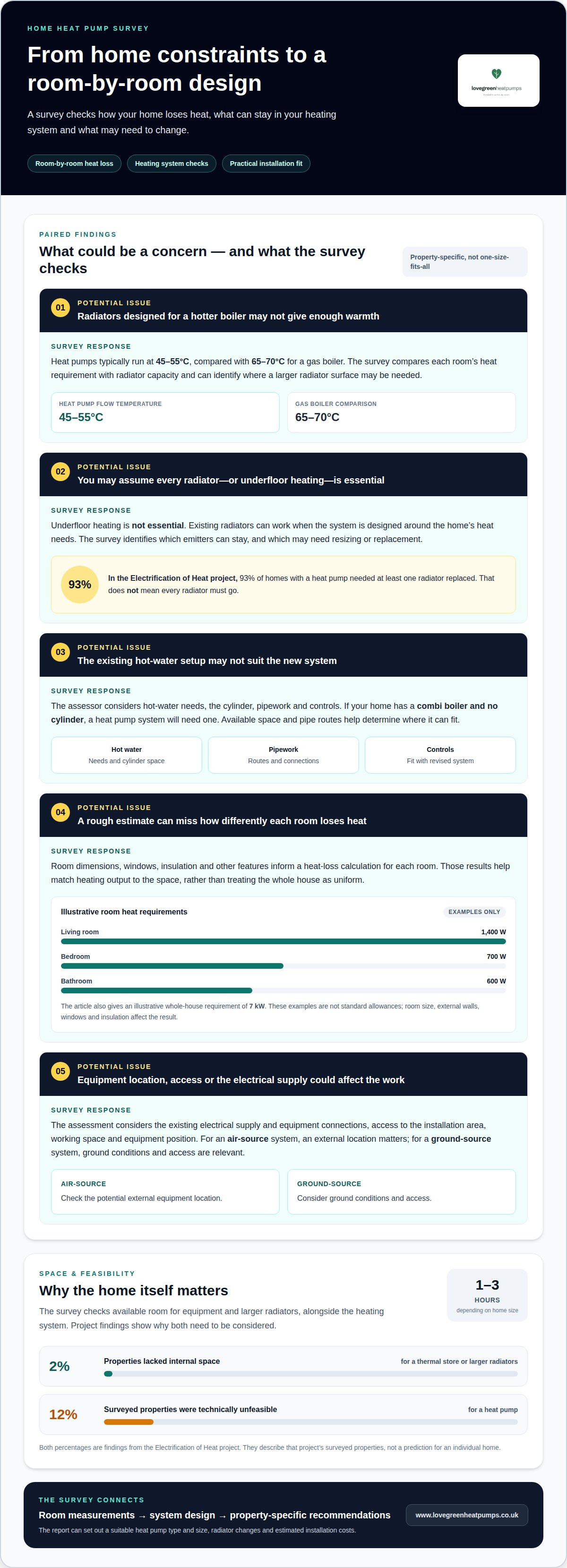
Suitability means checking whether existing radiators or underfloor heating can deliver enough warmth at a heat pump’s lower flow temperature. Heat pumps typically run at 45 to 55 degrees, compared with 65 to 70 degrees for a gas boiler. This difference matters: radiators designed around boiler temperatures may need a larger surface area to heat rooms comfortably.
Underfloor heating isn’t essential. Existing radiators can also work when system design matches the home’s heat requirements. In the Electrification of Heat project, 93% of homes with a heat pump needed at least one radiator replaced. That doesn’t mean every radiator must go. The survey identifies which rooms need changes and whether existing emitters can remain.
Property Measurements and Radiator Sizing
Room measurements help determine the heat output required from each radiator. The survey considers room dimensions, windows and other features that affect heat loss, then compares the room’s heating needs with the radiator’s capacity. A radiator suited to a small bedroom, for example, may not provide enough heat in a larger living room.
A larger radiator can provide more heat across a wider surface at lower water temperatures. The design can identify which radiators to keep, resize or replace, rather than treating the whole house as one uniform space.
The survey also considers the rest of the heating system. An existing hot-water cylinder, pipework and controls all inform the design. If your home has a combi boiler and no cylinder, a heat pump system will need one. Available space and pipe routes help determine where it can fit.
The electrical supply is another practical consideration. The assessment considers the existing supply and equipment connections alongside heating changes. Access matters too: the route to the installation area, available working space and equipment position can affect how the system is fitted.
The condition of radiators and other heating components informs the recommendations. The survey considers whether an emitter is damaged, poorly positioned or difficult to connect with the proposed layout. It also checks whether pipework and controls suit the revised system, helping distinguish necessary changes from items that can stay.
Space can affect feasibility. In the Electrification of Heat project, 2% of properties lacked internal space for a thermal store or larger radiators. The project also found that 12% of surveyed properties were technically unfeasible for a heat pump. These figures show why the assessment considers both the heating system and the home’s available space.
What will a heat pump survey cover?
A heat pump survey for home use examines how each room loses heat and what the property needs to stay comfortable. A room-by-room heat-loss calculation is central to the assessment and helps shape the system’s design and size.
A remote or desktop assessment can miss details that affect the design, such as actual room dimensions, window condition, insulation gaps or existing heating equipment. An in-person survey lets the assessor inspect these features directly. Remote information can support an initial review, but incomplete measurements or photographs may leave important details unclear.
The assessment begins with the property’s layout and construction. Room measurements, insulation and window details help show where heat may escape. The assessor can also consider the home’s Energy Performance Certificate and space for equipment. Together, these details help establish heat demand instead of relying on floor area alone.
Heat loss is calculated for each room, including the warmth needed on colder days. The result informs how much heat the proposed system must deliver and where. An example calculation might show a whole-house requirement of 7 kW, with separate figures for individual rooms. Those room totals help distinguish a small bedroom’s demand from a larger living room’s needs.
For example, an illustrative calculation could put a living room’s requirement at 1,400 W, a bedroom’s at 700 W and a bathroom’s at 600 W. These are examples, not standard allowances for every home. Room size, external walls, windows and insulation all influence the result. The figures help match heating output to each space and provide a basis for the proposed system design.
The assessor records the current heating system and considers how it fits the proposed design. Checks may cover hot-water needs, potential cylinder space and possible locations for indoor or outdoor equipment. For an air-source heat pump, an external location is relevant; ground conditions and access matter when considering a ground-source system.
A UK heat pump assessment can take 1-3 hours, depending on home size. The findings explain which rooms drive heat demand and what technical factors shape the recommendation. For a heat pump survey for your home, those calculations connect the property’s measurements with a system designed around its actual needs.
A detailed heat pump installation assessment can connect room-by-room findings with a practical system design.
Assessment report recommendations and installation costs
The survey findings inform the recommended system design, including the heat pump type and size, any radiator changes and the work involved. Love Green Heat Pumps provides a clear, property-specific quote after the home survey, rather than a generic cost estimate.
Illustrative installer quotations show how recommendations can differ: one proposes a 12 kW heat pump, another an 8 kW model. An example report also recommends changing three radiators. These are examples, not standard specifications. The right design depends on the property’s heat demand, existing equipment and planned upgrades.
How much does a heat pump survey cost in the UK? The cost depends on the property and the scope of the assessment. Love Green Heat Pumps provides a property-specific quote after understanding your home, rather than a generic price list.
A proposal should explain what the installation work includes. Check how it accounts for the heat pump, fitting, hot-water arrangements, controls and any radiator or electrical upgrades. A clear, property-specific quote helps you understand what is included and what shapes the design, rather than focusing on equipment alone.
For most UK homes replacing a gas boiler, the standard Boiler Upgrade Scheme grant is £7,500, according to the Department for Energy Security and Net Zero. The grant can affect the amount a household needs to fund, but it doesn’t replace the report’s project-specific cost estimate.
Settings also shape running costs. The design considers the household’s preferred indoor temperature, heating schedule and the home’s heat demand. For example, someone who prefers 22°C may need a different heating pattern from a household comfortable at 18°C. Lower heat demand, insulation and suitable system settings all influence energy use; the report should explain how its design fits the home.
How can I find an MCS-certified heat pump installer and check survey credentials? Love Green Heat Pumps carries out a full home survey and heat-loss calculation before designing an installation. The company is a member of the HEIS Consumer Code and accredited to the TSI Approved Code. Its installations are carried out with MCS-certified installation partners.
How long does a heat pump survey take and how soon can installation follow? A UK assessment takes 1-3 hours, depending on the home’s size. Installation can follow once the design, required upgrades, equipment supply and practical arrangements are in place; the survey duration alone doesn’t determine the start date.
Compare the recommended system with the survey’s heat-loss findings and the work described in the proposal. This connection between the calculations, system design and any upgrades helps you understand the plan for your home.
When a heat pump assessment may be suitable
A heat pump assessment helps establish whether a home’s layout, heating system and available space suit a heat pump. It is useful before choosing equipment or planning changes to hot water, the electrical supply or the outdoor unit.
In the UK, the GOV.UK suitability check asks which nation the home is in, its current heating system and its number of bedrooms. Grant details depend on the scheme and heating fuel: most UK homes replacing a gas boiler can receive the £7,500 Boiler Upgrade Scheme grant, whilst homes currently heated by oil or LPG can receive £9,000 until 31 March 2027.
Heat Pump Suitability for UK Homes
A suitability assessment compares the home’s heating needs with the space and equipment a heat pump requires. An existing boiler, limited indoor space or restricted outdoor space can all affect the recommended design.
Radiators or underfloor heating may form part of a suitable system when designed to deliver enough warmth. Hot-water arrangements also matter: a home with a combi boiler and no cylinder needs a cylinder installed for a heat pump. In the Electrification of Heat project, 81% of homes required a new thermal store, such as a hot-water tank.
Space is another practical factor. The same project found 8% of properties lacked external space for an outdoor unit. An assessment considers where equipment could go and whether access allows installation. It can also consider whether the electricity supply and meter arrangement suit the proposed system, rather than assuming every existing setup is ready.
Using a Home Suitability Checker
The GOV.UK heat pump suitability check is an initial online tool to help assess whether a heat pump could suit a home. Questions about location, current heating and bedroom count provide a starting point, not a room-by-room system design.
Use the result to guide what you discuss during a full survey. A home with a gas boiler and no hot-water cylinder, for example, has different planning needs from one that already has a cylinder. An online checker cannot inspect a potential outdoor-unit location or assess existing heating equipment.
Grant eligibility also depends on the home’s current fuel and the relevant scheme. The Boiler Upgrade Scheme figure for gas-boiler replacement is £7,500 for most UK homes; oil- and LPG-heated homes have a separate £9,000 grant until 31 March 2027. These examples do not set out a complete nation-by-nation comparison, so the home’s location and heating fuel both matter when considering support.
A home survey brings together the current boiler and hot-water setup, electrical supply, available indoor and outdoor space, and existing radiators or other heating emitters. This helps ensure recommendations reflect the property, rather than a generic assumption about UK homes.
Air-source and other heat pump survey types
The survey needs to address the heat pump type being considered. Air-source, ground-source and hybrid systems have different equipment, space and access requirements, so the assessment focuses on the proposed design.
An air-source heat pump takes heat from outdoor air. The survey considers where the external unit could go, how installers can access the location and how it sits in relation to the home and neighbours. Placement matters for access and noise. The assessment also considers the home’s heat demand and the system design needed to provide comfortable heating.
Ground-source heat pumps draw heat from the ground, so the assessment considers the site as well as the home. Available outdoor space and access for ground works help determine whether an individual system is practical. Shared ground-source arrangements have different site requirements because the equipment and ground infrastructure serve more than one home. The survey connects these physical constraints with the household’s heating needs.
Hybrid systems combine a heat pump with another heating source, often retaining a boiler. The assessment considers how the two sources will work together, which heating demand each is expected to meet and how the existing system fits the design. This differs from assessing a standalone air-source or ground-source heat pump.
The Electrification of Heat project installed 742 heat pumps, showing a mix of system types in its trial homes. Low-temperature air-source models made up 41%, while high-temperature air-source models accounted for 33%. Hybrid heat pumps represented 21%. Individual ground-source systems made up 1%, and shared ground-source systems accounted for 4%.
The design depends on the property, not a universal recommendation. For an air-source system, the outdoor location is a key consideration. For ground-source, land and access matter. For a hybrid design, the existing heating arrangement influences how the system is assessed.
Efficiency depends on matching the heat pump and its operating temperature to the home’s heat demand and heating emitters. The assessment should explain why the proposed design suits the property, which site conditions affect installation and how the system is intended to provide heat. A type label alone cannot tell you whether the layout works for your home.
If you’re weighing air-source against ground-source options, discuss a suitable heat pump design for your property.
Love Green Heat Pumps: Heat Pump Installation
Love Green Heat Pumps Ltd can turn survey findings into a practical plan for a home heat pump installation. If the report identifies changes to radiators, hot water or equipment placement, its installation service covers the process from design to commissioning.
You can discuss how the survey’s findings shape the system design and what work your home needs. Love Green Heat Pumps Ltd also offers heating engineering, air conditioning, and solar PV and other renewables for related home energy needs.
When you’re ready to discuss the next step, contact Love Green Heat Pumps Ltd about your home and survey findings.
Make your next heating decision with confidence
A heat pump survey for home use is most valuable when the findings help you make an informed decision. Consider how the proposed system fits your household’s routine, the rooms you use most and the changes you are comfortable making. A clear conversation can turn those priorities into a plan for your property.
Love Green Heat Pumps Ltd can help you explore the next step through its heat pump installation service. Bring your survey findings and questions about the recommended design, so the discussion can focus on what matters in your home.
Contact Love Green Heat Pumps Ltd to discuss your home and the way forward. A considered plan can make the transition feel manageable and keep comfort at the heart of your decision.
Frequently Asked Questions
Can I get a heat pump if I have a combi boiler?
Yes, a home with a combi boiler can have a heat pump, but it will need a separate hot-water cylinder if it has none. The survey can consider where a cylinder could fit, such as an airing cupboard or utility space, and how pipework might reach it. Your household’s hot-water use also helps shape the proposed arrangement and available storage.
Does my home need to be perfectly insulated?
Perfect insulation is not a prerequisite, but insulation affects heat loss and system design. The assessment can identify where improvements may reduce heat demand, such as draughty windows or poorly insulated walls. An Energy Performance Certificate provides useful context, while the room-by-room assessment shows how the home performs in practice. Use the findings to understand which upgrades may be worthwhile, rather than assuming every part of the home needs work.
Is my home suitable for a heat pump?
Suitability depends on your home’s heat demand, existing heating, hot-water needs and space for equipment. A UK home suitability check asks which nation the property is in, its current heating system and its number of bedrooms. This gives an initial indication, not a final design. A full survey examines details the online questions cannot capture, including equipment access and practical installation constraints.
Is there a grant available to help with the cost?
Yes. The standard Boiler Upgrade Scheme grant for most UK homes replacing a gas boiler is £7,500, according to the Department for Energy Security and Net Zero. Grant eligibility isn’t guaranteed, so confirm it with the relevant scheme administrator before work begins. Whether support applies depends on the scheme’s rules and your circumstances. Treat any grant as a possible contribution, not a confirmed reduction.
What happens if my home needs upgrades first?
The survey findings can identify upgrades that may be needed and how they relate to the proposed heating system. These could include improving insulation, changing selected radiators, adding hot-water storage or making electrical changes. Understanding the work before installation planning helps you consider your options. If improvements are planned in stages, discuss their timing as part of the design so the installation reflects the home’s intended condition.
What is a home heat pump survey and what does it assess?
A home heat pump survey assesses a property’s heating needs to plan a suitable system. It considers the layout, construction, insulation, existing heating and hot-water arrangements, as well as potential equipment locations. The design can inform the recommended heat pump and any property changes. A heat-loss calculation is central because it estimates the heat each room needs in colder conditions.
What information and access should homeowners provide before a survey?
Before the visit, share your current heating type, property details and Energy Performance Certificate information, and provide a floor plan if you have one. Make the rooms, radiators, hot-water equipment, meter area and potential outdoor-unit locations accessible. Clear access helps the assessor understand connections and available space. Mention planned renovations or rooms that are often difficult to heat, as these details may affect the design.
How does a heat pump survey assess insulation, heat loss and radiator suitability?
The assessor records room dimensions and relevant features, including windows and external walls, to estimate heat loss. Insulation affects how quickly warmth escapes, while each room’s estimated heat demand indicates the output its heating emitter needs. Existing radiators are compared with that requirement and the proposed operating temperature. This room-by-room assessment helps identify which emitters may suit the design and which may need adjustment.
Disclaimer
Disclaimer
The information published on this website is provided by Love Green Heat Pumps for general information and educational purposes. As a specialist provider of heating and renewable energy solutions, we strive to ensure that our content is accurate, relevant and up to date. However, heating requirements, system suitability, installation specifications, costs and performance can vary depending on individual property characteristics, usage and other site-specific factors.
Information provided in our articles should not be regarded as a substitute for a professional property assessment, technical survey or tailored recommendation. Any decisions regarding the selection, installation, replacement or maintenance of heating systems should be made with appropriate professional guidance.
Love Green Heat Pumps accepts no responsibility for decisions made solely on the basis of general information published in these articles. For advice specific to your property or project, we encourage you to contact our team for professional guidance and an assessment of your requirements.


