

Improving an EPC rating doesn’t always require a major renovation. If you’re looking for how to improve a UK property’s energy rating, start with the recommendations on its Energy Performance Certificate (EPC), then prioritise practical measures such as insulation, heating controls and draught-proofing. These can improve comfort and energy efficiency, but the effect on the rating depends on the property and the work completed.
You may also want to know whether improvements could affect your property’s value and how to manage the cost. This guide explains where upgrades can make a difference, how an EPC may inform property decisions, and what support might be available. It also sets out a practical way to plan improvements, from straightforward household measures to larger heating and insulation projects.
Key Takeaways
- Start with your EPC recommendations and prioritise improvements that suit your home, from cylinder insulation to draught-proofing.
- Heating controls and energy-efficient lighting can support better efficiency; focus on practical upgrades that fit your existing setup.
- An improved EPC may matter to buyers and landlords, but its effect on property value depends on the home and local market.
- Look into financial help before planning larger work: according to the Department for Energy Security and Net Zero, eligible households can receive up to £7,500 towards heat-pump installation.
- When a heating upgrade is part of your plan, Love Green Heat Pumps can help with heat pump installation.
Hot water cylinder insulation
Compare improvements by dividing each measure’s upfront cost by its estimated annual saving.
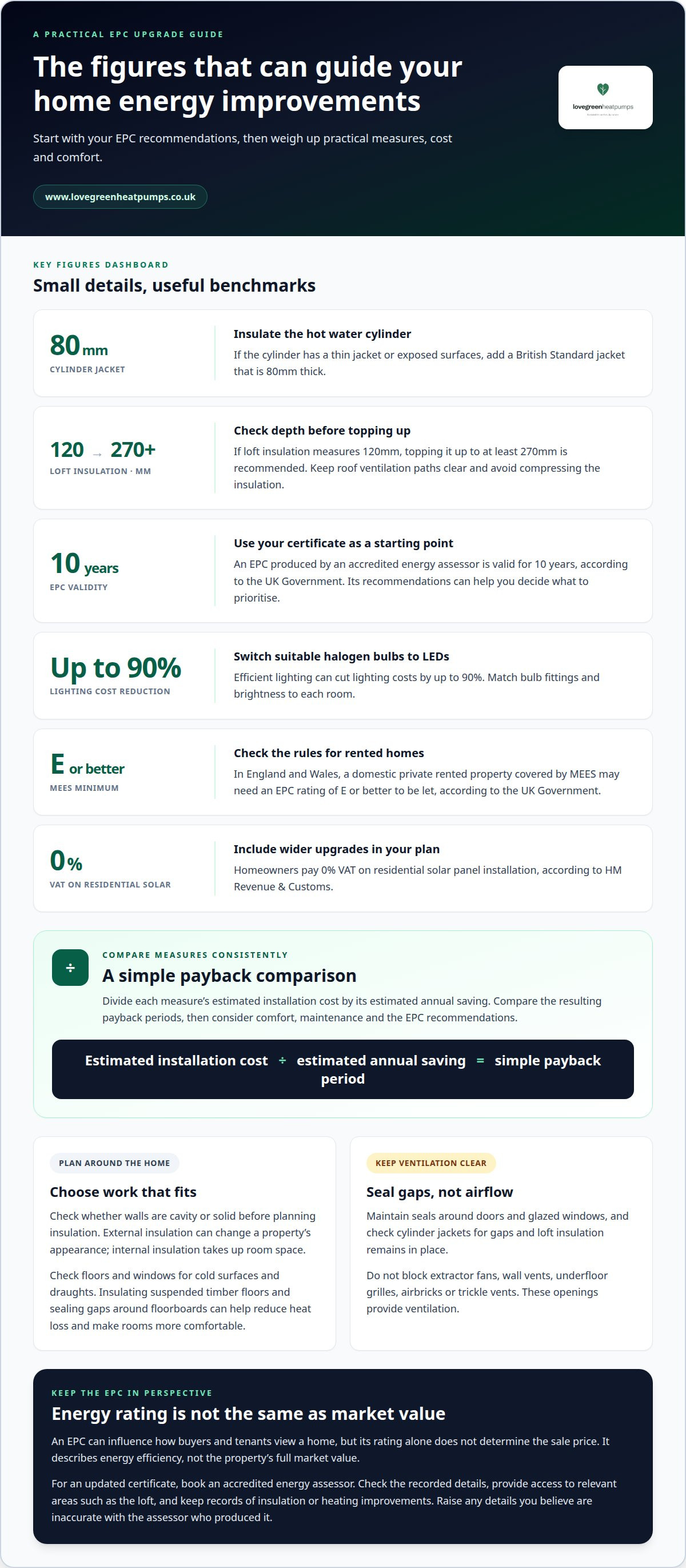
- Check the hot water cylinder first. If it has a thin jacket or exposed surfaces, add a British Standard jacket that is 80mm thick.
- Compare like with like before choosing work. Use the same measure for every option: estimated installation cost divided by estimated annual saving gives a simple payback period. Then consider comfort, maintenance and the property’s EPC recommendations. An EPC produced by an accredited energy assessor is valid for 10 years, according to UK Government.
- Check loft insulation depth with a ruler before adding more. If it measures 120mm, topping it up to at least 270mm is recommended. Keep insulation clear of roof ventilation paths, and avoid compressing it around stored items, because compressed material insulates less effectively.
- Before planning wall insulation, find out whether your walls are cavity or solid. Solid walls need a different approach: external insulation can change the property’s appearance, while internal insulation takes up room space.
- Check floors and windows for cold surfaces and draughts. Insulating suspended timber floors can help reduce heat loss, and sealing gaps around floorboards can make rooms more comfortable.
- Keep improvements effective after installation. Check cylinder jackets for gaps, keep loft insulation in place, and maintain seals around doors and glazed windows. Don’t block extractor fans, wall vents, underfloor grilles, airbricks or trickle vents when draught-proofing. These openings provide ventilation, so seal unwanted gaps without blocking designed airflow.
- Include renewable upgrades when comparing a wider plan. Homeowners pay 0% VAT on residential solar panel installation, according to HM Revenue & Customs. Record each measure’s cost and estimated saving separately, then compare the payback periods alongside its comfort benefits and contribution to the home’s overall energy performance.
Can my EPC rating impact the value of my property?
An EPC can influence how buyers and tenants view a home, but its rating alone does not determine the sale price. To arrange an updated certificate, book an accredited energy assessor. If you believe details are inaccurate, raise the evidence with the assessor who produced it.
- Use the EPC as a starting point for discussions about property value. Compare its rating and recommendations with the home’s condition, heating system and insulation. Buyers can use these details to understand likely energy performance, while landlords should consider the minimum standards for rented homes. An EPC describes energy efficiency, not the property’s full market value.
- If you’re a landlord, check whether the Minimum Energy Efficiency Standards (MEES) apply to your rental property. In England and Wales, a domestic private rented property covered by MEES may need an EPC rating of E or better to be let, according to the UK Government. Review the certificate’s recommendations and prioritise suitable work on its lowest-rated features.
- Replace frequently used halogen bulbs with LEDs where suitable. Efficient lighting can also cut lighting costs by up to 90%. Match bulb fittings and brightness to each room, then note which fittings you have changed.
- Choose efficient appliances when replacing a fridge, washing machine or other household equipment. The 2021 energy-label scale advises choosing appliances rated A or B. Compare labels for the appliance type, as the label helps you assess energy use between similar models. Pair efficient lighting and appliances with sensible hot water use to reduce household energy demand.
- Before arranging another assessment, check the certificate’s address, property description and recorded features against the home. Give the assessor clear access to relevant areas, such as the loft, and keep records of insulation or heating improvements. An accredited assessment can reflect the property’s energy features. Ask the assessor to explain any entry you believe is inaccurate.
- Use the certificate to plan upgrades in a practical order: address its recommendations, complete suitable work, then arrange reassessment. A new EPC assessment can record the home’s current energy performance and provide updated improvement recommendations. Keep receipts and installation details together, so the assessor can consider the work completed.
Heating controls
Start with the heating controls already fitted. A thermostat, programmer and radiator valves help match heating to rooms and daily routines. Reliable controls can make a meaningful difference to energy efficiency without changing the boiler.
- Set a clear temperature schedule. Programme the heating to run around the times rooms are used, rather than heating an empty home. Adjust settings gradually and check that living areas and bedrooms remain comfortable.
- Use thermostatic radiator valves to manage room temperatures. They let you reduce heat in rooms that need less while keeping frequently used spaces comfortable. Valves can be fitted to every radiator when the boiler has a flow meter that detects when all radiator valves are closed.
- Consider a smart thermostat if you want to manage heating schedules more easily. Set it around your regular routine, then update it when that routine changes. Smart controls work best when settings reflect how rooms are actually used, rather than repeatedly heating rarely occupied spaces.
- Review all the heating controls, not just the thermostat. The programmer, room thermostat and radiator valves work together to direct heat. When set up and used correctly, they can also help avoid unnecessary boiler use.
- Assess the boiler before deciding to replace it. A newer condensing model could improve an EPC rating by as much as 40 points compared with an older boiler. Age, condition and the existing controls all affect whether replacement is a sensible part of an upgrade plan.
- Compare boiler improvements with other heating options, including heat pumps. The right system depends on the home’s heat demand, insulation and existing equipment. Don’t assume that a system with lower running costs will automatically improve an EPC score: assessments consider the property’s overall energy performance and heating setup.
- Consider permissions separately from system design. Changing controls inside a home is different from replacing a heating system or altering a listed building. Planning permission, building regulations and listed-building restrictions depend on the property and the work, so identify the relevant requirements before committing to a substantial installation.
The average boiler lifespan is 10 to 15 years. Consider boiler replacement when a boiler is over 15 years old.
Draught-proofing
Work methodically around windows, doors and floor edges. Seal unwanted gaps while keeping designed ventilation clear, starting with draughts you can feel in regularly used rooms.
-
Identify draughts around windows and doors
Check window frames, door edges, letterboxes and keyholes for moving air. On a windy day, move your hand slowly around each frame to locate gaps. Pay attention to older windows and doors that no longer close neatly. Around 18% of an uninsulated UK home’s heat is lost through its windows, so include glazing in your room-by-room inspection.
Check the gap between the door and floor, too. A draught beneath an external door can make a hallway feel cold even when the heating is on. Note the location and type of each gap before choosing a seal, brush or other draught-proofing measure.
-
Apply draught-proofing
Fit suitable draught-proofing strips around movable window and door frames. Choose a strip that lets each window or door close properly, and follow the fitting instructions. For a gap beneath an external door, a fitted brush or draught excluder can reduce unwanted airflow without stopping the door from working properly.
Don’t seal extractor fans, wall vents, underfloor grilles, airbricks or trickle vents. They provide intended ventilation. Focus draught-proofing on unwanted gaps around frames, not openings designed to let air flow through the room.
- Decide whether a window needs a repair or a larger glazing upgrade. Look for loose catches, cracked seals and frames that don’t meet evenly. Repairing a poorly closing window may reduce draughts without replacing the whole unit. If you’re considering replacing single glazing, double glazing can reduce heat loss and improve the home’s energy performance.
- After fitting seals, check window coverings and the surrounding frame. Curtains can reduce the cold feeling near glazing, but shouldn’t cover radiators or stop warm air reaching the room. Make sure doors still open freely and windows latch securely after draught-proofing.
- Review the work during colder weather. Check the same windows and doors again, note any remaining draughts, and adjust or replace worn seals. Keep ventilation openings clear, and plan further changes alongside improvements to insulation, lighting and heating.
Financial assistance for energy improvements
The budget depends on the property’s starting point and the measures it needs. A practical approach to how to improve a UK property’s energy rating is to match suitable upgrades with support that may be available.
- Start with the EPC recommendations and separate smaller measures from larger projects. List the insulation, heating and window work, then note which changes could improve comfort or reduce energy bills. This helps you plan how to improve a UK property’s energy rating in an order that suits your budget and priorities.
- Check whether a heat pump suits your home and whether grant support applies. According to the Department for Energy Security and Net Zero, the Boiler Upgrade Scheme offers eligible households grants of up to £7,500 towards heat-pump installation. Eligibility matters, so don’t build a budget around receiving support until it applies to your circumstances.
- Compare any grant with the full project budget, including preparation such as radiator or heating-control changes. A heat pump’s suitability depends on the home and its heating system. Consider the system design alongside the EPC recommendations, rather than assessing the appliance on its own.
- For cavity wall insulation, compare the estimated saving with the installation cost. The wall construction affects whether this measure is suitable for the property.
- Make a simple comparison for each improvement. Record its estimated cost, annual saving and likely comfort benefit. Divide the cost by the estimated annual saving for a basic payback estimate, then compare it with your available budget.
- Read the terms of each support scheme before arranging work. Check which property types, measures and household circumstances qualify, and how funding is claimed. Keep estimates, EPC recommendations and installation records together to compare options and track remaining costs.
- Plan work in manageable stages. Pair smaller measures with a larger project where they complement each other, such as improving insulation before changing the heating system. For a heating upgrade, plan your next heating improvement around the property’s needs and any applicable support.
Love Green Heat Pumps: Heat Pump Installation
Love Green Heat Pumps Ltd provides heat pump installation for homeowners planning a heating upgrade. If you live in Southwark, Lewisham or Greenwich, the team can help you explore whether a heat pump suits your property and what changes the system may need.
The process begins with a home survey and heat-loss calculation, followed by system design tailored to the property. Share details of your current heating setup and the improvements you’re considering to help shape the next steps.
Contact Love Green Heat Pumps to discuss heat pump installation for your property.
Make your next energy upgrade count
Choose your next step based on the property’s needs, not just a target rating. A clear plan for how to improve a UK property’s energy rating helps you weigh comfort, energy use and the work involved before committing to an upgrade. The best sequence depends on the home’s heating, insulation and EPC recommendations.
Love Green Heat Pumps offers heat pump installation, air conditioning, solar PV and EPC assessments. These services can support different plans, from changing the heating system to understanding the home’s current performance. Consider which improvement fits your needs, then contact the team to discuss a practical next step.
Contact Love Green Heat Pumps to talk through your property’s energy improvements. A considered plan can make each upgrade feel more manageable and help you move forward with confidence.
Frequently Asked Questions
How do I improve the EPC rating of my home?
Use the EPC recommendations to choose improvements that address the property’s weakest areas. If the report highlights an older heating system, for example, compare suitable heating upgrades with insulation work before deciding what to do first. Keep records of completed changes, including product details and installation documents. Once the work is complete, arrange a new assessment so the certificate reflects the home’s current features.
What do EPC ratings mean?
An EPC gives a home an energy-efficiency rating from A to G, with A representing the highest band. Each band corresponds to a score out of 100: A is 92 or more, B is 81-91, C is 69-80, D is 55-68, E is 39-54, and F is 21-38. Band G covers scores from 1 to 20.
I have electric heating - how does that affect my EPC rating?
Electric heating can affect an EPC because the assessment considers fuel costs; on that basis, gas heating scores higher than oil or electric heating. The result also reflects the home’s wider efficiency features, not just its heating fuel. Check the certificate’s recommendations for insulation, controls and heating improvements, then compare the options with the property’s layout and existing system.
Can I change my EPC rating?
Yes. Improving features recorded in the assessment can change the rating, and a new assessment can record those changes. To correct an error, raise the specific entry with the assessor who issued the certificate and provide relevant evidence, such as details of installed insulation. A new assessment records the property as it stands; it does not amend an old certificate retrospectively.
How is an EPC rating decided?
An accredited energy assessor evaluates the home’s energy performance and records its features through the assessment process. The result reflects the property’s efficiency score, which determines its band from A to G. The report also identifies recommended improvements. The same heating upgrade, for example, may have a different effect in homes with different insulation or heating arrangements.
What Is an EPC Rating and Why Does It Matter?
An EPC rating is the energy-efficiency band recorded on a property’s Energy Performance Certificate. It gives buyers, owners and tenants a consistent way to understand a home’s assessed performance. The rating can inform decisions about future improvements and running the property, but it does not capture every factor affecting comfort or sale value. Read the recommendations alongside the home’s condition and your plans.
What Will an EPC Tell Me?
An EPC shows the property’s current energy-efficiency band and gives recommendations for improving its performance. The assessor’s recommendations include estimates of how much each measure could save over 3 years. Use these estimates to compare suggested work, then consider how each option fits the home. The certificate can help turn a broad aim, such as reducing energy use, into practical next steps.
How is a UK Energy Performance Certificate (EPC) rating calculated?
A UK EPC rating is calculated from an assessment of the home using the Standard Assessment Procedure, or SAP. The result is a score that maps to an efficiency band. For example, a score from 1 to 20 falls into band G, while a score of 69 to 80 is band C. The assessor records the property’s features to produce its assessment.
Disclaimer
Disclaimer
The information published on this website is provided by Love Green Heat Pumps for general information and educational purposes. As a specialist provider of heating and renewable energy solutions, we strive to ensure that our content is accurate, relevant and up to date. However, heating requirements, system suitability, installation specifications, costs and performance can vary depending on individual property characteristics, usage and other site-specific factors.
Information provided in our articles should not be regarded as a substitute for a professional property assessment, technical survey or tailored recommendation. Any decisions regarding the selection, installation, replacement or maintenance of heating systems should be made with appropriate professional guidance.
Love Green Heat Pumps accepts no responsibility for decisions made solely on the basis of general information published in these articles. For advice specific to your property or project, we encourage you to contact our team for professional guidance and an assessment of your requirements.


