

The best home battery storage systems in the UK for 2026 aren’t necessarily the newest or largest. If you already have solar panels, an AC-coupled battery can often be easier to add; for a new solar installation, a DC-coupled system is generally a better fit. The right choice depends on your existing equipment and how you use electricity at home.
It’s sensible to compare more than battery capacity. Usable storage, power output, backup capability and compatibility with your inverter can all affect how well a system suits your household.
This guide compares four common battery options and explains how to assess their practical differences. You’ll also learn what to consider when sizing a system, choosing an installer and planning a retrofit, including relevant certification and network notification processes.
Key Takeaways
- Match battery capacity to your household’s electricity use, and distinguish stored energy from the power available to run appliances.
- Compare systems by more than capacity: efficiency, output and backup capability can shape how useful a battery is at home.
- Understand how MCS certification, installer qualifications and DNO processes fit into a compliant installation.
- If you already have solar panels, an AC-coupled battery may offer a retrofit route that keeps a working solar inverter in place.
- Use your existing equipment and energy habits to narrow the options before choosing a system.
Is Battery Storage Worth It UK 2026?
A home battery can store solar electricity for later use or charge from the grid when a time-of-use tariff is cheaper. For 2026, domestic solar panels and battery storage carry 0% VAT until 31 March 2027, according to HM Revenue & Customs.
Solar and off-peak electricity storage
During sunny hours, solar panels can generate more electricity than a household is using. A battery stores some of that surplus for evening use. With an off-peak tariff, it can instead charge from the grid at a lower rate, then supply electricity during more expensive periods. Depending on its controls and your routine, a system may use both charging sources.
| Option | Electricity source | Typical use |
|---|---|---|
| Solar charging | Surplus from panels | Use stored energy later |
| Off-peak charging | Lower-rate grid supply | Shift use away from peak periods |
| Combined charging | Solar and grid | Choose between available sources |
Choose by comparing when your panels generate electricity with when your household uses it.
Sizing batteries for household use
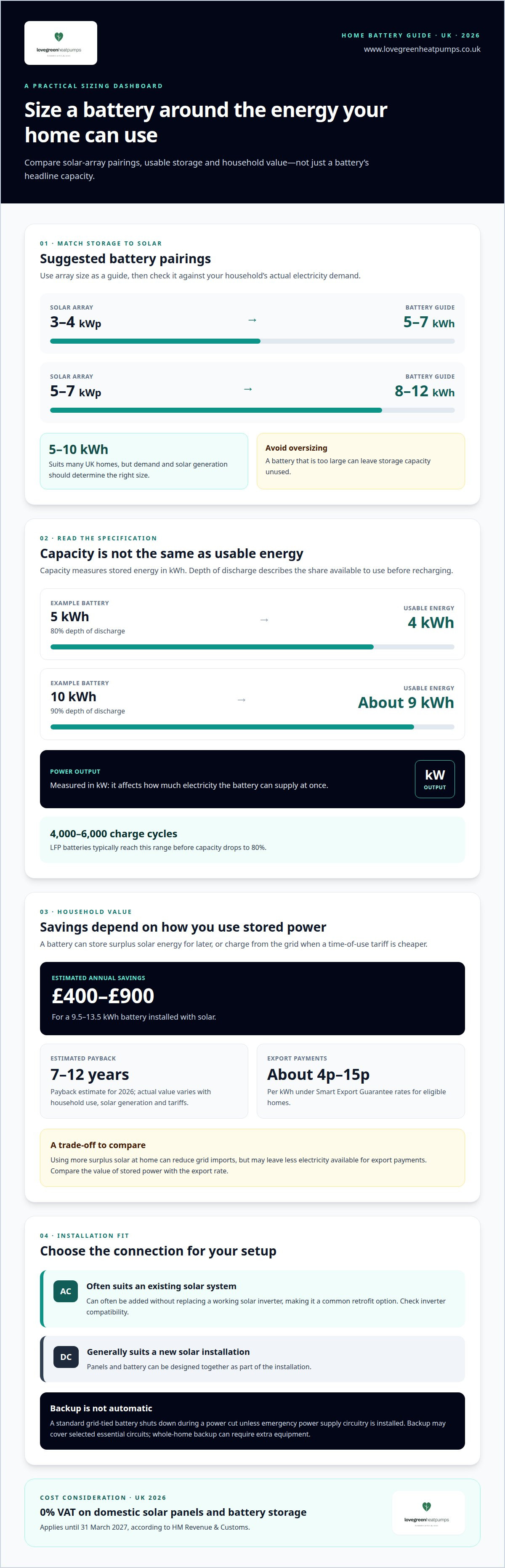
Battery capacity should reflect actual electricity use, not a standard package. Many UK homes suit 5-10 kWh, but the right size depends on household demand and the solar array. As a guide, a 3 kWp-4 kWp array pairs with a 5 kWh-7 kWh battery; a 5 kWp-7 kWp array pairs with 8 kWh-12 kWh. Oversizing can leave capacity unused.
Retrofitting batteries to solar panels
An AC-coupled battery can often be added to existing solar panels without replacing a working solar inverter, making it a common retrofit option. A DC-coupled system is generally better suited to a new solar installation, where the panels and battery can be designed together. In either case, inverter compatibility affects how the battery connects and operates.
Self-consumption and export payments
A battery can store surplus solar electricity instead of sending it straight to the grid, increasing the share used at home. That can reduce grid imports, but it also means less electricity may be available for export payments. Eligible homes can receive Smart Export Guarantee payments for electricity sent to the grid; rates range from about 4p to 15p per kWh. Compare the value of using stored power with the export rate.
For a typical 9.5 to 13.5 kWh battery installed with solar, estimated annual savings are £400 to £900, with a 7 to 12 years payback period in 2026. Actual value depends on solar generation, household use, tariff rates and how much stored electricity replaces grid imports. A battery is most useful when its capacity matches the energy your home can use.
Why should you get a solar battery?
A battery can make stored electricity more useful, but its headline capacity doesn’t tell the whole story. Compare usable energy, power output, chemistry and installed cost before choosing a system.
Usable capacity and depth of discharge
Capacity, measured in kilowatt-hours (kWh), describes stored energy. Depth of discharge is the share available for use before charging again. A 5 kWh battery with 80% depth of discharge provides 4 kWh of usable energy. A 10 kWh battery with 90% depth of discharge provides about 9 kWh. Compare usable capacity, not just the larger headline figure.
That difference matters at home. Usable energy shows how much stored electricity is available for appliances after generation stops. When comparing the best home battery storage systems in the UK in 2026, consider usable capacity alongside guarantee terms, so you can see both the available energy and the cover provided.
Capacity, power and battery chemistry
Capacity and power describe different things. Capacity is stored energy, measured in kWh; power output is measured in kilowatts (kW) and affects how much electricity the battery can supply at once. Battery chemistry also shapes the comparison. LFP batteries typically achieve 4,000 to 6,000 charge cycles before capacity drops to 80%. Check how each specification suits your household’s daily pattern.
For a Tesla Powerwall 3, compare its stated usable capacity and inverter arrangement with the rest of your system. An integrated inverter can affect how a battery connects with solar panels. To narrow down the best home battery storage systems in the UK in 2026, compare usable energy, output and inverter compatibility, not just headline capacity.
Household demand should guide capacity. A typical UK residential battery system holds 5-13.5 kWh, while 5-10 kWh suits many homes. Actual use still matters: a household using more electricity in the evening may value more usable storage than one whose demand falls after sunset. Allow for the appliances you expect to run, rather than sizing around a standard package.
Compare installed costs against usable capacity. Look at what the installation includes and the cost per usable kilowatt-hour, not capacity alone.
If solar generation or a heat pump will shape your electricity use, solar PV planning can help align the system components with household demand.
What are the best home battery systems in the UK in 2026?
Compare usable capacity, power output, round-trip efficiency and warranty together. UK home batteries commonly provide 5-13.5 kWh, but backup equipment and inverter output determine what they can run during an outage.
Backup during power cuts
A system with backup can supply selected household circuits when the grid fails. A standard grid-tied battery shuts down during a power cut unless emergency power supply circuitry is installed. Some systems support essential circuits only; whole-home backup may require extra equipment. Compare the backup function itself rather than assuming stored electricity will keep the home powered.
Output matters during an outage. A battery rated at 3 kW continuous output can run lighting, a fridge and a television, but may not cover several high-demand appliances together. A home using a heat pump, induction hob and electric shower simultaneously can exceed 7 kW. List the circuits and appliances that matter most, then compare them with the system’s continuous output.
Three-phase supplies also need careful matching. The battery and inverter arrangement must suit the home’s supply and the circuits intended for backup. A system that supports selected circuits should not be treated as whole-home cover. This distinction helps you compare practical backup with everyday savings, which depend on storing and using electricity effectively.
Power output and round-trip efficiency
Power output describes how much electricity a battery can deliver at once. Round-trip efficiency describes how much remains available after charging and discharging. AC-coupled systems typically achieve 85%-89% efficiency; hybrid DC-coupled systems typically achieve 90%-95%. Top-tier systems are reported at 88%-94%, so compare the stated figure alongside system type.
These figures serve different comparison purposes. AC and hybrid DC describe system configurations, while the top-tier range describes performance across systems. Efficiency alone doesn’t show whether a battery can run your appliances. Check both output and the actual backup arrangement before weighing small efficiency differences.
Warranty terms add another useful comparison. Residential batteries should have a warranty of at least 10 years. A battery with a 6,000-cycle warranty is described as lasting approximately 15-20 years under normal residential use. Premium LFP packs generally promise 6,000 to 8,000 cycles whilst retaining at least 70% of original capacity under warranty.
For a clear shortlist, compare usable capacity, continuous output, round-trip efficiency and warranty coverage. Then match the backup circuits to the appliances you need during a power cut. This helps distinguish batteries used mainly to shift electricity use from systems designed to provide emergency power.
MCS certification, installer qualifications and DNO processes
A battery installation needs a compatible system design, a suitable location and any required network notification. In the UK, compare these practical details alongside certification, installer competence and warranty terms.
For a grid-connected system, the inverter’s output affects the DNO process. Inverter output of 3.68 kW (16A single-phase) or lower follows the G98 fit-and-inform notification process. Inverter compatibility and any required DNO process should be built into the installation plan, not treated as separate afterthoughts.
MCS certification is relevant to solar installations and export payments. A qualifying setup for Smart Export Guarantee payments typically needs an MCS-certified solar installation and a compatible export meter. Certification does not replace good system design: the panels, inverter and battery still need to work together.
To compare installers and quotations, put the proposed equipment, design, installation scope, commissioning and aftercare side by side. Check that each quote explains the battery warranty, including its duration and any capacity or cycle conditions. This makes differences easier to identify than comparing headline battery size alone.
For planning and safety, distinguish the local installation-location guidance from the DNO process. BSI’s PAS 63100 is a current UK safety guideline relevant to home battery installation locations. It informs decisions about where equipment can be installed; it is not itself a DNO notification process.
Location affects whether a system can be installed safely and practically. The design needs to account for the battery’s position, access for installation and maintenance, and compatibility with the home’s existing electrical equipment. A modular battery may allow capacity to be built from multiple units, but each unit still needs an appropriate location.
A professional assessment brings these checks together. It should consider existing solar generation, inverter compatibility, battery position, export arrangements and the home’s electrical supply. For a hybrid system, the battery and inverter need to be selected as a working combination, not as unrelated components.
Planning rules can depend on the property and proposed location, so don’t treat PAS 63100 or G98 as a blanket planning approval. The practical UK checks covered here are the safety guidance for battery location and the DNO process linked to inverter output; the installation design must account for both where applicable.
Battery options for retrofits and existing systems
For homeowners with existing solar panels, the main decision is how a battery will connect to the current equipment. An AC-coupled system can often be added without replacing a working solar inverter, making it a practical retrofit option. The right fit depends on inverter compatibility, household consumption and how much solar electricity currently goes unused.
Start with the existing system, not a standard package. Note when the panels generate electricity, when the household uses it and how much is exported. This helps show whether stored power could cover evening use or whether daytime consumption already uses most of the generation. Choose usable capacity to suit both the surplus available to store and the electricity the home can use later.
Next, assess the inverter and proposed connection. An AC-coupled battery connects on the alternating-current side of the system; a DC-coupled arrangement connects on the direct-current side. Existing solar systems often suit AC coupling, while DC coupling is generally suited to new solar installations. The installer’s design also needs to account for any required DNO process and the home’s electrical supply.
Physical access can shape a retrofit as much as electrical compatibility. A battery weighing 100 kg can be difficult to move through a loft hatch. Location planning should consider the route into the property, the space available and safe access for installation and maintenance. BSI’s PAS 63100 is a current UK safety guideline relevant to home battery installation locations.
- Match the battery’s usable capacity to surplus solar generation and household consumption.
- Confirm that the proposed battery and inverter can work together.
- Plan the installation location and access route before equipment arrives.
- Include the relevant DNO process in the system design.
A retrofit may also affect what happens during a power cut. Storing solar electricity doesn’t by itself mean the battery will power the home during an outage. Backup depends on the system’s emergency power arrangements and the circuits it supports. If backup matters, include that requirement in the design rather than assuming an existing solar setup already provides it.
For a home without solar, adding panels and storage together allows the system to be designed as one integrated setup. For an existing array, retaining a working inverter may be possible with AC coupling. Discuss your existing solar system when planning a retrofit around generation, consumption and available space.
Love Green Heat Pumps
Love Green Heat Pumps Ltd can help plan the renewable-energy side of a home project. If you’re considering a battery alongside new solar panels or reviewing an existing solar setup, the key is how generation, household use and system components fit together. Its Solar PV & Other Renewables service covers the design and installation of renewable energy systems, helping you make informed decisions about your home’s wider setup.
Bring your questions about solar generation, inverter compatibility and future energy needs to Love Green Heat Pumps Ltd. Contact the team to discuss your home energy project and arrange a property-specific assessment.
Plan for the way your home will use energy next
A battery choice should suit not only today’s electricity habits, but the changes you’re planning for your home. Adding solar panels, changing how you heat rooms or installing air conditioning can alter when electricity is generated and used. The best home battery storage systems in the UK in 2026 are the ones that fit those practical plans, rather than simply offering the biggest capacity.
Love Green Heat Pumps Ltd can help bring home energy decisions together through Solar PV & Other Renewables, Heat Pump Installation and Air Conditioning. If you’re planning a new system or adapting an existing one, discuss how its different parts should work together with the team.
Contact Love Green Heat Pumps Ltd to discuss your home energy plans. A clear next step can make it easier to choose a setup that feels right for your home.
Frequently Asked Questions
What is Depth of Discharge?
Depth of discharge (DoD) is the proportion of a battery’s stored energy used before it recharges. The remaining energy is the reserve. For example, a battery may be set to retain some charge rather than empty completely. When comparing models, consider DoD alongside usable capacity to understand how much stored electricity is available for everyday use.
How Much Battery Capacity Is Normal to Lose in a Year?
There isn’t one annual capacity-loss rate that applies to every home battery. Capacity changes with chemistry, operating conditions, charging patterns and how deeply the battery is discharged. Cycle-life information is another useful measure: manufacturers may state how many cycles a battery is designed to complete before reaching a specified remaining capacity. Read this alongside the warranty conditions rather than judging performance by one year alone.
How Much Does Home Battery Storage Cost in the UK?
Installed cost depends on battery capacity, inverter requirements, installation work and whether the system is being added to existing solar panels. Backup equipment or changes to the electrical setup can also affect the project. Compare quotations on the same basis, including the battery, installation scope and any included equipment. A property-specific quote provides the clearest cost for the home and proposed system.
LFP vs NMC: which battery chemistry is better?
LFP and NMC suit different priorities, so compare their published cycle life, usable capacity and warranty terms. LFP batteries typically achieve 4,000 to 6,000 charge cycles before capacity drops to 80%; NMC batteries typically achieve 800 to 2,000 cycles. Those figures help compare longevity, but the right choice also depends on the system design and how the household plans to charge and use it.
Verdict: Which Battery Should You Install?
Choose a battery that suits your solar generation, household electricity use and existing equipment. A home with working solar panels may need a different connection approach from a new solar installation. If backup matters, include the required circuits and power output in your decision. Compare usable capacity, inverter compatibility, efficiency and warranty together. The best match is the system whose specifications suit your home’s actual energy use.
Which home battery storage systems are rated best in the UK in 2026?
There isn’t one battery that is best for every UK home. A useful shortlist compares usable capacity, continuous output, round-trip efficiency, warranty and backup capability. Also consider whether the system suits a new solar installation or an existing array. A high rating on one measure won’t tell you whether a battery fits your household’s consumption, inverter or preferred tariff.
What are the installed prices of popular home battery systems in the UK in 2026?
Installed prices vary with battery capacity, inverter configuration, installation complexity and any backup equipment. A retrofit may also involve different work from a new solar-and-battery installation. Compare quotations by what they include, such as equipment, installation and commissioning, rather than by battery capacity alone. The property and system design determine the cost, so like-for-like quotations are the most useful comparison.
Which UK home batteries work with solar panels, inverters and time-of-use tariffs?
AC-coupled batteries can often suit existing solar panels without replacing a working solar inverter, while hybrid DC-coupled systems are generally suited to new solar installations. Compatibility depends on the inverter and overall design. For time-of-use tariffs, the battery needs controls that allow it to charge during lower-rate periods and supply stored electricity later. Compare those functions with your tariff and household routine before choosing.
Disclaimer
Disclaimer
The information published on this website is provided by Love Green Heat Pumps for general information and educational purposes. As a specialist provider of heating and renewable energy solutions, we strive to ensure that our content is accurate, relevant and up to date. However, heating requirements, system suitability, installation specifications, costs and performance can vary depending on individual property characteristics, usage and other site-specific factors.
Information provided in our articles should not be regarded as a substitute for a professional property assessment, technical survey or tailored recommendation. Any decisions regarding the selection, installation, replacement or maintenance of heating systems should be made with appropriate professional guidance.
Love Green Heat Pumps accepts no responsibility for decisions made solely on the basis of general information published in these articles. For advice specific to your property or project, we encourage you to contact our team for professional guidance and an assessment of your requirements.


