

Solar panels can charge an electric car, but the amount available depends on sunshine and when the car is plugged in. Using solar panels to charge an electric car in the UK can mean drawing power straight from your roof, with grid electricity filling the gap when generation is low. A 4kW system can produce around 16kWh on a sunny day.
It’s reasonable to wonder whether solar generation can cover a daily commute or whether you’ll also need a home battery. Solar panels generate direct current, which an inverter converts into the alternating current used by your home and EV charger. A battery isn’t essential for solar charging, but it can store surplus electricity for later.
This guide explains how solar EV charging works, how daily driving needs compare with solar generation, and how seasonal output affects the balance between solar and grid electricity. It also covers installation considerations and the factors that influence running costs and potential savings, helping you assess how solar charging might suit your home and driving routine.
Key Takeaways
- Solar panels can charge an EV without a home battery, while stored or grid electricity can help when generation and charging times don’t match.
- Estimate your charging needs from your usual mileage, then consider how seasonal solar output may affect the amount available.
- Using solar power directly can reduce reliance on grid electricity, but the balance depends on when your car is at home and how much power your household uses.
- Compare the whole installation, including panels, an inverter and a compatible charger, rather than judging the decision on one component alone.
- Roof direction, available space and electrical requirements all shape how a solar and EV charging system can work at home.
How does solar EV charging actually work?
Solar panels produce direct current electricity, while household circuits and most EV chargers use alternating current. A home inverter converts the panels’ output into electricity your vehicle can use. In suitable conditions, a typical 4kW solar system can power a 3.6kW home charger. Actual output changes with daylight and weather. If the car is plugged in while panels are generating, compatible charging equipment can direct available solar power to the vehicle. A battery isn’t required, but one can store surplus solar energy for charging later.
The main choice is whether to charge during daylight or use a cheaper overnight tariff. Daytime charging can use solar power directly, reducing electricity imported from the grid, but the car must be at home while the panels are generating. Overnight charging suits cars parked at home after dark, especially when an off-peak tariff is available. For households using solar panels to charge an electric car in the UK, a smart tariff can complement solar: panels supply the car when generation is available, and cheaper grid electricity covers other charging times.
Compare the value of using solar electricity with the cost of buying power later. One example exports surplus solar electricity at 15p per kWh, then imports overnight electricity at 7p per kWh. In that example, exporting and charging overnight costs less than using that same electricity directly, before considering other tariff terms. A separate comparison sets a standard import tariff at 25p per kWh against an EV tariff’s 7p off-peak rate, a difference of 18p per kWh. These are example rates, not universal tariffs. Your actual choice depends on your import and export rates, charging times, and available solar output.
The Smart Export Guarantee (SEG) pays for eligible surplus electricity exported to the grid under a supplier’s export tariff. Ofgem says energy suppliers with over 150,000 customers must offer a Smart Export Guarantee tariff. This is an export arrangement, not a household grant. ECO4 was stated to run until 31 March 2026, so its stated programme period has passed by November 2026. Keep support schemes separate from export payments when weighing household options.
Smart charging apps and time-of-use tariffs can help coordinate charging with solar generation. You can prioritise daytime solar when the car is home, then use a lower-priced overnight period if more energy is needed. The available settings depend on compatibility between the app, charger, vehicle and tariff. For example, a car arriving home after sunset cannot use that day’s solar generation directly. A battery can store some surplus for later, or an overnight tariff can supply the charge. This approach combines solar and grid electricity in one charging plan. Using solar panels to charge an electric car in the UK works best when charging settings reflect both solar availability and the household tariff.
How much solar generation is needed for daily EV charging
The electricity your car needs depends on how far you drive and the vehicle’s efficiency. Comparing your daily mileage with local solar generation gives a more useful estimate than looking at panel count alone.
Solar generation and daily driving needs
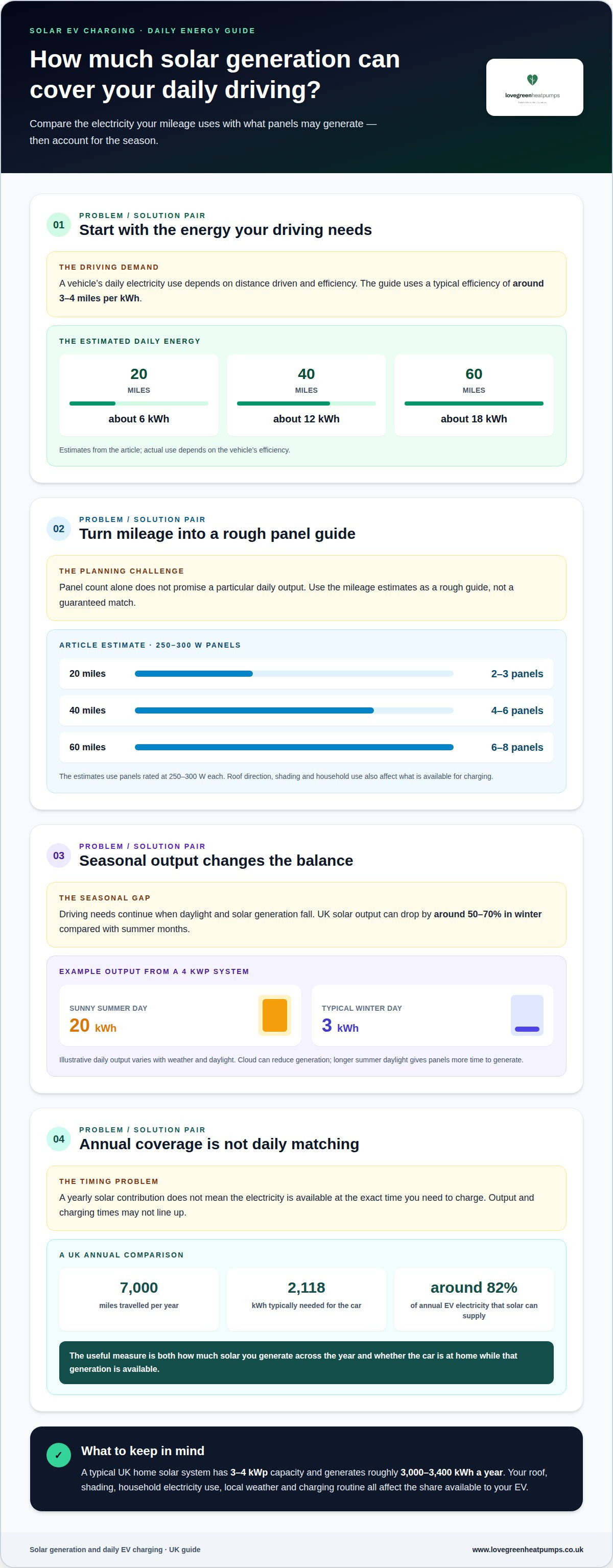
Daily solar generation is the electricity your panels produce compared with the energy your driving uses. A typical electric vehicle travels around 3-4 miles per kWh, so 20 miles needs about 6kWh. At 40 miles, the estimate is 12kWh; at 60 miles, it is 18kWh. These figures help show how much daily driving solar generation might cover.
Panel numbers offer a rough guide, not a promise of daily output. The estimate for 20 miles is 2-3 panels rated at 250-300W each; 40 miles takes 4-6 panels, and 60 miles takes 6-8. A typical UK home system has 3-4kWp capacity and generates roughly 3,000-3,400kWh a year. Roof direction, shading and household use also affect the electricity available to charge your car.
Weather and daylight effects
UK weather and daylight affect how much electricity panels generate each day. A 4kWp system might produce 20kWh on a sunny summer day, but around 3kWh on a typical winter day. Cloud can reduce output, while longer summer daylight gives panels more time to generate. This matters because driving needs continue even when solar production falls.
Seasonal differences affect whether you can charge directly from daytime generation or need grid electricity, storage or suitable tariffs to fill the gap. UK solar output can drop by around 50-70% in winter compared with summer months. A 4kW system can produce around 16kWh on a sunny day, enough for roughly 40-50 miles of EV range. That output is not a year-round daily amount, so a charging plan should account for shorter winter days.
Annual totals offer another useful comparison. A UK driver travelling 7,000 miles a year typically needs 2,118kWh for their car. Solar panels can supply around 82% of the electricity needed for annual EV driving, although that yearly share doesn’t mean generation matches charging each day. Shifting suitable charging to sunny hours can increase direct solar use and reduce your driving carbon footprint.
For a home-specific view of roof capacity and likely generation, explore solar PV options alongside your daily mileage.
Solar self-consumption and grid electricity
To charge your EV with surplus solar, you need a solar-compatible charger that can use available panel output. Solar-compatible charging can start when excess generation reaches around 1.4kW; otherwise, the vehicle can draw electricity from the grid.
Solar and grid charging modes
Solar mode directs surplus electricity from your panels to the car, while Solar & Grid mode can combine solar supply with grid electricity. The choice affects how much generation your household uses rather than exports, and how consistently the car charges when output varies.
Self-consumption means using generated electricity at home instead of exporting it. Panels supply household appliances first, and a compatible charger can use any available surplus for the car. If household demand increases or clouds reduce generation, grid electricity can make up the difference. This lets you charge when solar power is available without relying on every unit coming directly from the roof.
Exporting surplus electricity means sending unused generation to the grid under an export arrangement. This may suit households whose car is away during daylight or whose panels generate more than appliances and charging use. Alternatively, you can shift charging to times when solar power is available. The better option depends on when the car is home, household demand and the import and export tariff rates.
Grid connections and charging setups
A grid-tied charging setup stays connected to the electricity network, so grid power can support charging when solar output falls. An off-grid setup relies on local generation and storage, making available energy and charging times central to how it operates.
The Distribution Network Operator (DNO) manages the local electricity network. Solar and charger design should account for your home’s grid connection and any applicable DNO notification process. This matters because generation equipment connects to the wider network, while the charger and household appliances share the home’s electrical supply. A system design brings these elements together before installation.
EV charger compatibility with solar
Solar-compatible EV chargers can respond to surplus generation and direct it to the car. A charger with solar diversion is useful when the panels produce more electricity than the home is using, as it can send that excess to the vehicle rather than exporting it.
Not every charger offers the same solar controls. The key practical distinction is whether its charging mode can use surplus generation, supplement it with grid electricity, or charge from the grid independently. Around 1.4kW of excess solar power is generally needed to start charging an EV with a solar-compatible charger. The home’s generation, appliance demand and charger settings determine when that threshold is reached.
Grid electricity remains part of the picture for many grid-connected households. The stated emissions figure is 125g of CO2 per kWh of grid electricity. Using more of your own solar generation can reduce grid imports, while exporting unused output returns electricity to the network. Comparing both uses helps show how charging mode, household appliances and export rates shape the value of each unit generated.
Installation costs and running-cost savings
The financial case for solar depends on the initial system investment and the electricity savings over time. The outcome varies with how much generation your home uses, stores or exports.
Upfront solar installation costs
Upfront costs cover the equipment and work needed to generate and use solar electricity. System size, roof suitability, an inverter, and whether you add a home battery or EV charger all shape the installation. Because these components vary between homes, compare the complete system design rather than considering panel costs alone. HM Revenue & Customs says the UK government currently applies a 0% VAT rate to the installation of domestic solar panels.
A battery stores electricity, while a compatible charger can direct surplus generation to your car. Each affects the balance between initial investment and how much renewable energy you use at home. Solar PV installation costs are specific to each project, so a quote should reflect the equipment and work involved.
Solar panel payback
Payback is the time it takes for accumulated bill savings and export income to offset the original installation cost. A typical UK household solar installation could have a payback period of 6 to 10 years. The time depends on the system’s output, household electricity use, export payments and how much electricity you buy from the grid.
Using more solar electricity at home can increase the value of each unit generated, because it replaces electricity you would otherwise import. A battery may shift surplus generation to evening use, but it adds to the initial investment. When assessing payback, compare expected self-consumption and export income with the full installed system cost.
Running-cost savings
Running-cost savings come from using solar generation instead of buying as much grid electricity. Actual savings depend on household consumption, when electricity is used, system output and export arrangements.
EV charging can add to the electricity a household uses, especially when the vehicle is charged during sunny periods. Charging mainly with solar energy can cost about 1-2p per mile, compared with around 4-8p per mile from grid electricity. These running-cost estimates help compare energy sources, but don’t include the upfront cost of panels, a charger or storage.
Solar and grid charging costs
For a direct comparison, multiply the miles driven by the relevant cost per mile. These examples show potential running-cost differences, not the cost of installing solar equipment.
Grid charging can still help when solar output is low or the car is away during daylight. A time-of-use tariff may offer cheaper overnight electricity, while solar generation can reduce daytime imports. Compare your charging pattern with export income and household demand to assess potential savings, energy costs and the carbon impact of using more renewable electricity.
Solar and EV charger installation considerations in the UK
A well-designed installation matches the panels, home EV charger and household electricity needs. Roof suitability, electrical requirements and planning rules all influence the design.
A typical 4kW solar-panel system comprises around 14 to 16 panels. Many UK homeowners install 10 to 14 panels, roughly a 4 to 5.5kWp system, for household electricity and EV charging. A three-bedroom home adding car charging may need a 6.75kWp system with 15 panels rated at 450W each. These examples show why the design should reflect both home use and driving needs.
A 7kW home EV charger is the most common domestic charger rating. That doesn’t mean a solar panel system will always produce enough excess electricity to run it at full power. A solar-compatible charger can use available surplus, while the grid can support charging when generation is lower. The right combination depends on the household’s energy use and when the vehicle is parked at home.
Roof direction affects the amount a panel system can produce. East- or west-facing UK roofs generate around 15-20% less solar energy than south-facing roofs. Roof space and layout also influence how many panels fit and how the system is arranged. Considering these details alongside charger placement helps the design work with the home, rather than treating panels and vehicle charging as separate projects.
Most UK solar panel and EV charger installations do not need planning permission. Exceptions can include listed buildings and conservation areas, where permission may be required. Solar panels generally fall under permitted development, but the property’s status and location matter. Address these planning considerations during installation design, before work begins.
Electrical design matters too. Solar panel installations should comply with the BS 7671 wiring standards, according to the British Standards Institution. MCS-certified installers are recommended for UK solar installations. The design also needs to consider how panels, inverter, charger and household circuits connect safely and operate together. This is particularly relevant when a home adds solar generation and EV charging to existing electrical equipment.
Planning the work has several stages. Research and consultation may take 1-2 weeks, followed by 2-4 weeks for a site survey and design. Approvals and paperwork may take 2-6 weeks, while physical installation of panels, an inverter and charger may take 1-3 days. These stages help coordinate the renewable system and its connection to the home.
For a solar PV system designed around your home and EV charging needs, plan your solar PV installation.
Love Green Heat Pumps: Solar PV & Other Renewables
Love Green Heat Pumps can help plan solar PV around your household’s electricity use and EV charging needs. If you’re weighing panel capacity, a compatible charger or whether battery storage suits your routine, a tailored design can bring those choices together. The team handles the installation process from design to commissioning, with a free, no-obligation quote to set out the proposed work.
Solar may also form part of a wider home energy plan alongside heat pump installation or heating engineering. The right combination depends on your property, existing systems and how you use energy. If you’re ready to discuss solar PV for your home, contact Love Green Heat Pumps.
Make your next energy decision with confidence
Choosing solar is also an opportunity to plan how your home may use electricity in future. Consider when your car is usually parked, which household demands may increase, and whether you might add other low-carbon technologies. These choices help shape a system around your routine, rather than focusing only on vehicle charging.
For households considering using solar panels to charge an electric car in the UK, the next step is turning daily travel and home energy use into a practical design. Love Green Heat Pumps Ltd can discuss how solar PV could fit your property and wider plans. Talk to Love Green Heat Pumps Ltd about your solar plans, and take the next step at a pace that suits you.
Frequently Asked Questions
How Much Solar Power Does an EV Actually Need?
A typical electric vehicle needs about 7-10kWh for a decent daily charge, though your mileage and car efficiency affect demand. For context, most UK EV batteries hold 40-60kWh, so a daily top-up is usually only part of the battery’s capacity. A useful estimate starts with your regular daily distance, then accounts for the vehicle’s energy use and any household electricity competing for solar generation.
Does a battery make a difference?
Yes. A home battery can store surplus solar electricity for later, which can help if your car returns after the panels stop generating. For example, daytime generation can be stored for evening charging instead of being exported immediately. A battery does not create extra electricity, and its usefulness depends on surplus generation, household demand and when the car is plugged in. It is an optional part of a solar charging setup.
How long does it take?
Charging time depends on the vehicle’s battery, its current charge and the power available. As a reference, a typical 7kW home charger takes around six hours to charge an average EV from 20% to 80%. Solar-only charging can take longer if panel output varies or household appliances use some generation. Overnight charging from the grid can provide a steadier supply when the car needs charging outside daylight hours.
Solar vs Grid: which should I use?
Use solar when the car is home during generation and electricity remains available after household use. Grid charging is useful when you need to charge at another time or solar output is low. A practical routine might use solar during the day and schedule any remaining charging for a cheaper off-peak period. Your import tariff, export rate, driving pattern and charging flexibility determine the most suitable mix.
How many solar panels are needed to charge an electric car in the UK?
A rough estimate is six 450W panels for a UK household charging an electric car, but the number depends on driving and home energy use. A separate estimate suggests 7-8 panels can power a typical electric car over a year. These are planning guides, not daily output guarantees: panel direction, roof shading, daylight and season all affect how much electricity reaches the charger.
Can solar panels charge an EV directly, or is a home battery needed?
Solar panels can charge an EV without a home battery. An inverter converts the panels’ direct current into alternating current for household use and charging. If the car is plugged in while the panels are generating, compatible charging equipment can use the available solar electricity. A battery can store surplus generation for later, such as charging after sunset, but it isn’t essential.
What UK grants or tax incentives are available for solar panels and EV chargers?
HM Revenue & Customs says the UK government currently applies a 0% VAT rate to installing domestic solar panels. ECO4 was stated to run until 31 March 2026, so that programme period has ended; its former support should not be treated as a current entitlement. These details relate to domestic solar and ECO4. They do not establish whether a particular household qualifies for other support or an EV charger incentive.
Do UK planning permission or building regulations apply to home solar panels and EV chargers?
Most UK solar or EV charger installations do not need planning permission, but listed buildings and conservation areas can be exceptions. Solar panel installations should comply with BS 7671 wiring standards, according to the British Standards Institution. Planning status and electrical requirements are separate considerations. The property’s designation and the installation design affect what applies, so these points should be addressed as part of planning the work.
Disclaimer
Disclaimer
The information published on this website is provided by Love Green Heat Pumps for general information and educational purposes. As a specialist provider of heating and renewable energy solutions, we strive to ensure that our content is accurate, relevant and up to date. However, heating requirements, system suitability, installation specifications, costs and performance can vary depending on individual property characteristics, usage and other site-specific factors.
Information provided in our articles should not be regarded as a substitute for a professional property assessment, technical survey or tailored recommendation. Any decisions regarding the selection, installation, replacement or maintenance of heating systems should be made with appropriate professional guidance.
Love Green Heat Pumps accepts no responsibility for decisions made solely on the basis of general information published in these articles. For advice specific to your property or project, we encourage you to contact our team for professional guidance and an assessment of your requirements.


