

Adding a battery with new solar is estimated to pay back in 6–10 years. The cost of an installed home battery system varies depending on the system and installation. The solar battery storage cost vs benefit in the UK depends on how much stored electricity you use at home.
It’s reasonable to start with the upfront cost. But the Price Cap is only one part of the calculation: savings also depend on when you use electricity, how much solar power you export and which tariff you’re on. A solar battery storage cost vs benefit assessment should weigh these factors together.
This guide explains what a home battery does, how its cost relates to potential payback, and why adding storage alongside new solar can change the calculation. It also covers backup power and greater energy independence, helping you decide which benefits matter most in your home.
Key Takeaways
- Compare a battery’s upfront cost with the value of using stored solar electricity at home, rather than exporting it.
- A battery installed alongside new solar is estimated to pay back in 6–10 years, though your savings depend on how and when you use electricity.
- Check usable capacity as well as headline capacity: most modern solar batteries have a depth of discharge between 85% and 95%.
- Backup during a power cut requires a battery with an emergency power supply or backup function, plus suitable installation and wiring.
- UK solar battery installations have a 0% VAT rate from February 2024, according to HM Revenue & Customs.
What is a solar battery?
A solar battery stores electricity generated by your panels for use later. An inverter manages the flow between the panels, battery, household circuits and grid. Without a battery, surplus solar electricity can be exported rather than saved for evening use.
In the UK, eligible generators can receive payment for exported electricity through a Smart Export Guarantee (SEG) tariff. Available export rates vary: the stated range was 2p to 25.9p per kilowatt-hour as of 1 April 2025. A battery can change the balance between exporting surplus and storing it for your home. The useful comparison is the export payment against the cost of buying electricity later.
Time-of-use tariffs charge different rates at different times. A battery can store daytime solar power or charge from the grid during cheaper off-peak periods, then supply electricity when import rates are higher. Potential savings depend on the rate difference, charging losses and how much stored energy your household uses. For example, a home with high evening demand may use more stored power than one that uses most of its electricity during sunny hours.
Solar batteries can also work alongside a heat pump. The battery stores electricity, which the heat pump can use for heating. How much this helps depends on solar generation, household demand and tariff timings. Existing solar can be paired with storage, but the inverter arrangement affects how the battery connects and operates.
Are solar batteries eligible for VAT relief, grants, or other UK incentives? UK solar battery installations have a 0% VAT rate from February 2024, according to HM Revenue & Customs. The Department for Energy Security and Net Zero says the UK Warm Homes Plan is set to invest close to £15 billion in home improvements to cut energy bills.
How do UK electricity import and export tariffs affect solar battery savings? Import rates determine what you avoid paying when you use stored power; export rates determine what you forgo by storing electricity instead of selling it. The most beneficial approach depends on tariff rates and household consumption.
What are the main risks and drawbacks of solar batteries, including degradation and fire safety? Battery capacity degrades over time, and a typical UK home battery lasts about 10 to 12 years. Batteries also carry fire risks if damaged or incorrectly installed, so suitable equipment, wiring, siting and commissioning matter.
How long will a storage battery take to pay itself off on the Price Cap?
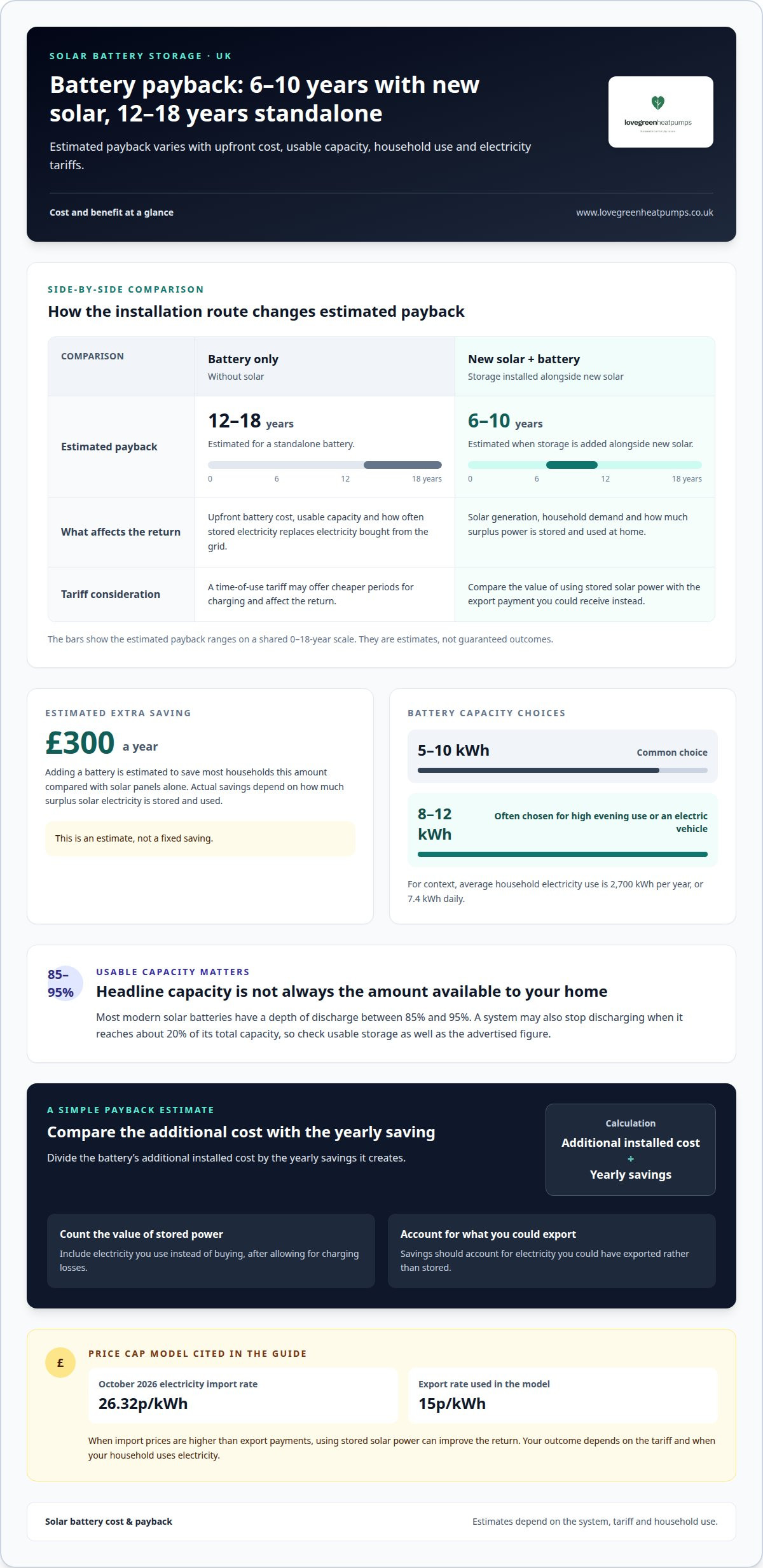
There’s no single payback period for every UK home. It depends on the battery’s upfront cost and usable capacity, as well as how often your household uses stored power instead of importing electricity. Capacity matters, but so does how much of it is available for use.
Most UK households choose a battery with a capacity of 5–10 kWh. Homes with high evening use or an electric vehicle often choose 8–12 kWh. For context, average household electricity use is 2,700 kWh per year, or 7.4 kWh daily. Your own usage pattern helps show whether a smaller or larger system better matches your needs.
Capacity is the battery’s total storage, while depth of discharge describes how much it can release for use. Most modern solar batteries have a depth of discharge between 85% and 95%. A system may also stop discharging when it reaches about 20% of its total capacity. So the advertised capacity isn’t necessarily the amount available to power your home.
For an estimate, divide the battery’s additional installed cost by the yearly savings it creates. Those savings come from using stored electricity instead of buying it, after accounting for electricity you could have exported and charging losses. The Price Cap model uses an October 2026 electricity rate of 26.32p/kWh and an export rate of 15p/kWh. When import prices are higher than export payments, using stored solar power can improve the return.
How much can a UK household save with a solar battery compared with solar panels alone? Adding battery storage saves most households an extra £300 a year. That is an estimate, not a fixed saving: the amount depends on how much surplus solar power you store and use.
What battery capacity and usable storage do UK homes typically need? A 5–10 kWh battery is a common choice, with 8–12 kWh often chosen for high evening use or an electric vehicle. Usable storage depends on the battery’s depth of discharge and its reserve.
Payback estimates vary with the system and tariff. A standalone battery without solar is estimated to take 12–18 years to pay back. A battery installed alongside new solar is estimated at 6–10 years. A time-of-use tariff with cheaper charging periods may also affect the return. Adding storage during solar system design lets generation, capacity and household demand be considered together. Explore solar PV and renewable energy options as part of that decision.
Solar battery backup and energy independence
A battery can store solar electricity for evening use and, with suitable backup equipment, supply selected circuits during a power cut. Its value depends on what you need to keep running and for how long.
Backup Duration and Essential Loads
Backup duration is the time a charged battery can supply selected essential appliances during an outage. A 5 kWh battery is estimated to provide 5–7 hours of backup for essential loads. A 3 kWh battery is estimated at 3–4 hours, while a 9.5 kWh battery may provide 10–14 hours.
Any estimate depends on the appliances drawing power and how much energy they use. Lighting, a fridge and communications equipment place different demands on a battery than several high-consumption appliances running together. Stated capacity alone cannot guarantee a fixed number of hours: the household’s load determines how quickly the battery discharges.
Backup also depends on system design. A standard grid-connected solar system in the UK switches off automatically during a power cut, even if its panels could still generate electricity. To keep selected circuits running, the battery needs an emergency power supply or backup function, with suitable installation and wiring. Without this setup, stored energy won’t provide backup during an outage.
Energy Independence
Energy independence means relying less on imported grid electricity, not disconnecting from the grid altogether. A UK solar battery can reduce grid reliance from about 65% to about 30%, according to the stated estimate. The practical value depends on when solar generation, household demand and battery charge align.
Without storage, households rely on the grid for evening electricity when solar panels aren’t generating. A battery can hold excess daytime solar power for later use, supporting everyday needs and potentially reducing bills. Its contribution varies with the season, generation and household consumption, so it won’t guarantee power throughout every outage or eliminate all grid imports.
Storm Arwen showed why outage resilience matters: nearly 1 million homes in Britain lost power in November 2021. Ofgem’s review found nearly 4,000 homes were without power for more than a week. A battery backup system can support selected appliances during a cut, but the stored charge is finite and depends on the loads connected.
Think of backup as a planned reserve, not a promise that the whole home will keep running. The essential circuits, battery capacity, current charge and appliance use determine how stored energy is shared. A household that prioritises a fridge and lighting can make its reserve last longer than one running several high-demand appliances at once.
Typical solar battery prices and installation costs
The upfront cost covers more than the battery unit. Installation may involve an inverter, wiring, electrical work and commissioning, so the total depends on the existing system and the installation required. On the UK market, the current typical installed home battery price band is £6,700–£7,300. This is a market range, not a quote for a particular home.
What is the typical installed cost of a solar battery by capacity in the UK? The available market band is £6,700–£7,300 for an installed home battery system, rather than separate verified prices for each capacity. Larger capacity, usable storage, inverter compatibility and installation work all affect the overall cost.
Compare quotes on the same basis: battery capacity, usable storage, inverter changes, installation and commissioning. A lower upfront figure may cover a different scope of work. The Energy Saving Trust recommends getting at least three quotes from MCS-certified installers for a home battery installation. Comparing the details helps clarify differences in system size and included work.
VAT also affects the final bill. UK solar battery installations have a 0% VAT rate from February 2024, according to HM Revenue & Customs. The rate applies to qualifying installations, so the VAT treatment should be clear in the written quote. Don’t assume every associated purchase or separate piece of work has the same treatment.
Installation standards and aftercare matter alongside price. The battery must suit the household’s consumption, discharge needs and existing electrical setup. A clear quote should identify the system being installed and the work included. If a problem arises, UK guidance states an installer has 14 days from receiving a formal complaint to resolve it.
How long do home solar batteries last, and what are replacement and maintenance costs? A typical UK home battery lasts about 10 to 12 years, so replacement may be needed before solar panels reach the end of their useful life. Maintenance and replacement costs depend on the battery, labour, access and whether inverter or wiring work is also needed.
A larger battery costs more because it stores more electricity, but that extra capacity adds value only when household use can draw on it. Consumption patterns, usable capacity and available solar power all influence system choice. For an existing solar installation, inverter compatibility can also affect the work involved and overall cost.
Battery cost and payback with new solar
Adding a battery while installing new solar can change the economics compared with fitting storage later. One UK estimate puts the payback period for a battery installed alongside new solar at 6–10 years. The key difference is how much extra solar electricity the household can use instead of exporting and buying power later.
Consider the price gap in the payback model: for October 2026, it uses an electricity import rate of 26.32p/kWh and an export rate of 15p/kWh. Using a stored kilowatt-hour at home avoids importing at the higher rate, but forgoes the export payment. That leaves an 11.32p/kWh difference before charging and storage losses.
Actual returns depend on timing. A household that is out during sunny hours may export more excess generation without a battery. Storage can shift some of that electricity to the evening, when household demand may be higher. A model estimates £300–£450 in annual savings for a 5kWh battery added to a new UK solar installation. Treat this as a scenario, not a fixed outcome for every home.
Self-consumption is another useful measure. UK homes without a battery typically use 20–30% of their solar generation themselves; adding storage can raise this to 70% or higher. The added benefit is strongest when the battery has excess solar to charge from and household demand later uses that stored electricity. A battery that remains partly unused cannot deliver the same savings.
Tariffs change the calculation. A Smart Export Guarantee rate affects the value of sending surplus electricity to the grid, while import rates shape the value of using stored power. Time-of-use tariffs offer another option: a battery may charge when electricity is cheaper and discharge when rates rise. The result depends on the tariff, battery operation and household use.
Payback is only one part of the decision. Solar panels typically last about 25 years, while a typical home battery lasts about 10 to 12 years. That difference means battery replacement may fall within the panels’ working life. Some participating battery systems come with a 10-year manufacturer warranty as standard, but warranty terms and coverage matter alongside the forecast savings.
For a sound comparison, assess the solar system and battery storage system as one design. Include export income, avoided imports, tariff timing, usable storage and expected replacement in the calculation. If you’re planning a renewable installation, explore solar PV options as part of your system design.
Love Green Heat Pumps: Solar PV & Other Renewables
Love Green Heat Pumps can help you consider solar PV as part of a wider home energy plan. This is a natural next step if you’re weighing new panels, already have solar or want to understand how storage might fit your household’s electricity use.
Solar generation, battery capacity and evening demand need to work together. Love Green Heat Pumps handles the solar PV installation process from design to commissioning, helping you understand how a renewable energy system can suit your home. A free, no-obligation quote gives you a clear starting point for discussing your project and its requirements.
If you’re planning solar or reviewing how it could meet your home’s energy needs, contact Love Green Heat Pumps to discuss your options.
Plan your next home energy step
A UK assessment of solar battery storage costs versus benefits should consider how your home may change, not just its current electricity use. A future heat pump, electric vehicle or change in working patterns could alter when you need power. That can affect whether storage fits your plans and how your wider energy system should be designed.
Consider your priorities at home: using more solar generation, managing energy bills or keeping selected essentials powered during an outage. For households in Southwark, Greenwich and nearby areas, a property-specific design can bring generation, storage and demand together in one practical plan.
If you’re ready to explore solar for your home, contact Love Green Heat Pumps Ltd to start a conversation. A clear discussion can help you consider your options and decide on a suitable next step.
Frequently Asked Questions
Is battery storage worth it in the UK in 2026?
A battery may be worthwhile if your home has solar surplus to store and electricity demand later in the day. The financial case is stronger when stored power replaces electricity you would otherwise import, rather than electricity that could earn a good export payment. Backup during outages and greater control over when you use grid electricity may also matter, even if savings alone don’t settle the decision.
Is a 5 kW battery enough to run a house?
Not necessarily, because 5 kW describes power, not the amount of energy stored. Battery storage capacity is usually expressed in kilowatt-hours (kWh). How long a battery can supply your home depends on its usable capacity and the appliances running at the same time. A fridge, lighting and communications equipment have different demands from cooking or electric heating, so the battery rating alone can’t establish whole-house runtime.
What factors affect the battery size you need?
Start by looking at how much electricity your household uses and when. Evening demand, solar generation, an electric vehicle and any planned heat pump can all affect the useful storage capacity. The inverter arrangement and the battery’s usable capacity matter too. A system sized around daytime surplus may not cover high evening use, while extra capacity has less value if there isn’t enough electricity to charge it.
What happens when the battery is full?
Once the battery reaches its charge limit, it can’t accept more electricity. If your panels continue generating more than the home is using, the surplus can be exported to the grid, depending on the system setup and export tariff. A battery cannot store unlimited excess generation. Its charge level, household demand and current generation determine whether electricity is stored, used at home or exported.
How much does home solar battery storage cost in the UK in 2026?
The current UK market band for an installed home battery system is £6,700–£7,300. It is an overall market range, not a price for every capacity or a quote from a particular installer. The final cost depends on the battery size, usable storage, inverter compatibility and installation work. A system added to existing solar may need different work from a battery fitted with new panels.
What is the payback period and return on investment for a home solar battery in the UK?
Payback depends on the system cost and the value of electricity the battery lets you use instead of importing. That example isn’t a universal return: tariff rates, solar surplus, evening use, charging losses and installation requirements all affect the result.
What UK electrical, planning and building regulations apply to home battery storage?
Home battery installations need to account for electrical safety, existing wiring and the inverter arrangement, as well as any planning or building-control requirements that apply. Details can vary according to the building and equipment location. Backup operation also requires suitable equipment and wiring. These factors belong in the system design, not as an afterthought to choosing a battery.
Disclaimer
Disclaimer
The information published on this website is provided by Love Green Heat Pumps for general information and educational purposes. As a specialist provider of heating and renewable energy solutions, we strive to ensure that our content is accurate, relevant and up to date. However, heating requirements, system suitability, installation specifications, costs and performance can vary depending on individual property characteristics, usage and other site-specific factors.
Information provided in our articles should not be regarded as a substitute for a professional property assessment, technical survey or tailored recommendation. Any decisions regarding the selection, installation, replacement or maintenance of heating systems should be made with appropriate professional guidance.
Love Green Heat Pumps accepts no responsibility for decisions made solely on the basis of general information published in these articles. For advice specific to your property or project, we encourage you to contact our team for professional guidance and an assessment of your requirements.


