

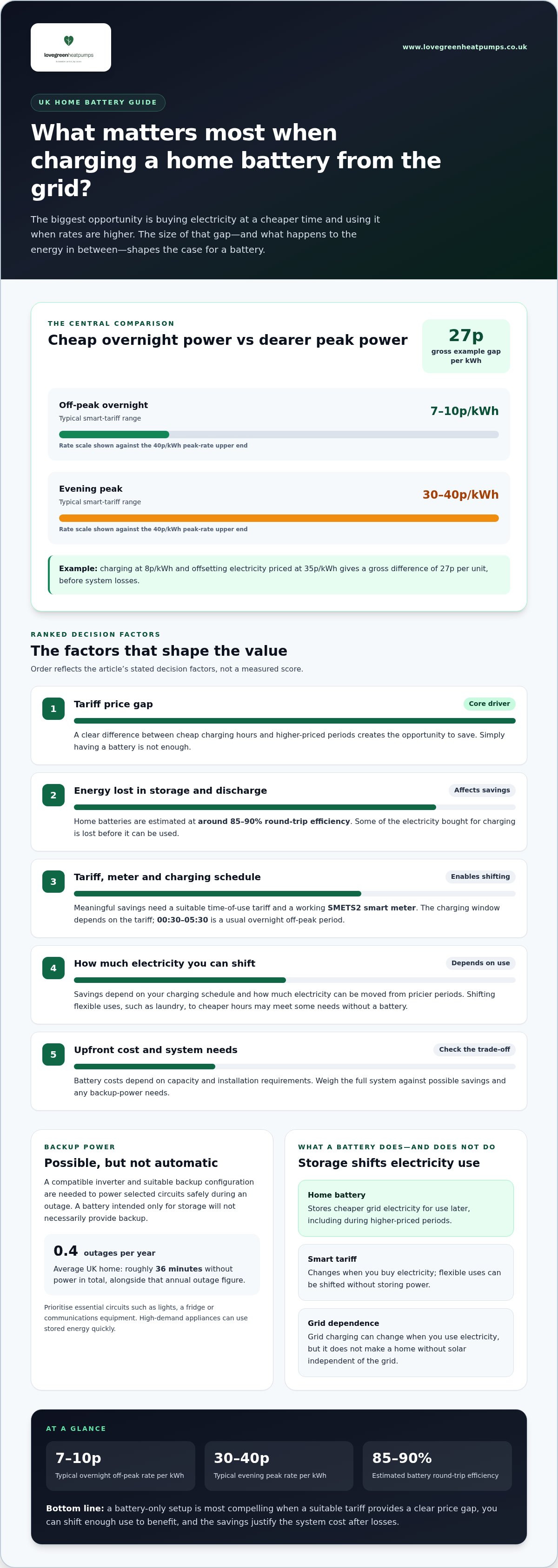
A home battery can be worth buying without solar when you can charge it cheaply overnight and use that electricity during pricier periods. UK smart tariffs commonly offer off-peak rates of around 7-10p per kWh and evening peak rates of around 30-40p per kWh, so the price gap is central to whether a home battery is worth it without solar. Without a suitable time-of-use tariff, savings are harder to make.
It’s reasonable to weigh the upfront cost against potential savings and ask whether a battery can keep essential circuits running during a power cut. Grid charging can shift when you buy electricity, but it won’t make your home independent of the grid.
This guide explains how tariff rates, battery costs and efficiency affect the sums, when backup power is possible, and how an AC-coupled battery can work with solar panels added later. You’ll learn what makes a battery-only setup more or less suitable, so you can weigh its benefits now against future solar plans.
Key Takeaways
- A battery without solar is most useful when your tariff offers a clear gap between cheap overnight electricity and higher-priced peak periods.
- Allow for energy lost during charging and discharging when weighing potential savings against the battery’s upfront cost.
- Backup power depends on compatible equipment and a suitable setup; think about which essential circuits you would want to keep running.
- Grid charging can shift when you use electricity, but a home without solar still relies on the grid to generate its power.
- An AC-coupled battery can be installed before solar panels, leaving room to add solar later as your plans change.
Battery Storage Without Solar - Does It Make Sense in the UK?
A standalone battery can store cheaper grid electricity overnight and supply your home during more expensive periods. Whether that makes financial sense depends on your tariff, charging schedule and how much electricity you can shift.
Time-of-use tariffs and bill savings
A time-of-use tariff charges different rates at different times. Charging overnight can be useful when off-peak electricity costs less, allowing the battery to supply stored power during peak periods and reduce purchases at higher rates. The size of the rate difference matters more than simply having storage.
For example, charging at 8p per kWh and offsetting electricity priced at 35p per kWh gives a gross difference of 27p per unit before system losses. Home batteries are estimated to have around 85-90% round-trip efficiency, so some electricity is lost during storage and discharge.
A working SMETS2 smart meter and a time-of-use tariff are needed for meaningful savings. Without a suitable tariff and meter, it may be harder to schedule charging for cheaper periods and use stored power when rates are higher.
Overnight rates and battery export payments
UK time-of-use tariffs can offer cheap overnight electricity and, under some arrangements, payments for exporting electricity. Typical smart-tariff overnight rates are around 7-10p per kWh, compared with evening peak rates of around 30-40p per kWh. The charging window depends on the tariff; 00:30 to 05:30 is a usual overnight off-peak period.
These are separate from savings made by using stored electricity at home, so treat them as a distinct potential benefit rather than assuming every tariff includes them.
Export payments depend on your household’s arrangement and the electricity sent back to the grid. Compare the value of exporting power with keeping it in storage for your own use during peak periods.
Battery comparisons with other options
A smart tariff changes when you buy electricity; a battery stores it for later. Shifting laundry and other flexible uses to cheaper hours may meet some needs without a battery. A battery adds storage for higher-priced periods, but charging and conversion losses affect the savings.
An EV battery is primarily designed to power the vehicle. Using it to supply a home depends on compatible vehicle and charging equipment, whereas a home battery is designed for household storage. A generator produces electricity during an outage rather than shifting grid electricity between tariff periods.
For either battery option, consider whether your priority is daily bill management, backup power, or both. UK domestic consumer units and earthing arrangements must meet IET Wiring Regulations (BS 7671), according to the Institution of Engineering and Technology.
Can batteries provide backup power?
A home battery can supply electricity during a power cut if it has compatible hardware and a suitable backup configuration. Its practical value depends on which household circuits it can support and how much energy those circuits use.
Backup power during outages
During an outage, a compatible inverter and backup setup can keep selected circuits running from stored electricity. Essential lights, a fridge or communications equipment may be priorities, while high-demand appliances can use stored energy quickly. A battery may power essential circuits for several hours, depending on household load.
The average UK home experiences 0.4 electricity outages per year and loses power for roughly 36 minutes in total, alongside that annual outage figure. Those averages help put backup in perspective: a battery may offer useful cover, but most households will use it more often for everyday energy management than for outages.
Backup depends on more than battery capacity. The system needs compatible equipment and a suitable configuration to provide power safely when the grid is down. Don’t assume a standalone battery intended only for storing electricity will automatically provide backup.
Household suitability for backup power
Backup is most useful when an interruption would affect essential needs at home. List the circuits you would prioritise, then consider how long they may need power and what else might run at the same time. The combined load affects how quickly the battery discharges.
For example, keeping a fridge and a few lights running places a different demand on storage than operating several high-energy appliances together. Choosing what to power matters as much as battery capacity. During an outage, limiting use to essential circuits can help stored electricity last longer.
There is also a financial trade-off. If outages are infrequent and brief, backup alone may not justify a battery for a household. Regularly shifting electricity use between cheaper and more expensive tariff periods may provide another use, with backup as an additional benefit. If your plans include solar generation, solar PV and renewable energy can be part of the wider home-energy picture.
Consider which periods matter most: an evening outage, an interruption during colder weather, or a cut that affects working from home. Matching the backup configuration to those needs helps avoid expecting one battery to power everything. It also clarifies whether your priority is a few essential circuits or broader household coverage.
Battery capacity, installation costs and efficiency
Battery costs depend on capacity and installation requirements, while usable energy and efficiency shape potential savings. Compare the full system with your household’s electricity use, peak rates and backup needs.
Battery installation and system costs
A standalone home battery in the UK typically costs about £3,000-£7,000, depending on its size and other factors.
These figures give a starting point, not a single price for every home. The battery’s capacity and the work needed for installation affect the total. Battery-storage installations may qualify for 0% VAT relief under current rules, depending on the system type and installation circumstances.
Maintenance and replacement are separate parts of the ownership picture. Modern lithium-ion home batteries typically last around 10-12 years, whilst many systems are rated for 6,000-10,000 cycles. How often the battery cycles and how it is used affect how its working life fits your household’s plans.
So, what are the installation, maintenance and replacement costs for a UK home battery? Installation is typically about £3,000-£7,000, with size and installation requirements affecting the price; modern lithium-ion batteries typically last around 10-12 years. Maintenance and replacement costs depend on the system and its condition.
Battery capacity and efficiency
Capacity, measured in kilowatt-hours, describes how much electricity a battery can store. A 9-10 kWh battery is described as suitable for a typical UK home using 3,400 kWh of electricity annually, but the household’s timing and pattern of use matter too.
Round-trip efficiency accounts for electricity lost during charging and discharging. Home batteries are estimated to achieve 85-90% efficiency, so a 90% assumption means 10% of imported electricity is lost across a full cycle. Savings depend on the usable energy left after these losses.
Match capacity to the electricity you can use during higher-priced periods. A larger battery may store more, but it only helps if you can charge and discharge it effectively. For backup, consider which circuits need power and for how long. For bill savings, compare the electricity you can store and use with the difference between off-peak and peak rates.
Assess the whole system, not just the battery’s stated capacity. Inverter capability affects how quickly stored electricity can reach household circuits, while usable capacity and efficiency affect how much reaches appliances. These details help explain why systems with similar stated capacities may suit different homes.
Can I charge a home battery from the grid?
Yes. A standalone battery can charge from the UK grid without solar panels, then discharge stored electricity later. Its usefulness depends on charging times, household consumption and system settings.
How grid charging works
A grid-charged battery takes electricity from your supply, stores it, then releases it to household circuits when needed. Its inverter manages the flow between the electricity supply, battery and home. Solar panels aren’t required for this cycle, although a home without solar remains 100% dependent on the grid for energy generation.
Grid charging can shift consumption rather than eliminate it. The battery imports electricity during one period and supplies stored energy during another. Round-trip efficiency matters because some electricity is lost during charging and discharge. At an estimated 90% efficiency, around 10% of imported electricity is lost over a full cycle.
Grid charging times
Charging can be scheduled for cheaper tariff periods, often overnight, and discharge can be set for times when the household needs electricity. A typical single-phase UK inverter is rated at 3.6kW to 5kW for charging a domestic battery from the grid. The charging rate and battery capacity determine how long replenishment takes.
Most domestic home batteries take 2.5 to 4 hours to charge from empty to full using grid electricity. For example, a 10 kWh battery can be filled in five hours on a tariff charging 20p per kWh between midnight and 5am. The system’s charging power and tariff window therefore need to work together.
The charging schedule also needs to reflect daily use. If the battery discharges heavily in the evening, it may need to recharge overnight before the next peak period. Household consumption, the off-peak window and the battery’s state of charge all affect this pattern.
Grid charging and electricity export
A battery can charge from the grid and store electricity for later use. Exporting electricity is a separate function that depends on the system’s capability and your tariff or export arrangement. Don’t assume you’ll receive payments for exported electricity simply because the battery can charge from the grid.
Before buying, check how the system handles charging, discharge and export, and what its warranty covers. Read the stated cycle limits, exclusions and conditions for using backup power. For safety, the domestic consumer unit and earthing arrangements must meet BS 7671, the IET Wiring Regulations, according to the Institution of Engineering and Technology.
Grid charging makes most sense when your tariff offers a useful price difference and the battery can charge during the cheaper window. If rates are similar throughout the day, charging and discharging may add little value after efficiency losses. Compare the tariff schedule with your household’s consumption before deciding how the system would operate.
Adding solar panels to a battery later
You can install an AC-coupled home battery without solar panels and add a solar installation later. This can suit homeowners who want storage now but may add panels as their plans or budget change.
How an AC-coupled battery leaves room for solar
An AC-coupled battery can work alongside a later solar installation, so buying storage first doesn’t rule out adding panels. Initially, the battery stores electricity from the grid. Once solar panels are installed, the home-energy system can use both sources, depending on how the equipment is designed and configured.
Plan for the future system as well as the battery you need today. Consider where the battery will sit, how its inverter connects, and how future panels could work with the existing equipment. These choices affect how easily the components can work together and whether changes are needed during the later installation.
What changes when solar panels are added?
Solar panels generate electricity during daylight. A battery can store some of that generation for later use, such as in the evening, reducing reliance on grid electricity. Without panels, grid charging can still shift electricity use between tariff periods, but it won’t make your home self-generating.
Solar generation and household consumption don’t always happen at the same time. For example, panels may produce electricity during daylight, while the household needs more power later. Storage can help bridge that timing gap. Its value depends on generation, when you use electricity, and the battery’s usable capacity and efficiency.
Adding panels doesn’t mean every existing battery will automatically work with every solar setup. The system design needs to account for the battery, inverter and solar equipment together. That’s why future plans matter when choosing a battery: an AC-coupled system can provide a route to adding solar later.
When is waiting for solar the better fit?
If you expect to install panels soon, compare the cost and design of a combined project with installing a battery first. A UK comparison gives a typical payback period of 8-11 years for solar panels with battery storage. That estimate is a useful point of reference, not a promise for every household or tariff.
Between June 2024 and May 2025, 94% of UK solar installations included both panels and a battery. That shows combined systems are common, but it doesn’t mean every home needs both at once. If your roof, budget or plans aren’t ready for panels, a battery that can later work with solar may offer a phased route.
Planning a staged system? Explore solar PV options for your home alongside your battery plans, so today’s storage choice can fit tomorrow’s energy setup.
Love Green Heat Pumps: Heat Pump Installation
Love Green Heat Pumps Ltd can help you consider a home battery alongside solar PV and other renewables, or as part of a wider plan that includes heat pump installation. This is a natural next step if you’re weighing grid-charged storage now against adding solar panels later.
The right setup depends on how your household uses electricity, whether you want backup power, and how future equipment could work together. Love Green Heat Pumps Ltd handles installation from design to commissioning, helping you consider the project as a whole rather than treating each decision in isolation.
If you’re planning a battery, future solar or a heat pump, contact Love Green Heat Pumps Ltd to discuss your home’s options.
Make your next energy decision fit your home
Whether a home battery is worth it without solar depends on the role you want it to play in your longer-term energy plans. Look beyond the battery itself: consider how your electricity use may change, whether solar could be added later, and how your heating choices fit into the same plan.
A joined-up plan can help you make decisions in a sensible order, rather than treating each upgrade as a separate project. Love Green Heat Pumps Ltd offers Solar PV & Other Renewables, Heat Pump Installation and Air Conditioning, helping homeowners explore options for their energy and comfort needs.
If you’re weighing a battery now against solar or heating improvements later, take the next step by discussing how these choices could fit your home. Contact Love Green Heat Pumps Ltd to explore your options. A clear plan can make the path forward feel more manageable, whether you start with one change or plan several together.
Frequently Asked Questions
Will a battery without solar save me money?
A battery can save money if you charge when electricity is cheaper and use stored power when rates rise. For example, a household that shifts evening use away from peak-priced electricity may reduce grid purchases. The key is whether the tariff gap outweighs battery losses and system costs over its working life. If your tariff stays flat, there’s less opportunity to save by shifting use.
Can I install a battery without having solar panels?
Yes, a standalone home battery can be installed without solar panels and charged from the electricity grid. It can store electricity bought at a cheaper time for later use, depending on the system setup and tariff. This can also suit a household planning to add solar in future: AC-coupled batteries can work with a later solar installation, so storage doesn’t have to wait for panels.
How much does a standalone battery cost?
A standalone home battery in the UK typically costs about £3,000-£7,000, depending on its size and other factors. Installation requirements affect the total. Battery-storage installations may qualify for 0% VAT relief, depending on system type and installation circumstances.
Are there any grants for batteries?
Don’t assume a standalone battery is covered by a grant. ECO4 is listed as available until December 2026, but that does not establish that a battery-only installation qualifies. UK battery-storage installations may qualify for 0% VAT relief, depending on the system and installation circumstances; this is VAT treatment, not a grant. Check the scheme’s eligibility rules before relying on funding in your budget.
How does a battery-only system work?
A battery-only system imports electricity from the grid, stores it, then supplies it to the home when needed. A controller can schedule charging during cheaper tariff periods, with discharge timed for higher-priced hours. The system still relies on the grid for its electricity. Its financial value comes from shifting when electricity is used, while backup power requires compatible hardware and a suitable configuration.
How long do batteries last?
Modern lithium-ion home batteries typically last around 10-12 years. Their lifespan also relates to how often they charge and discharge: most systems are rated for 6,000-10,000 cycles. A cycle means using stored energy through a charging and discharging cycle, though daily use patterns vary. When comparing systems, consider the stated cycle rating alongside the warranty terms and your expected household use.
How much does a home battery cost in the UK without solar?
Without solar, a standalone home battery typically costs about £3,000-£7,000, depending on capacity and installation factors. These are battery-system costs, not a quote for every home. The installation requirements and chosen capacity affect the final total.
How much can a UK household save using a battery with a time-of-use electricity tariff?
A UK household may save around £300-£700 per year using a battery without solar and a time-of-use tariff, depending on capacity. The result depends on how much electricity can be charged at off-peak rates and used during expensive periods. For a fair estimate, account for charging and discharging losses, the tariff’s rate difference and how regularly the battery cycles.
Disclaimer
Disclaimer
The information published on this website is provided by Love Green Heat Pumps for general information and educational purposes. As a specialist provider of heating and renewable energy solutions, we strive to ensure that our content is accurate, relevant and up to date. However, heating requirements, system suitability, installation specifications, costs and performance can vary depending on individual property characteristics, usage and other site-specific factors.
Information provided in our articles should not be regarded as a substitute for a professional property assessment, technical survey or tailored recommendation. Any decisions regarding the selection, installation, replacement or maintenance of heating systems should be made with appropriate professional guidance.
Love Green Heat Pumps accepts no responsibility for decisions made solely on the basis of general information published in these articles. For advice specific to your property or project, we encourage you to contact our team for professional guidance and an assessment of your requirements.


