

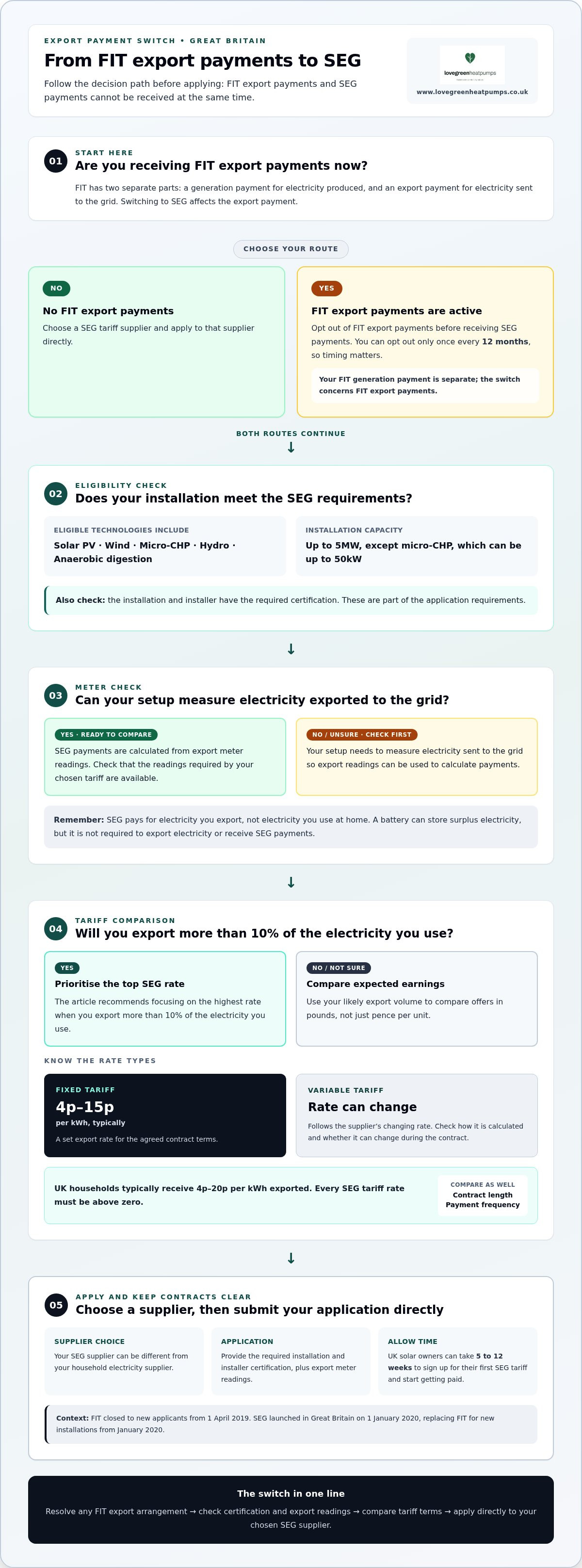
You can’t receive Feed-in Tariff export payments and Smart Export Guarantee payments at the same time in England, Scotland or Wales. To switch to SEG, opt out of FIT export payments and apply directly to a SEG tariff supplier. If you’re working out how to sell electricity back to the grid in the UK, the key point is that SEG pays for electricity you export, not the power you use at home.
It’s easy to assume you need to change your electricity supplier as well, but your SEG supplier can be a different company. You can also only opt out of FIT export payments once every 12 months, so the timing matters.
This guide explains how the switch works, what affects SEG eligibility and how to compare export rates. It also covers application requirements and how to keep your electricity supply contract separate, so you can weigh up the practical choices before deciding what to do.
Key Takeaways
- You can’t receive Feed-in Tariff export payments and SEG payments at the same time, so understand the opt-out rules before switching.
- Compare fixed and variable export tariffs, alongside payment terms, to find an option that suits how much electricity you send to the grid.
- Check that your renewable installation and installer meet SEG certification requirements before applying.
- Your SEG tariff and household electricity supply can be with separate suppliers, giving you more choice when comparing offers.
- Export meter readings help calculate SEG payments, so make sure your setup can measure electricity sent to the grid.
How do I switch from the Feed-In Tariff to the Smart Export Guarantee?
Switching means ending your Feed-in Tariff export payments before receiving payments under a Smart Export Guarantee tariff. Ofgem says the FIT scheme closed to new applicants from 1 April 2019, but existing participants can still have choices about export payments.
How SEG export payments work
The Smart Export Guarantee pays eligible generators for each unit of renewable electricity exported to the grid. It matters because electricity used at home earns no SEG payment, while export meter readings calculate the amount due. The scheme launched in Great Britain on 1 January 2020, replacing FIT for new installations from January 2020.
Using solar electricity at home reduces the electricity you import from the grid; SEG pays only for surplus electricity you export. A battery can store surplus for later use, but it isn’t required to export electricity or receive SEG payments.
Applying for an export tariff
To apply, choose a SEG tariff supplier and submit your application directly. You’ll need an eligible renewable installation, export meter readings and the required installation and installer certification. The supplier calculates payments from your export readings under its tariff terms, so check how its rate and payment arrangements suit your household.
Allow time for the application: UK solar owners can take five to 12 weeks to sign up for their first SEG tariff and start getting paid. If your home already receives FIT export payments, resolve that arrangement before applying for SEG payments.
Moving FIT export payments to SEG
FIT has two separate payment parts: a generation payment for electricity produced, and an export payment for electricity sent to the grid. Switching to SEG concerns export payments. A UK customer can opt out of FIT export payments only once every 12 months, so consider the timing before making that change.
For the period from 1 April 2026 to 31 March 2027, FIT export payments are 5.43p per kWh for solar panels installed between 1 April 2010 and 31 July 2012, and 7.64p per kWh for panels installed on or after 1 August 2012. FIT generation payments are separate; UK solar installations from 2010 received a generation payment of 76.80p per kWh.
Most UK households’ SEG income falls within HM Revenue & Customs’ £1,000 annual trading and miscellaneous income allowance. The allowance gives households a useful starting point for understanding the tax treatment of modest export earnings.
Comparing SEG tariffs
There isn’t one SEG supplier that suits every generator: tariff rates and terms vary. UK households typically receive between 4p and 20p per kWh exported. Fixed SEG tariffs typically range from 4p to 15p per kilowatt hour, whilst variable rates can change. Every SEG tariff rate must be above zero.
Check how the rate is calculated and whether it can change during the contract. A fixed tariff offers a set export rate for the agreed contract terms; a variable tariff follows the supplier’s changing rate. Compare the contract length and payment frequency too, as both affect when you receive SEG payments and how predictable they are.
Use your likely export volume to compare offers in pounds, not just pence per unit. This shows why the rate matters alongside the amount of electricity you export.
Your export volume depends partly on how much solar electricity you use at home. Using generation directly can reduce the electricity you import from the grid, while storage can hold surplus for later use. If you export more than 10% of the electricity you use, focus on the top SEG rate when comparing tariffs.
SEG differs from the Feed-in Tariff because it pays for exported electricity under a supplier’s tariff, rather than combining FIT generation and export payments. A generator already receiving FIT export payments in England, Scotland or Wales cannot receive SEG payments at the same time. Review your existing FIT export arrangement before switching schemes.
Social landlords and developers can use the same comparison principles when assessing homes with renewable generation. Estimate expected exports for each property, then compare available rates, contract terms and payment frequency. The right option depends on the amount of electricity exported and how the project manages applications and payments. A high unit rate alone may not suit every development.
Check whether your smart meter provides the export readings required by your chosen tariff. SEG payments are based on export meter readings, so your setup must measure electricity sent to the grid. Compare tariffs using the same expected export volume and calculation period, then note differences in rate type, contract length and payment timing.
If you’re planning renewable generation alongside your tariff choice, solar PV and renewable energy systems are part of the wider picture. Love Green Heat Pumps Ltd can help you consider generation as part of your plans.
Which Energy Suppliers Offer the Best Smart Export Guarantee Rates?
There isn’t one SEG supplier that suits every generator: tariff rates and terms vary. In England, Scotland and Wales, Ofgem lists suppliers offering SEG tariffs. Domestic electricity suppliers with at least 150,000 customers must offer at least one tariff, but compare the actual rate and terms for your situation.
SEG eligibility depends on the type and capacity of the renewable electricity installation. In Great Britain, eligible technologies include solar PV, wind, micro-CHP, hydro and anaerobic digestion. Eligible installations can have capacity up to 5MW, except micro-CHP, which can have capacity up to 50kW.
Solar panels are a familiar option for households, but they aren’t the only eligible technology. Older, well-maintained solar PV systems may still qualify if they meet the scheme’s criteria. SEG has no minimum system size requirement, so eligibility isn’t limited to homes with a large solar array.
Can UK households export electricity from a home battery or another renewable system? Yes. A household battery or electric vehicle that can import and export electricity may also be used to benefit from SEG. Eligible generation technologies include solar PV, wind, hydro, micro-CHP and anaerobic digestion.
Battery storage isn’t required to export renewable electricity. It can affect how much generated energy a home uses later, while SEG payments relate to exported electricity. This distinction matters when comparing a system designed mainly for household use with one that sends surplus energy to the grid.
Power cuts affect solar export. A UK solar panel system will likely shut down during an outage, so it won’t export electricity to the grid during that interruption. Having a battery doesn’t automatically mean the solar system can keep exporting during an outage; the system’s operation and grid connection determine what happens.
For an application, the renewable installation and installer must be certified through the Microgeneration Certification Scheme (MCS) or an equivalent accredited scheme. This applies alongside the technology and capacity criteria. Keep the installation details and certification information together, as suppliers use them to assess your application.
Use the Ofgem supplier list to find SEG options, then compare each tariff’s export rate, contract terms and payment arrangements. The highest rate alone won’t show how well an offer fits: your export volume and the tariff conditions also affect its value. Rates can change, so compare current offers when choosing.
Application requirements and certification
For a SEG application in England, Scotland or Wales, the renewable electricity installation and its installer must be certified through the Microgeneration Certification Scheme (MCS) or an equivalent accredited scheme. This demonstrates that the installation and installation work meet the scheme’s eligibility requirements. Certification is one part of the application, alongside export metering and any other details required by the supplier.
For solar panels, gather the installation certificate and system details before applying. The supplier needs evidence that the renewable installation and installer meet the certification requirement. If paperwork is missing, contact the original installer for copies. Older solar PV systems may still qualify if they meet the SEG criteria, so their age alone doesn’t rule out an application.
MCS is the named certification route in the SEG criteria. An equivalent accredited scheme may also meet the requirement; Flexi-Orb is another certification scheme used in the renewables sector. The installation and installer must satisfy the scheme’s certification criteria. Keep the certificate ready to provide to the tariff supplier.
Grid connection involves a separate consideration: notification to the distribution network operator (DNO). UK solar installations up to 3.68kW per phase fall under Engineering Recommendation G98 and can use a simplified notification process without detailed DNO approval. This threshold concerns the installation’s grid connection process, not the MCS certification needed for SEG eligibility.
What certifications and approvals are required for grid-connected solar panels or batteries in the UK? For a SEG application, the renewable installation and installer need MCS or equivalent accredited-scheme certification. Grid-connected solar installations up to 3.68kW per phase can use the G98 simplified notification process; batteries that import and export electricity may also support SEG participation.
Metering and registration are practical steps in preparing an application. SEG payments are calculated from export meter readings, so your setup must measure electricity sent to the grid. Check with your supplier what export metering and registration details are needed to receive payment. Keep this export information separate from your household’s existing electricity supply details.
Before applying, organise the evidence: installation and installer certification, export meter readings, and the export MPAN. Then apply directly to a SEG tariff supplier. The supplier assesses your system against its application requirements, while certification and DNO processes address separate aspects of eligibility and grid connection. Clear records make each step easier to follow.
Separate SEG and electricity supply contracts
Your SEG tariff supplier doesn’t have to supply electricity to your home. In England, Scotland and Wales, you can choose one energy supplier for electricity you import and another for renewable electricity you export. This gives you separate choices: compare import tariffs for the power you buy and SEG rates for the units you send to the grid.
Keep the two arrangements distinct when reviewing bills and payments. Your electricity supplier charges for energy imported from the grid, while your SEG supplier pays for eligible exports measured by the export meter. Changing your import tariff doesn’t mean you must choose the same company for export payments. The contracts cover different parts of your household’s electricity use.
Compare each contract on its own terms. For your import supply, consider how the charges fit your household’s electricity use. For SEG, compare the export rate, whether it is fixed or variable, the contract length and payment frequency. A high export rate may matter more if you send substantial surplus to the grid; a competitive import tariff affects the electricity you still need to buy.
Separate suppliers can also make it easier to compare offers across the two sides of your energy account. Before choosing, make a simple record of:
- Which company supplies electricity to your home.
- Which company pays for electricity recorded by your export meter.
- The import tariff terms and SEG export rate.
- How each supplier issues bills or payments.
This record helps you see which contract relates to each charge or payment, especially when the supplier names differ.
Tell your SEG supplier if your export details change, and keep the meter readings used to calculate payments. If you switch your household electricity supplier, your SEG contract remains separate. Review the export tariff independently rather than assuming your new import supplier offers the best SEG rate. Likewise, changing your SEG supplier doesn’t require changing your electricity supply contract.
There is one practical risk to consider. If your SEG provider goes out of business, you won’t receive payments while you find a new provider. This gap affects export income, not the electricity supply contract you hold with another company. Keeping supplier details and recent export readings accessible can make arranging a replacement tariff easier.
If you’re considering renewable generation for your home, explore solar PV options alongside your plans for separate import and export contracts.
Love Green Heat Pumps Ltd: Heat Pump Installation
Love Green Heat Pumps Ltd can help if you’re planning a heat pump alongside renewable energy improvements at home. Its Heat Pump Surveys & Installation service complements Solar Panel Installation, giving you a practical way to discuss heating and generation as part of the same project.
For households considering export payments, solar generation and home electricity use are connected decisions. Love Green Heat Pumps Ltd handles solar installations from design through to commissioning and provides free, no-obligation quotes. A project discussion can help you understand how renewable generation fits your home and plans for using or exporting electricity.
If you’re considering a heat pump or renewable energy project, contact Love Green Heat Pumps Ltd to discuss your home.
Plan your next energy step with confidence
Choosing how to sell electricity back to the grid in the UK is one part of a broader decision about how your home generates and uses power. Before making changes, consider what you want your household energy setup to do: generate renewable electricity, support a different heating system or improve comfort through cooling. This broader view can help your decisions work together instead of treating export payments as a standalone goal.
Love Green Heat Pumps Ltd offers Solar Panel Installation, Heat Pump Surveys & Installation and Air Conditioning. If you’re planning a renewable system or considering how generation fits alongside heating, it can help to look at your home’s needs as a whole. Start with the project that matters most to you, whether that’s generation, heating or cooling.
Contact Love Green Heat Pumps Ltd today to discuss your plans. A clear next step can help you shape a home energy setup that suits your needs.
Frequently Asked Questions
How do I get an export reading from my smart meter?
Use the meter’s export register, which records electricity sent to the grid, rather than the import reading for electricity brought into your home. Depending on how your meter data is provided, the register may appear on the meter display or in your energy account. Record the reading date and value together. Your SEG supplier uses export readings to calculate payments, so follow its accepted method.
How often will I receive SEG payments?
Your SEG tariff determines how often you’re paid. Suppliers set their own payment schedules, so check the contract for when readings are collected and payments are issued. If a tariff pays after receiving readings, note its submission dates and keep records for each export period. Payment timing is separate from your household electricity bill, particularly when different suppliers handle import and export.
Can I sell electricity if I’m using older solar panels?
Yes, an older, well-maintained solar PV system may qualify for SEG if it meets the scheme’s criteria. The installation and installer must also meet the certification requirement through MCS or an equivalent accredited scheme. Before applying, gather your system’s installation and certification records. Age alone doesn’t determine eligibility, and existing Feed-in Tariff export payments affect whether you can receive SEG payments at the same time.
Selling Electricity Back To The Grid: How Does It Work?
A renewable system generates electricity for your home, and surplus power can flow to the grid for export payments. To sell electricity back to the grid in the UK, apply to a SEG tariff supplier as an eligible generator and have your exports measured for payment. Solar electricity used by household appliances reduces imported power, while only exported units count towards SEG payments.
What SEG tariff am I eligible for?
Eligibility depends on your renewable technology, installation capacity, certification and the tariff’s terms. Eligible technologies include solar PV, wind, micro-CHP, hydro and anaerobic digestion. Suppliers set their own rates and conditions, so qualifying for the scheme doesn’t mean every tariff will suit your setup. Compare export rates, contract length and payment arrangements against how your household generates and exports electricity.
What is the SEG scheme?
The Smart Export Guarantee is a scheme for eligible generators in England, Scotland and Wales. It pays for renewable electricity exported to the grid, not electricity used in the home. Eligible technologies include solar PV, wind, micro-CHP, hydro and anaerobic digestion. Apply directly to a SEG supplier, which calculates payments from export meter readings under its tariff terms.
Are SEG payments taxable?
Most UK households’ SEG income falls within HM Revenue & Customs’ £1,000 annual trading and miscellaneous income allowance. SEG income is money received for renewable electricity exported from your home, rather than a reduction to your electricity bill. Keep a record of payments and consider them alongside your other relevant income when reviewing your tax position. The allowance figure is annual, not a monthly threshold.
How does selling electricity back to the grid work in the UK?
A home renewable system can meet household demand first, then export surplus electricity through its grid connection. An export meter records electricity sent out, and a SEG supplier uses those readings to calculate payments under its tariff. Apply directly to the SEG supplier. It can differ from the company supplying electricity to your home, so the two contracts can remain separate.
Disclaimer
Disclaimer
The information published on this website is provided by Love Green Heat Pumps for general information and educational purposes. As a specialist provider of heating and renewable energy solutions, we strive to ensure that our content is accurate, relevant and up to date. However, heating requirements, system suitability, installation specifications, costs and performance can vary depending on individual property characteristics, usage and other site-specific factors.
Information provided in our articles should not be regarded as a substitute for a professional property assessment, technical survey or tailored recommendation. Any decisions regarding the selection, installation, replacement or maintenance of heating systems should be made with appropriate professional guidance.
Love Green Heat Pumps accepts no responsibility for decisions made solely on the basis of general information published in these articles. For advice specific to your property or project, we encourage you to contact our team for professional guidance and an assessment of your requirements.


