

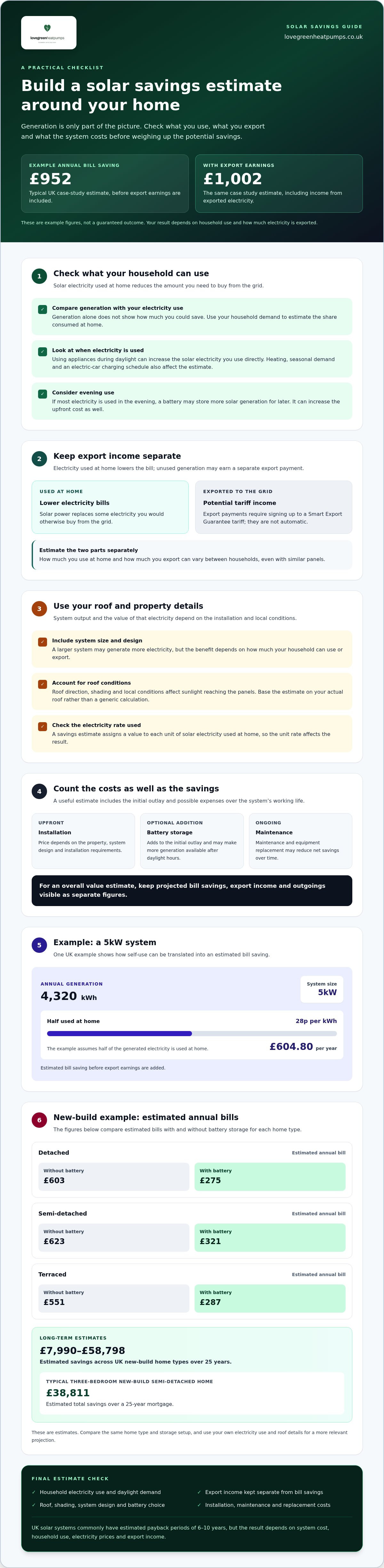
A typical UK solar case study estimates annual electricity-bill savings of £952, or £1,002 when export earnings are included. So, how much money you save with solar panels in the UK depends on how much of the electricity you use at home and how much you export to the grid.
It’s sensible to look beyond the headline saving. Installation costs, household electricity use and when you use that electricity all affect how long a system takes to pay for itself. An estimate for one home may not apply to another.
This guide explains how to estimate potential savings, factor in Smart Export Guarantee payments and assess payback periods. It also considers how installation choices, including battery storage, affect the balance between using your own electricity and exporting it. You’ll have a practical framework for assessing the figures for your home, without treating an estimate as a promise.
Key Takeaways
- Estimate savings from the electricity you use at home, not just the panels’ total generation. Using more solar electricity yourself can reduce the amount you buy from the grid.
- Include installation costs and any battery costs in your calculations. Battery storage can increase how much generated electricity your household uses.
- Export payments can add to savings, but you need to sign up to a Smart Export Guarantee tariff; it isn’t automatic.
- UK solar systems commonly have payback periods of 6-10 years. Your estimate depends on the system cost, household use, electricity prices and export income.
- Good installation planning considers your roof, electricity use and any export limits, helping you understand how the system may perform at your home.
How much could you save with solar panels?
A typical UK case study estimates annual electricity-bill savings of £952, rising to £1,002 when export earnings are included. Your potential savings depend on how much solar electricity your household uses and how much it exports.
Electricity bill savings and export income
Solar panels reduce your electricity bill by supplying energy that you would otherwise buy from the grid. Any unused generation can be exported for payment through a suitable tariff. In one UK example, a 5kW system generates 4,320kWh annually. Using half at 28p per kWh gives an estimated bill saving of £604.80 per year, before export earnings are added.
That distinction matters: electricity used at home lowers the bill, while exported electricity can bring separate income. Actual savings and export earnings vary by household and depend on how much electricity is used at home and how much is exported. These are example figures, not a single fixed outcome for every home.
Personalising savings estimates
Personalise an estimate by comparing expected generation with your household’s electricity use. Solar can offer greater savings in electrically heated homes because it may offset some electricity used for heating. Timing matters too: using appliances during daylight can help you consume more of your own solar power.
Consider an electric car as well. Charging it during sunny periods can use solar electricity that might otherwise be exported. Your charging schedule, household demand and seasonal electricity use all affect potential savings. If your household uses most of its electricity in the evening, a battery may store more generation for later use.
Solar savings compared with electricity costs
Without solar, your household buys its electricity from the grid, and the bill reflects total consumption and the unit rate. With panels, electricity used directly from solar reduces how much you need to buy.
Ofgem’s standard variable electricity unit rate was 27.69p/kWh for the price-cap period from 1 January to 31 March 2026, using direct debit and typical regional averages. The rate used in a savings estimate affects the value assigned to each unit of solar electricity used at home.
Adding a battery affects both the upfront cost and how much solar electricity you can use later. It may make more of the system’s generation available after daylight hours, but it also adds to the initial outlay.
For a practical estimate, compare your electricity bills throughout the year with your likely daytime use. Consider whether electric heating or an electric car could use solar generation at home. These patterns help explain why households with similar panels can have different bills and export income.
Estimating solar panel savings and installation costs
A useful estimate combines expected generation, household electricity use, export income and upfront system cost. Examples for new-build homes also show how the property and battery storage can affect projected bills.
Savings, costs and electricity generation
A solar estimate compares the electricity a system could generate with the energy your home uses and exports. Generation alone doesn’t show how much you might save.
A calculator can help organise the estimate, but enter realistic household electricity use and the system details carefully. For a standard 4kW system, the installation price depends on the property and project, including system design and installation requirements; the price is given after a quote request. Keep export income separate from bill savings, then subtract the initial outlay when assessing the overall value.
System and property factors affecting savings
System size, location and roof orientation affect how much electricity panels generate, shaping potential savings. A larger system may generate more, but the benefit depends on how much your household can use or export.
Roof direction, shading and local conditions affect how much sunlight reaches the panels. Use estimates based on your actual roof and household demand rather than relying on generic calculations. Consider daytime appliance use too: shifting electricity use to sunnier periods can increase the share of generation consumed at home.
Maintenance and ongoing costs
Ongoing costs may include maintenance and replacing equipment as it wears. These reduce net savings over the system’s working life, so include them in a long-term estimate.
Include possible ongoing expenses alongside the initial installation cost. Keep them separate from projected electricity savings so your calculation shows both gross savings and likely outgoings.
New-build examples illustrate how home type and battery storage affect estimated energy bills. A detached home with solar panels is estimated to have an annual bill of £603 without a battery, compared with £275 with battery storage. For a semi-detached home, the estimates are £623 without storage and £321 with it. A terraced home is estimated at £551 without a battery and £287 with one.
Across UK new-build home types, estimated savings from solar panels and battery storage range from £7,990 to £58,798 over 25 years. A typical three-bedroom new-build semi-detached home has estimated total savings of £38,811 over a 25-year mortgage. These are long-term estimates, so compare the same home type and storage setup when reviewing a calculator’s result.
For a more relevant projection, use your household’s electricity use and roof details, then account for export income and ongoing costs. A tailored solar PV assessment can help connect the estimate to your property’s installation requirements.
Smart Export Guarantee payments
The Smart Export Guarantee (SEG) allows eligible solar panel owners to receive payments for electricity exported to the grid. These payments can add to your savings, but you must sign up to a tariff. Enrolment is not automatic.
Solar panels supply electricity to your home first, and any surplus can flow to the grid. Your SEG tariff determines the payment for each exported unit. To estimate the contribution, consider how much electricity your home uses while the panels are generating, how much is left to export, and the tariff rate. Export income is separate from the bill savings you get by using solar electricity at home.
Don’t assume every tariff pays the same amount for exported electricity. Rates and terms vary, so compare the options available to you. Solar Energy UK publishes a league table of solar export tariffs. Use it as a comparison point, then consider how each tariff suits your household’s export pattern and energy arrangements.
Signing up is essential: installing solar panels does not automatically start SEG payments. Apply for an export tariff and follow the supplier’s process for exported electricity to qualify for payment. Keep tariff details with your generation and export readings to see how payments contribute to your overall savings.
Your Distribution Network Operator (DNO) may limit how much electricity your system can export to protect the grid from overload. This can reduce the surplus available for SEG payments. Where an export limit applies, the installation may use a smaller inverter or an export limiter. Either can reduce export payments, so account for the limit in your estimate.
For residential solar, the relevant VAT relief is a 0% rate on qualifying solar battery installations, including standalone and retrofitted batteries, according to HM Revenue & Customs. This is a VAT measure rather than a payment for exported electricity; it applies to qualifying battery installations, not as a SEG tariff.
For a realistic estimate, separate three figures: bill savings from solar electricity used at home, income from exported electricity, and any export limit that restricts payments. Compare SEG tariffs and include the one you can actually sign up to. Export earnings depend on surplus generation, tariff terms and any network limit, so a single headline figure won’t describe every home.
Review the export tariff when assessing your system’s annual performance. If your household uses more electricity during daylight, less may be available to export. If generation exceeds household demand, more surplus may reach the grid, subject to the DNO limit. This distinction shows whether the main benefit is lower bills, export income, or both.
Solar panel payback periods
A solar system’s payback period is the time it takes for accumulated bill savings and export income to match its initial cost. UK estimates commonly put solar panel payback at 6-10 years, with annual electricity savings around £500-£700. This gives a useful starting range, but the calculation depends on the system’s cost and the value of electricity it generates.
How to understand a system’s payback
For a simple estimate, divide the system’s upfront cost by its expected yearly savings, including export income where relevant. The result is an approximate number of years to recover that initial outlay. A typical UK case study estimates a 6.99-year payback period. Another example, a 5kW system, estimates 8.61 years when export income is included.
These examples show why it’s important to compare like with like. A payback figure that includes export income may differ from one based only on bill savings. Household energy use also affects the result: solar electricity used at home reduces grid purchases, while surplus may earn export payments. The tariff and amount exported therefore affect the annual benefit in the calculation.
What changes the payback period?
The initial system cost and yearly savings have the biggest effect on payback. Higher savings shorten it, while a higher upfront cost lengthens it. Generation, household use and export earnings all shape annual savings. A home that uses more solar electricity itself may avoid more grid purchases; a home exporting more surplus may depend more on its export tariff.
Payback estimates are not the same as total savings over the system’s life. Once the initial cost has been recovered, ongoing bill savings and export income can continue to benefit the household. Solar panels can provide free electricity for up to 20 years or more after payback, though system performance and household energy use affect the value gained over time.
Use the same assumptions when comparing estimates. Check whether each includes export income and whether it uses the full installation cost. Then compare estimated annual savings with your household’s electricity use. Different systems, tariffs or patterns of solar use can produce different payback periods.
Assess a renewable energy investment by keeping payback and longer-term savings separate. The payback period estimates when benefits equal the initial cost; the years after that show the potential value of continued generation. Comparing both helps you judge the timing and longer-term contribution of solar for your household.
Solar panel installation guidance
A sound installation plan connects your roof, household electricity use and export arrangements. These factors affect how much energy the system can generate, how much your home can use and what happens to surplus electricity.
Start with the roof. Its orientation, available space and shading affect how much sunlight reaches the panels. A south-facing roof is not the only option, but direction and obstructions influence expected generation. Ask for an estimate based on your actual roof, not a generic property example. This gives you a more useful basis for comparing expected savings with your household’s electricity needs.
Next, consider when electricity is used. A home that runs appliances during daylight can use more solar generation directly. If household demand is higher in the evening, battery storage can hold some generated electricity for later use. New-build examples show battery storage can increase estimated annual savings by around £300, but the benefit depends on the home’s use and system design.
Discuss export arrangements as part of the installation. Your DNO may limit exports to protect the grid from overload. If a limit applies, the installation may use a smaller inverter or an export limiter, which can reduce export payments. Include the permitted export level in your savings estimate, as it affects the value of surplus generation.
Before installation, gather the details that will shape the design and financial estimate:
- Your electricity bills, to show how much energy the household buys.
- Roof direction, shading and usable space, to inform expected generation.
- Daytime and evening electricity use, to assess direct use and storage needs.
- Export arrangements, including any DNO limit and the tariff you plan to use.
Then compare the proposed system’s generation with your annual electricity use. Without a battery, most homes use 20-40% of the electricity their panels generate; with a battery, homes can use 60-80%. These ranges help explain why storage can change the balance between using solar power at home and exporting it. They are not a substitute for an estimate based on your property and household pattern.
Finally, review the installation estimate alongside the assumptions behind it: generation, self-use, export income and storage. A clear breakdown makes it easier to see what drives projected savings and payback. To plan a system around your roof and electricity use, arrange a solar PV installation assessment.
Love Green Heat Pumps Ltd: Heat Pump Installation
Love Green Heat Pumps Ltd provides Solar PV & Other Renewables for households assessing how solar could fit their energy use. The team can guide your installation from design through to commissioning, considering panel generation, battery storage and electricity use together. Request a free, no-obligation quote for a clear next step towards a system tailored to your property.
Solar PV can also form part of a wider home energy plan alongside a heat pump. This may be useful if you’re considering how renewable electricity could support heating as well as everyday household needs. Each technology has a different purpose, and the right combination depends on your home and plans.
Contact Love Green Heat Pumps Ltd to discuss solar PV for your home.
Plan your next step with your home in mind
To judge how much money you save with solar panels in the UK, look beyond the panels themselves. Consider how your household’s energy needs may change, including future plans for heating or cooling. This broader view helps you decide whether solar fits into a practical home energy plan rather than treating it as a standalone upgrade.
Love Green Heat Pumps Ltd offers Solar PV & Other Renewables, Heat Pump Installation and Air Conditioning. If you’re exploring which options may suit your home, discuss your plans and priorities with the team. They can explain the next steps clearly, without pressure or assumptions about what your property needs.
Contact Love Green Heat Pumps Ltd to discuss your home energy plans. A considered decision starts with your household, your property and the way you want it to work.
Frequently Asked Questions
Payback period: When will my solar system pay for itself?
A UK solar system commonly reaches simple payback in 6-10 years. Simple payback means the point when accumulated bill savings and export income equal the initial installation cost. To estimate yours, use yearly savings after accounting for how much electricity you use at home and export. Include any battery cost if you’re assessing a system with storage, because it changes the upfront amount being recovered.
What might limit the energy my panels can export?
Your Distribution Network Operator (DNO) can set an export limit to protect the local grid from overload. It controls how much surplus electricity can flow from your system to the grid, affecting potential export earnings. If a limit applies, the installation may use a smaller inverter or an export limiter. Reflect that restriction in your expected export income rather than assuming every unused unit can be exported.
Why might my savings be different from your estimate?
Your actual savings depend on household electricity use, system generation and how much power you export. A household using more electricity during sunny hours, for example, can avoid buying more from the grid. Roof direction, shading, location and battery storage also affect the calculation. Electricity rates and export tariff terms influence the value of each unit, so estimates based on different assumptions won’t match exactly.
How much can UK households save on electricity bills with solar panels per year?
Common UK estimates put annual electricity savings at around £500-£700, while a typical case study estimates £952 in annual fuel-bill savings. For households asking how much money they save with solar panels in the UK, the key distinction is whether a figure includes export income. Check whether an estimate reports bill reductions alone or combines them with payments for electricity sent to the grid.
What is the average cost of installing solar panels in the UK in 2026?
The cost of an installation depends on the system design and property requirements, with battery storage adding to the cost. Compare estimates on the same basis: check system size, whether storage is included and what installation work the quoted total covers.
How much can a UK home earn by exporting surplus solar electricity under the Smart Export Guarantee?
Export earnings depend on how much surplus electricity your home sends to the grid and the SEG tariff rate. There is no single payment that applies to every household because export levels and tariff terms differ. Estimate income using expected exported units and the rate offered by your chosen tariff. You must sign up: SEG payments do not start automatically.
How long is the payback period for home solar panels in the UK?
Home solar panels commonly have a UK payback period of 6-10 years. A case study estimates 6.99 years, while an example 5kW system reaches simple payback in 8.61 years including export income. These figures describe different examples, not a single standard result. Check whether a calculation includes export payments and battery costs before comparing it with another estimate.
What factors reduce solar panel output and savings in the UK?
Shading, roof orientation, location and system size affect how much electricity panels generate. Household habits matter too: using little electricity during daylight can mean more generation is exported instead of replacing grid electricity at home. A battery can make solar power available for later use, but its cost also affects the calculation. Export limits may further restrict how much surplus electricity reaches the grid.
Disclaimer
Disclaimer
The information published on this website is provided by Love Green Heat Pumps for general information and educational purposes. As a specialist provider of heating and renewable energy solutions, we strive to ensure that our content is accurate, relevant and up to date. However, heating requirements, system suitability, installation specifications, costs and performance can vary depending on individual property characteristics, usage and other site-specific factors.
Information provided in our articles should not be regarded as a substitute for a professional property assessment, technical survey or tailored recommendation. Any decisions regarding the selection, installation, replacement or maintenance of heating systems should be made with appropriate professional guidance.
Love Green Heat Pumps accepts no responsibility for decisions made solely on the basis of general information published in these articles. For advice specific to your property or project, we encourage you to contact our team for professional guidance and an assessment of your requirements.


