

Solar panel installation cost in the UK depends on the system size and the work needed to fit it. Roof layout, equipment choices and whether you include a battery all affect the quote. Your savings then depend on how much electricity you use at home and what you receive for exporting surplus power.
It makes sense to consider the whole picture, not just the upfront cost. A lower installation quote does not show how quickly a system might pay back, and export payments can also affect the calculation.
This article explains how system size affects a solar installation quote, what can add to the cost, and how using solar electricity at home and receiving export payments can influence savings and payback. You’ll have a clearer basis for understanding what a quote covers and how the figures relate to your household.
Key Takeaways
- System size is only one part of an installation quote. Roof layout, equipment and fitting requirements also shape the total.
- A battery can change the upfront cost and how much solar electricity you use at home. Consider your household’s electricity use when weighing up the options.
- Your savings depend on how much generated electricity you use and how much surplus you export. Export payments can add to the value of a system.
- Installer certification matters when you want to receive Smart Export Guarantee payments. Find out how the scheme works before estimating your payback.
- According to the UK Government, qualifying solar panel installations are zero-rated for VAT from 1 May 2023 to 31 March 2027. This can affect the total cost shown in a quote.
What factors can affect cost?
System size, roof access and equipment choices all shape a UK solar quote. Adding a battery changes the equipment required and can affect how much solar energy you use at home.
Installation cost components
Installation costs cover the solar panels, inverter, mounting system and labour. Understanding these components helps explain why two homes with similar systems can receive different quotes. Panel output and quantity determine the array, while the inverter converts its electricity for household use. Mounting secures the panels to the roof, and labour and scaffolding depend on the work involved.
Without a battery, the quote covers the panels and equipment needed to connect them. Adding a battery increases the upfront cost, depending on its capacity, inverter compatibility and whether it is installed with the panels or added later.
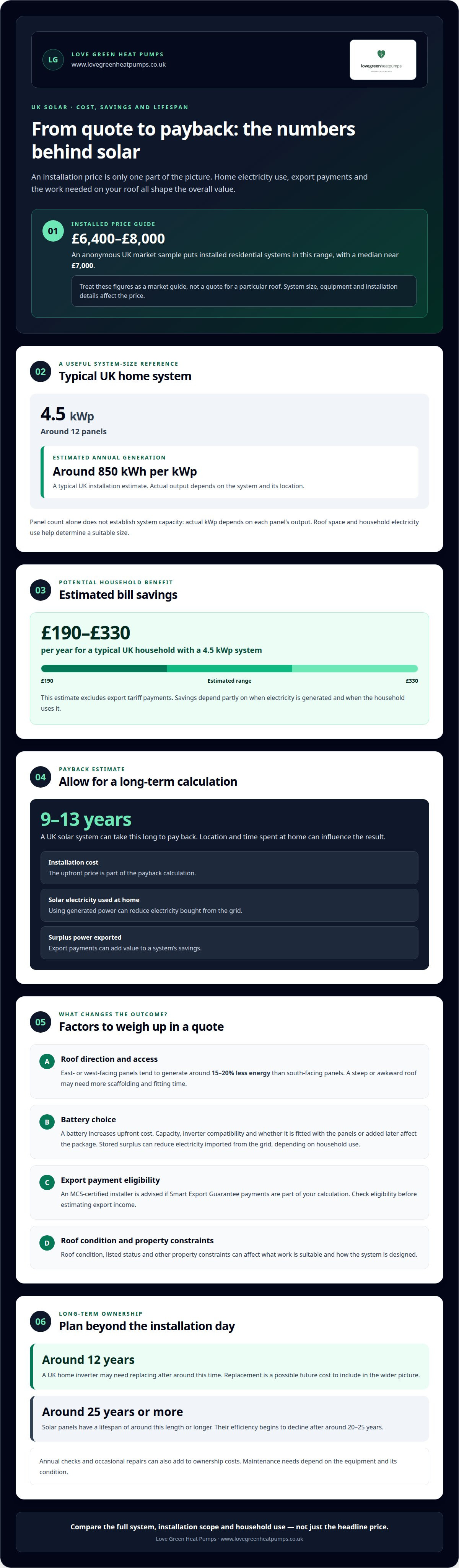
A typical UK home system is around 4.5 kWp and commonly uses about 12 panels. That gives a useful reference point, not a fixed installation price. A smaller array needs fewer panels and less mounting equipment, while a larger system can require more roof space, materials and installation work.
Roof shape and access also matter. A straightforward roof may need less scaffolding and fitting time than a steep or awkward roof. East- or west-facing panels tend to generate around 15-20% less energy than south-facing panels, which can affect system design and the output expected from a given installation.
Future inverter and maintenance costs
Future costs include inverter replacement and system upkeep, so the initial quote is only part of the long-term picture. A UK home inverter may need replacing after around 12 years. Allowing for that possibility helps you consider the system’s lifetime cost, rather than judging it only by its first installation quote.
Annual checks and occasional repairs can also add to ownership costs. Panels have a lifespan of around 25 years or more, while their efficiency begins to decline after around 20 to 25 years. Maintenance needs depend on the equipment and its condition, so include upkeep when considering future energy savings.
Standard domestic solar installations in the UK generally count as permitted development, so planning permission is not usually needed, although exceptions apply. Roof condition, listed status and other property constraints can affect what work is suitable. These factors influence the system design and installation requirements.
Financing can also affect the total paid, as interest changes repayments over time. Weigh the upfront cost of a solar array against how much electricity your household can use directly and any payments it may receive for exporting surplus power.
Installed solar panel system prices by size
System size is usually described in kilowatts peak (kWp), while the panel count shows how the array is configured. UK market prices vary according to the system and installation details.
An anonymous market sample collected in November 2026 puts installed residential systems between £6,400 and £8,000, with a median near £7,000. Treat this as a market guide, not a quote for a particular roof.
System size and panel count
System size measures the panels’ combined peak capacity; panel count is one way that capacity is delivered. A six-panel array is smaller than a twelve-panel array when panel output is similar, but panel count alone doesn’t establish kWp. The size of a domestic solar system varies between homes. Typical recommendations range from three to six panels for smaller homes, to at least 14 for larger homes.
A typical 4.5 kWp UK system uses around 12 panels. Actual capacity depends on each panel’s output, so two arrays with the same count may differ. Roof space and household electricity use help explain why suitable sizes vary. A larger home may need more capacity, but adding panels only makes sense if there is suitable roof area and a use for the extra generation.
Cost per watt
Cost per watt is the installed system price divided by its rated output in watts. It can help compare systems of different sizes, but it does not capture every difference in equipment or installation work. A larger array may cost more overall even if its cost per watt is lower.
For a fair comparison, consider total system capacity, included equipment and installation scope together. A quote that includes battery storage is not directly comparable with one that does not. Battery capacity and compatibility affect the overall package. Storing surplus generation can reduce electricity imported from the grid, depending on household use.
Payback depends on the installation cost, electricity used at home, and export payments. A UK solar system can take 9-13 years to pay back, with location and time spent at home influencing the result. Generation also varies: a typical UK installation is estimated to produce around 850 kWh per kWp annually. That figure helps explain why the same system size may deliver different savings in different homes.
Certification matters when export payments are part of your calculation. An MCS-certified installer is advised for Smart Export Guarantee eligibility. Keep that alongside system size and battery storage when considering quotes. For a system designed around your home, explore solar PV installation.
Solar panel savings and payback periods
Solar savings come from electricity you use instead of buying from the grid, plus payments for surplus power exported. Payback estimates compare these benefits with the installation cost.
Estimated bill savings
For a typical UK household with a 4.5 kWp system, estimated electricity bill savings are £190 to £330 a year, excluding export tariff payments. The actual benefit depends partly on when electricity is generated and used. Running appliances during sunny periods helps use more solar power directly, reducing the electricity imported from the grid.
Export payments provide a separate source of income for surplus generation. The amount depends on the tariff and how much electricity you export, so it varies between households. A battery stores some surplus for later use, while a household with a heat pump may use solar electricity for heating when generation and demand coincide.
Electricity prices also affect the value of each unit used at home. The savings calculation depends on the rates used for imported and exported electricity. Those rates illustrate why direct use and export should be considered separately: each exported unit earns a different amount from one that replaces imported electricity.
Payback and break-even estimates
Payback is the estimated time for bill savings and export payments to equal the original installation cost. A typical UK home may take at least 10 years to recoup the cost of a 4.5 kWp system, based on current Energy Price Cap rates. This is an estimate, not a guaranteed break-even date.
The Energy Saving Trust gives a wider payback range of 11-21 years for UK solar panels with export payments. Differences in location, household routines, installation cost and electricity use help explain why estimates vary. A home using more generated electricity directly may save more on imports, while one exporting more depends more on its export tariff.
To make a more useful estimate, focus on matching generation with household demand. Shift suitable electricity use to daylight hours and consider whether a battery fits your routine. Compare the total installation cost with estimated annual savings and export payments, rather than relying on a single payback figure.
Scaffolding and installation work contribute to the upfront cost, affecting how much savings need to offset. Planning permission is generally not needed for standard domestic installations, although exceptions apply. Check that the quote reflects the intended system size and any battery, as these choices affect both the initial cost and the electricity available to use later.
Installer certification and the Smart Export Guarantee
The Smart Export Guarantee (SEG) pays participating households for surplus electricity sent to the grid. An MCS-certified installer is advised if you want to access SEG payments.
UK households can save around £500 to £700 a year on electricity bills through solar, according to market estimates. The amount depends on how much generated electricity is used at home, alongside the system’s output and the household’s tariff. SEG export payments are additional, not part of those bill-saving figures.
The SEG is an export-payment incentive, not an upfront grant or loan. It rewards eligible households for electricity they do not use and send to the grid. It does not provide an upfront installation payment; its value comes from payments for exported electricity.
Export tariffs differ between suppliers. Rates can range from 1p to 25p per kWh, while a typical SEG rate is around 12p per unit. The payment you receive depends on the tariff and the quantity of surplus electricity exported. A higher rate can improve the value of exports, but using electricity at home can save more than exporting the same unit.
For example, a household that exports more electricity during sunny daytime periods may receive more SEG payments. A household that runs appliances while its panels are generating may rely less on grid electricity and reduce its bill instead. Battery storage can hold some surplus for later, changing how much electricity is exported and how much is bought from the grid.
MCS certification is relevant to accessing SEG payments and should be considered before estimating export income. It is separate from the tariff itself: certification relates to the installation, while the supplier’s rate determines payment for each exported unit. Keep both factors in mind when interpreting savings and payback estimates.
Consider installation quotes alongside expected electricity use and export patterns. A quote describes the system and installation cost; an export tariff sets out payment for surplus generation. They answer different questions. For a useful estimate, consider system output, household demand, likely exports and the tariff rate together, rather than treating SEG income as a fixed annual amount.
Factors that affect solar installation quotes
A solar quote reflects more than the number of panels. Roof access, equipment choices, extra protection and tax treatment can all affect the upfront cost. These details also influence how much electricity a household can generate and use, shaping the savings available to offset the initial outlay.
Roof shape and access influence the work required. A complex roof may need different mounting arrangements or additional scaffolding, while shading can affect panel placement and expected generation. East- or west-facing systems tend to generate around 15-20% less energy than south-facing systems. That difference can influence the design chosen for a household and its likely payback.
Battery storage is another major variable in a quote. These market figures help explain why quotes for similar panel capacity can differ. Retrofitting a battery to an existing system costs more than installing it alongside the panels.
Some properties also need bird protection beneath the panels, which starts at about £400. Mounting equipment and roof access can add further work. A quote should make clear which system components, installation tasks and additional measures contribute to its total, so the household can understand what the upfront figure covers.
Tax treatment affects the amount payable, too. According to the UK Government, solar panel installations are zero-rated for VAT from 1 May 2023 to 31 March 2027. This applies within the stated period; the eligibility of a particular installation depends on the applicable rules and work included.
Payback depends on both the initial quote and the electricity the system generates. A household that uses more solar power directly can reduce electricity imported from the grid, while surplus exports may earn payments under its tariff. Roof orientation, shading, household routines and battery capacity all influence these outcomes. Equipment choices in a quote therefore matter beyond installation day.
Consider the full scope as well as the price. For example, compare whether battery storage, bird protection and required roof access are included, rather than looking only at headline totals. Financing can also change the amount repaid, as interest affects the total paid over time. Weigh the upfront cost against likely generation when judging value.
For a quote shaped around your roof, equipment needs and household use, request a solar installation quote.
Love Green Heat Pumps: Heat Pump Installation
Love Green Heat Pumps Ltd provides solar PV and other renewable energy solutions, including heat pump installation. If you’re considering solar alongside changes to your home’s heating, you can consider both as part of your wider energy plans.
For solar PV, Love Green Heat Pumps Ltd handles the installation process from design to commissioning and provides free, no-obligation quotes. The design stage shapes a system around your property and energy needs, while commissioning completes the installation.
To discuss solar panels, a heat pump or how they might suit your home, contact Love Green Heat Pumps Ltd.
Plan your next step with confidence
Solar panel installation cost in the UK is only one part of deciding whether solar suits your home. Consider how your household uses energy and whether you want to plan solar alongside other home improvements. Taking that wider view can help you choose an approach that fits your priorities.
Love Green Heat Pumps Ltd offers Solar PV & Other Renewables, Heat Pump Installation and Air Conditioning. Whether you’re considering one improvement or how different systems could work together, a conversation can help clarify the practical next step for your property.
Tell the team what you want to achieve and discuss the options. You don’t need to have every detail settled before starting the conversation.
Contact Love Green Heat Pumps Ltd today to talk through your plans and take the next step at your own pace.
Frequently Asked Questions
Got questions about solar?
Yes. The key questions are how much electricity your home uses, what the roof can accommodate and how you’ll use surplus generation. A household that uses electricity during daylight can make different use of its system from one that exports most of its output. Ask how the quote accounts for your roof, equipment and expected household use, rather than judging it by panel count alone.
How long will it take for the panels to pay for themselves?
Payback depends on the installation cost, electricity used at home and export payments received. The Energy Saving Trust gives a UK estimate of 11-21 years when export payments are included. For example, a household at home during daylight can use more generated electricity directly, while one out during the day may export more. Those different routines affect the balance between bill savings and export income.
How much can you really save?
A 4kW solar system is estimated to save a UK household £400-£900 a year, depending on the assumptions used. Savings are higher when household demand matches generation, because each unit used at home replaces electricity bought from the grid. Export payments add a separate benefit for surplus power. Your household’s usage pattern and export tariff determine how those two sources of value combine.
How much does solar panel installation cost in the UK in 2026?
The solar panel installation cost in the UK varies with system size and installation details. An anonymous market sample collected on 4 November 2026 places installed residential PV systems between £6,400 and £8,000, with a median near £7,000. This is a market range, not a price for every property. The quote changes with the equipment selected, roof access and installation requirements.
What is the average UK solar panel installation cost by system size and number of panels?
There isn’t one price that applies to every system size and panel count. The average domestic system is around 3.5 kWp, while a typical 4.5 kWp system uses around 12 panels. Panel output varies, so the same number of panels can produce different system capacities. Compare the quoted kWp, included equipment and installation scope, not just the number of panels on the roof.
What affects solar panel installation quotes in the UK, including roof type and location?
Quotes reflect system capacity, roof access, mounting needs, scaffolding and selected equipment. Orientation also affects expected generation: east- or west-facing systems tend to produce around 15-20% less energy than south-facing systems. Shading and usable roof area influence panel placement. Location affects generation too, so a system design for a London property can differ from one elsewhere in the UK.
What is the typical payback period for solar panels in the UK?
The Energy Saving Trust estimates payback with export payments at 11-21 years. This range reflects differences in household routines, location and system costs. To interpret a payback estimate, distinguish electricity bill savings from export income, then consider how much electricity the home uses while panels are generating. A household that uses more solar power directly can reduce grid imports and rely less on export payments.
What are the UK rules for planning permission and building regulations for solar panels?
Standard domestic solar panel installations in the UK are generally permitted development, although exceptions apply. Planning permission and building regulations are separate considerations: permitted development relates to planning, while building regulations cover building work and installation. Property type and the work involved determine which requirements apply. Listed buildings and other constrained properties need particular attention to planning considerations before installation proceeds.
Disclaimer
Disclaimer
The information published on this website is provided by Love Green Heat Pumps for general information and educational purposes. As a specialist provider of heating and renewable energy solutions, we strive to ensure that our content is accurate, relevant and up to date. However, heating requirements, system suitability, installation specifications, costs and performance can vary depending on individual property characteristics, usage and other site-specific factors.
Information provided in our articles should not be regarded as a substitute for a professional property assessment, technical survey or tailored recommendation. Any decisions regarding the selection, installation, replacement or maintenance of heating systems should be made with appropriate professional guidance.
Love Green Heat Pumps accepts no responsibility for decisions made solely on the basis of general information published in these articles. For advice specific to your property or project, we encourage you to contact our team for professional guidance and an assessment of your requirements.


