

Could an installer’s RECC membership give you more confidence without guaranteeing a trouble-free installation? That’s the important distinction when you’re considering renewable energy work. The RECC consumer code for renewables sets standards for how member businesses deal with domestic customers, but membership isn’t a substitute for checking the installer, the proposed work and the contract.
It’s reasonable to want clear reassurance before committing to a heat pump or solar project. It can also be difficult to tell a consumer code apart from technical certification, or to know where to turn if something goes wrong. Each serves a different purpose, so check the details rather than relying on a badge alone.
This guide explains what the code covers, what it doesn’t guarantee, and how to check whether a company is currently a member and whether the terms apply to your project. It also sets out questions to ask about the written scope, payment terms, aftercare and complaints process before signing, so you can compare installers with a clearer picture of the protections in place.
Key Takeaways
- Learn what the RECC consumer code for renewables is intended to cover and how its requirements differ from your statutory consumer rights.
- Compare RECC, TrustMark and technical certification by what each scheme indicates, not by the badge alone.
- Check the official RECC listing against the exact business named in your paperwork, then confirm your technology and project fall within its scope.
- Before signing, ask for a clear written breakdown of the work, aftercare arrangements and the route for raising a complaint.
- Use code membership as one point of comparison alongside the proposed system design, relevant experience and like-for-like written proposals.
What is the RECC consumer code for renewables?
The Renewable Energy Consumer Code (RECC) is a consumer code for businesses selling or leasing small-scale renewable energy systems to domestic customers. Its current Code was published on 1 July 2026, with amendments listed on RECC’s website. It sets standards for participating businesses’ dealings with customers, covering the journey from marketing and sales through installation and after-sales service.
A consumer code sets expectations for how member businesses deal with customers. A technical product standard sets requirements for a product, material or process. They serve different purposes. RECC membership is not a blanket guarantee of workmanship, future savings or a system’s suitability for your home. Those depend on the project, equipment, design and work carried out.
Renewable projects are part of a changing UK energy picture, as outlined in this overview of Renewable energy in the United Kingdom. For a homeowner, the practical question is more specific: what does a particular installer’s membership cover, and what does the written agreement say?
What does RECC membership mean for a homeowner?
Membership means the business has agreed to follow the applicable RECC Code for eligible consumer-facing work. The Code addresses conduct across sales, contract arrangements, installation and aftercare. Check the current version for the precise commitments rather than assuming every protection associated with approved codes applies automatically.
Any protection depends on the business’s current membership, whether your contract and project fall within the Code’s scope, and its eligibility rules. Membership alone doesn’t confirm the quality of a proposed design or guarantee a particular result. Read the agreement and ask the installer to explain any terms you’re unsure about.
Which renewable projects and businesses may be covered?
RECC’s stated scope concerns businesses selling or leasing small-scale renewable energy systems to domestic consumers. Check the current Code and the company’s listing for the exact technologies and activities covered. Don’t assume a business’s membership applies to every service it offers, every contract it signs or every subcontractor involved.
Before proceeding, match the name on your quote and contract to the member business, then confirm the proposed work is within its membership scope. For a heat pump installation, ask who is responsible for the survey, design, equipment supply, installation and commissioning. Make sure those responsibilities are clear in writing. A straightforward explanation of the project is useful, but it isn’t evidence of RECC membership.
How does the RECC consumer code protect renewable energy customers?
The RECC Code is designed to set standards for member businesses throughout the customer journey, from sales discussions to installation and aftercare. It gives you a framework for checking how an installer says it will handle your project. The exact commitments, complaint stages and available remedies depend on the current Code and your eligibility. Check the Renewable Energy Consumer Code for its latest requirements rather than relying on a general description of consumer codes.
Think about protection in stages. Before agreeing to work, check the information the business provides and whether the proposal is clear. In the written agreement, look for the system specification, included work, exclusions, payment stages and how changes will be handled. During installation, keep records of what was agreed and raise any differences promptly. For aftercare, find out who to contact and how the company handles concerns. These are practical checks, not a promise that every issue will be resolved in a particular way.
The RECC consumer code for renewables sits alongside, rather than replacing, your statutory consumer rights. A code sets additional standards for participating businesses; your legal rights arise separately. If you’re unsure how those rights apply to your circumstances, consult current guidance from an authoritative UK consumer advice service.
What should the code say about quotes and contracts?
Compare proposals on more than the headline price. Check the equipment and work specified, what’s excluded, when payments are due and what the contract says about cancellation. For a heat pump project, make sure the written scope explains the stages included, such as survey, design, supply, installation and commissioning, where applicable. Ask for verbal promises and later changes to be confirmed in writing before work starts. Then compare those terms with the current RECC requirements for pre-contract information and changes to agreed work.
What can a customer do if installation work goes wrong?
Start by keeping a clear record. Save the contract, quote, emails and messages. Note key dates, take photographs where useful, and write down what you’ve already done to resolve the issue. Contact the installer through its stated complaints process, explaining the problem and the outcome you’re seeking. If it remains unresolved, check RECC’s current escalation route before submitting a complaint. Confirm eligibility, deadlines, evidence requirements and possible remedies. Don’t assume a particular route or outcome applies to every project.
Clear paperwork makes it easier to compare what was promised with what happened. If you’re considering heat pump work, you can also review the project scope and request a heat pump installation quote as one proposal to compare. A quote isn’t evidence of RECC membership, so check membership separately.
RECC, TrustMark and technical accreditation: what is the difference?
These credentials address different parts of a renewable energy purchase. RECC is a consumer code that sets standards for how participating businesses deal with domestic customers. TrustMark is a government-endorsed quality scheme for work in and around the home. Technical certification relates to specified products, technologies or installer requirements. One does not automatically prove the others.
| Credential | Purpose | What it may indicate | What you must verify |
|---|---|---|---|
| RECC | Consumer-facing standards for member businesses selling or leasing eligible renewable systems to domestic customers. | The business has agreed to follow the applicable RECC Code for work within its scope. | Current membership, the contracting business, covered technology and whether your project is eligible. |
| TrustMark | A government-endorsed quality scheme for work carried out in and around the home. | The business is registered under the scheme for relevant work, subject to its requirements. | Its current listing, registration scope and the work or measures covered. |
| Technical certification | Standards or requirements relating to particular technologies, products or installer competence. | That specified criteria apply to the certified product or business. | The scheme’s current name, status, technology scope and whether the credential belongs to the company doing your work. |
Is RECC the same as TrustMark?
No. TrustMark’s scheme information for RECC explains its role in relation to the consumer code. Their purposes are connected but distinct. A company appearing in one scheme should not be assumed to belong to the other. Search each scheme’s official register and check that the listed legal or trading name matches your quote and contract. Then confirm the relevant work is within the registration or membership scope.
How do technical credentials fit into the comparison?
Technical credentials can help you assess whether specified technical criteria apply. On their own, they don’t tell you how clearly an installer explains a contract or handles a customer concern. Consumer codes focus on business conduct and customer-facing commitments. Neither type of credential guarantees a particular installation outcome.
For a heat pump, check the installer’s relevant technical credentials and ask how the proposed system has been designed for your home. Separately, check any consumer-code membership and read the written scope, including who is responsible for each stage. Verify current scheme names and requirements with the scheme itself rather than relying on a logo or an old certificate.
Use credentials alongside project-specific checks, not as a single pass-or-fail test. The RECC consumer code for renewables can inform your view of customer protections, while technical credentials and a clear proposal help you assess other parts of the decision.
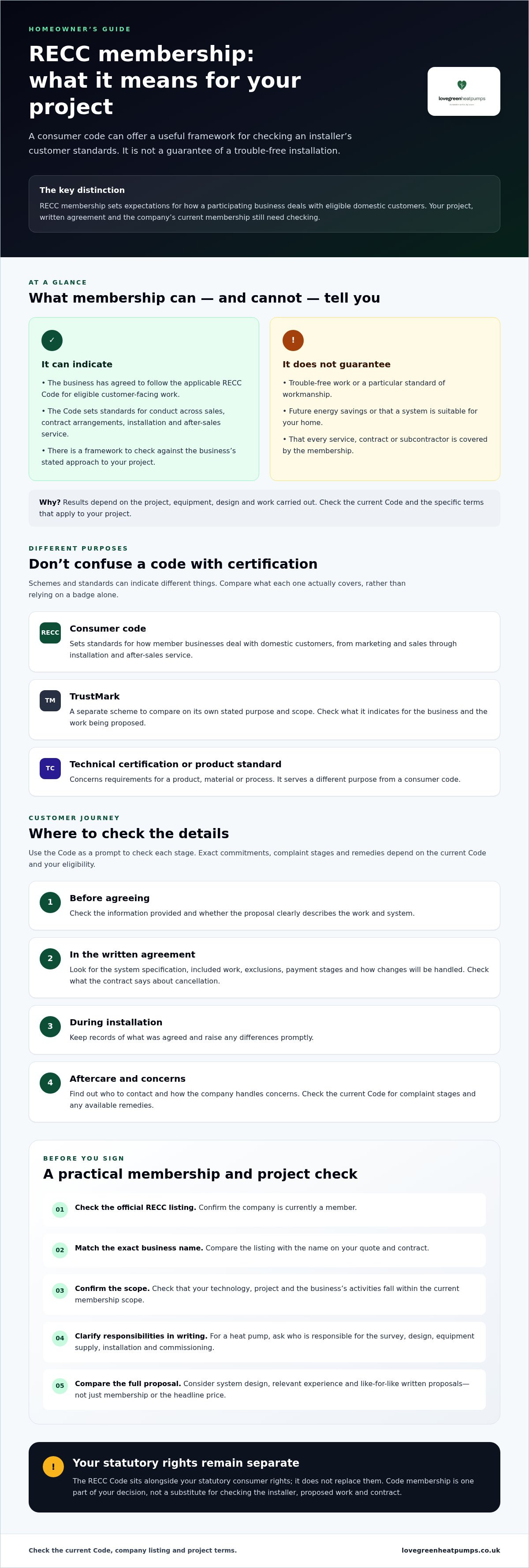
How to check RECC membership before signing a renewable energy contract
A logo on a website or brochure is a prompt to check, not proof that a company is currently a member. Search the live RECC website and match the result to the business named in your paperwork. Then check that the membership applies to the work you’re considering.
Use this checklist before you sign:
- Identify the contracting business. Find its exact legal or trading name on the quote and proposed contract. If the invoice will come from a different company, ask why and clarify who is responsible for the work.
- Search the official RECC listing. Check the current membership status and compare the listed name with the contract. Use the scheme’s live register to confirm the member’s identity, status and any published scope details, rather than relying on a logo.
- Confirm the project is in scope. Check whether the listing and current Code cover your proposed technology and the relevant sales and installation activities. Don’t assume membership covers every service the business offers.
- Check who does each part of the job. Ask whether the member company or a subcontractor will carry out the installation, and who will manage the work and aftercare. Clarify how the arrangement affects the applicable Code terms.
- Keep a record. Save a dated copy or screenshot of the listing and the Code terms you reviewed. Keep these with your quote, contract and related messages.
What should you verify in the membership listing?
Look for the exact company name and current status, then compare the listed scope with your project. A similar trading name may belong to a different business, so don’t rely on a logo or an unchecked search result. If the listing doesn’t make the relevant technology or activity clear, ask RECC or the installer to explain before proceeding.
What questions should you ask an installer?
Ask which company will sign the agreement, complete the work and handle aftercare. Find out where the complaints process and applicable Code terms are set out in the paperwork. For a heat pump installation, request a plain explanation of the design, commissioning and handover documents, along with a written list of exclusions. This helps you understand what is included and who is accountable at each stage.
These checks help you use the RECC consumer code for renewables as one practical part of comparing proposals, not as a substitute for reading the contract. If you’re weighing up a heat pump project, you can request a heat pump installation quote and compare its written scope with other proposals. A quote does not indicate RECC membership, so verify that separately.
Choosing a renewable installer: use RECC as one part of your decision
RECC membership can be a useful signal about a company’s customer-facing commitments, but it shouldn’t decide the whole appointment. A suitable project also depends on the proposed design, the installer’s relevant experience, a clear written scope and practical aftercare arrangements. Compare what each business will actually do, not just its credentials or headline claims.
How can homeowners compare renewable installation proposals?
Ask each installer to set out the proposal in writing. Then compare the same details across quotes:
- System and scope: What equipment and work are included, and what is excluded?
- Design assumptions: How has the proposed solution been matched to your property and household’s needs?
- Responsibilities: Who will carry out each stage, manage any subcontractors and answer questions?
- Handover and aftercare: What documents will you receive, and who should you contact after installation?
For a heat pump, ask how the survey informs the system design, how commissioning will be explained, and what records or handover information you’ll receive. Clear answers make it easier to judge whether proposals are genuinely comparable. If something is vague or missing, ask for clarification in writing. An unclear response is a reason to pause and ask questions, not proof of misconduct.
What is a sensible next step for a heat pump project?
Start with a property-specific discussion. Ask what a survey involves, what information is used to develop the design, and how the proposed work will be documented from supply through commissioning. Check that the written proposal reflects your home and sets out the installer’s responsibilities clearly. Then weigh the design and scope alongside membership checks and aftercare, rather than relying on one credential to make the decision.
Love Green Heat Pumps Ltd's turnkey heat pump service covers survey, system design, equipment supply and commissioning. The company also offers free, no-obligation quotes. These can help you understand a proposed project, but they don’t indicate RECC membership. Compare the written details with other proposals before deciding.
When you’re ready to discuss your requirements, discuss a heat pump project with Love Green Heat Pumps Ltd.
Make your next renewable energy decision with confidence
The RECC consumer code for renewables can help you understand a member business’s customer commitments, but it isn’t a guarantee of workmanship or project results. Check the company’s current listing and confirm your technology and work are covered. Then compare written proposals for design, scope, exclusions, responsibilities and aftercare, rather than choosing on credentials or headline claims alone.
For a heat pump project, clear explanations of the survey, system design, equipment supply and commissioning can help you judge what’s included and what to ask next. Love Green Heat Pumps offers a turnkey heat pump service covering these stages, along with free, no-obligation quotes. If you’re considering its stated HEIS accreditation, check the company’s current wording directly.
Ready to talk through your plans? Discuss your heat pump plans with our team. A well-informed decision starts with clear questions and a proposal you can compare with confidence.
Frequently Asked Questions
Is RECC membership a guarantee that an installer will do a good job?
No. Membership means a business has agreed to follow the applicable consumer code for work within its scope. It doesn’t guarantee workmanship, energy savings or that a proposed system is suitable for your home. Check the installer’s experience with the technology, ask how the design fits your property, and read the written specification and exclusions. Treat membership as one useful check alongside project-specific questions and clear contract terms.
How can I check whether a renewable energy installer is a RECC member?
Search the current member directory on RECC’s official website. Match the listing’s legal or trading name to the company named on your quote and contract, and check its current status. Then confirm that the listed scope covers the technology and work you’re considering. If another company or subcontractor will do the work, ask how that affects coverage. Save a dated copy of the listing and the relevant Code terms.
Can I complain if a RECC member’s installation goes wrong?
You can raise the issue with the installer through its stated complaints process, then check whether RECC’s current escalation route applies if the matter remains unresolved. Eligibility, deadlines, evidence requirements and possible outcomes depend on the Code’s current terms and your circumstances. Keep your contract, quote and correspondence, note key dates, and take photographs where useful. Check RECC’s official guidance before submitting a complaint, as the route isn’t automatic for every project.
Does RECC cover heat pump installations?
Coverage depends on RECC’s current technology scope, the member’s listing and the type of work in your contract. Don’t assume every heat pump service or subcontractor is covered just because a business says it’s a member. Check RECC’s current Code and directory, then ask the installer to confirm in writing that your proposed heat pump project falls within its membership scope. This is separate from checking relevant technical credentials and system design.
What should I check before signing a renewable energy contract?
Check that the contracting company matches the current RECC listing and that your project is within its scope. Read the written specification, included work, exclusions, payment stages, cancellation information and arrangements for changes. Ask who will complete each stage and provide aftercare. For a heat pump, clarify how the survey, system design, commissioning and handover will be explained and documented. Get verbal promises confirmed in writing before agreeing to proceed.


