

What if the installer with the most impressive badge or lowest quote isn’t the right choice for your home? Knowing how to vet a solar panel installer means looking beyond the headline and checking the evidence behind the proposal. Credentials can be hard to interpret, and two quotes may cover different equipment or work.
It’s sensible to want confidence that your system will be installed properly and that help will be available afterwards. A clear checklist can make that decision easier without turning it into a technical exercise or a pressured sales choice.
This guide explains how to check an installer’s credentials and scheme memberships, compare proposals on a like-for-like basis, and assess the planned work. You’ll also learn what to confirm in writing, from equipment and installation responsibilities to commissioning documents, warranties and aftercare. Use these checks to build a shortlist, ask more useful questions and understand what you’re agreeing to.
Key Takeaways
- Learn how to vet a solar panel installer by checking current credentials and whether their scope covers the work proposed.
- Compare quotes side by side, including system design, output assumptions, equipment and installation scope.
- Ask how roof suitability, shading, orientation and survey limitations have shaped the proposal.
- Check relevant customer references and make sure contract terms, warranties and aftercare are clear.
- Know when to pause: important promises should be documented, not left as verbal assurances.
How to vet a solar panel installer before you compare quotes
A solar PV system is a long-term home improvement. The decision deserves more than a quick look at the headline quote. Sound design, careful workmanship, complete paperwork and dependable aftercare all matter. This checklist will help you compare installers, but it isn’t a substitute for technical or legal advice about your property or contract.
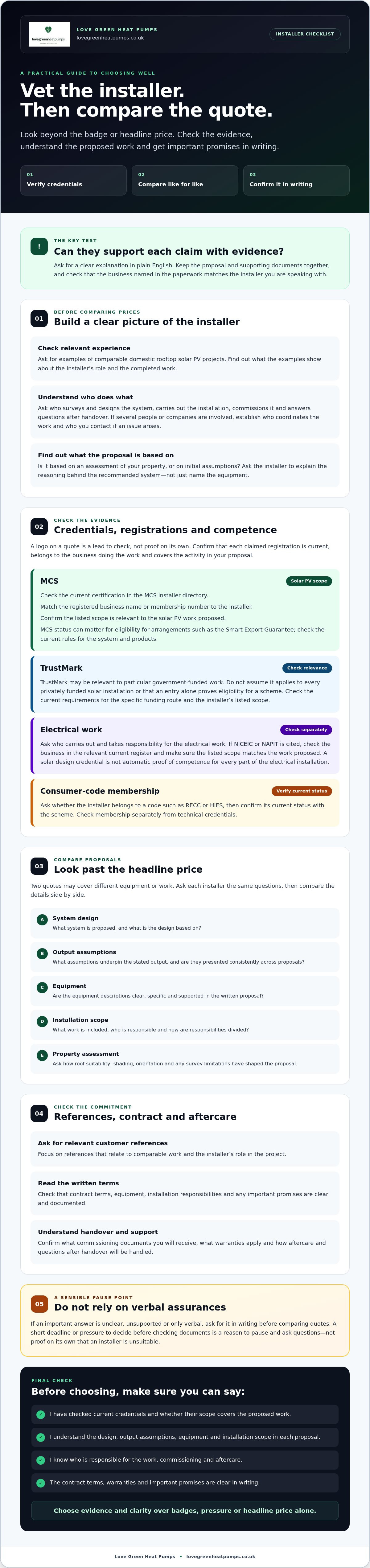
Before weighing up proposals, gather each installer’s credentials, written design or proposal, scope of work and contract terms. Ask the same questions of each one. The central test is straightforward: can the installer support each claim with evidence and explain it in plain English?
Start with the installer’s experience and project fit
Ask for examples of comparable domestic rooftop solar PV projects. Look for work that resembles your home and proposed system, rather than relying on general claims of experience. Ask what the examples show about the installer’s role and the completed work.
Find out whether the proposal is based on an assessment of your property or on initial assumptions. Ask who is responsible for surveying and designing the system, carrying out the installation, commissioning it and answering questions after handover. If different people or companies are involved, ask who coordinates the work and who you should contact if an issue arises.
A clear proposal should explain the installer’s reasoning, not just name a recommended system. For wider background on the UK market, see Solar power in the United Kingdom. That context can help explain the place of rooftop solar, but it isn’t evidence of an individual installer’s competence.
Separate reassuring sales claims from evidence
Vetting means checking verifiable evidence before choosing an installer. If a salesperson mentions credentials, specific equipment or project responsibilities, ask for the details in writing. The next section explains how to check scheme memberships and electrical competence. For now, note exactly what the installer claims and which document or register entry supports it.
Keep the proposal and supporting documents together. Check that the business named in the paperwork matches the installer you’re speaking with. Ask for clarification if responsibilities or equipment descriptions are vague. The explanation should be easy to follow and consistent with the written scope.
Don’t feel rushed into signing. A short deadline or pressure to decide before you’ve checked the documents is a reason to pause and ask questions, not proof on its own that an installer is unsuitable. Give yourself time to review the terms and resolve gaps. If an important answer remains verbal, unclear or unsupported, ask for it in writing before comparing quotes.
Check solar installer accreditations, registrations and electrical competence
A logo on a quote is a useful lead, not proof on its own. When learning how to vet a solar panel installer, check that each claimed registration is current, belongs to the business doing the work and covers the solar PV activity in your proposal. Ask for the installer’s registered business name or membership number, then check it against the relevant scheme’s own directory. Similar names or an out-of-date certificate can cause confusion.
What MCS and TrustMark checks can tell you
Use the MCS installer directory to check current certification and confirm that the listed scope is relevant to solar PV. If the proposal refers to certification for a particular technology or activity, make sure the register entry supports that claim. MCS status can matter for eligibility for arrangements such as the Smart Export Guarantee. Check the current rules for the system and products rather than relying on a sales explanation.
TrustMark is a quality scheme that may be relevant to particular government-funded work. Don’t assume it applies to every privately funded solar installation or that an installer’s TrustMark entry alone proves eligibility for a scheme. Check the current requirements for the specific funding route and the installer’s listed scope. Even verified scheme registration can’t show whether a design suits your roof, shading or household needs.
Check electrical work and consumer protections separately
Ask who will carry out and take responsibility for the electrical work, and how their competence can be checked. If the installer cites NICEIC or NAPIT, look up the business in the relevant current register and check that the listed scope matches the work proposed. Don’t treat a solar design credential as automatic proof of competence for every part of the electrical installation.
Check consumer-code membership separately. Ask whether the installer belongs to a code such as RECC or HIES, then confirm its current status with the scheme and read what protection applies to your contract. Find out how to raise a complaint and whether dispute resolution is available in your circumstances. A membership name alone doesn’t confirm what your particular installation is covered by.
- Match the name: Does the register entry match the contracting business?
- Match the scope: Does it cover the work and technology in your proposal?
- Match the timing: Is the registration current, and do scheme rules apply to your project?
Keep copies of register details and written explanations with your proposal. If you’re comparing a solar PV proposal from Love Green Heat Pumps, ask for its current solar credentials and relevant project documents so you can verify them in the same way. Review its solar PV design and installation information as part of your research.
Compare solar panel installer quotes beyond the headline price
A quote is useful only if you can see what the proposed system includes and how its performance has been estimated. Compare the design, equipment, assumptions and work scope side by side. A lower headline figure may reflect a different system or leave some work outside the quoted scope.
Build a like-for-like solar PV proposal comparison
Use a simple comparison sheet. Record each proposal’s system capacity, panel and inverter specifications, estimated output and the assumptions behind that estimate. Note whether battery storage is included, offered as an option or excluded. If the equipment is described only in general terms, ask for the exact specification before comparing.
Check the proposed work as carefully as the equipment. Does the scope include scaffolding, electrical work, commissioning and any making-good or remedial work identified during the survey? Are any tasks conditional, excluded or dependent on a further inspection? Ask each installer to explain differences in plain, consistent language. This is how to vet the proposal, not just compare totals.
- System: capacity, panel and inverter specifications, and whether storage is included.
- Design: roof suitability, orientation, shading and survey limitations.
- Work: what is included, excluded or conditional, including scaffolding and electrical work.
- Estimate: projected generation and the assumptions used to calculate it.
Test the proposal’s technical and export assumptions
Ask how the design accounts for your roof layout, shading and expected household electricity use. If a survey hasn’t taken place, find out which details are assumptions and when they’ll be checked. Projected generation and savings are estimates, not guaranteed results. Ask what conditions or inputs could change them, and whether each installer has used comparable assumptions.
For a grid-connected system, ask who will check the relevant Distribution Network Operator (DNO) requirements and handle any required notification or application. Systems up to 3.68kW per phase typically use the G98 notification process, while larger systems require G99 approval before installation. Ask which route the proposal assumes and who is responsible for each step.
If you expect to export surplus electricity, check current Smart Export Guarantee eligibility and the chosen supplier’s requirements independently. The Microgeneration Certification Scheme (MCS) is a useful place to understand certification. Don’t assume an export estimate confirms eligibility or guarantees a particular tariff. Confirm the relevant installer, product and supplier conditions for your own system before relying on projected returns.
Verify references, contract terms, warranties and aftercare
Once you’ve assessed the proposal, check what the installer’s past customers and written terms can tell you. Follow a simple sequence: speak to relevant references, read the full scope, review the contract, then confirm the handover documents and support arrangements. This helps turn reassuring conversations into checks you can rely on.
Ask past customers about the whole installation experience
Ask for recent references from customers with a similar type of domestic solar PV project. Where possible, request permission to contact them directly. Ask whether the survey, schedule, installation and commissioning matched what they had agreed, and whether changes were explained before work continued.
Ask how the installer dealt with unexpected issues and post-installation questions. A reference can offer useful detail about communication and follow-through, but treat testimonials as one piece of evidence, not a substitute for checking credentials, documents and contract terms yourself.
Read the terms before you commit
Check that the contract reflects the proposal and sets out the work, equipment, responsibilities and exclusions. Read the terms for cancellation, payments, delays, complaints and changes to the agreed scope. If an issue arises during installation, the contract should make clear how decisions and any additional work will be handled. Ask for unclear wording to be explained in writing before signing. For legal advice about your specific agreement, consult a qualified adviser.
Confirm written terms and the handover pack
Get the equipment warranties and workmanship terms in writing. Check what each covers, any exclusions, how long cover applies and how to make a claim. Don’t assume a manufacturer’s product warranty also covers installation work, or that a verbal assurance forms part of the written terms.
Before accepting the proposal, ask what you’ll receive at handover. Depending on the system and work, this may include commissioning records, relevant certificates, operating instructions and details of the installed equipment. Confirm which documents the installer will provide and when. Also ask who to contact about faults, monitoring questions or future service, and whether any support arrangements have limits.
An itemised proposal makes these checks easier. If you’re considering Love Green Heat Pumps for solar PV design and installation, ask about the project scope, credentials and documents to be supplied, then compare the answers with other proposals. Discuss your solar PV project with Love Green Heat Pumps.
Use the final checklist to choose a solar panel installer confidently
A strong choice is supported by evidence, not just a reassuring conversation. Before deciding, check that the installer’s credentials are verifiable, the design is clear, the work scope is comparable with other proposals, and the contract sets out responsibilities, terms and aftercare. Use the same questions with each shortlisted installer so you can judge their answers fairly.
If an important answer is still verbal, unclear or unsupported by documents, pause before signing. Ask for clarification in writing, then check that the revised proposal reflects it. Resolving gaps now can make the project easier to understand later.
A final pre-appointment and pre-contract checklist
Before a survey, gather recent electricity-use information if you have it, note relevant roof details and prepare questions about changes you’re considering, such as future household electricity use. You don’t need to design the system yourself. These details help the installer explain the choices in the proposal.
Before signing, check that the final documents agree on the system design, equipment, installation responsibilities, full scope and contract terms. Confirm which commissioning and handover documents you’ll receive, and when. Keep written answers and dated proposal versions together. If the installer changes an assumption or an item in the scope, you’ll have a clear record of what has changed.
- Credentials: Have you checked current registration and relevant scope?
- Proposal: Can you understand the design, assumptions and included work?
- Terms: Are responsibilities, exclusions and change arrangements written down?
- Handover: Do you know which documents and support arrangements to expect?
Consider solar alongside wider home energy plans
If you’re also planning a heat pump for the same property, mention that during the design discussion. The installer can explain how the plans may affect the solar PV proposal and what needs to be considered together. Treat this as a joined-up design conversation, not a promise of savings. For more background, see the heat pump installation UK homeowner guide.
With this checklist, you can make a more informed choice about how to vet a solar panel installer and what you’re agreeing to. Love Green Heat Pumps provides solar PV design, procurement and installation. You can request a free, no-obligation solar PV quote and ask for details of the project-specific credentials and documents relevant to your proposal.
Choose with clear evidence and confidence
Knowing how to vet a solar panel installer comes down to checking the details behind the proposal. Verify credentials and their relevant scope, compare system designs and included work on a like-for-like basis, then make sure contract terms, warranties and aftercare are clear in writing.
If something important is unclear, take time to get a straightforward answer before you commit. A suitable installer should be able to explain the proposal and provide the documents you need to assess it.
Love Green Heat Pumps provides turnkey solar PV design, procurement and installation for customers across the UK. With a clear proposal and your checks in hand, request a free, no-obligation solar PV quote and ask about the project-specific credentials and documents relevant to your plans.
Frequently Asked Questions
How do I check if a solar panel installer is MCS certified?
Search the official MCS installer directory using the business name or registration details provided by the installer. Check that the entry is current and that its certified scope covers the solar PV work being proposed. Make sure the registered business matches the company named in your quote and contract. If anything doesn’t line up, ask the installer to explain and provide supporting details before you proceed.
Is MCS certification required to install solar panels in the UK?
No. MCS certification isn’t a legal requirement simply to install solar panels. However, it may be needed to qualify for schemes such as the Smart Export Guarantee, alongside certification of the relevant products. Check the current eligibility rules for your system and chosen supplier rather than relying on a general assurance. Also check the installer’s electrical competence and any other requirements relevant to your property and project.
What should a solar panel installation quote include?
A useful quote describes the proposed system, including its capacity, panel and inverter specifications, and whether battery storage is included, optional or excluded. It should explain the estimated generation and the assumptions behind it, including roof orientation and shading where assessed. Check the installation scope for included and excluded work, such as scaffolding and electrical work, along with responsibilities, payment terms, warranties and expected handover documents. Ask for unclear items in writing.
How many solar panel installer quotes should I get?
There’s no fixed number that guarantees the right choice. Getting several proposals gives you a way to compare design, equipment, assumptions and scope, provided each installer has enough information about your property. Two or three comparable quotes can be a practical starting point, but focus on clarity rather than collecting quotes for their own sake. If one proposal differs sharply, ask what assumptions or included work account for the difference.
Can I trust solar panel installer reviews and testimonials?
Reviews and testimonials can help you understand communication, installation experience and aftercare, but don’t rely on them alone. Look for specific, relevant accounts rather than broad praise, and check feedback across more than one source where possible. Ask the installer for recent references from customers with similar projects and permission to contact them. Then compare what you hear with verifiable credentials, the written proposal and contract terms.
What questions should I ask a solar panel installer before signing?
Ask who will survey, design, install and commission the system, and who will handle queries afterwards. Confirm credentials and relevant scope, equipment details, design assumptions, included and excluded work, and who handles any required grid notification or application. Ask what warranties cover, how to raise a complaint, and which handover documents you’ll receive. If an answer affects your decision, get it in writing and check it matches the contract.
What happens if my solar installer stops trading?
Your options depend on the contract, warranties and any separate protection that applies to your installation. Keep the quote, contract, payment records, certificates, commissioning information and warranty documents together. Check whether product warranties are handled by the manufacturer and whether workmanship cover or consumer-code protection has separate conditions. Contact the relevant warranty provider or scheme to confirm what remains in force. If work is incomplete or a dispute arises, seek independent consumer or legal advice.


