

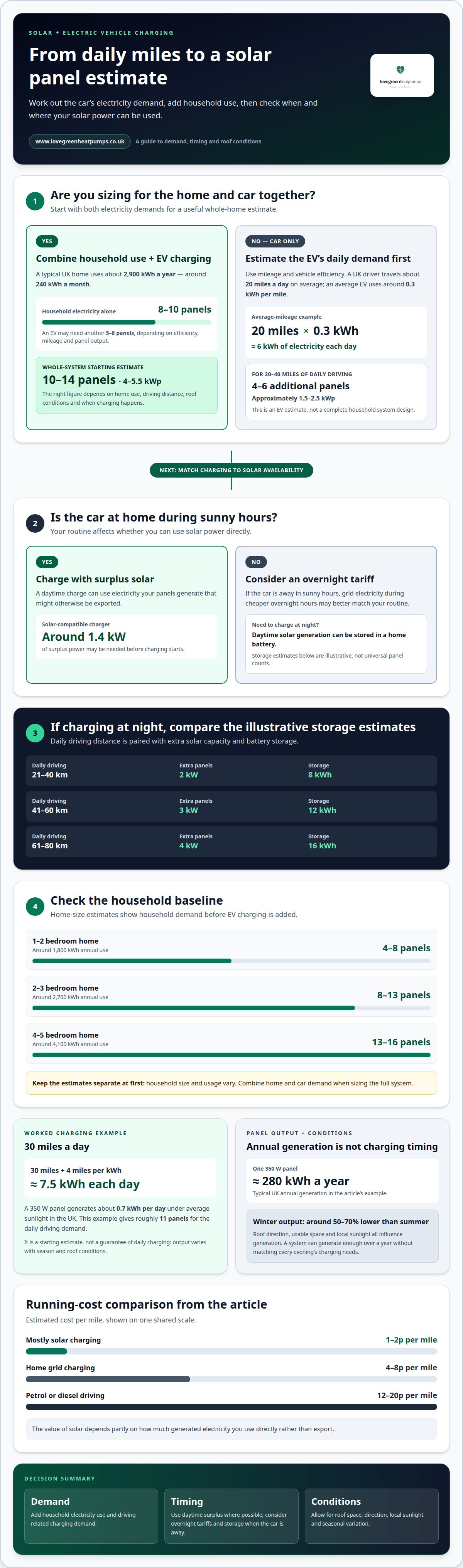
Yes, solar panels can help power a UK home and charge an electric car. A typical estimate is 10 to 14 panels, around 4 to 5.5 kWp, for household electricity use and EV charging together. The right number depends on how much electricity your home uses and how far you drive, so working out how many solar panels you need to run a house and charge a car starts with both.
It’s reasonable to want a clear panel count before planning an installation. But household electricity use is only part of the picture: your car’s mileage, roof direction and charging times all affect how much solar power you can use.
This guide explains how household and car energy needs shape a panel estimate, what changes with driving distance and roof conditions, and how installation costs fit into the decision. A system may generate enough electricity over a year without covering every charge when you need it.
Key Takeaways
- Solar can contribute to home electricity and EV charging, but annual generation does not always match when you need to charge.
- Use your regular driving distance and vehicle efficiency to understand how much extra electricity charging may require.
- Roof direction, usable space and local sunlight all influence how much a solar system can produce.
- Installation costs depend on the system design and whether you include battery storage or a solar-compatible charger.
- A tailored solar PV assessment can bring household use, driving habits and roof conditions into one practical plan.
Can You Charge an Electric Car with Solar Panels at Home?
Yes. A home solar panel system can generate electricity for household appliances and an electric car, although its output varies throughout the year.
According to GOV.UK, solar panels generally do not need planning permission if they protrude no more than 200 mm from the roof and do not rise above its peak, excluding chimneys. Building regulations and the relevant grid-connection process also apply; the system design and export arrangement shape what is needed.
Solar charging and overnight tariffs
Solar charging uses electricity your panels generate, while an overnight tariff supplies grid electricity during cheaper hours. The better fit depends on when your car is parked at home and when your panels produce power.
A daytime charge can use surplus solar generation that might otherwise be exported. If the car is away during sunny hours, an overnight tariff may better match your routine. A solar-compatible charger can also need around 1.4 kW of surplus power before charging starts.
Calculating panels for daily car charging
Estimate daily charging demand by dividing miles driven by the car’s miles per kWh. A car travelling 30 miles daily at four miles per kWh needs about 7.5 kWh each day.
A 350 W panel in the UK generates about 0.7 kWh per day under average sunlight. Dividing 7.5 kWh by 0.7 gives roughly 11 panels for that daily driving example. This is a starting estimate, not a guarantee of daily charging, because solar output varies with season and roof conditions.
Household electricity use and solar generation
A typical UK home uses about 2,900 kWh of electricity per year, or around 240 kWh monthly. Household demand and car charging both draw from the system’s generation, so estimating them together gives a more useful picture than sizing panels for the car alone.
Covering average household electricity use generally takes 8 to 10 panels. An electric car may need another 5 to 8, depending on its efficiency, driving distance and panel output. Actual use also depends on whether electricity is consumed at home or exported.
Panel wattage and annual generation
Panel wattage describes its rated power, not the electricity it will generate across a year. For example, a 350 W solar panel typically produces about 280 kWh annually in the UK. A higher-wattage panel can generate more electricity from a similar roof area, though location and orientation affect the result.
Use annual generation to compare a system with household and driving demand. Then consider timing: a system may produce enough over a year without matching every evening’s charging needs. Winter output can be around 50-70% lower than summer output.
For a running-cost comparison, charging an electric car mainly with solar can cost about 1-2p per mile. Home grid charging is estimated at 4-8p per mile, while petrol or diesel driving can cost 12-20p per mile. These figures make the value of solar depend partly on how much generated electricity you use directly, rather than export.
Estimated solar panel numbers for different daily driving distances
Driving distance is a useful starting point for estimating the solar capacity an electric car needs. A UK driver travels about 20 miles a day on average, and an average electric vehicle uses around 0.3 kWh per mile. That works out at roughly 6 kWh daily for that mileage, before accounting for differences between vehicles and real-world journeys.
For UK drivers covering 20-40 miles a day, an estimate is 4-6 additional solar panels, or a panel system of approximately 1.5-2.5 kWp. Treat this as an EV-charging estimate, not a complete household design. Your home’s existing electricity demand also needs to be included when sizing a system for both uses.
Vehicle efficiency changes the result. For 40 km of daily driving, a Nissan Leaf example needs about 6 kWh of solar electricity each day; a Tesla sports car example needs about 8 kWh. Battery size alone doesn’t determine the panel count. How efficiently the car uses electricity, and the distance driven, both matter.
Household size offers another starting point, although people in similar-sized homes can use different amounts of electricity. These estimates indicate household demand before EV charging is added:
- A 1-2 bedroom UK home is estimated to need 4-8 panels for around 1,800 kWh of annual electricity use.
- A 2-3 bedroom home is estimated to need 8-13 panels for around 2,700 kWh annually.
- A 4-5 bedroom home is estimated to need 13-16 panels for around 4,100 kWh annually.
Keep the car and household estimates separate initially, then combine their electricity demand. For instance, a household using 2,700 kWh annually and a car driven daily needs a system sized for both loads, not just the home. The resulting panel count also depends on the panel system’s output and the sunlight available at the property.
For charging at night, panel output during the day can be stored in a home battery. One estimate pairs 2 kW of extra panels with 8 kWh of storage for daily driving of 21-40 km. For 41-60 km, it pairs 3 kW with 12 kWh; for 61-80 km, 4 kW with 16 kWh. These are illustrative capacity estimates, not universal panel counts.
To turn mileage and home use into a workable design, a solar PV system assessment can account for both demands.
Solar installation costs and estimated break-even periods
Costs depend on what the system includes, while savings depend on its generation and how much electricity you use at home. Separating the costs of solar panels, storage and charging helps clarify what each part contributes.
Installation costs for car-charging solar
A solar setup for car charging may include panels, an inverter, battery storage and a compatible charger. System size and storage affect the work involved, so compare proposals that include the same components.
The overall cost depends on the system design, roof requirements, storage and charger integration. Solar PV installation costs are tailored to these project details, with a property-specific quote setting out the proposed system.
UK costs and potential savings
A typical 4 kWp solar system can save a UK household around £400 per year on electricity bills. This estimate depends on system output and how much generated electricity the household uses rather than exports.
Using solar power for daytime charging can reduce the electricity you buy from the grid. A battery can store surplus generation for later, but adds another part to the system. Weigh household demand, driving patterns and storage together when comparing potential savings with installation costs.
Comparing solar, grid and public charging
Solar charging can reduce the cost of electricity used for driving, while grid and public charging have different tariffs. A home setup combining solar panels, battery storage and EV charging could save £700 or more per year compared with relying heavily on public charging.
The comparison depends on how often you use public chargers and how much solar electricity reaches your car. If it is away during daylight, more of your solar generation may be exported. Overnight home charging also affects the balance, depending on your tariff and routine.
Estimated break-even periods
Break-even describes the estimated time for bill savings to match an installation’s initial cost. One estimate gives a 9-year payback period for a UK home solar system in London, whether occupants are home all day, half the day or out all day.
This estimate uses fuel prices from July 2026. It illustrates how household routines and electricity use can affect the financial picture alongside system output. A home that uses more solar generation directly may see a different result from one that exports more.
Does my roof face the right way?
Roof direction, pitch, shading and location all affect how much electricity panels generate. In the UK, east- or west-facing roofs produce around 15-20% less solar power than south-facing roofs; pitch and nearby obstructions also influence the result.
Roof orientation and panel efficiency
Orientation means the direction a roof face points, and it affects when sunlight reaches the panels. A south-facing roof generally produces more electricity, while east- and west-facing panels generate power at different times of day.
That timing can matter for a London household that uses electricity in the morning or late afternoon. East-facing panels receive more morning sunlight, while west-facing panels receive more later in the day. If the roof has suitable faces in different directions, placing panels across them can spread generation over more of the day.
The best layout depends on the roof’s shape and usable area, not just its direction. A site design assesses how each roof face contributes to the home’s expected solar generation.
Roof shading and solar output
Shade from a chimney, tree or nearby building reduces sunlight reaching the affected panels. The impact depends on where the shadow falls and how long it lasts, so a roof assessment considers obstructions throughout the day.
For example, a chimney may shade part of a roof in the morning, while a neighbouring building blocks sunlight later. Mapping these patterns helps identify areas with clearer exposure and avoids basing a panel estimate on roof space that receives limited sunlight.
Shading can reduce the electricity available for household use, car charging or battery storage. A good design accounts for shaded areas when estimating output, rather than treating every square metre of roof as equally productive.
Roof pitch and location
Pitch is the roof’s angle, and it affects how directly sunlight reaches the panels. The right arrangement depends on the roof’s direction and shape; a different pitch does not automatically rule out solar.
Location also matters. Average sunlight hours are around 4.1 per day in England, including London and the South East. Local conditions and seasonal changes influence how much electricity a system can generate, even where two homes have similar roofs.
Roof type and condition affect usable space and how panels can be installed. The roof’s suitability for the installation is considered alongside the layout, so surface area alone does not determine system capacity.
As a reference, a typical 4.5 kWp UK system uses around 12 panels and covers approximately 20-30 square metres. Comparing that footprint with clear, suitable roof area helps establish whether the planned system can fit.
Factors affecting the number of panels a home needs
Panel numbers depend on household electricity use, driving distance, panel output and usable roof area. A UK home combining household demand and EV charging commonly uses 10-14 panels, around 4-5.5 kWp. That range gives a starting point, not a fixed design. Estimating how many solar panels to run a house and charge a car means accounting for both sets of electricity needs.
Battery storage can shift surplus solar electricity for use later. A 10-15 kWh battery is commonly recommended alongside a 4-6 kWp system paired with EV charging. Whether that capacity suits a home depends on its usage patterns and when the car needs charging.
Panel counts for a typical UK home
Most UK homes need 8-16 panels for typical energy needs, while a three-bedroom home is estimated to need 10-13 panels rated at 350 W each. These figures describe household demand. They do not automatically include an electric car or other substantial electrical loads.
Adding an EV increases demand, so the estimate needs to reflect annual driving and the car’s electricity use. A household with a heat pump also has a significant additional load: a typical air-source heat pump uses 5-8 kWh per day. Bringing those uses together helps explain why homes with similar bedroom counts may need different systems.
Panel wattage affects the electricity a system can produce from its available roof area. Modern premium panels rated at 400 W or more generate more electricity per square metre than older models. Their output still depends on roof direction, shading and local sunlight, so a higher rating alone does not determine the total yield.
Sizing a home solar system with an electric car
A suitable solar PV system is sized around household use, driving mileage and expected panel output. For a UK home with an EV, 4-6 kWp is a useful reference range, but the right capacity depends on the combined demand. Working out how many solar panels to run a house and charge a car therefore involves more than choosing a panel count.
Charging habits shape the system design. Daytime charging can use solar generation directly, while a battery can store surplus electricity for charging later. A home that often charges after dark may have different storage needs from one where the car is regularly parked during sunny hours.
A practical system assessment brings together annual household electricity use, typical mileage, vehicle efficiency, panel output and usable roof area. It can also account for a heat pump as part of the home’s energy plan. These details help turn a broad estimate into a design suited to the property and its energy use.
A solar PV system design can bring these household and vehicle requirements together.
Love Green Heat Pumps: Solar PV & Other Renewables
Love Green Heat Pumps provides Solar PV & Other Renewables for homes planning to use solar electricity for household needs and EV charging. Consider this service when you want a system designed around your electricity use, driving habits and roof conditions, rather than a panel estimate alone.
The installation process covers system design through commissioning, bringing the plan and installation together. If you’re also considering a heat pump, its electricity demand can be included in the wider picture of your household’s energy needs.
For a clear next step, contact Love Green Heat Pumps to discuss solar PV for your home.
Plan a solar system around your next step
How many solar panels to run a house and charge a car is a starting question, not a complete system design. The next step is to consider your priorities together: how you use electricity, when the car is available to charge and whether you may add other electrical needs later. This gives the design a practical purpose beyond reaching a panel count.
Your system should reflect your roof and energy use, with direct solar use, export and storage considered together. If you're planning a wider home energy upgrade, consider how solar could work alongside changes such as heating improvements, without assuming every measure suits every property.
For a considered discussion of solar PV for your home, contact Love Green Heat Pumps Ltd. A clear plan can make the next decision easier.
Frequently Asked Questions
How Much Solar Power Does an EV Actually Need?
An electric car’s annual electricity need depends mainly on its mileage and efficiency. A useful estimate is miles driven multiplied by the car’s electricity use per mile. For example, a car travelling 30 miles daily at four miles per kWh uses about 7.5 kWh daily. Around 5-8 panels may cover an average EV’s charging, but the result changes with driving and panel output.
How much do solar panels cost to install?
Installation costs depend on system capacity, roof specifications and whether battery storage is included. Adding an EV charger also affects the overall design and work required. For a London property in Southwark, the quote reflects that home’s roof and electricity needs, not a generic rate. Love Green Heat Pumps provides a property-specific quote after assessing the home and proposed solar system.
What Does Solar EV Charging Cost, and How Much Can You Save?
Charging an electric car mainly with solar is estimated to cost around 1-2p per mile. A home setup combining solar panels, battery storage and EV charging could save £700 or more yearly compared with relying heavily on public charging. The actual value depends on how much solar electricity powers the car and how much charging would otherwise take place elsewhere.
Do I have enough space?
A typical 4.5 kWp UK system uses around 12 panels and covers approximately 20-30 square metres of roof. The usable area matters more than the roof’s total surface: chimneys, roof windows and shaded sections can affect panel layout. A clear roof area on one face may also be combined with another suitable face, depending on orientation and system design.
Does my roof get too much shade?
Shade does not automatically rule out solar, but its position and timing matter. A chimney shading a few panels in the morning creates a different design challenge from a tree blocking sunlight across a larger roof area. A site assessment considers nearby buildings, trees and roof features, then estimates how they affect the system’s usable solar generation.
How Many Solar Panels Do You Need for Everyday Appliances?
Covering average UK household electricity use generally takes 8-10 panels. Appliances draw different amounts of electricity: a modern fridge-freezer typically uses around 1 kWh daily, while a television uses about 0.1 kWh per hour. The home’s total consumption, including cooking, laundry and heating equipment, gives a more useful basis for panel sizing than counting appliances alone.
How much electricity does an average UK household use per year?
An average UK home uses about 2,900 kWh of electricity annually, equivalent to roughly 240 kWh monthly. Actual household demand varies with occupancy, appliances and heating choices. For example, adding an electric heat pump changes the household’s electricity profile, so an estimate based only on a home’s current appliances may understate future demand.
How much electricity does a typical UK electric car use per year?
A typical EV is estimated to use about 362 kWh monthly, an annual equivalent of around 4,344 kWh. This is a useful planning figure, not a fixed allowance for every driver. A car covering fewer miles or using electricity more efficiently needs less; frequent long journeys increase charging demand and affect the solar system required.
Disclaimer
Disclaimer
The information published on this website is provided by Love Green Heat Pumps for general information and educational purposes. As a specialist provider of heating and renewable energy solutions, we strive to ensure that our content is accurate, relevant and up to date. However, heating requirements, system suitability, installation specifications, costs and performance can vary depending on individual property characteristics, usage and other site-specific factors.
Information provided in our articles should not be regarded as a substitute for a professional property assessment, technical survey or tailored recommendation. Any decisions regarding the selection, installation, replacement or maintenance of heating systems should be made with appropriate professional guidance.
Love Green Heat Pumps accepts no responsibility for decisions made solely on the basis of general information published in these articles. For advice specific to your property or project, we encourage you to contact our team for professional guidance and an assessment of your requirements.


