

The lowest quote may not be the right commercial solar project for your business. Choosing commercial solar pv installers on headline price alone can hide differences in estimated generation, system design and project scope. A better test is whether the assumptions fit your site and the way your organisation uses electricity.
Before committing, get clear on the factors that shape a project. Roof condition and usable space, daytime electricity demand and practical site constraints all affect whether solar PV is suitable and how a system should be designed.
This guide explains how to assess suitability, compare proposals on consistent terms and understand practical project steps, including permissions, grid arrangements, installation disruption and ongoing oversight. It also covers the site and energy information to prepare before requesting a tailored proposal. Love Green Heat Pumps provides commercial solar PV design, procurement and installation, with systems planned around each project.
Key Takeaways
- Check whether your roof, site and electricity use make on-site solar PV a practical fit for your organisation.
- Understand how roof condition, orientation, shading and electrical infrastructure shape system design.
- Compare commercial solar pv installers using consistent proposal details, including forecast assumptions, inclusions, exclusions and aftercare.
- Use a practical checklist to gather site information, set priorities and compare project scope before deciding.
- See how Love Green Heat Pumps’ design, procurement and installation service can be tailored to your site and business requirements.
Commercial solar PV installers: when does solar suit a business?
Commercial solar photovoltaic (PV) panels convert daylight into electricity for use at a business site. With on-site generation, solar can meet some of your electricity needs as it is produced. How much your organisation uses directly depends in part on its operating hours and daytime demand. For a general explanation of the technology, see this Solar Power Overview.
A workplace with steady daytime equipment use may be a better fit than a site that is mostly active overnight, but the roof alone does not determine suitability. Solar output varies with daylight and site conditions. A useful assessment compares expected generation with real consumption, including when electricity is used. Commercial solar suitability depends on matching generation to site conditions and energy use.
Which businesses and sites may suit commercial solar PV?
Workplaces, warehouses, manufacturing sites and education buildings may all be worth assessing, but no building type is automatically suitable. A warehouse may have substantial roof space, while its daytime demand depends on activities such as lighting, refrigeration and equipment use. A manufacturer may use power throughout the working day. At a school, term-time occupancy and daytime operations influence demand. These examples help frame an assessment, but do not predict its result.
Solar can be considered in different settings, including panels on an existing roof, a ground-mounted array where suitable land is available, or a canopy above car parking. Each option uses different parts of the site and brings different practical considerations. Available area, ownership, access, building use and future plans all matter. For broader context on domestic systems, the UK rooftop solar installer guide explains general solar PV considerations.
What should a business clarify before exploring installers?
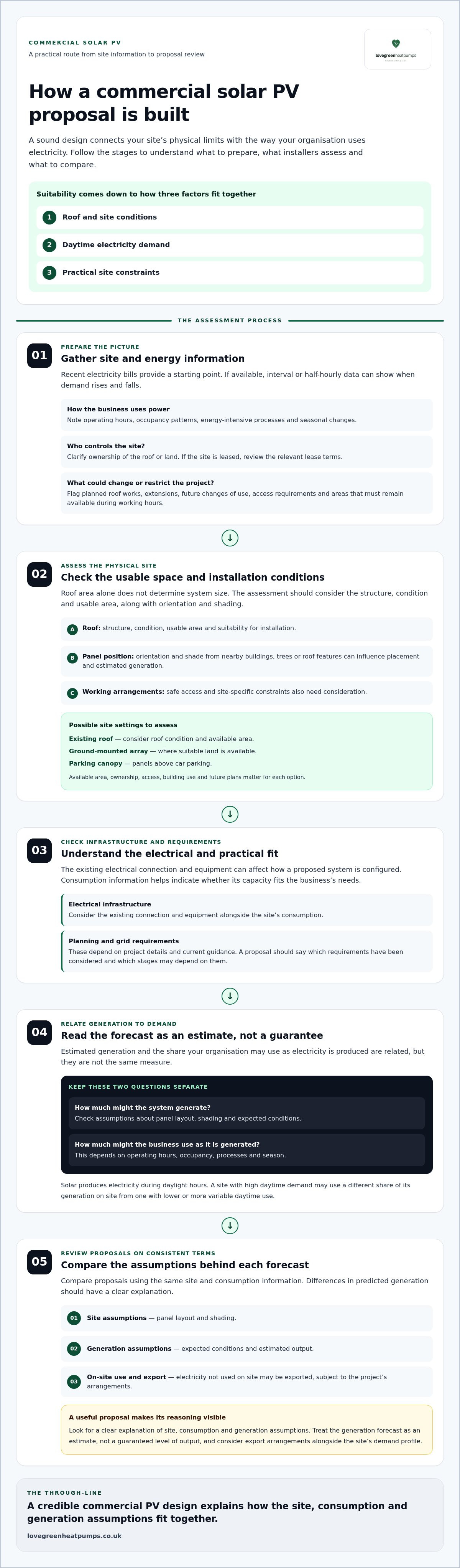
Gather information about how your site uses electricity and what could affect the project. Recent bills provide a starting point. If available, interval or half-hourly consumption data can show when demand rises and falls, helping a proposal reflect operating hours and processes rather than relying on an annual total alone.
- Record operating hours, occupancy patterns and energy-intensive processes, including seasonal changes.
- Clarify who owns the roof or land. If your organisation leases the site, review the relevant lease terms.
- Note planned roof refurbishments, extensions or changes in site use that could affect project timing or design.
- Identify operational constraints, such as access requirements or areas that need to remain available during working hours.
These details give commercial solar pv installers a clearer picture of both the site and the business. They also help you assess whether a proposed system fits current operations and likely future plans.
How commercial solar PV installers assess a site and design a system
A sound design connects the physical limits of a site with the business’s electricity needs. Roof area alone does not determine system size. Panel position, electrical infrastructure and the timing of demand all affect how much solar electricity could be generated and used.
A credible commercial PV design explains its site, consumption and generation assumptions. This gives your organisation a basis for understanding why a system has been proposed and what could affect its estimated output.
What belongs in a commercial solar PV site assessment?
The assessment should consider the roof’s structure and condition, its usable area and its suitability for installation. Orientation and shading from nearby buildings, trees or roof features can influence panel placement and estimated generation. Safe access and working arrangements also need to be considered alongside any site-specific constraints.
Electrical infrastructure helps shape the system. The existing connection and equipment can affect how a proposed system is configured, while consumption information helps indicate whether its capacity fits the business’s needs. A site with high daytime demand may use a different share of its generation on site from one with lower or more variable daytime use.
Planning and grid requirements depend on the project details and current guidance. A proposal should state which requirements have been considered and which stages may depend on them, rather than implying that every site follows the same process.
How should a business read a generation estimate?
Separate estimated generation from the proportion your organisation may use as the electricity is produced. They are related measures, but they are not the same. A system can generate electricity during daylight hours while business demand at those times varies with operating hours, occupancy, processes and season.
Check what the estimate assumes about the site and system, including panel layout, shading and expected conditions. Treat the forecast as an estimate, not a guaranteed level of output. Compare the assumptions across proposals so that differences in predicted generation have a clear explanation. A rooftop solar PV design guide can also help explain foundational design factors.
Any generation not used on site may be exported, subject to the project’s arrangements. Those arrangements affect how the business evaluates the overall proposal. Consider them alongside the site’s demand profile rather than assuming all generated electricity will be used directly.
Love Green Heat Pumps’ commercial solar PV design and installation service is tailored to site and business requirements, bringing assessment, design and delivery into one project plan.
How to compare commercial solar PV installers and project proposals
Compare the work being proposed, not just the headline price or a ranking. Quotes may use different system sizes, forecast assumptions or exclusions, so they may not describe equivalent projects. A side-by-side review shows what each figure includes and what your organisation would still need to arrange.
Use the same criteria for each proposal. When a detail is missing, record it as unclear rather than assuming it is included.
| Proposal area | What to compare |
|---|---|
| Design scope | Site survey, design work, structural considerations and grid or planning-related tasks included in the project. |
| Equipment schedule | Specified panels, inverters and other system components, with quantities and relevant details. |
| Forecast assumptions | System layout, site conditions and the basis for estimated generation, on-site use and export. |
| Exclusions | Work or costs outside the proposal, such as access arrangements or building work, where applicable. |
| Aftercare | What monitoring, maintenance and performance responsibilities are included, and who carries them out. |
Generation, savings and carbon figures are estimates, not guaranteed outcomes. Compare the assumptions behind them and check that each proposal describes the same site, operating profile and project scope. This makes differences easier to understand than comparing final figures alone.
Which installer credentials and project evidence matter?
Distinguish company credentials from qualifications relevant to the people and work involved in your proposed installation. Check whether any stated accreditation is current and applies to the work being offered. A broad company credential may not explain who will carry out the project. Case studies are most useful when they describe the site, project scope and work delivered. Reviews can offer context, but cannot replace a design based on your own requirements.
How do ownership and commercial arrangements affect comparison?
Where proposals include different arrangements, compare them as distinct propositions. A direct purchase, finance arrangement or power purchase agreement can differ in system ownership, payment responsibilities and contract duration. Consider what happens if your organisation changes the building, its use or occupancy during the contract term. The written proposal should set out these responsibilities clearly.
Look closely at ongoing oversight. Monitoring, maintenance and responsibility for investigating performance issues may sit with different parties or fall outside the project scope. Do not assume these are included because they appear in a sales summary. Compare how each proposal defines them and record the details alongside the installation scope.
Relevant experience is about fit, not just volume or ranking. For commercial solar pv installers, evidence from a similar building type or operating environment can help show familiarity with comparable constraints. A clear, site-specific proposal still matters most when judging whether that experience has been applied to your project.
A practical checklist for choosing a commercial solar PV installer
A clear decision process helps your organisation compare proposals on the same basis and identify unanswered questions before committing. The goal is not to choose the longest document or the biggest predicted output. It is to understand the project scope, how it fits your operations and what responsibilities remain with your business.
What information should a business prepare for a proposal?
Bring together recent electricity bills, available consumption data and site plans. Add operating hours, critical loads, access restrictions and planned building works. Note your priorities, such as matching generation to daytime demand or keeping particular areas clear. Identify who will approve the project, contract and site access arrangements so the proposal reflects how decisions and work happen at your premises.
How can decision-makers compare proposals consistently?
Give each commercial solar pv installer the same core information and assess each response against the same criteria. Compare stated design assumptions, project boundaries and contract terms, not just forecast figures. Record unresolved dependencies, including planning, grid, export or operational questions, and how the proposal addresses them using current guidance for the specific project.
- Gather site information. Collect bills, consumption records, site plans and details of roof or building works. Include access arrangements and any areas that must remain operational during installation.
- Define priorities. Agree what matters most to the organisation, such as fitting the system around working hours, maintaining business continuity or allowing for planned site changes.
- Assess proposals side by side. Check each forecast’s assumptions, the work included, the exclusions and who is responsible at each stage.
- Settle the scope before approval. Confirm how delivery, access, ongoing support and outstanding project dependencies are described in the proposal and contract.
Use a comparison table to keep the review practical. Record notes for each proposal instead of relying on memory or a single headline figure.
| Area | Record and compare |
|---|---|
| Design assumptions | Site conditions, system layout and the basis for generation estimates. |
| Inclusions and exclusions | Survey and design work, equipment, access arrangements and any work outside the quoted scope. |
| Delivery stages | Key stages, dependencies and how installation activity is planned around site operations. |
| Ongoing support | Monitoring, maintenance and responsibilities for reviewing system performance. |
| Contract terms | Ownership, payment responsibilities, contract duration and implications if the site changes. |
Before choosing, consider whether staff, deliveries or essential processes could be affected by access requirements or installation activity. Set out restrictions early. If the building may be refurbished, extended or used differently, include that in the decision because it could affect the project’s practical fit. Keep a written list of open questions and who is responsible for resolving them. Love Green Heat Pumps can develop a tailored commercial solar PV proposal around your site and business requirements.
Commercial solar PV installation with Love Green Heat Pumps: what happens next?
A commercial solar project should start with your organisation’s needs, not a standard package. Love Green Heat Pumps provides solar PV system design, procurement and installation, with the proposed scope tailored to your site and business requirements. Sharing your priorities and relevant site information helps shape a proposal around how the building is used and what matters to your organisation.
This creates a clearer basis for discussing the project. Explain your operating patterns, site constraints and plans for the building, then review how they are reflected in the proposed design and delivery scope.
What can a tailored commercial solar PV project cover?
The service covers three core stages: system design, procurement and installation. Design takes account of the site and the organisation’s requirements. Procurement and installation form part of the project scope set out in the proposal. The aim is to describe a system that responds to the actual building and its electricity use rather than assuming every workplace needs the same arrangement.
Your priorities provide useful context. The project may need to account for access restrictions, particular working hours or a planned building change. Include these details early so they can inform the discussion about scope and practical arrangements. Where wider building energy plans are relevant, Love Green Heat Pumps also works across renewable energy services, including heat pumps, air conditioning and EPC assessments.
What should happen before a business accepts a proposal?
Make sure the written proposal describes the project clearly. The scope, design and generation assumptions, exclusions and responsibilities should be understandable before your organisation agrees to proceed. Resolve unclear points before acceptance so everyone has the same understanding of what the work covers.
Review the practical arrangements too. Consider proposed timing, site access, how installation activity will fit around day-to-day operations and who within your organisation will coordinate approvals or access. If planning, grid connection or export arrangements are relevant, ensure outstanding questions are considered in line with current guidance for the specific project. Do not treat estimated generation or potential financial benefits as guaranteed outcomes.
To begin, share the information you have about the site, electricity use, operating requirements and project priorities. Love Green Heat Pumps can use this context to prepare a free, no-obligation quote tailored to your requirements. You do not need every detail finalised before starting a discussion. A clear outline of your objectives and constraints is a practical first step.
If you’re ready to explore a project for your workplace, discuss a commercial solar PV project with Love Green Heat Pumps. A considered conversation can help establish next steps for your site without promising a particular level of generation or savings.
Turn your project priorities into a clear next step
A solar proposal is most useful when the people responsible for the building, energy use and project approval share the same priorities. Bring them together before deciding what a successful project needs to achieve. This gives your organisation a practical starting point for comparing commercial solar pv installers without treating an estimate as a promise of future performance.
Love Green Heat Pumps works with businesses across the UK on commercial solar PV projects. If you’re ready to explore what may suit your site, share your requirements and request a free, no-obligation quote. This is a straightforward way to move from early consideration to a tailored proposal, with room to discuss the project before deciding.
Request a free, no-obligation commercial solar PV quote and take the next step at a pace that works for your organisation.
Frequently Asked Questions
Do commercial solar panels need planning permission in the UK?
Sometimes. Whether planning permission is needed depends on the installation, the building and its location within the UK. Some rooftop projects may be covered by permitted development rules, but conditions and restrictions can apply. Listed buildings, sensitive locations or ground-mounted systems may need additional consideration. Treat planning as a project-specific question and check the relevant planning authority’s current guidance before work begins.
How long does it take to install a commercial solar PV system?
A standard commercial project typically takes around two to four months, although the timeframe depends on the site and project requirements. The overall process can include assessment, survey, design, grid application, any required planning steps, installation and commissioning. For example, a project with unresolved grid arrangements or building work may take a different amount of time from one with fewer dependencies. Compare the key stages and dependencies in each proposed programme.
Can a business keep operating while commercial solar panels are installed?
Often, yes, but continued operation depends on the site layout, access arrangements and installation work required. A warehouse may need delivery routes kept clear, while a workplace may need staff access maintained around work areas. Some electrical work may require a planned interruption to relevant equipment or supplies. Agree access, working areas, safety arrangements and any potential interruptions with the project team before scheduling work, so operational teams can plan around them.
Are batteries necessary with commercial solar PV?
No. A battery is not essential for every commercial solar PV system. It may be worth considering if your business wants to store some daytime generation for later use, but its suitability depends on consumption patterns, system design and project priorities. A site with substantial daytime electricity use may use a different share of generation directly from one with evening demand. Compare the battery option as a separate part of the proposal.
Can commercial solar panels export unused electricity to the grid?
Potentially, subject to the system’s grid connection arrangements and any required approvals. Before assuming surplus power can be exported, establish how the connection, metering and export agreement would work for the specific site. Electricity suppliers may offer payment arrangements for exported power, but terms can differ. A proposal should distinguish estimated generation, expected on-site use and forecast export rather than treating all generated electricity as power the business will consume.
Can commercial solar PV work alongside a heat pump or EV chargers?
Yes, solar PV can form part of a wider site energy plan that includes heat pumps or EV charging. The important question is how their demand fits with solar generation and the building’s electrical infrastructure. For example, charging vehicles during working hours may use some generation as it is produced, depending on availability and charging schedules. A joined-up assessment can consider these loads together rather than sizing each system without regard to the others.
What should a commercial solar PV proposal include?
A useful proposal should set out the system design, equipment schedule, generation estimate and assumptions behind it. It should also describe the included and excluded work, and who is responsible for surveys, grid arrangements, installation stages and aftercare. Check that estimated generation is clearly distinguished from expected on-site use and export. This detail helps decision-makers compare proposals consistently and understand what remains to be resolved before approval.
Disclaimer
Disclaimer
The information published on this website is provided by Love Green Heat Pumps for general information and educational purposes. As a specialist provider of heating and renewable energy solutions, we strive to ensure that our content is accurate, relevant and up to date. However, heating requirements, system suitability, installation specifications, costs and performance can vary depending on individual property characteristics, usage and other site-specific factors.
Information provided in our articles should not be regarded as a substitute for a professional property assessment, technical survey or tailored recommendation. Any decisions regarding the selection, installation, replacement or maintenance of heating systems should be made with appropriate professional guidance.
Love Green Heat Pumps accepts no responsibility for decisions made solely on the basis of general information published in these articles. For advice specific to your property or project, we encourage you to contact our team for professional guidance and an assessment of your requirements.


