

Could being over State Pension age qualify you for solar panels, or does eligibility depend on something else? If you’re searching for solar panel grants for pensioners UK, age alone usually isn’t enough. Support is more likely to depend on your income or benefits, where you live and your home’s energy rating.
It’s understandable to want a clear answer before speaking to an installer. Grant offers can be confusing, particularly when loans, tax relief and payments for exported electricity are described as if they were the same thing. There is no single grant that automatically gives every pensioner free solar panels.
This 2026 guide explains which support routes may suit your circumstances across the UK, what eligibility details to check and what to prepare before applying or requesting a solar proposal. It also explains how grants differ from loans, zero-rate VAT and Smart Export Guarantee payments, and what to verify before agreeing to work. Use it to compare your options and avoid relying on an unverified promise of funding.
Key Takeaways
- Use this solar panel grants for pensioners UK guide to compare support routes by location and household circumstances.
- Check the scheme’s current rules and who handles applications before applying, as routes differ.
- Prepare details such as your address, tenure, household circumstances and energy documents, then confirm which evidence is required.
- Ask for written terms explaining what any grant covers and whether extra work or costs are involved.
- If you’re not eligible for support, compare your options carefully. A home assessment can inform a solar proposal, but it can’t confirm grant eligibility.
Solar panel grants for pensioners in the UK: what support may be available?
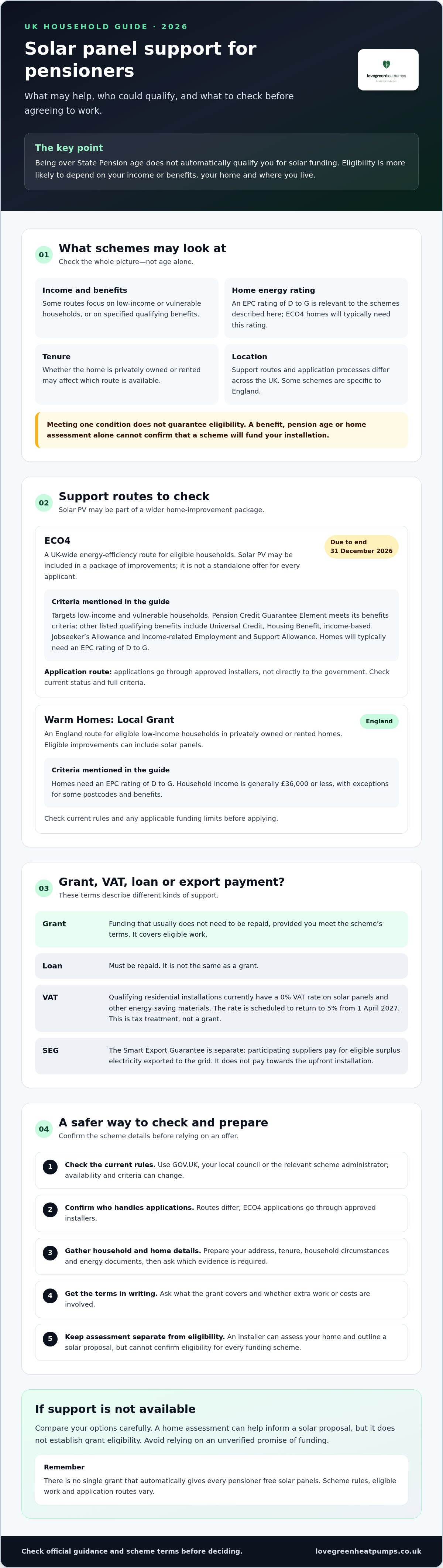
Some pensioners may be able to get help with solar panels, but reaching pension age does not automatically qualify someone for funding. Each scheme has its own rules. Eligibility may depend on income or benefits, the home’s energy rating, whether it is privately owned or rented, and where in the UK it is located. Some programmes may fund solar PV as part of a wider package of home improvements, rather than as a standalone measure.
For example, ECO4 is due to end on 31 December 2026. It supports eligible households with energy-efficiency measures, which can include solar panels as part of a package. The Energy Company Obligation (ECO) provides background on the scheme and its earlier phases. However, historical information cannot confirm whether a particular household or installation qualifies in 2026.
Think of solar panel grants for pensioners UK as a search for schemes that match your circumstances, not a single nationwide payment available simply because you’re a pensioner. Rules and availability can change. Before acting, check current details with GOV.UK, your local council or the relevant scheme administrator. An installer can assess your home and outline a solar PV proposal, but cannot decide eligibility for every funding scheme.
Does being a pensioner qualify you for solar panel funding?
You’ll need to meet the criteria of a specific scheme. Pension age is separate from tests based on income, qualifying benefits or the property itself. Receiving a benefit doesn’t automatically mean you’ll qualify either. A scheme may also assess the home’s energy rating, tenure or location. Check the full criteria before assuming your age, pension income or benefit status is enough.
What does “solar panel grant” mean in practice?
A grant is funding that usually doesn’t need to be repaid, provided you meet the scheme’s terms. A grant helps cover eligible work; a loan must be repaid; tax treatment affects the bill; and an export payment pays for electricity sent to the grid. These are different forms of support, each with its own conditions.
For qualifying residential installations, solar panels and other energy-saving materials currently have a 0% VAT rate, applied to the invoice by the installer. The rate is scheduled to return to 5% from 1 April 2027. That is tax treatment, not a grant. The Smart Export Guarantee (SEG) is separate: participating suppliers pay for eligible surplus electricity exported to the grid, so it does not provide money towards the upfront installation. Check current official guidance and scheme terms before deciding.
Which UK schemes could help pensioners with solar panels in 2026?
Support depends on where you live and the rules of the scheme. ECO4 is scheduled to end on 31 December 2026. It may fund solar PV as part of an eligible package of energy-efficiency improvements, rather than as a standalone offer for every applicant. Ofgem’s guide to the ECO scheme explains the scheme’s consumer guidance. Check its current status and application routes before relying on any information, particularly as deadlines approach.
Can ECO4 or other home-upgrade schemes cover solar panels?
ECO4 targets low-income and vulnerable households. Pension Credit Guarantee Element meets its benefits criteria, while other qualifying benefits include Universal Credit, Housing Benefit, income-based Jobseeker’s Allowance and income-related Employment and Support Allowance. A home will typically need an EPC rating of D to G. Meeting one condition does not guarantee eligibility. Check the full criteria and whether solar PV is suitable within the proposed package. ECO4 applications go through approved installers, not directly to the government.
England’s Warm Homes: Local Grant is another route to check. It is open to eligible low-income households in privately owned or rented homes with an EPC rating of D to G. Household income is generally £36,000 or less, with exceptions for some postcodes and benefits. The grant can cover eligible improvements, including solar panels, and applications can be started through GOV.UK. Check the current rules and any applicable funding limits before applying.
How do support options differ across the UK?
Devolved schemes have separate criteria and application routes. Use the table as a starting point, then confirm current details with the named official administrator.
| Route | Coverage and support | Eligibility and application |
|---|---|---|
| ECO4 | UK-wide energy efficiency funding; solar PV may form part of a package. | Benefit, household and property tests apply. Contact an approved ECO4 installer; check Ofgem guidance. |
| Warm Homes: Local Grant | England; grant funding for eligible home improvements, potentially including solar PV. | Income and EPC criteria apply. Start through GOV.UK or check with your local council. |
| Nest | Wales; advice and funding for eligible energy efficiency improvements. | Check current criteria and routes with the Nest scheme. |
| Home Energy Scotland | Scotland; loans are available for solar systems. | Confirm current loan terms and eligibility with Home Energy Scotland. |
| NISEP | Northern Ireland; may offer funding, including for solar panels, to eligible low-income households. | Check current offers and application details with NISEP. |
| Smart Export Guarantee | Available across Great Britain; supplier payments for eligible electricity exported to the grid, not an upfront grant. | System and meter requirements apply. Compare tariffs with participating suppliers. |
| Zero-rate VAT | Residential solar installations; tax treatment rather than a grant or payment. | Currently scheduled to end on 31 March 2027. Check current GOV.UK guidance. |
These routes are not interchangeable. An installer can assess your property and prepare a home-specific solar PV proposal, but scheme administrators decide funding eligibility. You can also review solar PV installation information as part of planning possible home energy improvements.
Are solar panel grants really free, and what should pensioners check?
A scheme may sometimes cover the full cost of specified work. But “free solar panels” only means something once you know exactly what the offer includes and whether you’ll have to contribute or repay anything. Read the scheme terms alongside the installer’s written quote. If either leaves costs unclear, pause and ask for an explanation before agreeing.
A grant, a loan and a commercial offer are not the same. Grant funding usually doesn’t need to be repaid, but may cover only approved work and can come with conditions. A loan is repayable under agreed terms. A Smart Export Guarantee payment is for eligible electricity exported after a system is installed, not money towards the initial work. A private offer may have its own payment plan or contractual obligations. Check which applies to your offer rather than relying on the word “free”.
What could a funded solar offer include or exclude?
The package depends on the scheme and an assessment of your property. Ask the written specification to say whether panels, an inverter, scaffolding, electrical work and aftercare are included. Check for exclusions, such as additional work that might be needed at your home, and ask who would pay for it. Get written confirmation of any contribution, repayment obligation or other charge before accepting the offer.
Compare the complete proposal, not just the headline promise. Review the equipment and work described, any warranties and their conditions, exclusions, the expected payment schedule and what happens if the scope changes. If the offer is funded, ask which parts the scheme covers and which, if any, would be your responsibility.
How can pensioners spot a misleading grant claim?
Be cautious if someone says every pensioner qualifies, guarantees funding before an application has been approved or pressures you to sign immediately. No installer can guarantee eligibility without scheme approval. Confirm the scheme and its application process directly with the official administrator before sharing personal information or relying on a sales claim.
Check the installer’s identity and relevant credentials independently, then read the written contract before agreeing. Don’t send sensitive information through an unexpected call, message or unfamiliar website. If you’re unsure, contact the scheme administrator using details you’ve found yourself, and ask a trusted person to review the paperwork. A clear offer should give you time to understand the work, costs and conditions. If you’re comparing solar panel grants for pensioners UK, careful checks can help protect your home and finances.
How can you check solar grant eligibility and apply safely?
Work through the checks in order. Don’t commit to installation or finance until the scheme has confirmed your eligibility and you understand the terms.
- Identify the scheme. Check which programme serves your nation and whether it covers solar PV on its own or as part of a wider home upgrade.
- Read the current rules. Use the official scheme administrator’s guidance. Check eligibility, application deadlines, covered work and whether you need to apply yourself or through an approved installer.
- Gather the requested evidence. The scheme may ask about your address, whether you own or rent, household circumstances, qualifying benefits or your home’s energy rating. Requirements vary, so use the administrator’s current document list rather than assuming what you’ll need.
- Confirm the installer. If the scheme requires an approved installer, check the business against the scheme’s official records. Ask who submits any application and who makes the final decision.
- Review everything in writing. Before signing, check the system design, work included, exclusions, any contribution or repayment obligation, and payment terms. Ask for anything unclear to be explained in plain language.
What information might an eligibility check require?
Prepare relevant details, but share documents only through a verified application route. Depending on the scheme, you may need information about property tenure, your household or benefits, and energy documents such as an EPC. Not every scheme asks for the same evidence. Confirm the secure submission method with the administrator, and don’t send sensitive documents in response to an unexpected message or through an unofficial channel.
What should you ask an installer before accepting an offer?
Ask for a written explanation of the proposed system, the work included, any exclusions and each party’s responsibilities. Check the installer’s identity and any required credentials or scheme approval independently. Ask directly: “Who handles the application, and who confirms my eligibility?” An installer can assess your home and outline a solar PV proposal, but the relevant scheme decides whether you qualify.
If you’re planning more than one home energy improvement, consider how the work may fit together. This guide to heat pump installation in the UK may help you think through wider planning. For a home-specific solar PV proposal, you can request a solar PV quote. A quote can inform your decision, but it doesn’t confirm grant eligibility.
What if you cannot get a solar panel grant? Compare your next steps
Being turned down for a grant doesn’t tell you whether solar PV is suitable for your home. It means only that a particular funding route isn’t available to you under its current rules. You can still compare other options without rushing into a decision.
- Wait and check again: If a scheme may reopen or new support is announced, follow updates from official sources. Don’t rely on adverts or assume future funding will be available.
- Look at finance carefully: A loan or other finance may spread payments, but it creates repayment obligations. Check the full terms and consider affordability before signing.
- Request a solar PV proposal: A home assessment can help you understand what system might suit your roof and household. Comparing written proposals makes differences in scope and assumptions easier to identify.
Export payments are separate from these options. Under the Smart Export Guarantee, participating suppliers pay for eligible electricity sent to the grid. The tariff and any conditions depend on the supplier, so check current terms directly. Don’t treat possible export income as upfront funding or a guaranteed reduction in your bills.
How can you compare funding with self-funded installation?
Ask each provider for a written system scope and the assumptions behind its expected electricity generation. Check what work is included, any exclusions, ongoing responsibilities and the terms of any finance. Ask how the proposal accounts for your household’s electricity use, and request clear explanations rather than relying on a promised bill reduction or payback period. If you’re comparing finance, review the repayment terms and affordability independently before committing.
Waiting for a verified scheme may suit you if you don’t want to borrow or pay for work now. If you’re considering a self-funded installation, an assessment can help establish whether a proposal fits your home. Neither route guarantees that solar PV is the right choice. The decision depends on your property, energy use and budget.
When is it worth asking for a solar PV assessment?
Consider an assessment if you want a clearer view of your roof’s suitability, a possible system design and the work involved. Love Green Heat Pumps Ltd provides solar PV installation and free, no-obligation quotes. An installer can outline a proposal, but cannot approve grant eligibility or promise funding.
If you’d like to explore your home’s options, discuss a solar PV assessment. Compare the written proposal with your funding choices, and proceed only when the scope and terms are clear.
Take your next step with confidence
For solar panel grants for pensioners UK, eligibility depends on each scheme’s rules, not age alone. Check current guidance with the official administrator, and make sure you understand what any funding covers before agreeing to work. A grant, finance agreement and export payment each have different terms.
If funding isn’t available, that doesn’t automatically mean solar PV is unsuitable for your home. A clear, home-specific proposal can help you weigh up the system design, expected generation and responsibilities before deciding. Take your time, compare written information and choose the route that suits your circumstances.
Love Green Heat Pumps Ltd provides solar PV installation across the UK and offers free, no-obligation quotes. An assessment can help outline a proposal for your home, though it can’t determine whether you qualify for a grant. If you’d like to explore your options, discuss a solar PV assessment with Love Green Heat Pumps Ltd. A calm, informed decision is a good place to start.
Frequently Asked Questions
Can pensioners get free solar panels in the UK?
Some pensioners may receive solar panels with no upfront payment if they qualify for a scheme that covers the work in full. This isn’t guaranteed. “Free” depends on the scheme’s written terms, the measures included and whether any contribution is required. Check exactly what the funding covers, including installation work and any exclusions, before agreeing. Pension age alone doesn’t qualify someone for free panels.
Are there solar panel grants for pensioners in the UK in 2026?
Some schemes in 2026 may support eligible households with solar PV, but criteria and application routes vary. ECO4 is scheduled to end on 31 December 2026 and may cover solar panels as part of an eligible package. In England, the Warm Homes: Local Grant may also fund solar panels for qualifying households. Search results for solar panel grants for pensioners UK aren’t proof of eligibility, so check current rules with official scheme sources.
Does being over State Pension age qualify me for a solar grant?
No. Being over State Pension age doesn’t automatically qualify you for a solar grant. Each scheme sets its own tests, which may consider benefits or income, property type, tenure, EPC rating and location. Receiving a qualifying benefit may help meet one part of the criteria, but it doesn’t guarantee approval. Check the specific scheme’s full requirements and how they apply to your home before arranging funded work.
Can ECO4 pay for solar panels?
ECO4 may fund solar PV as part of a wider package of eligible energy improvements, rather than as a standalone measure for every applicant. The scheme targets low-income and vulnerable households, and property conditions may apply, including an EPC rating of D to G. ECO4 is scheduled to end on 31 December 2026. Check current criteria and contact an approved installer about the application route. Approval depends on scheme eligibility.
Is the Smart Export Guarantee a solar panel grant?
No. The Smart Export Guarantee (SEG) is a payment for eligible surplus electricity exported to the grid, not an upfront grant to buy or install panels. Homeowners need an eligible renewable system and a smart meter capable of half-hourly readings. Tariffs are set by participating suppliers and can vary, so check current rates and conditions with suppliers. Don’t count SEG payments as guaranteed funding towards installation costs.
Can I get solar panel funding if I own my home but do not receive benefits?
Possibly. Not receiving benefits doesn’t rule out every funding route, but you’ll need to meet the relevant scheme’s other criteria. For example, England’s Warm Homes: Local Grant generally uses a household income threshold of £36,000 or less and requires an EPC rating of D to G, with some exceptions. Other UK nations have different programmes. Confirm current rules with the official administrator for your location.
How can I check whether a solar grant offer is genuine?
Find the scheme’s official website or administrator independently and confirm the offer, eligibility rules and application process directly. Check the installer’s identity and any required scheme approval against official records. Ask for a written specification, exclusions, payment terms and confirmation of any contribution or repayment obligation. Be wary of pressure to sign quickly or promises that every pensioner qualifies. An installer can explain a proposal, but can’t guarantee scheme approval.


