

The biggest myth in domestic heating is that you need scalding radiators to keep a house warm in freezing weather. Choosing to replace gas boiler with heat pump heating doesn't mean putting up with tepid showers or chilly rooms when winter bites. It simply means heating your home in a steadier, far more sensible way. Rather than burning fuel in short, scorching bursts, a well-designed system circulates warmth at lower temperatures to maintain comfortable, even living spaces all day long.
It's completely normal to worry about electricity prices eroding running cost benefits, or to dread the mess of pulling up floorboards for wider pipes and replacement radiators. You might also wonder where a hot water cylinder will fit. In this guide, you'll discover how the switch impacts your annual heating bills, what physical adjustments your property genuinely requires, and how seasonal performance holds up in the colder months. Here is a clear, unvarnished comparison to help you weigh your heating options with complete confidence.
Key Takeaways
- Discover why choosing to replace gas boiler with heat pump heating delivers gentle, consistent comfort while reaching seasonal efficiencies well above three hundred percent.
- Understand how achieving a high seasonal performance score balances the UK electricity-to-gas price gap to keep running costs sensible.
- Learn why switching systems rarely requires tearing out all existing pipework, focusing instead on targeted radiator resizing and dedicated hot water cylinder space.
- Use a straightforward fabric-first checklist to confirm whether your home's loft, wall insulation, and glazing are ready for low-temperature heating.
- See how a comprehensive room-by-room heat loss survey guarantees an accurately tailored design before any installation work begins.
Gas Boiler vs Heat Pump: Core Differences in Home Heating
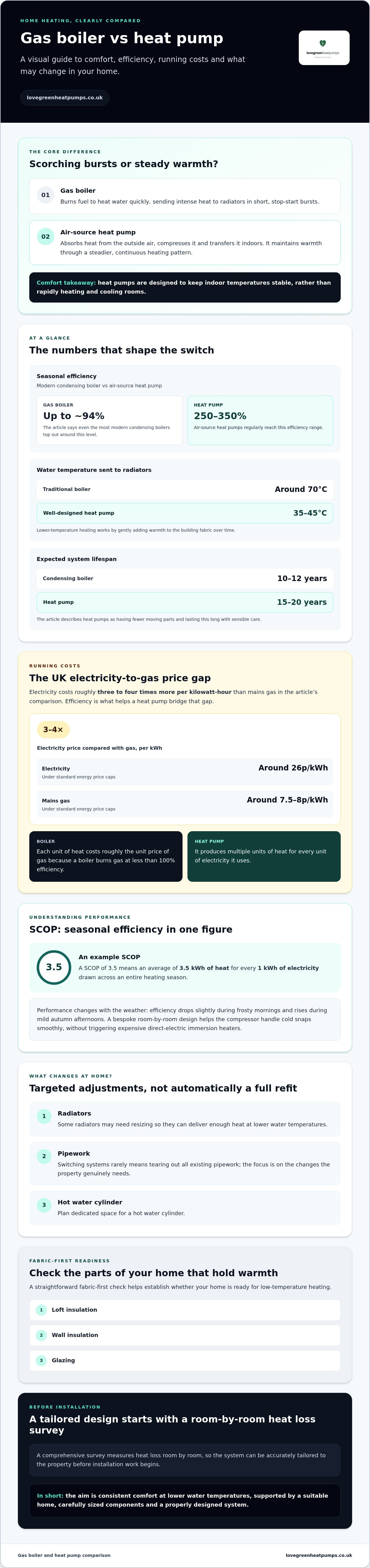
Most British homes rely on fossil fuel systems that deliver intense heat in short bursts. A standard gas boiler fires up, rapidly burns fuel, and blasts scorching water into your radiators before shutting down entirely. In contrast, when you replace gas boiler with heat pump technology, your home moves to a steady, continuous heating pattern. Understanding how heat pumps work highlights this thermodynamic shift: rather than creating thermal energy through combustion, the unit absorbs ambient heat from the outside air, compresses it, and transfers it inside.
This fundamental difference transforms home comfort and efficiency:
- Efficiency boundaries: Even the most modern condensing gas boilers top out at around ninety-four percent efficiency, losing the remaining heat through flue gases. Air source heat pumps regularly achieve efficiencies between 250% and 350%, turning one unit of electricity into three or more units of warmth.
- Balanced comfort: Gas heating creates noticeable domestic peaks and troughs. Rooms heat up quickly, cool down rapidly, and trigger draughty air movements. A heat pump maintains a flat, stable indoor temperature, eliminating the familiar evening chill.
- Winter reliability: Modern units extract usable thermal energy from outdoor air well below freezing, ensuring reliable heating throughout sub-zero British weather.
Operating Temperatures and Daily Heating Behaviour
Traditional combi and system boilers push water through radiators at around 70°C. That intense temperature makes radiators hot to the touch, but it forces the boiler into wasteful stop-start cycles. A well-designed heat pump circulates water at gentle temperatures between 35°C and 45°C. To get the best from this system, you adjust your daily habits. Instead of turning heating on and off twice a day, you set a continuous comfort level and let the system trickle heat into the building fabric around the clock.
System Lifespan and Routine Maintenance Requirements
Deciding to replace gas boiler with heat pump equipment also changes long-term domestic maintenance. A standard condensing boiler carries an expected lifespan of 10 to 12 years, working with high mechanical stress and combustion chambers. Heat pumps feature fewer moving parts, typically lasting 15 to 20 years with sensible care.
Annual servicing becomes far cleaner. Rather than stripping combustion burners, checking flue seals, and testing for carbon monoxide risks, a heating engineer cleans external evaporator fins, checks water filter strainers, and inspects refrigerant circuits. Removing burning fuel from your home delivers reliable heating alongside quiet peace of mind.
Running Costs and Efficiency: The UK Spark Gap Explained
To understand whether you will save money when you replace gas boiler with heat pump systems, you have to look at the UK "spark gap". In Britain, electricity currently costs roughly three to four times more per kilowatt-hour than mains gas. Under standard energy price caps, electricity sits around 26p per kWh whilst gas hovers near 7.5p to 8p per kWh. On paper, that makes electricity look uncomfortably expensive.
However, running costs depend entirely on how efficiently your equipment turns purchased energy into heat. Because a boiler burns gas at less than 100% efficiency, each unit of heat costs roughly the unit price of gas. A heat pump produces multiple units of heat for every unit of power it consumes. When your system generates over three units of heat per kilowatt-hour, you cleanly bridge that price divide. For a broader look at financial planning, explore our practical heat pump installation UK guide, or consult independent UK heat pump guidance to compare domestic projections.
Decoding the Seasonal Coefficient of Performance (SCOP)
System performance is measured by the Seasonal Coefficient of Performance (SCOP). A SCOP of 3.5 means that across an entire heating season, your heat pump delivers an average of 3.5 kWh of heat for every 1 kWh of electricity drawn. Outdoor temperatures fluctuate, meaning efficiency drops slightly during frosty mornings and surges during mild autumn afternoons. Bespoke room-by-room design ensures the compressor handles cold snaps smoothly without triggering expensive direct-electric immersion heaters.
Optimising Electricity Tariffs for Maximum Economy
Standard flat-rate electricity tariffs are rarely the best way to run modern clean heating. Time-of-use tariffs offer substantially cheaper electricity during off-peak hours. Many households take advantage of this through thermal pre-heating, gently lifting room temperatures during low-rate windows to store heat in floors and walls before peak pricing begins.
Pairing your installation with domestic solar panels trims running costs even further. Daytime solar generation directly offsets the electricity needed for gentle daytime circulation and domestic hot water generation. If you want an honest assessment of your home's seasonal performance potential, you can speak with our heating engineer team about a tailored property assessment.
What Happens to Your Home? Radiators, Pipework, and Cylinders
The fear of domestic disruption stops many homeowners in their tracks. Rumours persist that you must rip up every floorboard and dismantle your house to install new heating. In reality, choosing to replace gas boiler with heat pump systems involves targeted, methodical upgrades rather than wholesale renovation. Outside, an unobtrusive unit sits on an external plinth or wall brackets. UK permitted development rules allow straightforward positioning, provided the unit has sufficient clearance for clean airflow, quiet running, and easy engineer access.
Evaluating Radiator Surface Area and Pipework Dimensions
Because heat pumps run at lower water temperatures, your radiators need sufficient surface area to warm each room effectively. That rarely means doubling the width of every radiator. Heating engineers often replace shallow, single-panel models with double-panel convector radiators (Type 22), keeping the same wall footprint while significantly boosting heat output. In well-insulated spaces, existing radiators are frequently large enough already.
Pipework also deserves a sensible check. Standard 22mm distribution circuits and 15mm radiator tails typically handle required flow rates without issue. If your home uses narrow 10mm or 8mm microbore pipework, an engineer must assess whether the system can move water quietly without excess pump strain. Bespoke room-by-room heat loss calculations determine whether specific pipe sections require upgrading before fitting any hardware.
Domestic Hot Water: Accommodating a Dedicated Cylinder
If you currently rely on a wall-hung combi boiler, the main internal change when you replace gas boiler with heat pump heating is storing hot water. Gas combis burn huge amounts of fuel on demand. Heat pumps work steadily, heating water smoothly inside a dedicated, well-insulated unvented cylinder.
Finding cylinder space is usually simpler than expected. Airing cupboards, utility spaces, under-stair storage, and attached garages are all practical locations. Stored systems offer a noticeable domestic upgrade, providing mains-pressure hot water to several showers simultaneously without pressure drop-offs. For safety and peace of mind, modern heat pump controllers schedule a routine weekly pasteurisation cycle, automatically raising cylinder temperatures to eliminate any risk of bacteria.
Home Suitability Checklist: Is Your Property Ready for a Heat Pump?
There is a lingering myth across the UK that older stone cottages or Victorian terraces cannot accommodate modern electrification. In truth, any building can be kept comfortable with clean heating provided the hardware matches the building's thermal envelope. When planning to replace gas boiler with heat pump technology, a sensible homeowner self-assessment helps you spot quick improvements before scheduling technical surveys.
Work through this practical readiness checklist to see where your property stands:
- Loft insulation: Check whether your roof space has at least 270mm of mineral wool insulation installed across the joists.
- Wall construction: Identify whether you have insulated cavity walls or uninsulated solid masonry that leaks heat rapidly.
- Glazing condition: Ensure modern double glazing is in place, paying attention to degraded window seals or draughty frames.
- Electrical service: Locate your electrical service head to check if the main incoming fuse is rated at 60, 80, or 100 amps.
- Outdoor placement: Identify a clear external ground space or sturdy wall with adequate clearance from neighbouring boundaries.
Insulation and Heat Loss: Prioritising Fabric Upgrades
Topping up shallow loft insulation to 270mm delivers an immediate, inexpensive boost to system performance. Draught-proofing timber exterior doors and service penetrations stops conditioned indoor air escaping before lower-temperature heat can accumulate. While uninsulated solid-wall houses can still use heat pumps successfully, failing to tackle severe fabric heat loss means your system must run harder, increasing electricity consumption across long winter months.
Electrical Infrastructure and Permitted Development Rights
Before you replace gas boiler with heat pump hardware, your installer assesses whether your domestic electrical supply needs modernising. Most standard homes feature an incoming 60A, 80A, or 100A main service fuse. If your fuse requires an upgrade to safely power an outdoor compressor alongside electric cookers and vehicle chargers, your regional Distribution Network Operator (DNO) typically handles this straightforwardly.
Planning permission is rarely necessary. Under current UK Permitted Development rights, outdoor air-to-water units up to 1.5 cubic metres are allowed without formal applications, provided they meet clear acoustic and boundary guidelines. If you would like an impartial review of your property fabric and electrical setup, you can book an EPC assessment with our team to determine your exact starting baseline.
Making the Transition: Steps from Home Survey to Commissioning
Upgrading your central heating should never feel like a high-pressure transaction. When you decide to replace gas boiler with heat pump technology, success hinges entirely on engineering diligence rather than quick sales promises. Moving from an ageing fossil fuel system to modern low-temperature heating follows a structured, step-by-step workflow designed to protect your home's seasonal comfort.
A dependable project follows four clear stages:
- Technical site survey: Thorough measurement of the physical dwelling to calculate true heat loss.
- Turnkey system design: Matching heat pump output, cylinder capacity, and emitter sizes precisely to property demand.
- Installation and conversion: Safe decommissioning of gas appliances followed by hydraulic and electrical fitting.
- Balancing and handover: Final commissioning, fine-tuning operational curves, and guiding you through day-to-day controls.
The Room-by-Room Heat Loss Survey
Never accept a heating quote based on property square footage or rough guesswork. A skilled heating engineer visits your home to inspect external wall construction, measure window and door dimensions, and assess ceiling heights room by room. These bespoke calculations determine the exact peak heat demand of each living space during cold conditions. Accurate sizing prevents rapid short-cycling, reduces mechanical wear on the compressor, and avoids inflated winter electricity consumption.
Decommissioning, Installation, and System Handover
Once system design is finalised, the physical transition begins. Gas engineers safely isolate and cap off mains gas lines, decommission your boiler, and chemically power-flush central heating circuits to eliminate accumulated magnetite sludge. Installers position the external heat pump unit on heavy-duty, anti-vibration footings, running pre-insulated pipework through external walls to connect with your new unvented hot water cylinder.
The commissioning phase brings everything together cleanly. Your engineer balances individual radiator circuit valves to achieve even flow distribution, then configures the weather compensation curve. This outdoor temperature sensor automatically instructs the system to lower flow temperatures during mild weather and lift them gently as winter frost sets in. For comprehensive project management from initial design through to final paperwork, Love Green Heat Pumps delivers HEIS-accredited air source heat pump solutions right across the UK.
Taking the Next Step Towards Smarter Home Heating
Deciding to replace gas boiler with heat pump heating isn't about compromising on winter comfort or tearing your home apart. When backed by accurate room-by-room heat loss calculations, low-temperature systems deliver steady warmth, lower household carbon emissions, and genuine domestic dependability. By taking a fabric-first approach and sizing radiators correctly, you bridge the electricity price gap cleanly and protect your home against shifting energy markets.
A successful transition always comes down to skilled engineering rather than rushed box-swapping. As a HEIS-accredited domestic installer with independent heating engineering expertise across the UK, we handle every detail through complete turnkey project management, from your initial heat loss survey right through to final commissioning. If you're ready to explore what modern heating can do for your living spaces, request your free, no-obligation heat pump quote from Love Green Heat Pumps today.
Frequently Asked Questions
Can an air source heat pump work effectively with my existing radiators?
Yes, many standard radiators work perfectly well with lower water temperatures. If your home has undergone double glazing or insulation improvements since the central heating was fitted, certain radiators may already be oversized for the space. An engineer checks heat outputs room by room. Where extra heat output is required, swapping a single-panel radiator for a double convector usually provides sufficient surface area without widening the pipework footprint.
How long does it take to replace a gas boiler with a heat pump?
A typical residential conversion takes between three and five working days to complete. The first day covers decommissioning the old boiler, isolating the gas pipe, and chemically power-flushing the central heating network. Days two and three involve mounting the external unit, installing the hot water cylinder, and completing electrical connections. The remaining time is reserved for radiator adjustments, system balancing, and guided controls handover.
Will a heat pump provide enough hot water for a busy family household?
Yes, modern systems deliver exceptional hot water volume through a dedicated unvented cylinder. Because hot water is stored under mains pressure, multiple showers and taps can run concurrently without experiencing drops in pressure or temperature. Choosing to replace gas boiler with heat pump cylinders actually improves hot water flow rates compared to standard combi boilers, which restrict flow to one tap at a time.
Are heat pumps significantly louder than an outdoor boiler flue?
No, modern units operate at sound levels comparable to a quiet domestic refrigerator. Sited a few metres away, background ambient noise usually masks the compressor and fan. Anti-vibration rubber mountings absorb mechanical hum, while acoustic fan blades spin slowly to maintain quiet performance. By contrast, conventional gas boiler flues frequently create noticeable fan whine and plume noise during heavy firing cycles.
What happens to my heating if the outdoor temperature drops below freezing?
Your heat pump continues to heat your home reliably down to minus fifteen degrees or lower. Modern refrigerants absorb thermal energy from outdoor air even in harsh winter conditions. While the unit uses slightly more electricity during freezing weather, weather compensation controls automatically raise circulating water temperatures. This maintains steady indoor comfort through heavy winter frost without needing manual thermostat adjustments.
Do I need planning permission to replace my gas boiler with a heat pump?
Most installations fall under Permitted Development rights across England and Wales, meaning formal planning applications are not required. The outdoor unit must meet simple criteria, including an overall size limit of 1.5 cubic metres and clear boundary separation from neighbouring properties. Listed buildings and designated conservation areas have separate requirements, so your installer always checks local planning status during the initial survey.
Is an air source heat pump suitable for an older, uninsulated UK home?
Yes, older properties can be heated successfully, though tackling draughts and loft insulation first keeps your running costs economical. Solid-wall properties simply require larger heat emitters and careful system sizing to match higher rates of heat loss. Running steady low-temperature heat around the clock actually preserves historic building fabrics better than intense bursts of high heat from intermittent fossil fuel boilers.


