

What if the key to getting more from solar panels and a heat pump is planning them together, rather than treating them as separate upgrades? Solar panel and heat pump installation can work as a joined-up home energy project, provided the systems suit your property and the way you use energy.
It’s reasonable to ask whether your home and current heating setup are suitable, and whether solar electricity will be available when you need heating most. Solar generation is typically stronger in sunnier months, while heating demand rises in colder weather. That doesn’t rule out combining the systems, but it makes good design and realistic expectations important.
This guide explains what each system contributes, what to assess before choosing an installation order and how coordinated planning can help avoid design or timing problems. It also outlines the main project stages, from survey and system design through to installation and commissioning, so you can plan for year-round comfort.
Key Takeaways
- Understand the different roles solar PV and an air-source heat pump play in your home’s energy plan.
- See how solar electricity can support a heat pump, while recognising that heating still depends on the wider electricity supply.
- Compare installing both systems together with adding one later, and identify what an existing solar setup means for your plans.
- Prepare useful details about your energy use, heating system, solar equipment and household routines before design begins.
- Learn how coordinated solar panel and heat pump installation can be planned from survey and design through to commissioning.
Why plan solar panel and heat pump installation together?
Can solar panels and an air-source heat pump sensibly share one energy plan? Yes, but the right approach depends on the property, household energy use and system design. Solar photovoltaic (PV) panels generate electricity from daylight. An air-source heat pump uses electricity to move heat from outdoor air into the home, providing heating and hot water.
The systems have different jobs, but both affect your home’s electricity use. Planning solar panel and heat pump installation together lets the design consider both systems alongside your household’s needs, instead of treating each decision in isolation.
What each system contributes to the home
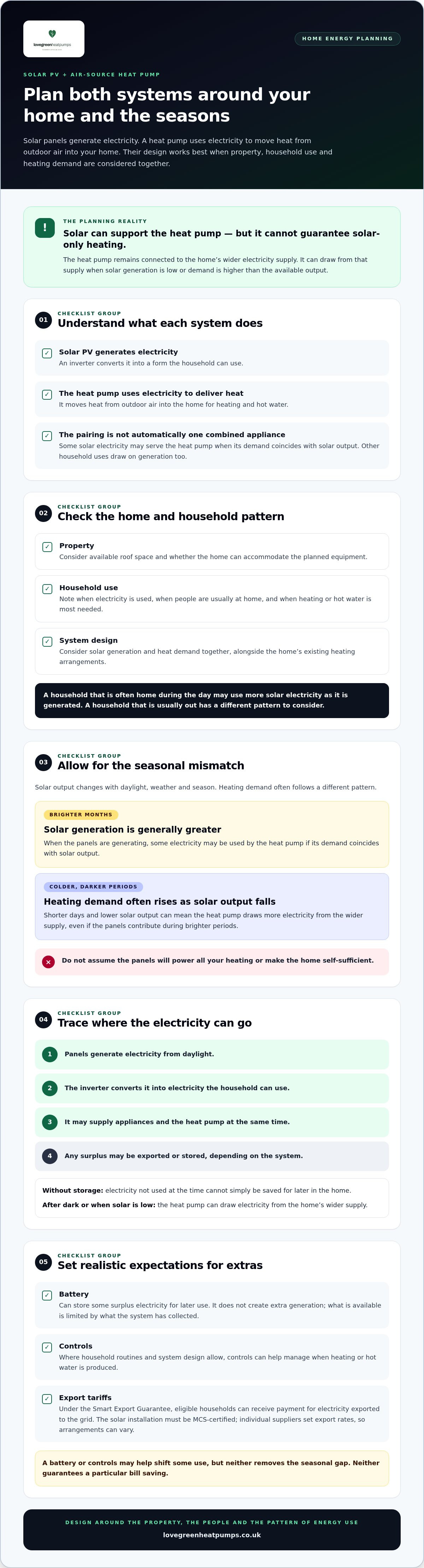
Solar PV produces electricity for household use, while the heat pump uses electricity to deliver heat. When the panels are generating, some of that electricity may be used by the heat pump if its demand coincides with solar output. Other household electricity use matters too, so the panels’ generation won’t necessarily all go towards heating.
Planning both systems together can clarify how they may work alongside one another. A household that’s often home during the day, for example, may use more solar electricity as it is generated. A household that’s usually out may have a different pattern to consider. The solar-assisted heat pump concept describes ways solar energy and heat pumps can be integrated. However, a standard solar PV and heat pump pairing doesn’t automatically operate as one combined appliance.
Why the combination needs realistic expectations
Solar output changes with daylight, weather and the season. In the UK, generation is generally greater during brighter months, while space-heating demand often rises during colder, darker periods. This seasonal mismatch is central to planning. Solar electricity can support the heat pump when available, but the heat pump still relies on the home’s wider electricity supply when solar generation is insufficient.
Don’t assume your panels will power all your heating or that your home will become self-sufficient. A sensible assessment considers how much electricity the home uses, when people are in, and how heating and hot-water demand changes across the year.
- Property: Consider available roof space and whether the home can accommodate the planned equipment.
- Household use: Note when electricity is used and when heating or hot water is most needed.
- System design: Consider solar generation and heat demand together, alongside the home’s existing heating arrangements.
These factors help set practical expectations before you decide on installation. The right combination is the one designed around the property and the people living in it, not one that promises a system will always meet the other’s needs.
How solar panels and a heat pump work together through the year
There are a few steps between sunlight on the roof and heat in your home. Solar panels generate electricity, then an inverter converts it into a form the household can use. That electricity may supply appliances and the heat pump at the same time. If generation exceeds what the home is using, the surplus may be exported or stored, depending on the system.
Solar can contribute to a heat pump’s electricity use, but it doesn’t guarantee solar-only heating. The heat pump remains connected to the home’s wider electricity supply. It can draw from that supply whenever solar generation is low or demand is higher than available output.
What happens to solar electricity when the heat pump is running?
Imagine a bright afternoon when the heat pump is operating and someone is cooking or using other appliances. Solar electricity helps meet the home’s simultaneous demand. Any remaining surplus may then be exported or sent to a battery, if one is installed. Without storage, electricity that isn’t used at the time can’t simply be saved for later in the home.
The pattern changes after dark. A battery can store some surplus electricity for later use, but it doesn’t create extra generation. The amount available is limited by what the system has collected. In winter, shorter days and lower solar output can mean the heat pump draws more electricity from the wider supply, even if the panels contribute during brighter periods.
The role of a battery, controls and energy tariffs
A battery can shift some solar electricity from the hours of generation to a later time. Where household routines and system design allow, controls can help manage when heating or hot water is produced. Neither guarantees a particular bill saving. Their usefulness depends on the home’s demand, available generation and how the equipment is set up.
Tariffs also affect how exported or imported electricity is accounted for. Under the Smart Export Guarantee, eligible households can receive payment for electricity exported to the grid. The solar installation must be MCS-certified, and export rates are set by individual suppliers, so arrangements can vary.
Think through a typical winter day: panels may produce some electricity around midday, while the home needs warmth early in the morning and again in the evening. A battery or carefully considered controls may help shift some use, but neither removes the seasonal gap. For wider UK context on the practical challenges of heat pump adoption, the Heat pump roll-out in the UK: barriers and solutions briefing explores barriers and possible responses.
This is why solar panel and heat pump installation benefits from a design that considers generation, household demand and heating schedules together. Love Green Heat Pumps Ltd’s solar PV and heat pump installations bring those considerations into one project.
Should you install solar panels or a heat pump first?
There isn’t one right order for every home. Installing both together can make sense if you’re planning both upgrades and want the design to consider heating needs and electricity use as a whole. A staged approach may be more practical if one system is the immediate priority, the home needs other work first, or you’d prefer to spread the project over time.
The decision is less about following a universal sequence and more about readiness. Consider the home’s current heating, your plans for comfort and hot water, and whether the information needed to design each system is available. Coordinating the work can help avoid treating the systems as unrelated projects, but it doesn’t guarantee lower bills or a particular financial return.
When a coordinated installation may suit your plans
If solar and a heat pump are both on your plans, one design process can consider the proposed equipment and household energy needs together. This gives the project a clearer overall picture, including how heating demand fits with expected solar generation. It can also help identify practical dependencies before work begins, rather than leaving them until a later upgrade. The benefit is joined-up planning, not a guaranteed saving.
This route may suit a homeowner who is already reviewing the heating system and considering roof-mounted solar at the same time. The design can take account of heating priorities and electricity use together. It’s still important to assess whether each system suits the property and household, rather than assuming that installing both together is automatically the better choice.
When a staged approach may be more practical
Installing one system first can let you focus on the most pressing need or prepare for a later upgrade. For example, you might prioritise replacing the heating system, then plan solar once you have a clearer picture of household electricity demand. Alternatively, you may install solar first and consider how a heat pump would fit into the home’s heating arrangements later.
If solar is already in place, it’s a useful starting point, not proof that it can meet a future heat pump’s electricity needs. A design assessment should consider the system’s capacity, inverter arrangements and the home’s demand, as well as the heating system and household energy use. The existing setup may shape the options, but the right next step depends on the whole property.
Before deciding, write down what is driving the project, what work is already planned and which details still need assessing. A heat pump installation buying guide can help you understand the wider considerations involved in planning a heat pump. Whether you choose a combined or staged route, good solar panel and heat pump installation planning starts with the home’s needs, not a fixed rule about which system must come first.
How to prepare for solar panel and heat pump installation
A little preparation makes the design discussion more useful. You don’t need to calculate what the roof can generate or decide which equipment is suitable. Share what you know about the home and how it’s used, then use a property assessment to inform the design.
Coordinated installation planning means assessing the solar PV and heat pump together before finalising the design. This allows the proposed systems to be considered against the home’s heating needs, electricity use and existing equipment.
Information to gather before the design discussion
Collect what’s readily available. Recent electricity bills or meter information can help describe household use. Note the current heating equipment, how hot water is provided and the usual pattern of occupancy. If solar PV or a battery is already installed, gather any system information you have, such as equipment details or paperwork. Roof suitability is part of the property assessment, not a judgement you need to make yourself.
Household routines matter too. Note when people are usually at home and when heating or hot water is most often needed. These details help build a realistic picture of demand. Broader solar panel installation planning can also help you understand the PV side of the project.
From system design to commissioning
A joined-up project generally moves through a clear sequence: assessment, system design, equipment supply, installation and commissioning. The assessment gives the design team information about the property and existing systems. The design then considers how solar generation relates to heating demand, rather than planning each system without reference to the other. Equipment is supplied and installed to the agreed design, before commissioning checks that the systems are set up to operate as intended.
- Gather household information about energy use, heating, hot water, occupancy and existing equipment.
- Arrange a property assessment so the design can account for the home itself.
- Review the proposed design and how the solar and heating systems relate to one another.
- Move through supply and installation in line with the agreed project plan.
- Complete commissioning and handover so you understand the systems and their controls.
Questions that help keep the project coordinated
Before the design is finalised, ask how it accounts for existing or planned solar equipment and the home’s heating requirements. At handover, make sure the explanation covers how the controls work and how to use them with your normal routines. For more on the final setup stage, see this guide to heat pump system design and commissioning.
Love Green Heat Pumps Ltd provides solar PV and heat pump installations across the UK, with projects covering survey, design, equipment supply and commissioning. Arrange a quote for your coordinated installation to start planning around your home and household needs.
Plan your solar panel and heat pump installation with Love Green Heat Pumps Ltd
Once you’ve considered how solar generation, household demand and heating needs fit together, the next step is to plan a system around your property. Love Green Heat Pumps Ltd provides heat pump and solar PV installation services across the UK. Its approach brings practical details into view before work begins, helping you understand how the proposed project is shaped around your home.
The company’s turnkey heat pump installation process covers the survey, system design, equipment supply and commissioning. Its team also brings HEIS-accredited expertise. A free, no-obligation quote gives you a straightforward way to explore your project requirements without committing to an installation.
What a joined-up installation process should make clear
A clear proposal should explain how the planned heat pump and solar PV relate to the property and household needs. It should set out the information used to develop the design and how existing or planned equipment has been taken into account. The aim is to understand the proposed arrangement, not to assume the systems will deliver a particular level of performance or savings.
Good communication matters throughout. At assessment, explain your current heating, electricity use and priorities. As the project develops, the design and installation stages should be clear, with commissioning and handover covering how to use the completed system and its controls. Clear explanations help you understand what has been planned and what to expect from the equipment in everyday use.
For a coordinated solar panel and heat pump installation, keep the reasoning behind key decisions clear. If the household’s heating schedule or existing PV equipment affects the design, for example, that relationship should be explained in plain terms. This gives you a practical basis for deciding whether the proposal suits your home, rather than relying on general claims about what the technologies can do.
A straightforward next step for your home
Before exploring a project, jot down what you know about your current heating, household electricity use and any solar equipment already installed. Add your main upgrade priorities, such as replacing an existing heating system or planning PV alongside a heat pump. You don’t need to arrive with technical answers. These details help make an initial discussion more focused on your home and how you use it.
Love Green Heat Pumps Ltd can take a heat pump installation from survey and design through equipment supply and commissioning, alongside its solar PV installation service. A free, no-obligation quote is an opportunity to discuss what the work may involve and how the systems could be planned together. It’s a practical starting point for understanding your options, not a promise of a particular outcome.
Ready to explore a joined-up plan? Discuss your home’s installation with Love Green Heat Pumps Ltd.
Take the next step towards a home energy plan
A useful next step is to decide what you want your home energy improvements to achieve first. Is your priority updating the heating, making better use of rooftop solar, or considering both as part of one project? You don’t need to have every technical answer. A clear sense of what matters most can help shape a practical conversation about your home.
For a solar panel and heat pump installation, start with an assessment of your property and household needs, followed by a design that sets out the proposed approach clearly. Love Green Heat Pumps Ltd can help you explore the project through a free, no-obligation quote, with HEIS-accredited expertise and a turnkey heat pump process from survey to commissioning.
Love Green Heat Pumps Ltd provides heat pump and solar PV installation services across the UK. Take the next step at your own pace and explore what a coordinated plan could look like for your household.
Explore a heat pump and solar PV installation for your home.
Frequently Asked Questions
Can solar panels power an air-source heat pump?
Yes, solar electricity can supply some of the electricity a heat pump uses when the panels are generating. The home remains connected to its usual electricity supply and can draw power when solar output is too low. For solar panel and heat pump installation, the useful question is how much generation may coincide with heating use, not whether panels can cover every operating hour.
Should I install solar panels before a heat pump?
Neither system has to come first in every home. If your current heating needs attention, that may shape your timing. If you’re already planning roof work, that could influence when you consider solar. Think about which upgrade is most pressing and what preparation each involves. A design discussion can account for your priorities without treating one installation order as a rule.
Do I need a battery with solar panels and a heat pump?
No, a battery isn’t essential for using solar panels alongside a heat pump. It can store some electricity for later, but whether that’s useful depends on when your home generates and uses power. Compare your daytime demand with evening use, and consider how surplus electricity is handled. Don’t assume a battery will provide power during a grid outage, as that depends on the system’s design.
Will solar panels produce enough electricity for a heat pump in winter?
Don’t plan on winter solar generation meeting all the heat pump’s electricity needs. Shorter daylight hours and lower generation can coincide with greater heating demand. The amount produced also depends on the specific system and conditions at the property. A realistic assessment compares expected winter generation with the home’s likely electricity use, rather than relying on the stronger output possible during brighter months.
Can I add a heat pump to an existing solar panel system?
Yes, an existing solar PV system can be part of a plan to add a heat pump. Share any information you have about the panels, inverter and battery, along with electricity-use details. This helps inform whether the existing arrangement suits the updated household demand and whether any changes need considering. Don’t assume the original system was designed with a future heat pump in mind.
Can I install solar panels and a heat pump at the same time?
Yes, both can be planned and installed as one project if the home and project arrangements suit that approach. A combined assessment can consider roof work, heating requirements and equipment placement together. It can also help coordinate installation stages and handover, so you understand how each system fits into the overall plan. Installing both together doesn’t guarantee a particular saving or performance level.
Does the Smart Export Guarantee pay for electricity from my solar panels?
It can pay eligible households for surplus solar electricity exported to the grid. To qualify for the Smart Export Guarantee, the solar PV system must be certified under the Microgeneration Certification Scheme; individual suppliers set their own export rates and terms. Payment relates to exported electricity, not all the electricity your panels generate. Check the current supplier offer and scheme requirements before relying on export income in your plans.
Disclaimer
Disclaimer
The information published on this website is provided by Love Green Heat Pumps for general information and educational purposes. As a specialist provider of heating and renewable energy solutions, we strive to ensure that our content is accurate, relevant and up to date. However, heating requirements, system suitability, installation specifications, costs and performance can vary depending on individual property characteristics, usage and other site-specific factors.
Information provided in our articles should not be regarded as a substitute for a professional property assessment, technical survey or tailored recommendation. Any decisions regarding the selection, installation, replacement or maintenance of heating systems should be made with appropriate professional guidance.
Love Green Heat Pumps accepts no responsibility for decisions made solely on the basis of general information published in these articles. For advice specific to your property or project, we encourage you to contact our team for professional guidance and an assessment of your requirements.


